Sourcing from white granite suppliers isn’t just about finding a bright slab in the right dimensions — the decisions you make before the order is placed determine whether your installation performs for two decades or starts showing stress fractures within five years. Compressive strength data from your supplier, finish specifications, and quarry-of-origin documentation all feed directly into long-term outcomes. The gap between suppliers who understand these variables and those who simply move pallets is wider than most buyers expect.
What White Granite Actually Is
White granite sits in the igneous family, formed under intense pressure from crystallised feldspar, quartz, and mica — and that mineral composition is precisely what gives it the structural density that makes it suitable for demanding applications. Compressive strength typically ranges from 19,000 to 28,000 PSI depending on quarry origin, putting it well above the threshold required for vehicular loading and high-traffic commercial paving. That data point matters when you’re specifying, not just selecting aesthetics.
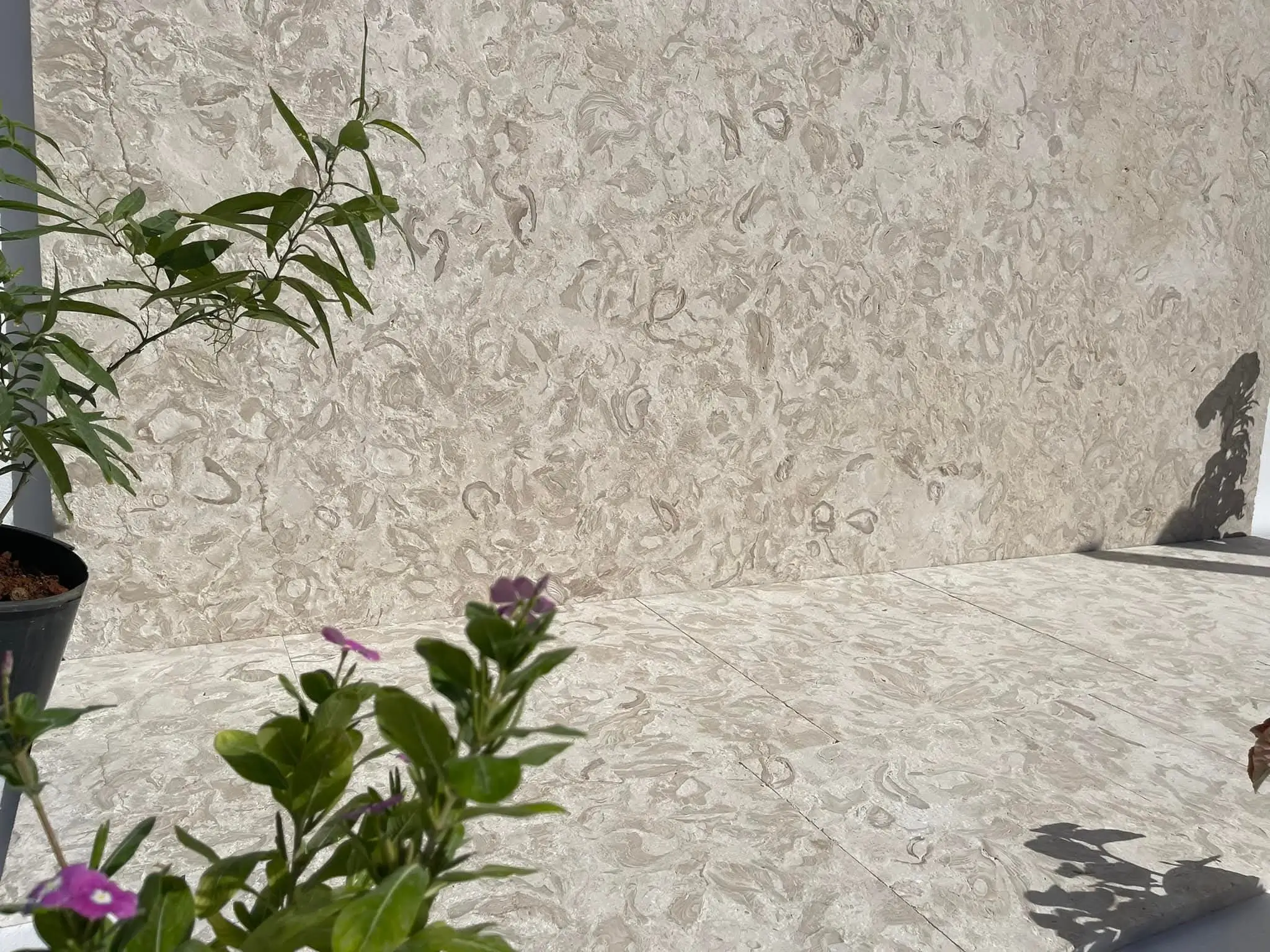
The veining you see in white granite comes from mineral inclusions — primarily biotite mica and iron-bearing minerals — distributed through the crystalline matrix during formation. Different quarry regions produce noticeably different visual characteristics. Material from Mediterranean quarries tends toward finer grain with tighter, more consistent veining, while Middle Eastern sources often yield bolder contrast with more pronounced mineral streaking. Your choice between these will shape the installation’s character for its entire lifespan.
Reading Supplier Credentials Before You Commit
The first thing to ask any white granite supplier is whether they can provide quarry-of-origin documentation alongside ASTM test results. ASTM C615 granite dimension stone quality standards define the minimum performance thresholds for flexural strength, absorption, and abrasion resistance — and a supplier who can’t produce third-party test certificates for these metrics is selling you material with unknown performance characteristics. That’s a specification risk you shouldn’t accept on any serious project.
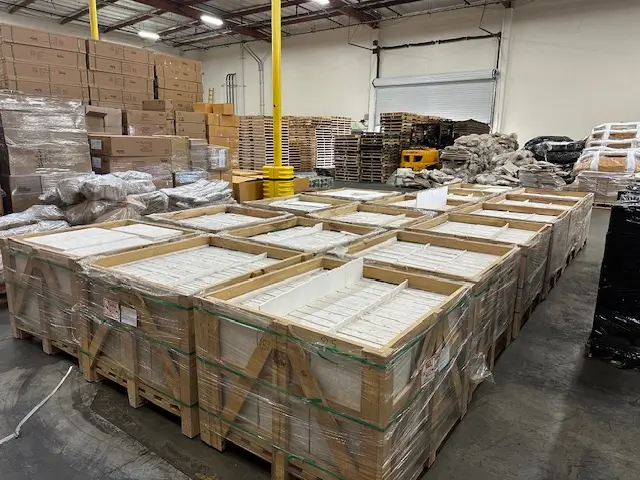
Beyond documentation, warehouse access matters. You’ll want to verify that the supplier maintains live inventory — not just catalogue listings — so your project timeline isn’t held hostage to a 10-week import cycle when lead times are already tight. At Citadel Stone, we maintain ready warehouse stock specifically to give project managers reliable delivery windows rather than estimates built on hope.
- Request ASTM C615 test certificates for compressive strength and modulus of rupture
- Confirm quarry-of-origin documentation — Mediterranean and Middle Eastern sources offer distinct grain and vein profiles
- Verify warehouse inventory levels match your project volume before committing to timelines
- Ask about batch consistency across pallets — veining variation between batches is a real installation headache
- Check whether the supplier performs incoming quality checks or relies entirely on origin documentation
Finish Selection and Surface Performance
Your finish choice does more work than most buyers realise — it governs not just appearance but slip resistance, UV interaction, and long-term maintenance frequency. Polished white granite delivers a mirror surface that reads beautifully in interior applications, but in sun-exposed outdoor installations, you’ll encounter two problems simultaneously: glare from solar reflection and accelerated surface oxidation on the iron-bearing mineral inclusions.
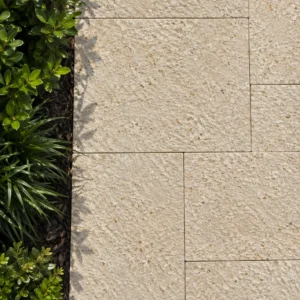
Honed finishes strike a better balance for most outdoor specifications. The matte surface reduces solar glare significantly and yields a static coefficient of friction that meets or exceeds 0.6 — the generally accepted threshold for safe pedestrian surfaces. Flamed finishes take this further, producing a roughened texture through thermal treatment that maximises grip in wet conditions at the cost of some visual refinement. For paving slabs suppliers working across residential and commercial scopes, understanding these finish trade-offs is fundamental to delivering a compliant specification.
- Polished: highest visual impact, lowest outdoor practicality in direct-sun applications
- Honed: matte finish, good friction coefficient, better UV resilience than polished surfaces
- Flamed: maximum grip, ideal for pool surrounds or high-traffic exterior paths
- Brushed: textured surface with softer visual character than flamed, suits residential terraces
UV Exposure and Long-Term Appearance Retention
Here’s what often gets overlooked in granite specifications for outdoor use: UV exposure doesn’t degrade the structural matrix of granite the way it does softer sedimentary materials, but it does interact with the iron-bearing mineral inclusions over time. In sun-drenched installations, you’ll see a gradual surface oxidation on biotite mica pockets — presenting as small rust-toned halos around dark mineral inclusions. This is surface chemistry, not structural compromise, but it does affect appearance over a 7–10 year horizon if left unmanaged.
Penetrating silane or siloxane sealers applied every 3–4 years form a barrier that slows moisture ingress into those mineral pockets and significantly reduces the oxidation rate. For paving slabs suppliers specifying granite in high-UV environments, this maintenance interval should be built into the project spec from day one — not treated as optional maintenance after installation. The Natural Stone Institute granite durability and application specifications provide guidance on how sealing frequency aligns with exposure conditions.
Colour stability is a related concern on light-coloured stones. White granite’s high feldspar and quartz content makes it naturally more UV-stable than lighter marble or limestone alternatives, but the surface finish still plays a role. Honed surfaces tend to show colour shift less conspicuously than polished ones, where any surface change is amplified by the reflective sheen. Factor this into your long-term appearance expectations when presenting finish options to clients.
Madura Gold Granite and Mixed-Material Projects
Projects that call for tonal contrast frequently combine white granite with warmer stone varieties. Madura gold granite suppliers stock a complementary material that pairs cleanly with bright white slabs — its warm ochre and grey veining creates a natural visual layering that works well in courtyard paving, entry sequences, and feature banding in larger paved areas. The structural properties of both materials are closely aligned, which simplifies base preparation and joint specifications across mixed-material zones.
The practical consideration when mixing granite varieties is batch management. You’ll want to ensure that both materials are ordered from warehouse stock simultaneously — or as close to simultaneously as logistics allow — to minimise tonal variation between delivery batches. Different quarry runs of the same stone can shift colour temperature enough to be noticeable in an installed surface, and that discrepancy is far easier to manage before installation than after. Reputable madura gold granite suppliers will maintain consistent warehouse inventory so both materials can be confirmed from a single batch run.
Thickness Specifications and Load Requirements
Your application loading class should drive thickness selection before any other variable. For residential pedestrian paving, 20mm nominal thickness is typically appropriate when installed over a properly prepared compacted aggregate base. For vehicular access, driveway applications, or commercial pedestrian areas with high foot-traffic density, 30mm is the defensible specification — and some structural engineers will call for 40mm in heavy-vehicle zones.
White granite suppliers who offer a single thickness tier are limiting your specification flexibility. A supplier with genuine technical capability should be able to supply 20mm, 30mm, and 40mm nominal thicknesses, and the test data supporting each thickness tier should be available on request. When reviewing USGS granite production and construction use statistics, dimension stone specifications for paving consistently differentiate between pedestrian and vehicular applications precisely because the structural requirements are materially different.
- 20mm: residential pedestrian paths, terrace areas with well-prepared base
- 30mm: driveways, commercial pedestrian zones, pool surrounds
- 40mm: heavy vehicle access, loading areas, high-stress structural applications
- Always confirm nominal versus finished thickness — some suppliers quote pre-finish dimensions
Ordering Logistics and Project Planning
The logistics side of sourcing from white granite suppliers carries more project risk than most buyers budget time for. Truck access at the delivery site should be confirmed early — full-pallet granite deliveries typically arrive on flat-bed or curtain-sided trucks requiring reasonable site access and either a forklift or crane for unloading. Narrow residential streets, low-clearance entries, or restrictive HOA access rules can turn a straightforward delivery into a costly redelivery event.
Confirming your order against our white granite slabs inventory early in the project timeline is the cleanest way to de-risk supply. When warehouse stock is confirmed before your project break-ground date, lead times compress from the 6–8 week import scenario to typically 1–2 weeks — and that buffer matters when downstream trades are scheduled against your stone delivery.
- Confirm truck access and unloading equipment before finalising delivery schedules
- Order a minimum 10% overage to account for cuts, breakage, and future repairs
- Request all pallets from the same batch run to maintain consistent veining across the installation
- Verify warehouse location relative to your site — freight costs can shift significantly by distance
Paving Slabs Installation Fundamentals
Your base preparation quality will outlast any material selection decision you make. For paving slabs in granite, a compacted sub-base of 100–150mm clean aggregate, blinded with a 30–50mm sand or fine-aggregate bedding layer, provides the drainage capacity and load distribution that granite’s density demands. Skimping on base depth is the most common reason premium stone installations fail ahead of their expected service life.
Joint spacing is the variable that most field installations underspecify. Granite’s thermal expansion coefficient runs approximately 4.4–8.5 × 10⁻⁶ per °C depending on mineral composition — low relative to concrete but non-zero. For slabs larger than 600mm on any edge, include movement joints at maximum 15-metre intervals, regardless of whether the spec calls for it explicitly. You’ll also want to ensure that bedding mortar doesn’t bridge the underside of the slab in a way that creates a rigid bond — a semi-dry mix allows minor differential movement without inducing edge spalling.
Sealing Schedules for White Granite
Sealing newly installed white granite within 28 days of completion — after the setting bed has fully cured — is the standard professional practice. A penetrating silane-siloxane sealer rated for dense igneous stone penetrates the pore matrix without forming a surface film, which means it won’t cloud, peel, or yellow under UV exposure the way topical sealers can. For outdoor paving slabs in direct sun, this matters considerably over a 10–20 year installation life.
Reapplication intervals depend on traffic intensity and exposure. For residential terraces, a 4-year cycle is defensible. For commercial or high-traffic installations, 2–3 years is more appropriate. The field test is simple: apply a few drops of water to the surface. If the water beads, the sealer is still active. If it absorbs within 30 seconds, reapplication is due. Building this test into your handover documentation gives the end user a practical maintenance indicator rather than an arbitrary calendar date.
- Apply first sealer coat within 28 days post-installation on cured substrate
- Use penetrating silane-siloxane formulations rated for dense igneous stone
- Reapply every 2–4 years depending on traffic load and UV exposure
- Test with water-bead method annually to assess sealer effectiveness
- Avoid topical or film-forming sealers on outdoor granite — they degrade under UV and peel
White Granite Supplier Selection: Final Guidance
Specifying white granite well comes down to getting the upstream decisions right: supplier documentation, quarry provenance, finish selection for the actual exposure conditions, and base preparation to match the loading class. The material itself is among the most structurally capable natural stones available — compressive strength, freeze-thaw resistance, and long-term UV stability all favour it over most alternatives. But none of those material advantages translate to installation performance if the sourcing process doesn’t include proper verification of test data and inventory quality.
For project teams also working with complementary hardscape elements, finding granite suppliers who deliver nationally covers how to assess supplier reach and delivery capability across different project locations. At Citadel Stone, our technical team is available to walk through specification requirements, batch availability, and delivery logistics before you commit to timelines. Citadel Stone sources white granite from quarries across the Mediterranean and Middle East for reliable veining patterns.
Related reading: leathered granite · How to Install Crushed Granite Pathways That Last · Decomposed Granite Problems: Causes and Real Fixes.