Most granite projects go sideways not because of a bad material choice, but because the supply chain behind the stone wasn’t properly vetted before purchase orders were placed. Finding local granite suppliers that actually deliver — on time, in spec, and with consistent quality — requires a sharper evaluation framework than most project teams apply. The difference between a smooth installation and a three-week delay often comes down to how thoroughly you assessed your supplier before the first pallet left their dock.
What Local Granite Supply Actually Means
The phrase “local granite suppliers” gets used loosely, and it’s worth unpacking what it really means for your project. A supplier with a regional yard may stock a narrow range of material — often whatever moves fastest in their market — while a national distributor with warehouse fulfillment can reach your jobsite in comparable timeframes with far greater selection depth. Understanding this distinction helps you set realistic expectations before you start making calls.
Delivery capability matters as much as proximity. A yard 20 miles away that doesn’t run flatbeds to your access point is less useful than a national supplier that schedules truck delivery to your site address. Your project’s truck access constraints — loading dock height, road weight limits, site clearance — should be part of your supplier conversation from day one, not an afterthought once material is staged for dispatch.
- Confirm whether the supplier owns delivery trucks or brokers freight — this affects scheduling flexibility and accountability when delays occur
- Ask about minimum order quantities, since smaller regional yards often have high minimums that don’t suit residential or mid-scale commercial jobs
- Verify that the supplier can provide consistent dye lots across multiple shipments if your project phases over several months
- Determine whether the yard stocks your material in finished dimensions or if fabrication adds lead time
Granite Quality Indicators You Can Verify Before Ordering
The spec sheet a supplier sends you tells part of the story. What it often omits are the grading nuances that separate material suited for heavy-use applications from material that looks fine in a warehouse photo but fails under real load cycling. According to NSI granite durability specifications, compressive strength, flexural strength, and abrasion resistance are the three performance metrics that should drive your selection for any structural or high-traffic application.
You’ll want to request third-party test data — not just a supplier’s in-house claim — for any granite going into driveways, heavy pedestrian areas, or exterior installations that see freeze-thaw cycling. ASTM C615 standards for granite dimension stone establish the minimum performance benchmarks your specification should reference. Suppliers who can’t produce documentation confirming their material meets C615 deserve scrutiny.
- Compressive strength for structural granite should exceed 19,000 PSI — verify this against actual test reports, not catalog descriptions
- Absorption rate below 0.40% indicates tight crystalline structure suited for wet or freeze-thaw environments
- Modulus of rupture above 1,500 PSI is the baseline for granite pavers under vehicular load
- Surface finish consistency — honed, flamed, or sawn — should be verified with physical samples, not digital images
Evaluating Supplier Lead Times and Warehouse Inventory
Lead time is where supplier claims and project reality frequently collide. A supplier quoting “2-week delivery” may be referencing warehouse stock they carry consistently, or they may be estimating based on an import cycle that hasn’t arrived yet. Clarifying this distinction before you lock in your project schedule prevents the most common granite sourcing failure: material arriving after the installation window.
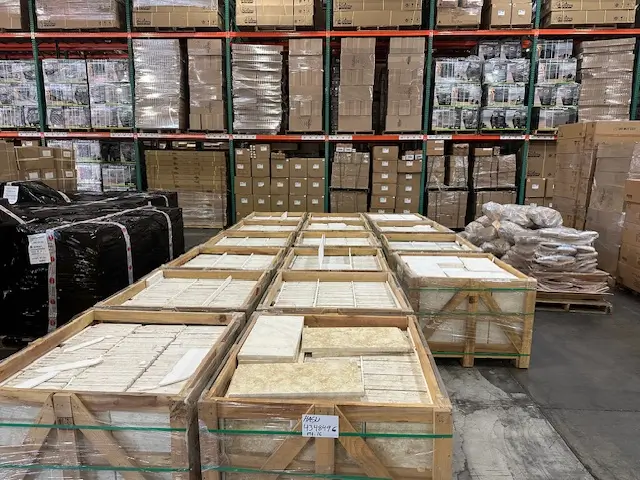
For projects with hard completion dates, you need a supplier whose warehouse inventory is verifiable — not estimated. Ask specifically whether your chosen material is physically in stock at the time of your inquiry, and request a written confirmation of available quantity. At Citadel Stone, we recommend confirming warehouse availability in writing at the time of order placement, because spot shortages can affect even well-stocked distributors during peak construction seasons.
- Ask for real-time inventory confirmation — not a general “we typically stock this” response
- Understand the difference between domestic warehouse stock (ships in days) and imported stock awaiting customs clearance (ships in weeks)
- Build a 10–15% material buffer into your order to account for cuts, breakage, and future repair matching
- Clarify whether partial shipments are available if full order quantities aren’t immediately in stock
Drainage Performance and Material Selection for Varied Climates
Granite’s near-zero absorption rate — typically under 0.40% — makes it one of the more forgiving natural stones in drainage-critical applications. That said, your base preparation and joint design carry more responsibility for water management than the stone itself. Projects in heavy rain regions, areas with seasonal flooding risk, or sites that experience monsoon-level precipitation events need drainage engineered into the substrate — not patched in after installation.
For exterior granite applications where water behavior is a primary concern, the base layer design is where the real specification work happens. A compacted aggregate base with a minimum 4-inch depth for pedestrian applications — and 8–12 inches for driveways or vehicular areas — paired with cross-slopes of 1–2% directed away from structures, handles the volume load that heavy rain seasons impose. Drought cycles followed by intense rainfall events create soil heave patterns that poorly prepared bases can’t absorb, and granite pavers over shifting substrates will telegraph every movement within two seasons.
- Specify permeable joint material in granite paver installations where surface drainage is constrained — this reduces hydrostatic pressure under slabs
- In regions with high annual precipitation, consider edge restraint systems that allow controlled drainage rather than solid borders that trap water
- Granite’s low porosity means it sheds water effectively — use this property actively by designing fall lines in your layout
- Avoid installing granite directly over clay-heavy soils without a geotextile separation layer — clay expansion under moisture loading causes edge lift at paver joints
Green Granite Options and Specialty Material Sourcing
Green granite represents one of the more demanding sourcing challenges in the natural stone category. The color range spans sage, forest, and olive tones depending on mineral composition — primarily chlorite, epidote, and serpentine content — and consistency between slabs varies significantly by quarry origin. When your project calls for green granite in a large-format application, your supplier’s ability to source from a single quarry run matters more than it does with neutral-toned granite.
Specialty colors like green granite also tend to have shallower domestic warehouse depth, so confirming available square footage against your project take-off before committing is critical. USGS dimension stone production data shows that specialty color variants represent a smaller share of total output — which directly affects how quickly suppliers can restock after a large order depletes their inventory. If you’re sourcing green granite in quantities above 500 square feet, ask your supplier about their replenishment cycle and whether they can hold inventory under a deposit arrangement.
- Request slab photographs taken under natural light — interior warehouse lighting distorts green and blue tones significantly
- Ask for the quarry of origin, not just the trade name — many “Verde” granites come from different quarries across multiple countries with different mineral profiles
- Batch-match your order if the application requires visual consistency — mixing quarry runs mid-project creates visible tonal breaks
- Green granite in polished finishes reads darker and more saturated than honed — confirm your finish selection against physical samples
Vetting Delivery Capability and Logistics Before You Commit
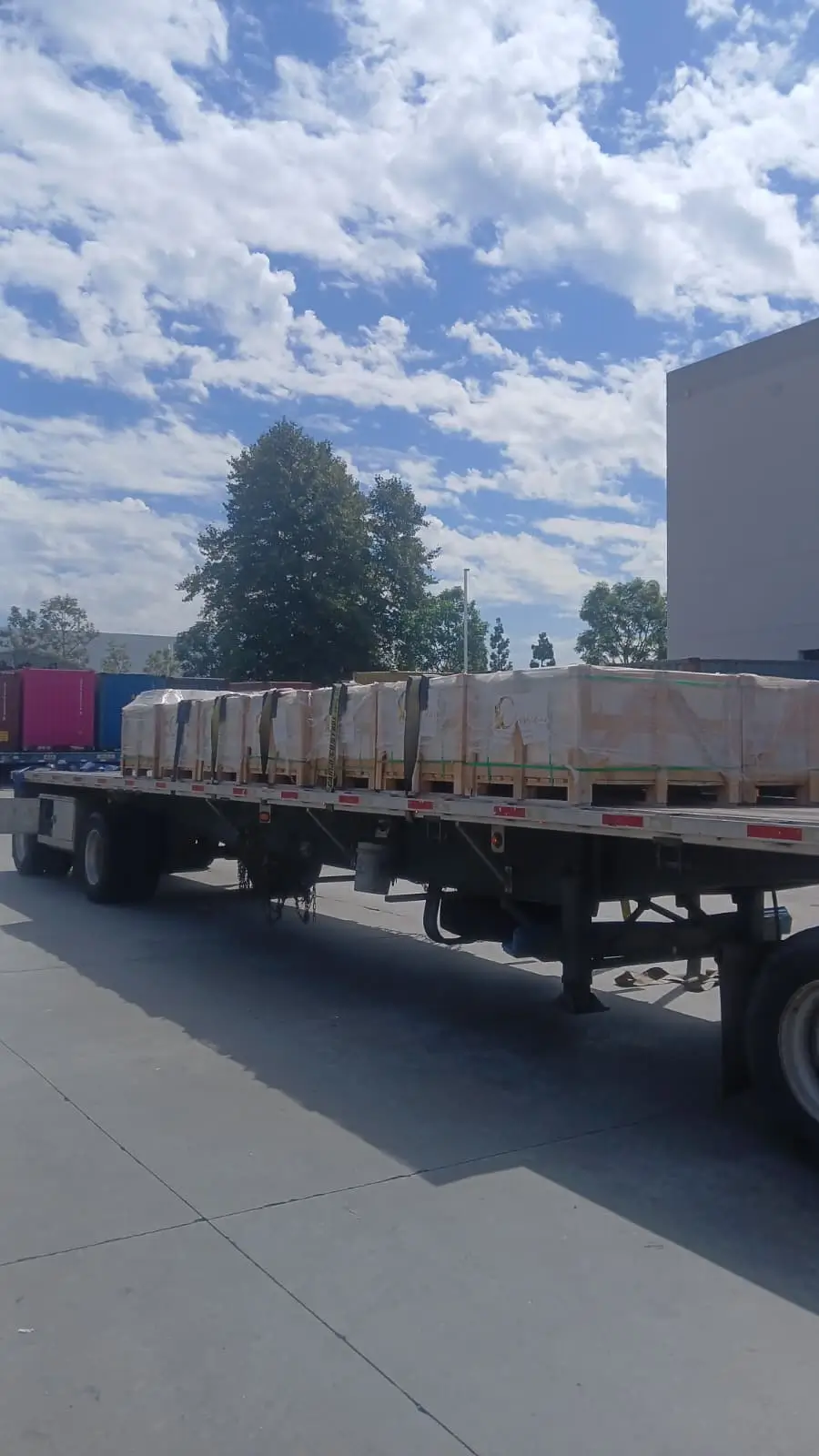
The logistics conversation with your potential supplier deserves as much rigor as the material conversation. Granite moves heavy — a standard pallet of 2-inch pavers runs 2,500–3,500 lbs — and not every supplier’s truck fleet is equipped for the delivery conditions your site presents. If your project is in a tight urban corridor, a rural area with weight-restricted roads, or a site without a loading dock, these constraints need to be discussed before you sign a purchase agreement.
Through our nationwide granite supply network, Citadel Stone coordinates delivery logistics that account for site-specific access requirements — something smaller regional yards often can’t accommodate without additional freight coordination. Truck delivery scheduling should confirm whether the driver is responsible for tailgate unloading or whether you need equipment on-site to handle material off the truck. Clarifying this in advance prevents a costly standoff at the delivery point.
- Ask whether the supplier uses dedicated stone delivery trucks or general freight carriers — dedicated carriers have proper load restraint equipment for stone
- Confirm delivery window precision — “delivery on Thursday” versus “delivery between 7am and 11am Thursday” affects your labor scheduling significantly
- For multi-phase projects, ask about staged delivery options that align with your installation schedule rather than one bulk drop
- Understand the supplier’s damage claim process before delivery — document pallet condition on arrival and flag breakage immediately
Questions to Ask Granite Suppliers Before Ordering
Sourcing granite from local granite suppliers — or from regional distributors serving your area — works best when you arrive at the conversation with a prepared set of qualification questions. Many buyers focus exclusively on price per square foot, which is the least useful single metric when evaluating total project risk. The questions that actually protect your project relate to consistency, documentation, and logistics accountability.
Here’s what a thorough pre-order qualification looks like in practice. You’re not just buying stone — you’re entering a supply relationship that will affect your installation schedule, your subcontractor costs, and your client’s final product.
- Can you provide current ASTM test reports for this specific material lot?
- Is this material in your warehouse now, or is it on order?
- What is your lot size, and can you guarantee consistent coloring across a full project order?
- What is your process if material arrives damaged or outside specification?
- Can you deliver to my site address, and what are your delivery constraints (weight limits, access requirements)?
- Do you offer material holds with a deposit while I finalize my project take-off?
- What is your lead time from confirmed order to truck departure?
Parting Guidance
Finding granite suppliers that actually deliver — in every sense — comes down to asking the right questions early and treating logistics capability as a non-negotiable selection criterion alongside material quality. The suppliers worth working with are transparent about inventory levels, can produce test documentation without hesitation, and have clear processes for handling the inevitable problems that arise in stone delivery. Those who can’t answer your qualification questions clearly are showing you something important about how the relationship will go when it matters most.
Your project’s success with granite isn’t determined solely at the installation phase — it’s determined when you select your supply partner and establish the terms of the relationship. As you evaluate your options across the supply chain, it’s also worth considering how different stone types and applications complement each other on larger projects; how to vet your granite source provides additional guidance on supplier qualification and material sourcing depth worth reviewing. Stone for nationwide projects moves from internationally sourced quarries through Citadel Stone to jobsites in weeks.
Related reading: how to install crushed granite · decomposed granite problems · how to choose white granite.