Granite slab distributors operate at the exact point where quarry output meets project reality — and the decisions made at that intersection determine whether your specification holds up or creates headaches three years down the line. Most project managers understand that granite comes from a quarry and arrives at a site, but the middle layer — how distributors manage grading, lot matching, and transit conditions — is where projects succeed or fail quietly. Understanding that layer changes how you write your purchase orders and what questions you ask before committing to a supplier.
How Distributor Supply Chains Are Structured
The path granite takes from quarry face to your project site is rarely a straight line. Granite slab distributors typically operate within a tiered structure: primary importers take raw quarried blocks and arrange gang-saw cutting at processing facilities, then regional distributors purchase bundled inventory and hold it in warehouse storage until orders arrive. Your position in that chain — whether you’re sourcing direct from an importer or through a second-tier distributor — affects lead time, lot consistency, and your leverage on quality inspection.
The critical variable most specifiers overlook is bundle integrity. Quarries cut slabs in sequential runs from a single block, and those sequential slabs are bundled together to preserve veining continuity. A reliable distributor maintains those bundles through the warehouse cycle. A distributor who breaks bundles to fulfill partial orders creates downstream matching problems that no amount of careful installation can resolve. Always confirm bundle integrity as a condition of purchase — it’s a question experienced distributors answer without hesitation.
- Primary importers manage quarry relationships and gang-saw cutting specifications
- Regional distributors hold bundled inventory and manage lot traceability
- Bundle integrity through the warehouse cycle preserves veining continuity across your order
- Your position in the supply chain affects pricing, lead time, and quality inspection access
- Partial-bundle orders create color and veining inconsistencies that compound during installation
Grading Standards: What Distributors Actually Inspect
Granite grading is not standardized across the industry in the way concrete compressive strength testing is. Different distributors apply different criteria, which means “commercial grade” from one supplier and “commercial grade” from another can represent meaningfully different material. According to ASTM C615 granite dimension stone quality standards, dimension granite must meet specific modulus of rupture, absorption, and compressive strength thresholds — but aesthetic grading (veining uniformity, surface pit frequency, edge integrity) remains largely distributor-defined.
Your specification documents should reference ASTM C615 performance thresholds as minimums, then add your own aesthetic criteria in writing. Distributors who operate at a professional level will expect this and will have QC documentation ready. Those who push back on written aesthetic standards are signaling that their inspection process is informal — worth noting before you place a large order.
- ASTM C615 governs mechanical performance: modulus of rupture, absorption rate, compressive strength
- Aesthetic grading — veining, surface pitting, edge quality — is distributor-defined and varies widely
- Professional distributors maintain lot-level QC documentation you can request before purchasing
- Written aesthetic specifications protect you when material arrives and doesn’t match samples
- Thin granite slabs suppliers face tighter tolerances because thinner profiles amplify any structural inconsistency
Lot Matching and Color Consistency Across Large Orders
Color consistency is the specification detail that causes the most field friction on large granite projects. Granite’s natural variation is part of its appeal, but within a single installation — particularly on continuous horizontal surfaces — uncontrolled variation reads as a quality problem to the end client, regardless of whether it’s technically within the stone’s natural range. Managing this starts at the distributor level, not on site.
Experienced granite slab distributors reserve matched lots for large orders rather than pulling from mixed stock. A matched lot means all slabs trace back to the same quarry block run, same processing batch, and same warehouse storage period. The color temperature, background tone, and veining density stay within a narrower band. For projects over 500 square feet of continuous coverage, requesting a matched lot isn’t optional — it’s the difference between a cohesive finished surface and one that looks assembled from mismatched sources. Confirm lot matching in writing, not just verbally during a sales call.
The Natural Stone Institute provides technical guidance on granite’s natural variation ranges and how quarry-of-origin affects color consistency. Reviewing NSI granite durability and application data before finalizing your lot matching requirements gives your specification language a defensible technical basis.
Thermal Cycling and What It Means for Your Granite Specification
Granite’s thermal expansion coefficient sits around 4.4 to 7.9 × 10⁻⁶ per °F depending on mineral composition — but that range matters most when dealing with significant temperature cycling rather than absolute heat or cold. Projects in climates with wide day-to-night swings, or seasonal freeze-thaw exposure, will stress granite joints and setting beds in ways that a static temperature environment simply won’t.
The engineering implication is straightforward but often under-specified: granite slab installations subjected to repeated thermal cycling need expansion joint spacing calculated against the slab’s specific thermal coefficient, not generic guidelines. A 10°F difference in assumed daily temperature swing can shift your required joint frequency by 15 to 20 percent across a large slab field. Granite slab distributors who supply into demanding-climate projects should be able to provide material data sheets that include thermal expansion coefficients specific to the stone’s quarry of origin — generic specifications averaged across granite types aren’t precise enough for this calculation.
Freeze-thaw performance adds another variable. Granite’s low absorption rate — typically below 0.4 percent by ASTM C615 standards — makes it highly resistant to freeze-thaw spalling, but the joint system and setting mortar have to be specified to match. A distributor who understands these performance demands will flag this during specification consultation rather than waiting for you to ask. That proactive knowledge is a reliable quality signal when evaluating supplier relationships.
- Thermal expansion coefficients range from 4.4 to 7.9 × 10⁻⁶ per °F depending on mineral composition
- Temperature cycling — not just peak heat or cold — drives joint stress accumulation over time
- Expansion joint spacing should be calculated against material-specific coefficients, not generic tables
- Granite’s sub-0.4% absorption rate provides strong freeze-thaw resistance when joint systems match
- Material data sheets from distributors should include quarry-specific thermal performance data
- Setting mortar and joint compound specifications must be compatible with granite’s thermal movement range
Thin Granite Slabs: Specification Considerations
The growing use of thin granite slabs in both interior and exterior applications has changed what distributors need to stock and what specifiers need to understand about structural behavior at reduced thickness. Standard slab granite runs 3/4 inch to 1-1/4 inch nominal thickness. Thin format granite — typically 3/8 inch to 1/2 inch — introduces flexural stress concerns that don’t exist at standard thickness, particularly over subfloor systems with any deflection potential.
Warehouse inspection processes that thin granite slabs suppliers rely on should include flexural strength testing against ASTM C880 standards, not just visual inspection. A slab that passes visual QC at 1/2 inch thickness can still carry hidden micro-fractures from the gang-saw process that manifest as breakage during installation or under point load. Reputable thin-slab distributors will have batch-level flexural test data available — if that documentation doesn’t exist, the risk profile of your order changes substantially.
For exterior thin granite applications exposed to temperature cycling, the reduced mass also means faster thermal response. The slab heats and cools more rapidly than standard thickness material, which increases the cumulative strain on adhesive bond lines over seasonal cycles. Factor a higher-flexibility tile adhesive into your specification when thin granite slabs go into exterior environments with meaningful temperature swings.

Warehouse Logistics and Lead Time Planning
Lead time is where the theoretical supply chain meets your actual project schedule, and granite slab distributors vary significantly in how reliably they hit committed delivery windows. The key variable isn’t how fast they can ship — it’s how accurately their warehouse inventory system reflects available stock at the moment you place your order. Distributors relying on manual inventory updates routinely oversell stock that has already been committed to other projects, creating lead time surprises that compress your installation schedule.
Confirm live warehouse stock levels — not catalog availability — before writing matched lot requirements into your project timeline. Distributors with real-time inventory systems can tell you exactly how many slabs from a specific lot are physically in the warehouse versus in transit or already allocated. That distinction matters enormously when planning a phased installation and needing to pull from the same lot across multiple truck deliveries.
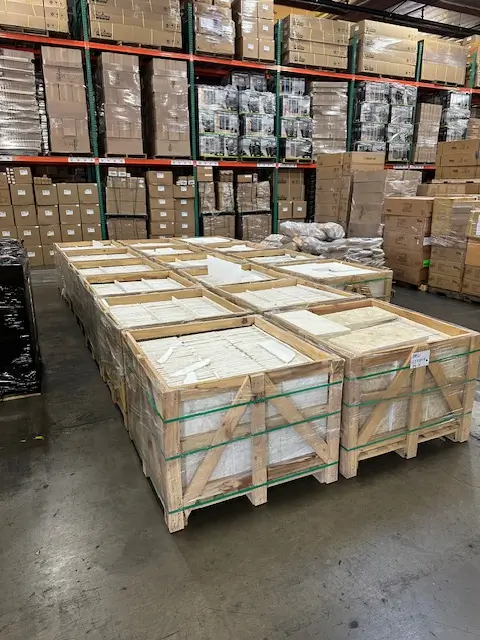
Truck scheduling is another detail worth discussing early. Large granite slabs require flat-deck or specialized crating for transit, and not every distributor’s truck fleet handles long-haul delivery of fragile large-format material with the same care. Ask specifically about how slabs are secured during transit, what the damage rate looks like on their last 20 shipments, and what the replacement process is if material arrives with edge chips or surface fractures. A distributor who has detailed answers to those questions has thought through their logistics seriously. At Citadel Stone, we run pre-shipment inspection on every pallet before it leaves our warehouse, and our truck scheduling accounts for transit time to your site — not just departure date from our facility.
- Confirm live warehouse stock levels, not catalog availability, before committing to timelines
- Real-time inventory systems prevent oversold lots from disrupting phased installation schedules
- Multiple truck deliveries from the same lot require confirmed stock reservation, not just a purchase order
- Ask about damage rates and replacement processes before the first truck leaves — not after a problem occurs
- Flat-deck or crated transit is required for large granite slabs to prevent edge and corner damage
Evaluating Distributor Quality Before You Commit
The due diligence phase with granite slab distributors deserves more structured attention than most project managers give it. The standard practice of requesting a sample and checking price per square foot misses the most important quality signals. A well-presented sample from a poorly managed lot is misleading — and price comparison without understanding what’s included in the price (lot matching, QC documentation, delivery terms, replacement policy) produces a false economy.
A structured distributor evaluation should cover five areas. First, can they provide ASTM C615 compliance documentation for the specific material you’re purchasing? Second, do they maintain bundle and lot traceability from quarry to warehouse? Third, what does their pre-shipment inspection process actually look like — visual only, or does it include dimensional tolerance checks? Fourth, what are their truck delivery lead times, and are those times based on confirmed warehouse stock? Fifth, what’s their replacement policy for material damaged in transit or found to be out of specification on arrival?
Distributors who can answer all five questions with documentation — not just verbal assurances — are operating at a professional level. Those who can answer three or four are probably workable. Those who struggle past the first two deserve careful consideration before you commit a large order to them. Understanding USGS dimension stone production and industry data can help you contextualize what a serious distributor at scale should look like compared to smaller, less structured operators.
Ordering and Project Coordination Best Practices
Coordinating a granite order across multiple project phases requires more pre-planning than most single-phase projects demand. The most common failure mode is ordering phase-one material, installing it, then returning to the same distributor for phase-two material without confirming lot availability — and discovering that the original lot has been depleted, requiring a substitution that won’t match what’s already on the ground.
The correct approach is to calculate your total project quantity at the outset — including a 10 to 15 percent overage for cuts and replacements — and reserve the full lot before phase-one installation begins. Most professional distributors will hold reserved stock in the warehouse for a defined period against a deposit. This isn’t unusual to ask for; it’s standard practice on any multi-phase commercial project. Order samples from the reserved lot after it’s been set aside for your project, not from general stock, to confirm the visual consistency of what’s been allocated.
For detailed information on how we manage lot reservations and phased project deliveries, explore our granite slab pipeline — the full process from quarry sourcing to warehouse allocation is laid out there. Citadel Stone reserves matched lots against confirmed project deposits, which keeps your phase-two and phase-three pulls consistent with what went down in phase one.
Granite Distributor Selection: Final Guidance
Granite slab distributors shape project outcomes at every stage — from how lot matching is managed in the warehouse to how slabs are secured on the truck for final-mile delivery. Your specification work only delivers its intended result when the distributor behind the material operates with the same level of rigor you’ve applied to the spec itself. Matching your documentation standards to a distributor who can meet them is the professional baseline, not an exceptional expectation.
The decisions that actually define long-term performance — thermal expansion joint frequency, thin-slab flexural testing, bundle integrity through the supply chain, and matched-lot reservation for phased projects — all connect back to distributor capability. A supplier who understands these variables and has operational systems to support them is worth more than a marginally lower price per square foot. As you expand your stone specification work into related material categories, granite tooling and equipment selection covers another dimension of the granite project supply chain worth reviewing. Granite slabs from Citadel Stone reach distributors in matched lots that ease color consistency across large orders.
Related reading: Suppliers of Granite: How to Vet Your Source · local granite suppliers · white granite suppliers.