Between the beach markets and the valley suburbs runs Costa Rica’s oldest property dream: the quinta – the country place, from weekend finca to serious estate, with pasture rolling to a mountain view, fruit trees the grandparents planted, and the corredor – the deep covered veranda – where the country’s rural life has always actually happened. The quinta market spans Ticos and expats alike, its register is the national countryside’s own, and its stone craft carries the estate from the gate to the last pasture wall. This guide walks the finca register end to end.
The Entrance Statement
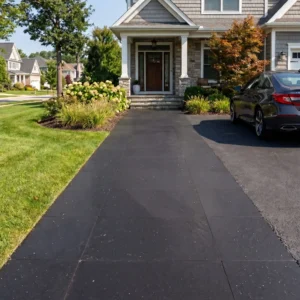
The quinta announces itself at the road: the gate assembly, the cattle grid where the register is honest, and the drive running long under the trees to the house. The stone craft is rural-formal – gate piers in coursed stone holding good ironwork, a paved apron carrying the turn-in off the public road, drive surfaces graded from stone-edged gravel to full paving as budgets and rains dictate, and the drive’s culverts and crossings engineered for the storm the green season will eventually send. The entrance is the estate’s handshake and its flood-control headwork at once.
The Corredor
The quinta’s heart is the corredor – the deep veranda wrapping the house, where meals happen, hammocks hang, rain is watched and the day is discussed:
- The floor runs pale stone at the historic threshold level, cool through the afternoon and warm-toned under the evening bulb.
- Depth is the luxury: a corredor that holds the table, the hammock line and the walking route earns every square meter.
- The outer edge carries a gentle fall and an honest drip line; the rain is a member of the household.
- Steps to the garden run generous and low – the corredor-to-lawn transition is walked fifty times a day.
The Working Yard
Behind the house, the quinta keeps its working side – the yard where trucks turn, tack and tools live, and the estate’s real work stages. The brief is agricultural-honest: paved aprons that hose clean, thresholds rated for machinery and mud boots, wash-down bays where the horses and the pickup share plumbing, and drainage that keeps the working mess from the living side. One stone family still serves – textured working grades and finer corredor finishes from the same batch – and the estate reads as one place with two speeds.
Walls, Fences and the Long Boundaries
Quinta boundaries run long, and the country’s solutions layer by purpose: living fences – the fence-post trees that leaf out and root – for the working pastures, stone walls where the estate makes its formal statements, and the gates between them detailed as the estate’s punctuation. Stone’s role is selective and telling: the entrance run, the garden enclosures, the corners where walls meet view – coursed work in the regional manner, engineered to the seismic code, capped against the rain, and left to gather the moss that makes a country wall convincing.
The Weekend Machine
Most quintas run part-time – the weekend place, the holiday gathering ground – and the absentee disciplines apply in rural dress: ground plans that wait patiently, caretaker routines from a one-page file, storage that locks, and surfaces that greet the returning family without a works list. The lock-and-leave logic scales up here – more ground, same principles – and the estates that run smoothest are specified for the caretaker’s Tuesday as carefully as the family’s Saturday. the rural build sequence proven walks the phased, patient building rhythm the quinta market shares across the border.
The Gathering Ground
The quinta’s social product is the gathering – the December week when the family converges, the birthday that fills the pasture with cars, the quinceañera under the big tree – and the ground plan hosts at scale: the corredor overflowing to a stone terrace, the barbecue court floored at working grade, parking pasture with a paved spine so the cars survive a wet December, and lighting that carries the party past the early country sunset. The estate earns its keep at these moments; the stone is specified for fifty guests and the morning after.
View Husbandry
The quinta’s wealth is its view – pasture falling away, the volcano or the valley beyond – and the estate practises view husbandry: the mirador platform at the land’s best moment, terrace orientations that put the corredor’s evenings against the show, tree management that frames rather than curtains, and paths that walk guests to the vantage the owner wants remembered. The stone craft is the mirador canon in pasture dress – benched platforms, low parapets, textured surfaces for dew-wet mornings – and the investment concentrates where the view performs.
The Quinta Market’s Quiet Rules
Quinta transactions run on the countryside’s quiet rules: water rights and road access verified before romance, boundaries walked with the neighbors who have always known them, the caretaker relationship inherited as carefully as the title, and improvements documented – the archive habit in rural form – for the eventual next family. Stone’s contribution to the file is its usual: batch records, specifications and an aging curve that makes the decade-old estate photograph better than the new one. estate memory, documented properly maps the archive practice; the quinta’s deep files are its rural edition.
The Country Standard
The quinta register asks stone for the countryside’s virtues – patience, honesty, capacity for the gathering and grace in the view – and pale coursed limestone answers in the national vernacular’s own accent. Build the finca from the gate to the mirador in one patient family, and the quinta does what Costa Rican country places have always done: hold the family’s best days, decade after pasture-green decade.
The Horse Line
Many quintas keep horses – the countryside’s working inheritance and its weekend pleasure – and the equestrian layer adds its own stone stations to the estate.
- Stable aprons and wash bays floor at agricultural grade: hoof-proof, hose-clean, drained to their own soakaways.
- The mounting court runs level, textured stone at the tack room’s door – the daily ritual’s stage.
- Gate thresholds along the riding routes take shod traffic without recording it.
- The farrier’s corner earns a hard standing the visiting truck can find in the wet season.
The horse line’s specification is durability without pretension – the animals are hard on surfaces and indifferent to finishes – and its reward is the estate’s living picture: horses at the pasture line, the morning ride leaving from a proper court, the countryside’s oldest partnership hosted on ground that works. The quinta kept its horses through every economic season; the stone simply keeps their stations standing.
A quinta is a working property, not a large garden
The distinction matters because it changes every surface on the plot. A country estate here typically still produces something, houses people who work on it, and receives guests, and those three uses want different things from the ground. The mistake is specifying the whole property to the standard of the guest terrace, which is expensive where it is not needed and inadequate where a tractor actually crosses.
- Working routes specified for vehicles, mud and daily use
- Guest areas specified for comfort, shade and appearance
- Staff and service areas finished to a real standard, not an afterthought
- Clear thresholds where the three uses meet
- One material family shared across all of them so repairs stay simple
The drive is the biggest thing on the property
On real acreage the approach is the longest run of hard landscaping and the one most often under-specified. It carries delivery trucks, farm vehicles, water bowsers in the dry months and every guest arrival, over a distance that makes any repair expensive and any failure very visible.
- Build-up designed for the heaviest vehicle that will ever use it
- Crossfalls and cutoff drains at intervals rather than one long fall
- Turning and passing places set out before the surface is laid
- Continuous edge restraint, since a long drive unravels from the edges
Most estates sit in a connected landscape
Rural properties here are rarely isolated from the conservation network. UNESCO’s listing for the Talamanca Range and La Amistad reserves, inscribed in 1983 and modified in 1990 across 570,045 hectares shared with Panama and supporting some 10,000 flowering plant species, describes the scale of what surrounds farmland in much of the country. Runoff, boundary treatment and lighting on a finca all connect outward.
- Runoff from yards and drives intercepted before it leaves the land
- Boundaries left permeable at ground level where possible
- Riparian margins along any watercourse kept planted
- Lighting limited to where it is genuinely needed
Choosing quinta estate stone the farm can maintain itself
Distance is what governs. Guidance on detailing natural stone paving for lasting durability ties installation method to long-term performance, and across a large property the test is simple: can a section be lifted, repaired and reset by the people already working the land, without bringing plant back onto the site.
- Build-ups that can be opened in patches rather than in runs
- One format and finish across the whole estate
- Bulk spare stock stored dry in the farm buildings
- A repair method written in plain language for the estate team
Our Costa Rica stone supply guide sets out the formats, finishes and lead times that suit this country. On land this size the cheapest luxury is a surface nobody has to think about.