Bonaire keeps its history in stone: Fort Oranje’s small works and lighthouse at the capital’s heart, the plantation-era buildings inside what is now the northern national park, the rock markings left in caves and overhangs by the island’s first peoples, the kunuku walls crossing the countryside, and the salt-country memorials of the south. None of it is museum-cased; all of it sits in the working landscape where the island builds. Knowing the register – and the manners it commands – is part of building well here, and this guide walks both.
The Heritage Register, Mapped
The island’s memory sorts into layers: the indigenous layer of rock markings and cave sites, strictly protected wherever they survive; the colonial layer of fort, plantation houses and the oldest town’s fabric; the working-heritage layer of kunuku walls, cactus fences and cistern craft still in daily use; and the memorial layer of the south, held apart with particular gravity. Each layer has its own rules, and the common principle beneath them is the region’s: history stays where it stands, and new work borrows language, never material.
The First Layer: Rock Markings
The island’s oldest heritage is its most fragile – pre-colonial markings in caves and overhangs, some visible at known sites, others surely unfound:
- Known sites are protected absolutely: no touching, no wetting, no lighting for photographs, no approach beyond the viewing distance.
- Groundworks anywhere in cave country brief crews on the find procedure: stop, protect, report.
- Suspected markings or artifacts are treated as protected until the authorities say otherwise.
- No heritage motif is copied onto new work – homage through restraint, not reproduction.
Fort, Town and the Colonial Layer
Kralendijk’s fort and the old town fabric around it, Rincon’s churches and house rows, the plantation buildings of the north – the colonial layer is the island’s visible architectural memory, and building near it follows the harbor-capital manners: new work low and quiet beside old, pale coral-toned surfaces echoing the register without imitation, structural separation from historic fabric, and ground finds reported rather than cleared. a colonial quarter’s stone manners walks the same discipline in a grander quarter; Bonaire’s version is smaller and no less serious.
Heritage That Still Works
The island’s most extensive monument is its working landscape: the kunuku walls, the cactus fences, the cisterns still catching rain. Its protection is continuation – walls repaired dry-stacked in kind, fence lines kept living, cistern craft carried into new builds – and its greatest threat is not demolition but casual harvesting, old wall stone migrating into new projects a load at a time. The rule is simple and worth stating: the countryside’s stone belongs to its lines. New work buys its own material and earns its own patina.
The South’s Gravity
The salt-country memorials – the huts and obelisks of the southern shore – carry the island’s heaviest memory, and their treatment is settled: memorial ground, approached with respect, never encroached upon, never imitated, never used as backdrop for commerce. Building anywhere in the south inherits a measure of that gravity, and the properties that carry it well are the ones whose owners learned the coast’s history before they drew a line on it. The island notices; on Bonaire, historical literacy is a building qualification.
New Work Beside Old
The practical craft of heritage-adjacent building is restraint executed well: siting that gives the old structure its space and sightlines, heights that defer, pale limestone surfaces that harmonize without mimicry, and detailing – coursing scale, cap profiles, path geometry – that quotes the island’s stone language in a clearly contemporary voice. Done honestly, new work extends the settlement pattern the heritage began; done lazily, it crowds the very asset that gave the location its value. The difference is design discipline, and it costs nothing but thought.
Adaptive Reuse, Island Scale
The register’s liveliest chapter is adaptive reuse: old structures gaining new lives – a town house becoming a gallery, a plantation-era building serving park visitors, a warehouse turning restaurant – with the island’s memory kept working rather than fenced. The stone craft of reuse is the junction between eras: new floors meeting old walls with a visible, honest joint; services threaded under new paving rather than chased through historic fabric; thresholds negotiated so accessibility arrives without carving the original stone; and every new element documented as removable in principle – the old building must always be able to tell its own story without the additions. Done well, reuse is preservation’s best economics: the building earns its maintenance, the public keeps its access, and the memory stays in daily service, which is where island memory has always lived.
The Island’s Long Memory
Bonaire’s heritage register runs from rock markings to salt memorials – layers of memory in one small landscape, all of it neighboring somebody’s building lot. The manners are consistent across the layers: protect, defer, continue, and never take. The parallel craft of honoring protected registers is mapped in protected registers, honored properly, and Bonaire applies it with Dutch administrative order and island-scale intimacy. Build beside the memory with restraint and new stone, and the island’s long story simply gains a well-mannered chapter.
The Archive Habit
Heritage-minded building leaves a paper trail on purpose, and the island’s better projects keep the archive habit: documenting what was found, built and changed, for the owners and inquirers of decades ahead:
- Pre-works photographs of the lot, its walls and any old features – the baseline every future question returns to.
- Find records, even for the minor and inconclusive; the authorities’ file grows more valuable with every honest entry.
- Material provenance – batch records and origin certificates – filed so new stone can always prove it is new.
- As-built drawings of what runs beneath the paving, because the next generation’s works deserve the courtesy.
The habit costs an afternoon per project and compounds like the island’s walls: properties with archives change hands more smoothly, renovate more confidently and answer heritage questions with documents instead of arguments. On an island whose memory is its identity, a private archive is a small act of citizenship – and the projects that keep one are, in their quiet way, building heritage of their own.
The salt trade left its evidence in the open
Bonaire keeps its industrial history in plain sight rather than in a museum, and the same landscape holds both. The Pekelmeer Ramsar site, designated on 23 May 1980 across 1,612 hectares of hypersaline lagoon with saltpans and dikes, is still a working salt operation and simultaneously one of the most important Caribbean flamingo nesting areas in the region. The small stone huts along that southern shore, the obelisks and the pans belong to the same story. Building anywhere near them means working inside a setting where the heritage is the landscape, not a single monument.
- Treat the wider setting as the heritage asset, not just the structure
- Keep new work low so sightlines across the pans stay open
- Record existing ground conditions before anything is altered
- Use matte, pale finishes that sit quietly in an open landscape
- Agree any works with the relevant authority before ordering material
Interpretation is mostly about access
Most damage to open heritage comes from people reaching it, not from weather. Cars park where they should not, paths widen, and a monument ends up ringed by compacted ground. A defined route, laid lightly, protects far more than a fence does.
- One clear route, laid over existing ground rather than cut into it
- Parking placed and surfaced deliberately, well back from the structure
- Edges restrained so the path cannot widen over time
- Signage and lighting kept minimal and reversible
Choosing bonaire heritage stone that defers to what is already there
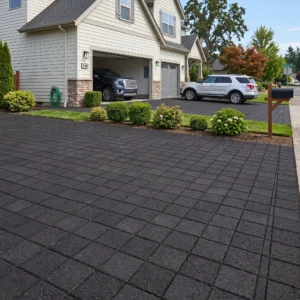
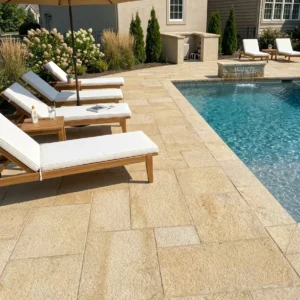
New work beside old fabric should read as a path and a threshold, nothing more. Guidance on detailing natural stone paving for lasting durability keeps the emphasis on bedding, joints and restraint, which is exactly where a reversible intervention succeeds or fails.
- Granular bedding that can be removed without trace
- Modest unit scale matched to the historic structures nearby
- Quiet color so the original fabric stays the subject
- A documented method so the next repair matches this one
Our Bonaire stone supply guide sets out the formats, finishes and lead times that suit this island. These huts survived by being left alone, and that is still the best treatment available.