What the Side-by-Side Reveals About Stone Selection
Natural stone hardscape uses compared across application categories expose a consistent pattern: the most expensive mistakes come not from choosing poor materials, but from matching excellent materials to the wrong application. Specifiers who get this right early avoid the costly rework that follows from pairing a beautiful stone with demands it was never engineered to meet. Understanding how different stone types respond to load, moisture, and thermal cycling separates a confident specification from an educated guess.
Limestone: Versatile Across Paving and Walling
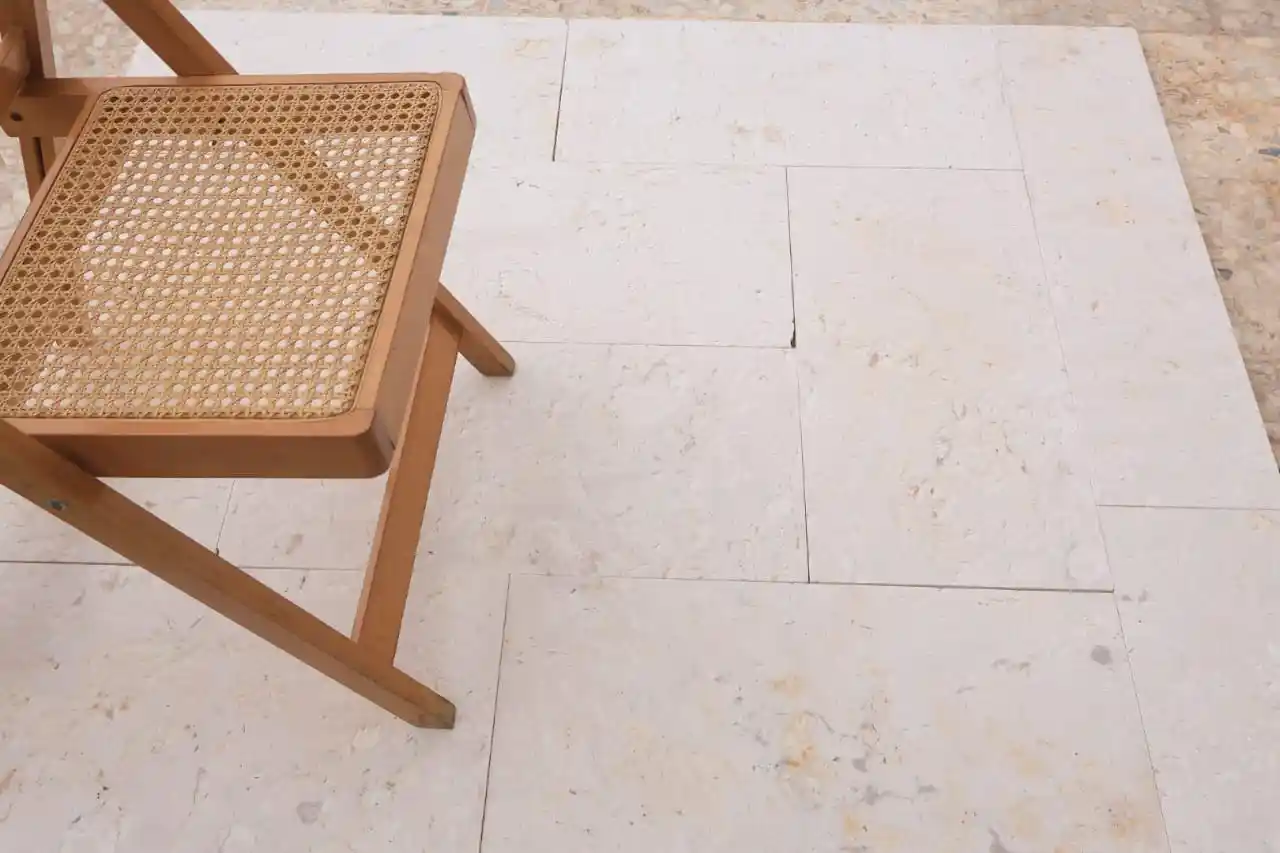
Limestone handles a wide range of natural stone hardscape applications because its mid-range density — typically 140 to 165 pounds per cubic foot — gives it enough mass for structural work without becoming unmanageable in large-format slabs. Honed limestone performs reliably in patio environments where foot traffic is consistent but vehicular loads are absent. For garden borders, retaining walls, and walkway paving, it delivers a cohesive aesthetic across all three elements simultaneously.
The calcium carbonate composition of limestone means it is mildly reactive to acid rain and poolside chemicals, so honest specification requires accounting for that in high-exposure zones. According to NSI limestone technical properties, surface porosity varies considerably between dense Blue Limestone and more open-grained buff varieties — and that porosity gap directly affects sealing frequency and stain resistance. Plan your maintenance schedule around the specific variant being sourced, not the material category as a whole.
- Dense Blue Limestone: compressive strength exceeding 15,000 PSI, suited to driveways and heavy-use paths
- Buff and cream limestone: lower density, better for patios and garden paving where load is light
- Tumbled limestone: irregular edges and worn faces reduce slip risk on gentle-grade walkways
- Honed finishes: consistent surface for formal settings, requires sealing every 2–3 years in outdoor use
Granite: Where Load Demands Igneous Strength
Granite earns its place in natural stone hardscape uses compared by doing something limestone and travertine cannot match: it handles vehicular traffic, point loading from heavy planters, and freeze-thaw cycling without surface degradation. Compressive strength routinely exceeds 25,000 PSI, and its near-zero absorption rate — typically below 0.4% — means water infiltration at the surface is negligible even without sealing.
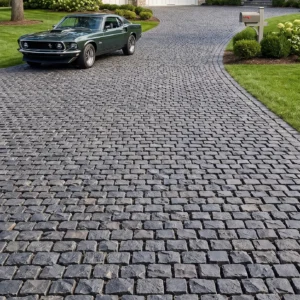
Driveway specification is where granite’s performance advantage becomes financially significant. A 2-inch granite cobblestone or sett installation laid over a properly compacted 8-inch aggregate base will outlast an equivalent limestone installation by 10 to 15 years in regions experiencing significant seasonal temperature swings. The thermal expansion coefficient for granite sits around 4.5 to 8.0 × 10⁻⁶ per °C, which means thermal cycling creates predictable, manageable movement — but joint spacing still needs to account for it. Under-sized joints in a granite sett driveway will develop pressure fractures at the edges when temperature ranges between overnight lows and afternoon highs exceed 40°F. That is not a granite failure — it is a joint design failure.
- Granite pavers for driveways: minimum 2-inch thickness for passenger vehicles, 3-inch for commercial applications
- Cobblestone and setts: self-draining profile reduces water retention at the surface, extending service life
- Granite pool coping: durable, low-absorption, but specify a flamed or sandblasted finish for wet-zone grip
- Thermal joint spacing: plan for 1/8-inch joints minimum in areas with significant day-to-night temperature cycling
Travertine: Pool Decks and Patio Paving
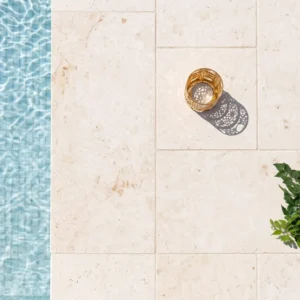
Travertine’s open-pore cellular structure is both its greatest advantage and its primary maintenance consideration. That porous matrix keeps surface temperatures measurably lower than dense igneous stone in high-UV conditions — a genuine performance characteristic, not marketing language. According to ASTM C1527 travertine dimension stone standards, travertine must meet specific absorption and modulus of rupture thresholds before it is suitable for exterior paving — and the best pool deck travertine is filled and honed, not left open-pored where poolside chemicals can migrate into the structure.
Travertine is genuinely suited to natural stone hardscape applications around pools and formal outdoor living spaces. The softness relative to granite — typically 3 to 4 on the Mohs scale — means it scratches more readily in high-traffic zones, so positioning matters. Reserve travertine for pool decks, covered outdoor dining areas, and low-traffic patio zones. A more abrasion-resistant stone type is the better choice for connecting pathways that see everyday foot traffic and furniture drag.
- Filled and honed travertine: best pool deck option — reduced absorption, consistent surface
- Unfilled tumbled travertine: suitable for garden paths and low-traffic areas, not for pool decks
- Thermal behaviour: travertine’s lower thermal mass means faster heat-up but also faster cool-down — relevant in areas with significant day-to-night temperature swings
- Sealing recommendation: penetrating sealers applied every 18 to 24 months for exterior pool deck use
Bluestone vs. Flagstone: The Flat-Lay Decision
Bluestone and flagstone are often treated interchangeably in project conversations, but they behave very differently in service — and this is where natural stone hardscape uses compared gets genuinely nuanced. Bluestone is a dense sandstone or fine-grained volcanic material (depending on origin) with excellent cleft-face durability and a characteristic blue-grey colour that weathers gracefully. Flagstone is a generic category: it describes any flat-splitting stone used for paving, which could be limestone, sandstone, slate, or quartzite depending on source.
Flagstone selection needs to start with the specific material, not the category label. A quartzite flagstone will outlast a soft sandstone flagstone by decades in the same installation. Bluestone, by contrast, is consistently reliable across stone hardscapes because its sedimentary layering produces a naturally flat split face with good load distribution. Flagstone sedimentary rock characteristics confirm that cleavage plane uniformity — the regularity of splitting — directly affects how evenly pavers bed into a mortar or aggregate base. Irregular cleavage means variable thickness, which means rocking and edge chipping over time.
- Bluestone: excellent for formal walkways, pool surrounds, and patio fields — consistent thickness and colour
- Quartzite flagstone: highest hardness in the category, ideal for high-foot-traffic garden paths and steps
- Sandstone flagstone: attractive colour variation but lower abrasion resistance — avoid for driveways
- Slate flagstone: excellent durability and layered texture, but can delaminate in severe freeze-thaw cycles if moisture infiltrates cleavage planes
Basalt: The High-Performance Outlier
Basalt does not get mentioned often enough in natural stone hardscape discussions, which is a genuine oversight. It is an igneous volcanic rock with compressive strength comparable to granite — often exceeding 20,000 PSI — and an absorption rate well below 1%, making it one of the most freeze-thaw resistant paving materials available. For projects in regions that experience significant seasonal temperature ranges, basalt holds its structural integrity and surface finish better than most alternatives when thermal cycling is aggressive.
The material’s dark, fine-grained surface absorbs solar radiation efficiently, which makes surface temperature management a consideration in exposed paving zones. Specify a honed or flamed finish to balance aesthetics and slip resistance. At Citadel Stone, we source basalt in formats suited to both formal courtyard paving and bold contemporary driveway applications — it is a material that rewards designers who understand its engineering properties rather than defaulting to more familiar options. Warehouse stock levels for basalt can vary seasonally, so verify availability before locking in project timelines.
- Basalt tiles and pavers: ideal for commercial hardscaping, heavy-traffic driveways, and contemporary outdoor spaces
- Thermal expansion: lower coefficient than limestone, performs reliably across a wide temperature range
- Finish selection: honed for patios and walkways, flamed for pool surrounds and wet-zone safety
- Colour consistency: basalt’s uniform dark grey-black coloration makes large-format layouts particularly striking
Thermal Cycling and Joint Design Across Stone Types
Freeze-thaw performance and thermal cycling deserve a dedicated look when comparing stone types for the same application. Every material in the natural stone hardscape category moves with temperature — the question is how much, how fast, and whether joint design accommodates that movement before it becomes a cracking problem. The thermal expansion coefficient ranges from roughly 3.0 × 10⁻⁶ per °C for some limestones to 8.0 × 10⁻⁶ per °C for granites — and that difference is material across a 10-metre run of paving with a 50°F temperature range between winter mornings and summer afternoons.
Dense, low-absorption stones — granite, basalt, quartzite flagstone — perform best in freeze-thaw conditions because water infiltration into the stone body is minimal. Porous stones like travertine and some limestone variants are more vulnerable if surface sealing lapses, because water that enters the pore structure expands approximately 9% on freezing, generating internal stresses that cause surface spalling over repeated cycles. The joint material matters as much as the stone itself. Polymeric sand or flexible joint compounds that remain pliable across a broad temperature range outperform rigid mortared joints in paving applications that experience day-to-night temperature swings beyond 30°F. The full range of stone hardscapes engineered for these conditions is available through the Citadel Stone hardscape stone collection, which includes options vetted for both performance and thermal durability.
- Granite and basalt: specify joints of 1/8 to 3/16 inch minimum to accommodate thermal movement in large-format installations
- Limestone and travertine: penetrating sealer every 18 to 24 months to prevent water infiltration before freeze cycles
- Slate flagstone: inspect annually for delamination in freeze-thaw climates — moisture in cleavage planes is the primary failure mechanism
- Joint compounds: flexible polymeric sand outperforms rigid mortar in exposed paving subject to significant temperature cycling
Matching Stone Type to Application: A Practical Reference
The discipline of natural stone hardscape uses compared comes down to matching material properties to application demands. Mismatches — travertine in a high-traffic driveway, soft limestone at a pool edge — create maintenance costs and premature replacement that dwarf the initial material savings. The table below provides a direct comparison framework across common applications.
- Driveway paving: granite cobblestone or setts, basalt pavers, dense blue limestone — all require minimum 2-inch thickness and compacted aggregate base of 8 inches minimum
- Pool deck: filled travertine (honed), bluestone with sawn face, flamed granite — all require DCOF above 0.42 for wet-surface compliance
- Patio fields: limestone, travertine, bluestone, flagstone — light foot traffic allows greater material flexibility
- Walkways and garden paths: quartzite flagstone, bluestone, tumbled limestone — cleft or tumbled surfaces reduce slip risk on grade changes
- Retaining walls and garden borders: limestone walling blocks, basalt, granite — look for consistent bed depth and compressive strength above 8,000 PSI
- Steps and treads: granite, dense limestone, quartzite flagstone — minimum 1.5-inch thickness, textured nosing treatment mandatory
Sourcing, Lead Times, and Project Coordination
Project timelines depend more on sourcing decisions than most project managers anticipate. Natural stone hardscape applications that use multiple stone types — a travertine pool deck with granite coping and limestone garden borders — require coordinating warehouse stock across different material families, and those lead times rarely align without deliberate planning. Imported stone, particularly travertine and some limestone variants, carries typical lead times of 6 to 8 weeks from order to site delivery when moving through standard import channels.
Citadel Stone maintains national warehouse inventory across stone types, which typically reduces lead times to 1 to 2 weeks for in-stock materials — a meaningful difference when the project schedule is already tight. Confirm warehouse availability for specific formats and quantities before finalising your subcontractor schedule. Truck access at the site is worth confirming early too: large-format stone pallets typically require a flat delivery surface and adequate clearance for a standard flatbed truck, and constraints that appear late in the process delay projects in ways that are difficult to recover from.
- Confirm warehouse stock for all specified stone types simultaneously — not sequentially
- Account for colour lot matching when ordering in stages — later truck deliveries may not match the original quarry batch
- Order 10 to 15% overage on cut-and-pattern work to absorb cuts, breaks, and future replacement needs
- Communicate truck access constraints to your supplier before scheduling delivery — narrow gates or steep grades require advance planning
Final Considerations for Natural Stone Hardscape Specification
Natural stone hardscape uses compared across application categories reveals a consistent principle: no single stone type dominates every scenario. Granite earns its place in high-load and freeze-thaw-exposed applications. Travertine and limestone deliver warmth and versatility across patios and pool surrounds when specified and maintained correctly. Basalt outperforms nearly everything in aggressive-cycling environments. Bluestone and flagstone reward specifiers who read past the category label to the specific material beneath it. The right specification framework holds all of these materials in their proper context, deployed where their individual performance characteristics align with what the application actually demands. For a broader look at how these stone families fit within the full natural stone range, stone material types and their uses provides additional guidance across the full building stone spectrum. Landscape designers integrating hardscape and structural stone often source both from Citadel Stone to maintain consistent tone and texture across paving, retaining walls, and garden borders.