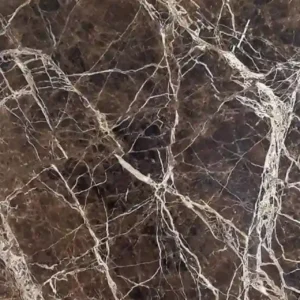
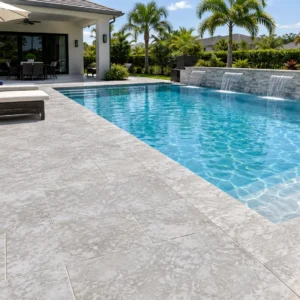
Large format marble tile forces a specification decision that most designers only half-think through: the interaction between slab size, substrate stiffness, and the natural variability that makes marble beautiful also makes it unpredictable at scale. Travertine presents a different set of demands entirely — its open pore structure and sedimentary layering mean you’re managing void fill and absorption alongside aesthetics. Both materials can anchor a stunning interior or exterior installation, but they fail for completely different reasons, and understanding those failure modes is what separates a durable project from an expensive rebuild.
What This Comparison Actually Covers
You’ll find a lot of surface-level write-ups that treat this as a purely aesthetic choice — marble for luxury, travertine for warmth. That framing misses the specification variables that actually determine which material performs in your specific application. The comparison here runs through structural behavior, finish options, maintenance requirements, and the cost factors that shift depending on where your project sits and how it’s sourced. Large format marble tile and travertine are both calcium carbonate-based sedimentary relatives, but their crystalline structures diverge sharply, and that divergence governs everything from adhesive selection to long-term maintenance intervals.
- Marble is a metamorphic rock — limestone or dolomite recrystallized under heat and pressure, producing a dense, interlocking crystal matrix
- Travertine is a sedimentary limestone deposited by mineral springs, with a characteristic banded, porous structure formed by escaping gases
- Both are calcium carbonate and acid-sensitive, requiring pH-neutral cleaners and periodic sealing
- Their thermal mass and surface temperature behavior differ measurably in full-sun exterior applications
Structural Behavior and Substrate Requirements
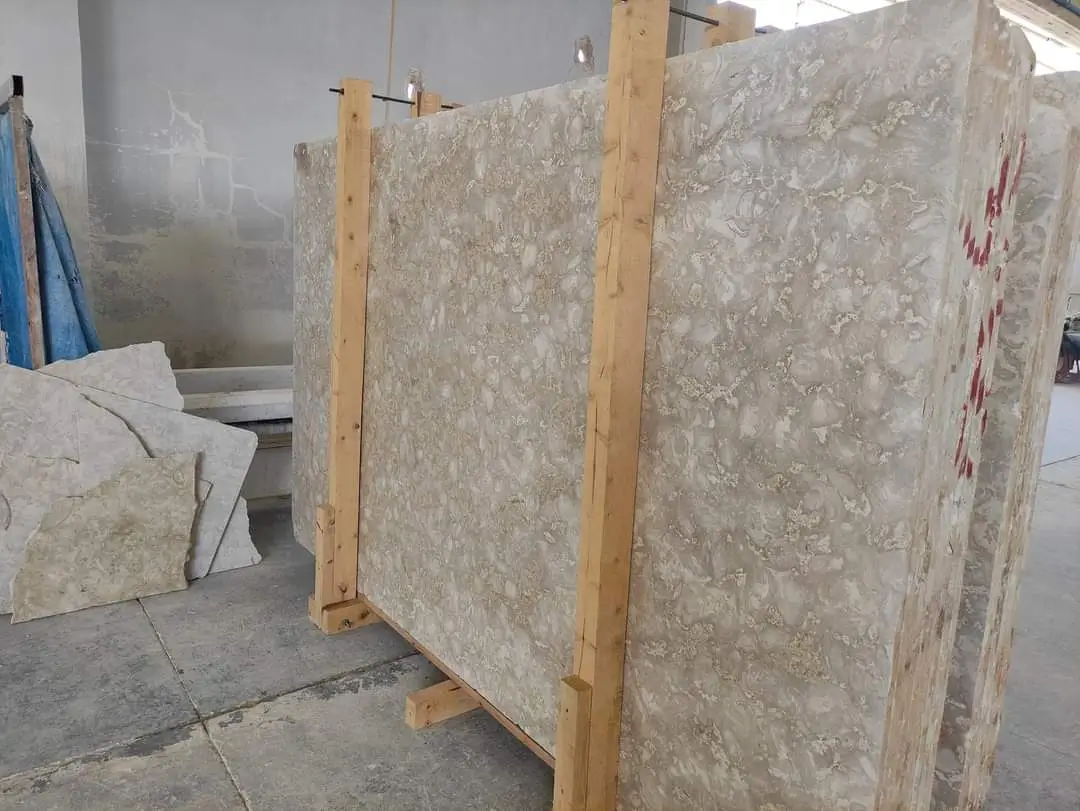
The density difference between marble and travertine shows up most clearly in how each material responds to substrate flex. Large format marble tile — anything running 24×24 inches or larger — demands a substrate that meets or exceeds the deflection limits specified by the Tile Council of North America installation standards for large-format stone. A substrate that passes the deflection test for a 12×12 ceramic tile will almost certainly crack a 48×24 marble slab. You need to run the L/360 deflection calculation for your actual joist span and slab thickness before specifying adhesive coverage or joint width.
Travertine, particularly in filled-and-honed form, tolerates modest substrate movement slightly better than dense marble because its internal void structure gives it a marginal degree of compliance — but that’s not a license to skip proper substrate preparation. The real substrate risk with travertine is differential settlement at the fill material. Unfilled travertine installed over an imperfect substrate will crack along the voids; the fill breaks out before the stone does, and you end up with hollow pockets that collect moisture and debris.
- Large format marble tile requires a minimum mortar bed coverage — request your adhesive manufacturer’s large-format specification sheet and follow it exactly
- Travertine fill material (typically epoxy or cementitious grout) can telegraph substrate movement differently from the host stone — account for this in your expansion joint spacing
- Both materials require back-buttering at large format sizes; a skim-trowel-only approach leaves voids that become stress concentration points
- Underlayment membrane systems are strongly recommended for large-format marble over timber subfloors — uncoupling membranes accommodate in-plane movement without transferring it to the tile
Finish Options and How They Affect Surface Texture
Your finish selection drives maintenance frequency, surface texture, and how each material reads in the space. For large format marble tile, the polished finish is the dominant commercial choice because it amplifies the crystalline veining that makes marble visually distinctive. The trade-off is surface porosity management — a polished marble surface is mechanically smoother and the open pores are compressed at the surface, but it’s not sealed by the polishing process itself. You still need to apply an appropriate impregnating sealer and reseal on the interval your sealer manufacturer states.
Travertine offers a wider practical finish range for exterior applications. A tumbled finish leaves an open, matte texture with softened edges that reads as naturally aged stone. A brushed finish produces a slightly directional surface texture without the sharp lines of machine cutting. Both are worth specifying over a polished travertine exterior where wet-weather exposure is a design consideration, because the finish is the variable that governs how the surface behaves underfoot — slip resistance under ANSI A326.3, measured wet, should be confirmed via a test report on request from your supplier for any exterior application. According to the Natural Stone Institute stone specifications, finish selection is a primary variable in both absorption behavior and surface performance.
- Polished marble: highest visual impact, requires consistent maintenance and resealing — interior applications where maintenance is controlled
- Honed marble: matte surface, slightly more open texture than polished, less reflective — good for high-traffic interior floors
- Filled and honed travertine: smooth, even surface with voids filled — the most practical large-format exterior option
- Tumbled travertine: open, matte texture with softened edges — traditional aesthetic, well-suited to outdoor environments
- Brushed travertine: directional surface texture, matte finish — exterior patios and pool surrounds where finish texture is a design element
Mosaic Marble Floor Tile as a Complementary Format
Here’s a specification detail that comes up consistently on projects that mix scales: mosaic marble floor tile installed as a feature border or threshold transition alongside large format slabs creates a grout line density differential that your installer needs to account for in adhesive selection. The mosaic sheet — typically mesh-mounted 1×1 or 2×2 pieces — has a dramatically higher grout joint to tile area ratio than a 24×48 slab. That means the mosaic section absorbs and releases moisture at a different rate, and the transition joint between the two formats needs to be an expansion joint, not a grout joint. Treating it as a standard grout joint is one of the most common field errors on mixed-format marble installations.
The veining match between mosaic marble floor tile formats and large slabs is a sourcing challenge worth flagging early. Citadel Stone cuts large format marble tile and mosaic marble tile formats from material sourced at our selected quarries, which gives us the ability to confirm lot consistency before the order ships — the step that eliminates the tonal mismatch that shows up at installation when material comes from separate lots.
Porcelain Marble Floor Tile: Where It Fits and Where It Doesn’t
The comparison isn’t complete without addressing porcelain marble floor tile, which has taken significant market share in large-format applications over the past decade. Porcelain fired to marble-look specifications achieves very low water absorption — confirmed by ASTM C373 — and dimensional consistency that natural stone simply cannot match. For applications where dimensional precision is non-negotiable (think thin-set over radiant heat systems with tight tolerances), porcelain’s consistency is a genuine engineering advantage, not just a cost shortcut.
The practical limitation is that porcelain marble floor tile doesn’t repair the same way natural stone does. A chipped or cracked large-format porcelain slab is almost always a full replacement — the fired surface can’t be refinished in place. A scratched or etched marble surface can be honed and repolished by a stone restoration specialist, extending the installation’s service life considerably. For high-foot-traffic commercial interiors where replacement logistics and cost matter, the ability to refinish natural marble in place is a real operational advantage over the full-replacement model that porcelain forces.
- Porcelain: superior dimensional consistency, very low absorption, no refinishing capability
- Natural marble: variable dimensions require skilled installation, refinishable in place, genuine material depth and veining
- Porcelain performs well in high-moisture environments where natural stone sealing maintenance is impractical
- Natural marble commands a price premium that reflects both material value and the skilled labor required for installation
Cost Factors and Sourcing Decisions
The material-to-labor cost ratio for large format marble tile installations skews heavily toward labor in most markets. The stone itself — even premium book-matched marble in large slabs — often represents less than half of the total installed cost once you factor in substrate preparation, back-buttering labor, precision cutting, and the slower production pace that large formats demand. That ratio shifts further toward labor in inland markets far from major port entry points, where freight cost adds a meaningful line item but skilled stone installation labor can be harder to source and price accordingly.
Travertine typically carries a lower material cost per square foot than comparable-quality large format marble tile, which makes it an attractive value-engineering option when the budget is under pressure. However, filled travertine in large formats requires its own set of installation skills — the void-fill integrity needs to be confirmed before installation, and hollow fill can cause adhesive bond failure at the slab edges. Swapping to travertine and then cutting the installation labor budget is a false economy. You need the same substrate precision and back-buttering discipline either way.
Freight distance from the port of entry affects both materials roughly equally, but travertine’s slightly higher thickness tolerance variation can mean more cutting waste on a precision layout — factor that into your material quantity calculation. You can explore our large-format travertine tile options to compare format dimensions and nominal thicknesses before finalizing your project budget.
Sealing and Maintenance Intervals
Both marble and travertine are calcium carbonate-based and will etch if exposed to acidic substances — citrus juice, wine, vinegar, and many household cleaners will dull a polished marble surface on contact. That’s not a defect; it’s the chemistry of the material, and any installer or specifier who doesn’t communicate it clearly to the client is setting up a warranty dispute. The maintenance conversation needs to happen before the specification is signed, not after the first dinner party leaves marks on the kitchen floor.
Sealing intervals depend on the specific impregnating sealer product, the porosity of the stone lot, and the traffic and exposure conditions. Your sealer manufacturer’s stated reapplication interval is the specification to follow — not a generic rule of thumb like “reseal every two years.” Travertine in unfilled form has a higher effective surface area available for absorption and will consume sealer more aggressively than a dense, polished marble. Test the sealer on a sample piece from the actual lot before applying to the full installation. Absorption testing per ASTM C97 is the baseline metric for confirming sealer compatibility with a specific stone lot — request the test report from your supplier.
- Use pH-neutral stone cleaners only — no vinegar, citrus, or bleach-based products on either material
- Polished marble shows etch marks more readily than honed marble because the contrast between polished and etched surface is more visible
- Travertine’s void fill (in filled formats) may require periodic maintenance as fill material settles in high-traffic areas
- Exterior installations require a sealer rated for UV exposure — not all impregnating sealers carry an outdoor rating
Delivery Logistics and Project Scheduling
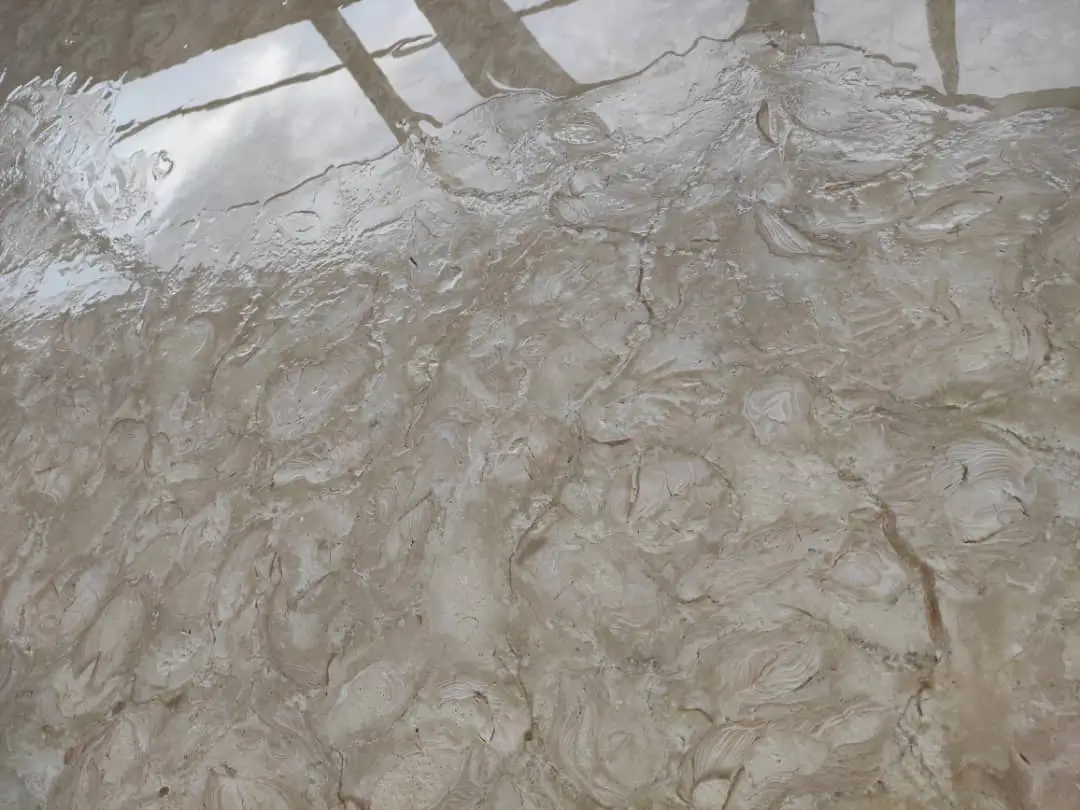
Large format stone — whether marble slabs or oversized travertine tiles — ships on custom pallets and requires careful offloading planning. Your project’s access constraints may affect delivery scheduling significantly. A long-wheelbase flatbed carries large-format stone more safely than a standard panel vehicle, and a site with restricted access or a tight turning radius needs to confirm clearance before the delivery date is confirmed. Offloading arrangements should be locked in before the stone arrives — a last-minute scramble with large marble slabs is how edges get chipped and corners get broken.
Lead times for cut-to-order large format marble tile are quoted at the time of order and depend on the format dimensions, finish specification, and current production scheduling at our selected quarries. Plan your project timeline to allow realistic buffer between the stone delivery date and the installation start — large format stone needs to acclimate to site temperature and humidity conditions before installation, particularly for interior heated or air-conditioned spaces where the ambient conditions differ significantly from transport and storage conditions.
Making the Right Call on Large Format Marble Tile vs. Travertine
The choice between large format marble tile and travertine comes down to three converging factors: the application environment, the maintenance commitment the client is genuinely prepared to make, and the substrate conditions you’re working with. Marble rewards projects where the substrate is engineered to perform, the installation labor is skilled and unhurried, and the maintenance program is built into the client’s operating plan from day one. Travertine is a more forgiving material in outdoor environments where the porous structure works with the climate rather than against it — but “more forgiving” doesn’t mean forgiving of sloppy substrate work or skipped sealing cycles.
For specifiers working through total project budget, the large format marble tile comparison with travertine rarely resolves cleanly on material cost alone. The labor component, the substrate engineering, and the long-term maintenance cost all belong in the calculation. The Natural Stone Institute marble grades and technical specifications provide the industry baseline for understanding material classification — start there, request test reports from your supplier for the specific lot, and build the specification from confirmed data rather than catalog descriptions. As you plan the broader scope of your natural stone project, related pricing considerations are worth reviewing: bluestone pricing and value factors explores how sourcing and market variables affect natural stone budgets across material types. Marble tile from Citadel Stone is sourced from our selected quarries in the Middle East for tone consistency.
Related reading: large format travertine tile · 24×48 travertine tile · large travertine slabs.