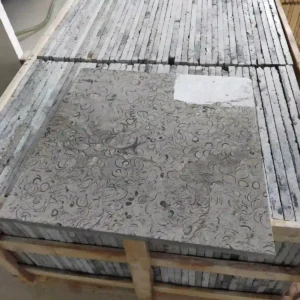
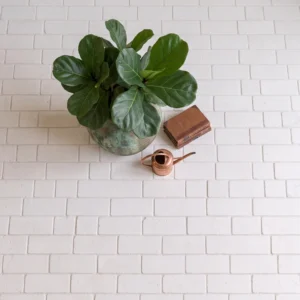
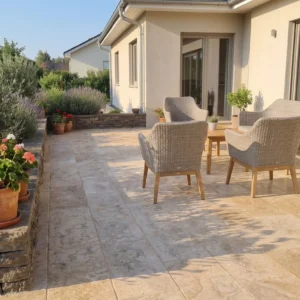
Large format travertine tile presents a specification variable that catches most designers off guard: the relationship between panel size and substrate flatness tolerance. The larger the tile, the more unforgiving the installation becomes — a substrate that passes muster for a 12×12 will telegraph every deviation through a 24×48 panel in a way you simply cannot grout over. Before you commit to a format, your floor-flatness survey needs to happen first, not after the material arrives.
Why Format Size Drives Every Other Decision
You’ll hear tile setters talk about the “lippage problem” with large format travertine tile, and what they mean is specific: when a tile edge spans a substrate undulation, the tile pivots rather than lays flat, and the high corner telegraphs immediately. The industry standard most specifiers reference — ANSI A108.02 — covers allowable substrate flatness tolerance, and it tightens considerably once tiles exceed 15 inches in either direction. For panels running 24 inches or more, your substrate preparation is a primary cost line, not a secondary one.
The detail most project managers miss is that thermal movement and large panel size interact. A 24×24 travertine panel carries significantly more surface area than a 12×12, which means the compressive force from thermal expansion accumulates differently across a continuous field. Your movement joint spacing calculation should account for the panel dimensions, not follow a generic rule of thumb. Request the coefficient of thermal expansion from your supplier’s test report, and work from that figure.
Reading Travertine Structure Before You Specify
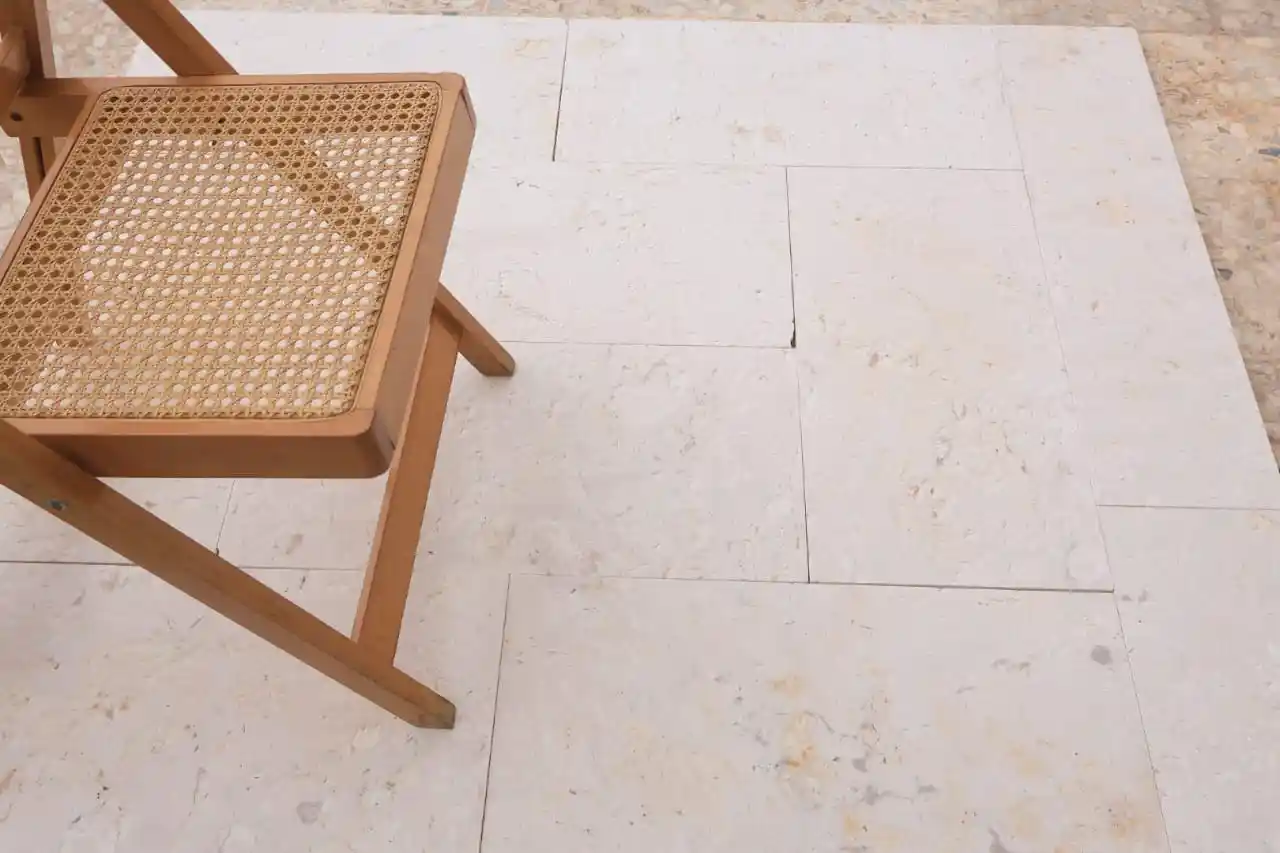
Travertine forms in spring-fed, mineral-rich water environments, and the characteristic voids — technically called macropores — are a direct record of gas escape during calcium carbonate precipitation. Those voids are not a defect. They are a defining structural feature, and how they are handled during processing determines the tile’s absorption behavior, its finish options, and its maintenance schedule for the life of the installation.
The two primary void treatments are filling and unfilling. Filled travertine has its voids grouted or epoxy-filled at the factory, giving you a more continuous surface that is less prone to dirt accumulation but more sensitive to thermal cycling in the fill material. Unfilled travertine retains the voids, which some specifiers prefer for character, but it places a higher demand on your sealing schedule. For large format travertine tile, filled and honed is the most common specification because the continuous surface reads cleaner across the expanded field.
- Filled and honed: factory-filled voids, matte surface finish, lower surface relief, easier maintenance in high-traffic areas
- Filled and polished: factory-filled voids, reflective surface, shows movement and veining at scale, more demanding maintenance to sustain reflectivity
- Unfilled and tumbled: open voids retained, rounded edges from tumbling process, strongly textural surface, open pore structure requires disciplined sealing
- Brushed: mechanically textured surface with a soft, matte appearance, retains some pore openness, intermediate maintenance profile
According to Natural Stone Institute travertine properties and outdoor suitability, the open-pore structure and absorption characteristics of travertine are the specification variables most directly tied to long-term surface performance — and they are where finish selection has the greatest practical impact.
Thickness Specification and Structural Loading
Your thickness selection for large format travertine tile is not a stylistic call — it is a structural one. Residential interior floors typically specify the thinner gauges, but the moment you move the same material to an exterior terrace, a commercial lobby, or a stair tread application, the loading conditions change and so does the appropriate thickness. The correct approach is to specify the ASTM test method for flexural strength and modulus of rupture, then request the test report from your supplier. That figure, combined with your anticipated point load, determines the minimum thickness for the application.
For large format panels in particular, handling stress during installation is a meaningful variable. A 24×48 tile in a thinner gauge is vulnerable to cracking during setting if the substrate has any flex or if the tile is not fully bedded. Full mortar bed coverage — not spot bonding — is non-negotiable for panels of this size. The industry standard for large format coverage, per ANSI A108 guidelines, is significantly higher than for standard-sized tiles, and your installer needs to verify coverage at pull-up checks during the installation.
Porosity, Absorption, and Sealing Protocols
Travertine’s porosity is the variable that governs your sealing decision, and the right sealer type depends on whether you want surface protection or subsurface penetration. Penetrating (impregnating) sealers are the standard choice for most travertine applications because they work below the surface, do not alter the appearance significantly, and do not peel or delaminate the way topical coatings can. For polished travertine where surface sheen matters, some specifiers add a topical enhancer, but that adds a maintenance obligation for reapplication.
Your sealing interval is not a calendar decision — it is a test-based one. The water-bead test is the field standard: apply a small amount of water to the surface and observe whether it beads or absorbs. Absorption without beading tells you the sealer has depleted. In residential interiors with moderate traffic, that test might pass for two to three years. In high-traffic commercial applications, or anywhere with consistent foot traffic, the interval compresses considerably. Agree on a sealing schedule with your maintenance team before handover, not after the first stain appears.
- Penetrating impregnating sealers: work below the stone surface, do not change appearance significantly, do not peel, preferred for most applications
- Topical sealers or coatings: sit on the surface, can enhance reflectivity, require reapplication and are more vulnerable to wear in high-traffic zones
- Color-enhancing penetrating sealers: deepen tone and improve saturation, appropriate for some exterior applications where a richer appearance is the design intent
- Epoxy-based void fillers (factory-applied): used in filled travertine production, not a site-applied maintenance product
UV Exposure and Surface Appearance Over Time
Sun-exposed travertine installations introduce a performance variable that interior specifications never encounter: prolonged UV exposure combined with surface oxidation of iron compounds within the stone. Travertine quarried from certain geological formations contains trace iron deposits that, under sustained UV exposure, can shift surface tone — particularly in ivory and gold-toned varieties, which may develop a warm amber cast over time rather than fading to a flat grey as some synthetic materials do. That color evolution is a characteristic of the material, not a defect, but it is worth communicating to clients before installation so expectations are calibrated.
The finish you specify for outdoor large format travertine tile has a direct relationship to how UV exposure reads on the surface. A polished exterior travertine panel will show UV-related tone changes more starkly because the reflective surface amplifies contrast. A honed or brushed finish diffuses light more evenly and tends to show gradual weathering more uniformly across the field. Tumbled finishes, with their already-irregular texture and open surface topography, integrate long-term weathering into the aesthetic most seamlessly — which is one reason they have remained a standard for exterior pool surrounds and terrace applications.
Sealer selection also affects UV response. Some penetrating sealers include UV-inhibiting chemistry that slows surface oxidation, particularly useful in high-altitude environments or in regions with intense sun exposure and low ambient humidity. Ask your sealer manufacturer for technical data on UV stability — not a marketing claim, a test report. The sealing interval in full sun typically shortens relative to shaded interior use, and a proactive schedule extends consistent surface appearance meaningfully.
- Honed and brushed finishes diffuse UV-related surface changes more evenly across the panel field
- Polished finishes amplify contrast and may make tone shifts more visually apparent on exterior surfaces
- Tumbled finishes integrate long-term weathering organically, particularly suited to informal or naturalistic exterior applications
- UV-inhibiting sealers are available from specialist sealer manufacturers — request technical data, not product brochures
- Iron-rich travertine varieties may develop a warm amber surface shift under sustained UV — document this for clients during material selection
Comparing Large Format Travertine to Alternative Materials
The decision between large format travertine tile and large format green porcelain tile comes up frequently in commercial specification discussions, and the comparison is not as straightforward as material partisans on either side suggest. Porcelain in large format panels offers very low absorption and high surface hardness, which simplifies maintenance and reduces sealing obligations. Travertine offers thermal mass, natural variation, and a surface warmth that porcelain engineering has not yet replicated convincingly at scale — and in barefoot exterior applications, its surface temperature behavior in sun is a meaningful differentiator.
Porcelain’s surface hardness is a genuine asset in high-abrasion zones, and its dimensional consistency simplifies installation slightly because the substrate flatness tolerance is less variable than with natural stone. Large format green porcelain tile also offers highly consistent color and pattern repeatability, which suits specifiers working to a tight visual standard. Travertine, being a natural material, carries inherent variation in vein pattern, tone, and void distribution that you cannot fully predict from sample chips. For designers who value that variation, it is a feature. For specifiers working to a tight, repeatable visual standard, it is a variable that requires careful batch selection. Requesting calibrated, gauged tiles from a specific quarry batch — and our large format travertine tile is available in calibrated thicknesses cut at our selected quarries — is how you manage that variable in practice.
The hexagon bathroom floor tile conversation is worth addressing here because format and shape interact with travertine’s character differently than rectangular panels. Hexagonal formats in travertine work well in smaller-scale interior applications where the natural variation in each unit contributes to the visual field rather than competing with a large continuous pattern. Grout line frequency increases with hexagonal tiling, which affects both the installation time and the maintenance surface area. A hexagon bathroom floor tile layout in travertine is a deliberate aesthetic and practical trade-off, and it is worth pricing the additional labor before committing to it in a specification.
Base Preparation and Installation Variables
Substrate preparation for large format travertine tile is the phase where most budget surprises occur, and it is almost always because the existing floor condition was assessed visually rather than measured. Your subfloor flatness measurement — typically expressed as a tolerance across a specific span length — needs to happen before product is ordered, not during installation. Corrections that take an hour before ordering can take a day mid-installation.
Mortar selection matters more with large format panels than with smaller tiles because coverage uniformity is harder to achieve and more consequential if it fails. Large format panels require a large-notch trowel and back-buttering in addition to full trowel coverage on the substrate. Hollow spots under large format travertine tile create stress concentrations that, under foot traffic load, can crack the tile at the hollow perimeter — a failure mode that is entirely preventable with correct setting technique. Current slip performance evaluation references ANSI A326.3, measured wet, with the finish being the primary variable; the predecessor ASTM C1028 static test was withdrawn in 2014. Always request the test report from your supplier rather than relying on published figures.
- Substrate flatness: measure with a straightedge across appropriate span lengths before ordering — correct deficiencies before tile delivery
- Mortar coverage: full coverage is mandatory for large format panels — back-butter tiles in addition to troweling the substrate
- Expansion joints: space them per your movement calculation, not per a generic rule — account for panel size and thermal exposure conditions
- Grout selection: unsanded grout for narrow joints, sanded for wider joints — match grout color to the filled void color on filled travertine for visual consistency
- Adhesive open time: check your setting material’s open time relative to the installation temperature and humidity — large format tiles take longer to position and set, and the window must accommodate that
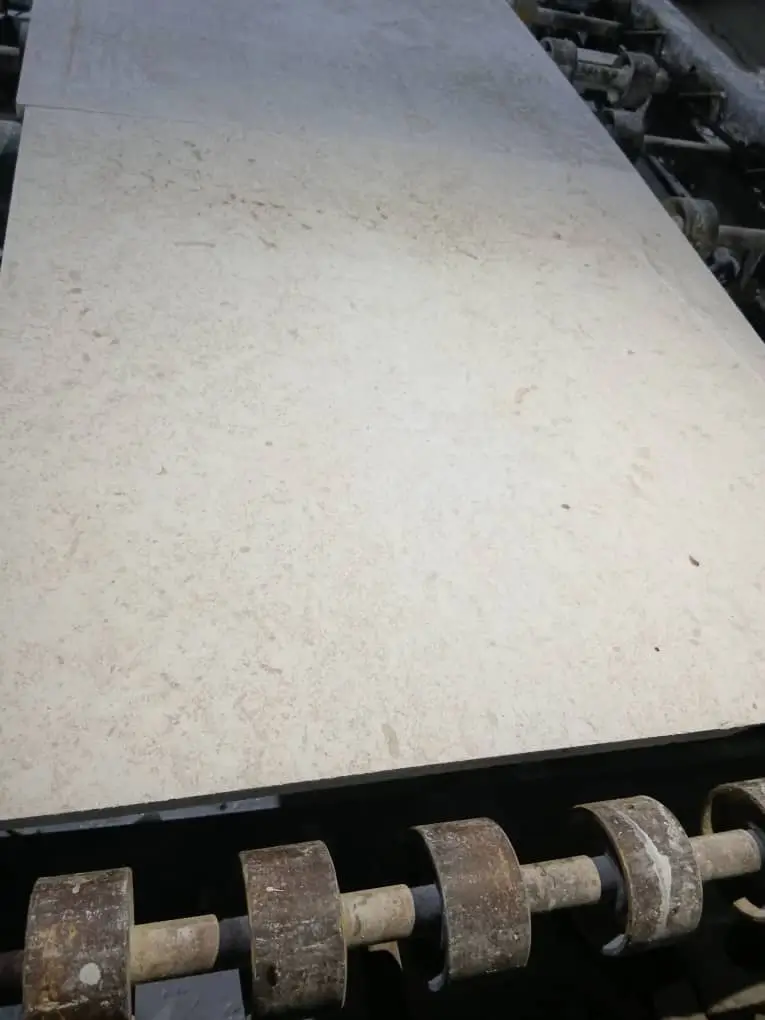
Delivery planning for large format stone also deserves attention. Large format panels are heavier and more fragile in handling than smaller tiles, and site access affects how the material is offloaded and staged. Confirm site access conditions and offloading arrangements before the delivery date — any constraints on access or material staging affect scheduling and should be communicated to your supplier at order placement.
Ordering, Logistics, and Project Planning
The quantity calculation for large format travertine tile needs to account for waste factor at a higher rate than standard tiles. Large format panels generate more offcut waste at borders and corners, and any pattern cut — particularly around curved elements or diagonal layouts — amplifies that further. A standard waste allowance for a straightforward rectangular room in a running bond or stacked joint pattern is typically in the 10–15% range, but complex rooms or feature patterns should be calculated from actual cutting diagrams, not percentage assumptions.
Lead times for natural stone are not the same as lead times for stocked manufactured product. Travertine is quarried, processed, and cut to specification, and that sequence has a real timeline. Citadel Stone provides lead times at the order stage — build those timelines into your project schedule before finalizing installation dates, and communicate them clearly to the general contractor. Last-minute reorders for matching material are more complex with natural stone than with manufactured alternatives because batch consistency requires matching the same quarry extraction and processing lot.
According to ASTM C1527 travertine dimension stone standard specifications, dimensional tolerances and surface finish requirements for travertine are defined by specific test methods — referencing these standards in your project specification protects both the installer and the owner by creating an objective acceptance criterion.
Your Action Plan for Large Format Travertine Tile
The specification decisions for large format travertine tile cluster around three points: substrate readiness, finish selection matched to the application environment, and sealing schedule aligned to actual traffic and exposure conditions. Get the substrate measurement done early — it determines whether your subfloor needs correction and whether that correction fits the project timeline. Choose your finish based on where the tile is going: polished for interior feature applications where maintenance commitment is high, honed for interior and low-UV exterior use where ease of maintenance matters, brushed or tumbled for exterior installations with UV exposure and informal aesthetic character.
Your sealing specification belongs in the project handover documentation, not just in the installation notes. The maintenance team that takes over after completion needs a written schedule, the sealer product name, and the water-bead test protocol — those three things prevent most long-term surface failures. The TCNA natural stone tile installation standards provide useful installation benchmarks worth referencing in your project specification, particularly for coverage requirements and joint treatment. For natural stone used in wet interior environments, the care principles that govern travertine apply broadly across other natural materials — if you’re specifying stone in bathroom or shower contexts, natural stone shower care and sealing covers the key maintenance decisions in detail.
Selecting large format travertine tile is ultimately a decision about long-term value — the material rewards correct specification and disciplined maintenance with decades of service life that synthetic alternatives rarely match in character or presence. Travertine from Citadel Stone arrives from our selected quarries in the Middle East in consistent thicknesses.
Related reading: large tile vs standard tile · marble look porcelain vs stone · large bathroom tiles for shower.