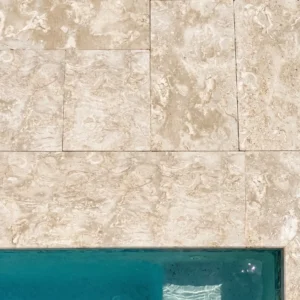
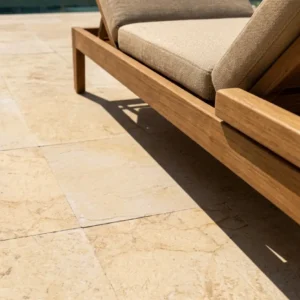
Sealing large travertine slabs is one of those decisions that separates installations that age gracefully from ones that develop staining, spalling, or joint deterioration within a few years. The pore structure in travertine — open, interconnected, and variable across even a single slab — means the material responds to moisture differently than a dense igneous stone or a glazed tile. Your sealer choice, application timing, and reapplication interval all hinge on understanding that porosity rather than treating large travertine slabs like a generic natural stone.
Why Travertine Porosity Drives Every Care Decision
Travertine forms through the precipitation of calcium carbonate around hot spring and geothermal activity, which leaves behind a network of voids in the finished material. Those voids — partially filled in most commercial slabs, fully filled in others — are the variable that governs sealing strategy. A filled surface holds sealer differently than a cross-cut face where the voids run parallel to the slab surface, and a honed finish opens the material more than a polished one. You’ll make better decisions when you specify the fill type and finish together, not as separate afterthoughts.
The porosity range across large travertine slabs can also vary between quarry batches, which is why our technical team recommends requesting a water absorption test report before specifying a sealer system for a high-exposure installation. According to Natural Stone Institute travertine properties and outdoor suitability, the open-pore structure and absorption characteristics of travertine are the primary variables that govern outdoor performance decisions, finish selection included. That data belongs in your specification file, not left to assumption.
- Cross-cut travertine exposes voids at the face — requiring more fill work and a penetrating sealer with high solids content
- Vein-cut slabs present a denser face with fewer open voids — sealer consumption is lower, but lateral moisture pathways still exist
- Honed travertine is more absorbent than polished — factor this into your maintenance interval planning
- Filled travertine simplifies sealing but the grout or epoxy fill can fail at edges if movement joints are mislocated
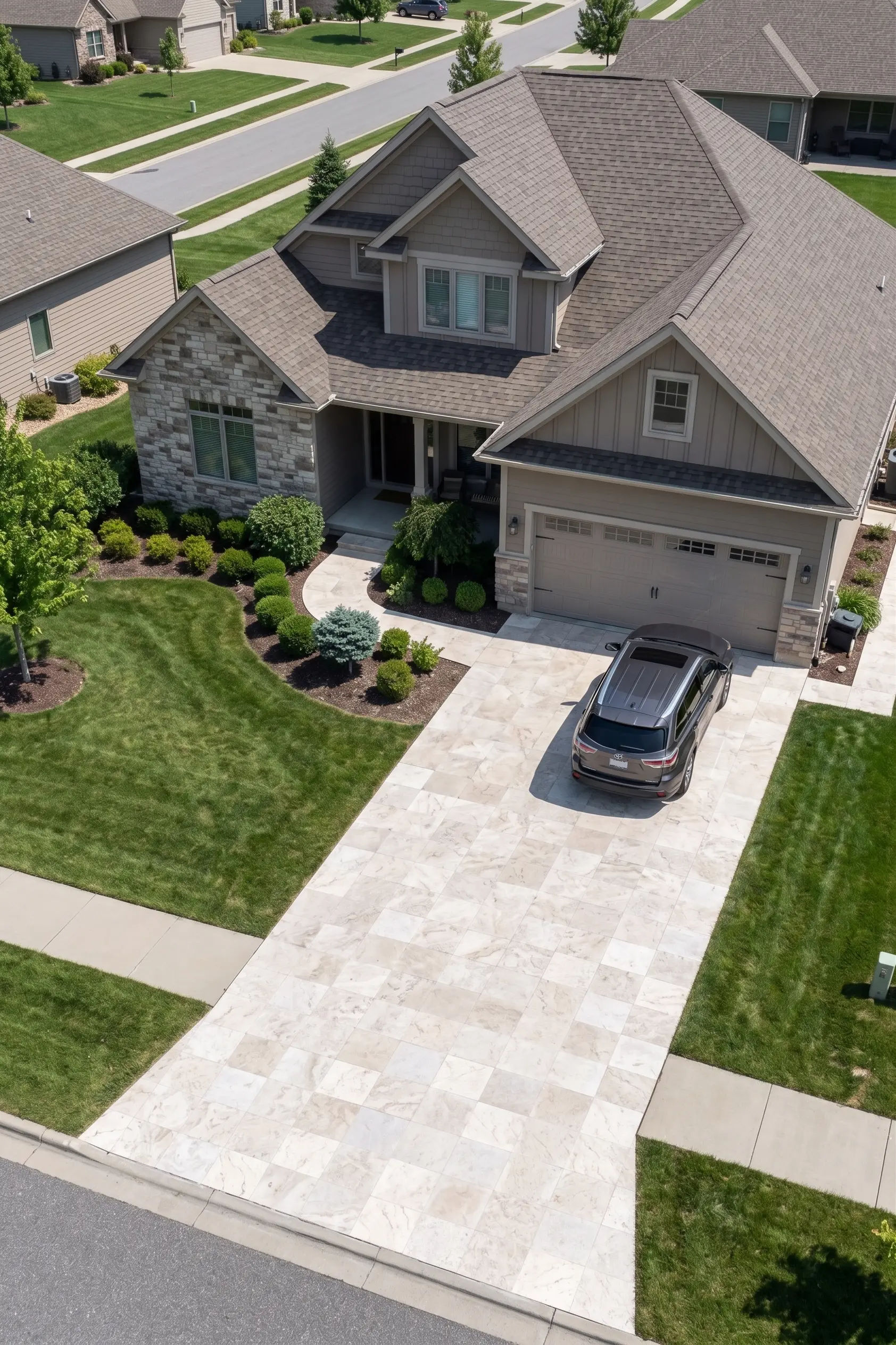
Choosing the Right Sealer for Large Travertine Slabs
The sealer category matters more than the brand. For large travertine slabs in most exterior applications, a penetrating impregnating sealer — one that deposits fluoropolymer or siloxane chemistry below the surface — outperforms a topical coating over the long term. Topical sealers create a film that can delaminate under thermal cycling, especially on slabs installed over a substrate that moves seasonally. Penetrating formulations work within the pore structure without bonding to the surface, so they won’t peel, and they don’t change the surface texture in ways that alter how the finish reads underfoot.
Topical sealers do have a role on interior travertine floors where stain resistance is the dominant concern and thermal movement is minimal. You can achieve a higher-gloss wet look with a topical product that a penetrating sealer simply cannot replicate. The trade-off is reapplication frequency and the risk of buildup if you layer coats without stripping the previous film. Understand the trade-off before you specify — the sealer decision should be documented in your finish schedule, not left to the installer on the day.
- Penetrating impregnating sealers: best for exterior slabs, freeze-thaw regions, and pool surrounds — they allow vapour transmission while resisting liquid ingress
- Topical enhancing sealers: suited to interior floors where aesthetic enrichment and surface stain resistance are priorities
- Colour-enhancing penetrating sealers: deepen tone without surface film — useful on tumbled or unfilled travertine where the raw texture is part of the design intent
- Epoxy-based sealers: high chemical resistance, but they lock in the surface condition at the time of application — avoid applying over marginal or unfilled surfaces
Your sealer manufacturer’s technical data sheet will specify application temperature windows, minimum drying time between coats, and the reapplication interval. Follow those parameters — the chemistry is engineered to tolerances that field improvisation overrides at your own risk.
Application Timing, Surface Prep, and Moisture Content
The detail most installations get wrong is moisture content at the time of sealing. Travertine slabs need to be genuinely dry before sealer goes on — not visually surface-dry, but dry through the body of the slab. Moisture trapped below a sealer film creates pressure as it attempts to vapour-transmit, and that pressure can cause the sealer to blister or delaminate. On new installations, a waiting period after grouting and curing is standard practice; the exact duration depends on your setting mortar, grout type, and ambient humidity.
Surface preparation starts with a neutral pH cleaner rather than an acid wash, particularly on filled travertine. Acidic cleaners etch the calcium carbonate matrix and can degrade epoxy or cement fills, leaving voids that read as shadows or colour variation after sealing. Mechanical preparation — light buffing with a white pad — removes installation residue without compromising the fill. A clean, open pore system before the sealer contacts the surface is the target, because contaminants sealed into the stone become permanent.
- Allow a minimum of 48–72 hours after grouting before sealing — longer in humid climates or where the substrate was wet during installation
- Use a neutral cleaner (pH 7) rather than anything acidic for pre-seal cleaning on filled travertine
- Apply sealer in thin, even coats — flooding the surface leads to pooling in open voids and a sticky residue when the excess isn’t removed in time
- Wipe off excess sealer within the flash-off window specified by the manufacturer — travertine’s variable porosity means some areas absorb faster than others
- Two thin coats typically outperform one heavy coat on large format slabs with uneven porosity
How Subgrade Conditions Affect Travertine Slab Performance
What often gets overlooked in sealing discussions is this: the long-term effectiveness of any sealer system depends on whether the slabs themselves remain stable. Large travertine slabs — particularly those in the 24×48 range or larger — are sensitive to differential movement in the substrate. An expansive clay subgrade that shrinks and swells seasonally will telegraph that movement into the slab bed, producing micro-cracks at joints and across fill areas that break the sealer barrier. Reapplying sealer indefinitely addresses a symptom; if the subgrade is moving, the underlying problem remains unsolved.
In regions with heavy clay soils, the standard fix is a deeper compacted aggregate base — typically crushed angular stone — that buffers the clay expansion before it reaches the setting bed. Sandy subgrades present a different challenge: they drain well, but they’re prone to washout and settlement under large-format slabs where point loads concentrate at corners. Caliche and hardpan soils can seem ideal — dense and stable — but they can also perch water above the hardpan layer and saturate the setting bed seasonally, which undermines the bonding layer and accelerates carbonation of cement-based mortars. Know your soil before you specify your base.
- Expansive clay: over-excavate and replace with angular compacted aggregate; movement joints are non-negotiable
- Sandy or loose fill: mechanically compact to specified density before base course placement; verify with plate compaction test
- Caliche or hardpan: check drainage — perched water above an impermeable layer saturates the bond coat from below
- Rocky or fill soils: irregular settlement risk — verify consistent bearing capacity across the entire slab area before setting
At Citadel Stone, we recommend specifying movement joints at intervals calculated from the expected thermal and moisture movement of the installation — not from a generic rule of thumb. The slab dimensions, base conditions, and exposure all feed into that calculation.
Routine Maintenance and Resealing Intervals
Routine care for large travertine slabs is simpler than most homeowners expect — the complexity is front-loaded into the sealing specification, not the daily maintenance. A weekly sweep or rinse removes particulate matter that would otherwise abrade the fill surface over time. For interior travertine, a damp mop with a pH-neutral stone cleaner handles most traffic soiling without introducing chemistry that degrades the sealer or etches the calcium carbonate surface.
Resealing intervals vary with traffic, exposure, and sealer type — the sealer manufacturer’s guidance is the authoritative source, not a generic annual schedule. A simple field test: drop a few beads of water on the slab surface. If they pearl and bead, the sealer is still performing. If they absorb and darken the stone within a few seconds, it’s time to reseal. For our natural travertine slabs used in high-exposure exterior settings, a test in early spring — before peak UV and heat loading — gives you the data to schedule resealing without guessing.
- Interior travertine floors with light foot traffic: reseal on the interval your sealer manufacturer states — typically every one to three years
- Exterior pool surrounds and terraces: check annually; high UV and chemical exposure (chlorine splash) accelerates sealer depletion
- Honed or tumbled exterior surfaces: monitor more frequently — the open texture consumes sealer faster than a polished face
- Never apply a new sealer coat over a failing film — strip first, clean, allow to dry fully, then reseal from scratch
Stain Removal Without Damaging Travertine
Stain removal on travertine requires the same respect for the calcium carbonate chemistry that governs sealing. Acidic cleaners — vinegar, citrus-based products, grout haze removers — etch the surface immediately and permanently, removing polish and dissolving fill at the edges of voids. You’ll see this as a dull, matte patch on a previously polished slab, or as micro-pitting on a honed surface. The damage is not reversible with cleaning; it requires re-honing or re-polishing, which is a fabrication task, not a maintenance one.
For organic stains — coffee, red wine, leaf tannin — a poultice of powdered chalk (calcium carbonate, which won’t etch the stone) mixed with hydrogen peroxide draws the stain out of the pore system over 24 hours. For oil-based stains, substitute a solvent-based poultice agent. The ASTM C1527 standard for dimension travertine addresses material characteristics that inform how these treatments interact with the stone’s pore structure — the test report is available on request from your supplier. Always test any stain treatment in an inconspicuous area before applying to the full surface.
- Organic stains (wine, coffee, leaves): chalk-and-peroxide poultice, 24-hour dwell, then neutral rinse
- Oil and grease: solvent-based poultice or a dedicated oil-lift stone cleaner — alkaline, not acidic
- Rust stains: specialist rust-lift chemistry formulated for calcium carbonate — standard rust removers are acidic and will etch travertine
- Efflorescence at joints: a dilute solution of a stone-safe alkaline cleaner, followed by sealer repair at the affected joint
- Etching from acid contact: no cleaning fix — mechanical refinishing is the only remedy

Travertine Slabs vs. Porcelain Tiles Large Format: Care Comparison
The comparison between travertine and large-format porcelain tiles large comes up frequently in specification discussions, and the maintenance difference is real. Glazed porcelain is essentially water-resistant at the face — the vitrified body absorbs very little moisture, and the surface requires no sealing in normal use. That simplicity is genuinely appealing for low-maintenance commercial applications. The trade-off is that porcelain’s dense, hard surface reflects rather than manages heat, and the through-body uniformity that makes it easy to maintain can make repairs after cracking or chipping difficult to blend invisibly.
Travertine requires more active maintenance — sealing, monitoring, and periodic reapplication — but it rewards that investment with a surface character that deepens over time rather than simply wearing. The variation in tone and fill across large travertine slabs is a feature, not a defect, and it’s what distinguishes a natural stone installation from a ceramic alternative. The care commitment is higher with porcelain tiles large in format offering a simpler routine; the visual result between the two materials is fundamentally different. Both are legitimate specification choices — the decision should be driven by the project’s maintenance program and aesthetic priorities, not by a misunderstanding of travertine’s requirements.
According to ASTM C1527 travertine dimension stone standard specifications, the material characteristics that govern care protocols — fill type, absorption class, surface finish — are all documentable through standardised testing. Request the test report from your supplier and specify maintenance requirements accordingly; that documentation belongs in the project handover package alongside the sealer product data sheet.
Ordering and Delivery Planning for Large-Format Travertine
Large travertine slabs introduce logistical variables that standard tile orders don’t. The slab dimensions — particularly anything 24×48 or larger — affect how material is palletised, how access needs to be configured at your site, and how the offloading process is staged. A jobsite with restricted access may need to schedule a crane lift or break the delivery into smaller consignments. These variables need to be confirmed before the order is placed, not on delivery day.
Citadel Stone cuts travertine to order at our selected quarries, which means lead times are quoted with the order rather than assumed from stock. Factor that lead time into your project schedule and confirm the cutting specification — fill type, finish, nominal thickness, and edge treatment — in writing at the order stage. Changes after cutting begins carry cost and schedule implications that are avoidable with a complete specification upfront. The USGS limestone and travertine natural mineral formation data reinforces why quarry-to-cut consistency matters: geological variability between batches is real, and a confirmed specification tied to a specific quarry batch protects colour and fill consistency across your full order.
- Confirm site access dimensions with your site manager before the delivery is booked — large-format slab pallets require adequate turning radius and unloading clearance
- Specify fill type, finish, and thickness in writing — verbal confirmations at order stage create disputes at delivery stage
- Order a minimum of 10% overage on large travertine slabs — cutting waste and breakage during installation is higher than on small-format tile
- Inspect material on delivery before signing off — check fill consistency, colour match, and edge condition while the delivery is still present
Getting Your Travertine Slab Specification Right
Your sealing and care program for large travertine slabs is only as good as the specification decisions made before installation starts — sealer category, fill type, surface finish, base preparation, and movement joint placement are all upstream of maintenance. Get those right and the ongoing care is straightforward. Miss any one of them and you’re managing consequences rather than preventing them. A well-sealed, well-based travertine installation on a stable subgrade can deliver decades of service life with nothing more than periodic resealing and neutral cleaning — that’s the realistic outcome when the specification is complete.
As you plan complementary elements for your stone project, format and layout decisions matter as much as material selection. Large-format travertine layout ideas covers how slab orientation, joint pattern, and format choice interact to define the finished installation. Travertine slabs from Citadel Stone arrive from our selected Middle East quarries with filled surfaces ready for finishing.
Related reading: Slip Resistant Shower Floor Tile: Finishes That Keep You Safe · bathroom shower floor tile ideas · Large Floor Tile Layout Guide: Planning Cuts and Reducing Waste.