What Fossil Limestone Actually Is
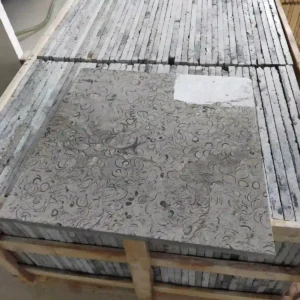
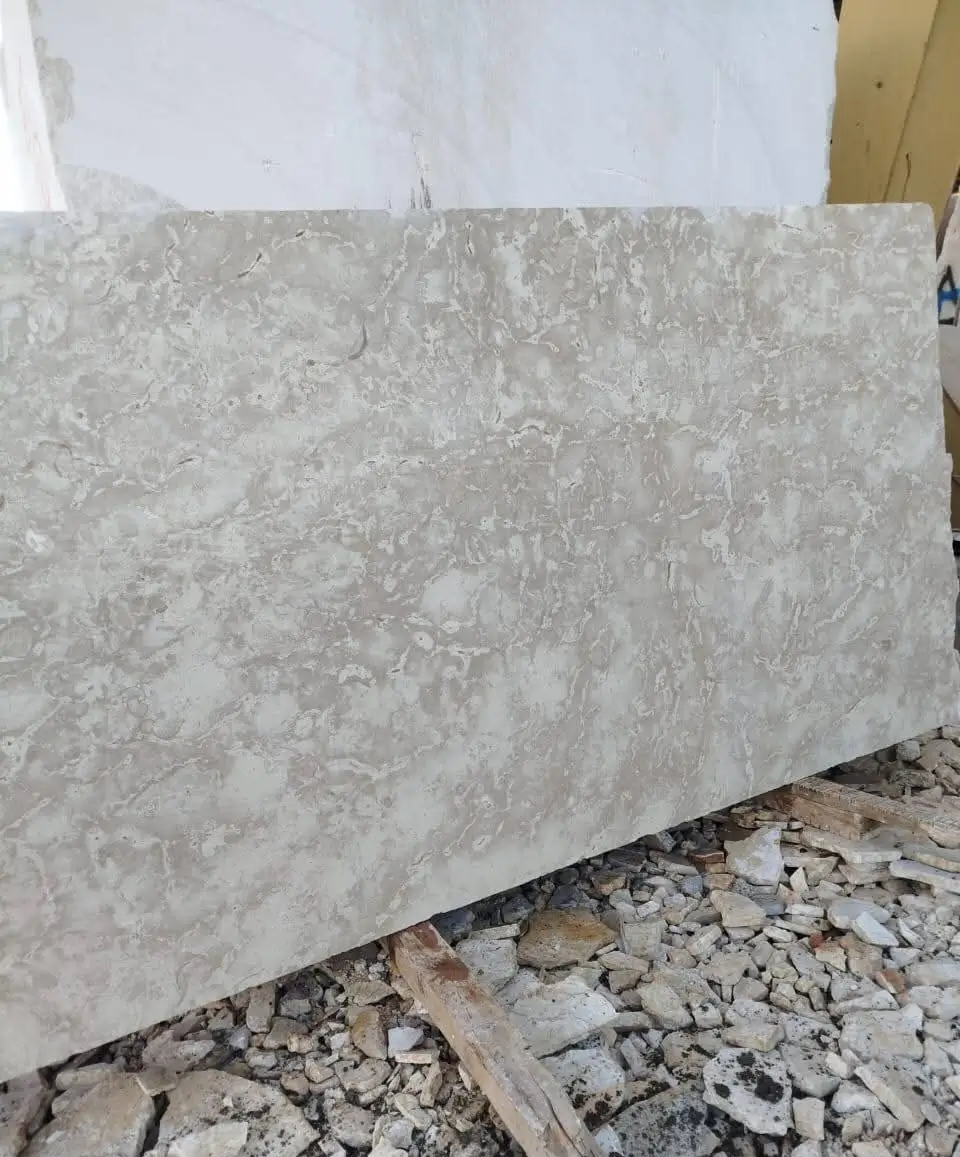
Any fossil limestone slabs guide worth following starts with the geology — compressed marine organisms, shell fragments, coral remnants, and crinoid stems locked into calcium carbonate matrix over millions of years. The pattern variety across a single slab stems from the density and orientation of those organic inclusions, which is why two slabs from the same quarry block can look dramatically different. That unpredictability is precisely what makes specification for large, matched-panel projects more demanding than it first appears.
The base rock chemistry is calcium carbonate — typically 95% or higher in quality dimensional stone. What differentiates fossil-rich limestone from standard sedimentary limestone is the concentration and visibility of bioclastic material: the cross-sections of shells, echinoderm plates, and mollusc fragments that read as cream, white, or grey contrast against the host stone. Porosity varies considerably between quarry sources, and that single variable — more than colour or fossil density — determines long-term outdoor performance. Limestone from Middle East quarries, for example, tends to run in the 5–12% absorption range, while stone from European formations often sits closer to 3–8%. Both figures affect your sealing schedule and jointing compound selection.
How Fossil Patterns Form
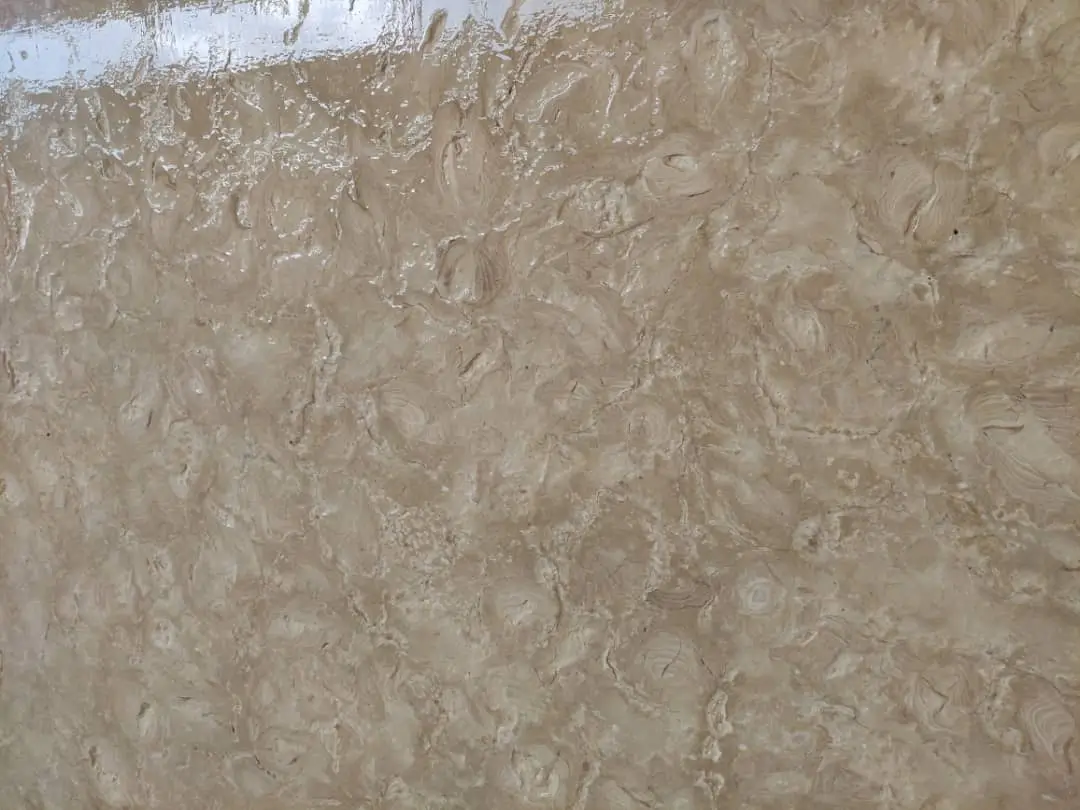
The formation process for fossil limestone spans roughly 300 to 500 million years and involves shallow marine depositional environments — warm, tropical seas where organisms accumulated on the seafloor in dense layers. Compaction, cementation, and diagenesis — the chemical transformation of sediment into rock — gradually replaced original organic tissue with mineral calcite. What you see in the finished slab is the calcified impression of those original organisms, preserved at cross-section by the saw cut.
According to Britannica’s overview of limestone formation and characteristics, bioclastic limestones form in marine environments where skeletal material from corals, molluscs, and echinoderms accumulates and lithifies under pressure. That process explains why fossil concentration tends to be higher in certain bed orientations — quarry operators select vein direction carefully to maximise pattern visibility and slab structural integrity simultaneously.
Pattern orientation matters practically. When you spec fossil limestone floor tiles for a large commercial area, diagonal laying patterns relative to primary fossil alignment typically distribute visible pattern more evenly across the field. Straight grid layouts parallel to dominant fossil lines can create unintentional directional striping at scale, which is rarely the intended design effect. This is the kind of detail that’s invisible in a small sample but becomes obvious once you’re laying 2,000 square feet.
Reading Fossil Limestone Slab Quality
Surface inspection of fossil limestone slabs needs to go beyond colour matching. You’re looking for three things: fossil density consistency across the face, matrix fill quality between inclusions, and the absence of open voids or clay lenses that weaken structural integrity. Voids — small pockets where the original organism decomposed without full mineral replacement — are common in fossiliferous stone, and a certain number of them is acceptable, particularly in honed or brushed finishes where the surface texture integrates small irregularities naturally.
The Natural Stone Institute provides technical grading benchmarks, and their limestone technical specifications and properties outline absorption thresholds and structural expectations for dimensional limestone. These benchmarks are useful as baseline references, but quarry-specific data — including individual slab absorption testing — remains the most reliable quality indicator when you’re specifying for high-traffic or wet applications.
- Request absorption rate data per ASTM C97 — anything above 8% warrants enhanced sealing protocols and more frequent maintenance cycles
- Check slab back faces for clay seams, which indicate geological discontinuities that can cause delamination under thermal stress
- Inspect slab edges under raking light — open void clusters near edges indicate sawing through a weaker zone of the block
- Verify flexural strength against ASTM C880 — for exterior slabs over 600mm span, you want a minimum of 2.5 MPa
- Confirm thickness tolerances — handmade-look versus precision-cut slabs carry different ±mm tolerances, which affects substrate build-up calculations
Fossil Limestone Floor Tile Applications
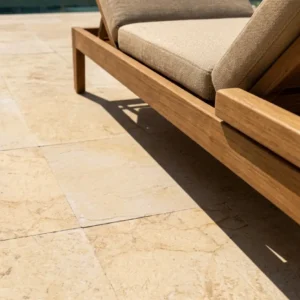
Fossil limestone floor tiles perform exceptionally well in interior applications where controlled loading and predictable moisture conditions allow the stone’s natural character to define the space rather than challenge the specification. Residential entry halls, living spaces, and bathroom floors represent the sweet spot — enough foot traffic to justify the material’s presence without the abrasion loading that wears the softer bioclastic inclusions faster than the host matrix.
The hardness differential between fossil inclusions and surrounding matrix is the key performance variable most specifiers underestimate. Shell cross-sections in fossil limestone typically run between 3 and 4 on the Mohs scale, while surrounding calcite matrix sits at 3. The differential is small, but over years of foot traffic with fine grit — the real abrasive in residential floors — shell edges can develop a slightly raised or recessed profile relative to the surrounding stone. This is normal and contributes to the material’s aged character, but it’s worth communicating to clients upfront so the evolution of the surface is understood as part of the stone’s natural behaviour rather than a defect.
- Honed finishes between 200 and 400 grit provide the right balance of fossil visibility and practical slip resistance
- Polished finishes on fossil limestone amplify the pattern but reduce wet-surface grip significantly — limit polished fossil limestone to dry interior areas
- Tumbled or brushed finishes work well for rustic interior schemes and are highly forgiving of the surface variation inherent in fossiliferous stone
- Calibrated thickness to ±1mm is preferable for floor tile applications — uncalibrated stone requires more skilled installation labour and increases total project cost
For demanding commercial projects, at Citadel Stone we recommend requesting samples from the specific warehouse batch allocated to the project — not just catalogue samples — because fossil density variation between production runs can be significant enough to affect the final installed appearance.
Large Flagstone Slabs and Outdoor Use
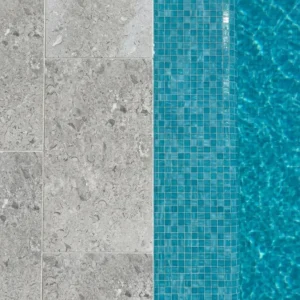
Large flagstone slabs in fossiliferous limestone present a different set of specification challenges than interior tile. Outdoor applications expose the stone to freeze-thaw cycling, UV loading, surface moisture, and biological growth — and not all fossil limestone performs equally across those stressors. The porosity figure becomes critical here: stone above 8% absorption in freeze-thaw climates needs to be evaluated carefully against your regional freeze-thaw cycle frequency. Water that infiltrates open pore structure and freezes at depth generates internal pressure of roughly 2,000 psi — enough to propagate micro-fractures through the calcite matrix over multiple seasons.
According to USGS geological data on limestone composition and construction applications, limestone’s calcium carbonate base makes it more susceptible to acid attack than siliceous stones — a relevant consideration for outdoor environments where acid rain and biological acids from leaf litter can etch exposed surfaces over time. For large flagstone slabs in outdoor settings, a penetrating impregnator sealer applied at 12-month intervals provides the primary defence against both moisture ingress and surface acid attack.
Thermal expansion in limestone runs approximately 4.4 × 10⁻⁶ per °F, which means a 600mm slab in a hot, dry climate context experiences linear expansion of roughly 0.5mm over a 40°F temperature swing. That figure sounds modest until you’re laying a continuous 30-foot run of fossil limestone slabs without adequate expansion joints — joint spacing should not exceed 12 feet in outdoor installations, and 8 to 10 feet is the more conservative and field-proven standard.
Seagrass Limestone as a Fossil Variant
Within the fossil limestone category, seagrass limestone occupies a distinctive niche because its patterning originates from preserved plant material rather than marine fauna — specifically from the carbonised traces of ancient seagrass beds. The visual result is a fine, linear striation overlaid across the host stone, creating a quieter, more directional pattern than the bold circular and radial fossil signatures you see in shell or coral limestone. That linear quality makes it exceptionally versatile for contemporary interiors where you want organic character without the visual weight of high-contrast fossil fields.
You can explore the full range of profile and finish options for our seagrass limestone slabs, which are available in both floor tile formats and outdoor slab dimensions. Specifying seagrass limestone tile for a contemporary interior project is a straightforward process once you understand the directional grain — the linear pattern simplifies layout planning on larger floors because the striation provides a consistent visual reference that other fossil types lack. The linear grain structure also makes it more directionally consistent than other fossil types, which simplifies pattern planning on larger projects.
From a performance standpoint, seagrass limestone tends to have a denser, less porous matrix than heavily shelled variants, typically running in the 4–7% absorption range for quality quarry material. That lower porosity translates directly into better outdoor durability and a more forgiving maintenance schedule — a genuine practical advantage beyond its aesthetic appeal.
Cost Factors and Sourcing Decisions
Fossil limestone slab pricing involves more variables than quarry origin alone — and understanding the full cost structure helps you make better value decisions rather than defaulting to the lowest unit price. The material-to-labour cost ratio shifts significantly based on slab size and finish complexity. Large-format fossil limestone slabs (600mm × 1200mm and above) carry a higher unit cost but reduce labour time and grout joint frequency — on a 500-square-foot interior floor project, the labour saving from larger slabs can easily offset a 15–20% premium in material cost.
Freight distance is the variable that reshapes project budgets most dramatically and least predictably. Fossil limestone sourced from Middle East quarries travels a longer logistics chain than domestic dimension stone — that chain includes port handling, customs processing, and final overland trucking from the receiving warehouse to your job site. Citadel Stone’s national warehouse inventory reduces the last-mile trucking cost and timeline significantly, but understanding the full freight structure before final specification prevents budget surprises. Requesting delivered cost rather than FOB warehouse cost gives you the number that actually matters for project budgeting.
- Freight zones matter — a project near a major distribution hub typically incurs lower final trucking costs than a remote site requiring dedicated truck runs over long distances
- Order consolidation reduces per-unit freight cost — coordinating fossil limestone slab delivery with other stone materials from the same supplier minimises truck movements and associated costs
- Labour market conditions in your region affect total installed cost as significantly as material pricing — in markets where skilled stone installation labour is scarce, the premium for calibrated, precision-cut slabs is recovered through faster, more accurate installation
- Waste factors for large fossil limestone slabs with pattern-matching requirements typically run 15–20% — budget accordingly rather than ordering to net square footage
- Regional availability of compatible grout and setting materials affects site logistics — some specialty fossil limestone installations require low-alkali mortars to prevent efflorescence through high-porosity stone
Installation and Substrate Requirements
Your substrate specification for fossil limestone slabs determines whether the material performs to specification or develops problems within the first three winters. The single most common failure mode in outdoor fossil limestone installation is inadequate base depth combined with poor drainage geometry — water accumulates beneath the slab, the substrate shifts seasonally, and point-load cracking initiates at the fossil voids and shell inclusions that are the stone’s inherent weak zones.
For outdoor large flagstone slabs, a compacted aggregate base of minimum 6 inches over native soil is the starting point — not the finished specification. In clay-heavy soils with high expansion coefficients, 8 to 10 inches of compacted aggregate over a geotextile separation layer is the defensible standard. Sand-set installations are appropriate for pedestrian-only applications in temperate regions, but mortar-bed setting on a concrete subbase is required wherever vehicular loading, heavy furniture, or significant thermal cycling is expected.
Interior fossil limestone floor tile installation over radiant heating systems introduces a constraint that frequently gets resolved incorrectly in the field. The thermal mass of the stone means the heating system needs to be ramped gradually on initial commissioning — rapid temperature cycling during the curing phase of the setting mortar can cause differential thermal stress at the stone-adhesive interface. A 7–10 day low-temperature commissioning period before full heating load is the professional standard.
Sealing and Long-Term Maintenance
Fossil limestone slabs require a sealing approach calibrated to their specific porosity rather than a one-size-fits-all protocol. High-porosity stone (above 7%) benefits from a two-coat penetrating impregnator application at initial installation — the first coat is absorbed rapidly and the second coat addresses the residual open pore structure more completely. Lower-porosity seagrass and similar dense fossil limestone variants may require only a single application, but you won’t know which regime applies without testing the specific batch.
The field test that actually works: apply a few drops of water to an unsealed, dry sample piece and time the absorption. If water is fully absorbed in under 30 seconds, you’re dealing with high porosity and need the two-coat protocol. If absorption takes 3–5 minutes, a single quality impregnator coat is adequate. This test costs nothing and prevents the mistake of either over-applying (which can leave surface residue) or under-applying (which leaves the stone exposed).
- Penetrating silane-siloxane impregnators outperform surface sealers for fossil limestone — they protect without altering the natural surface appearance or reducing breathability
- Reapplication frequency for outdoor fossil limestone slabs is typically every 12–24 months depending on UV exposure and rainfall intensity in the installation environment
- Avoid acidic cleaning products entirely — citrus-based or vinegar cleaners will etch calcium carbonate matrix and progressively damage fossil inclusions
- pH-neutral stone cleaners at dilution rates of 1:20 are the maintenance standard for routine cleaning of fossil limestone floor tiles
- Efflorescence on outdoor fossil limestone slabs indicates moisture movement through the substrate — address the drainage root cause before treating the surface symptom
Getting Your Fossil Limestone Slabs Specification Right
This fossil limestone slabs guide comes down to a few non-negotiable decisions that compound in their effect on long-term performance: absorption rate determines your sealing and maintenance schedule, substrate depth and drainage geometry determine outdoor durability, and slab size selection determines your real installed cost once labour is factored in properly. Getting those three variables right before committing to specification locks in a material that delivers decades of service life with minimal intervention. As your specification evolves, related natural stone applications are worth understanding alongside your primary selection — how limestone surfaces weather over time explores how the stone’s character continues to develop long after installation. Seagrass limestone supplied by Citadel Stone displays fine linear patterning caused by preserved plant material, making it a distinctive choice for both floor tiles and outdoor slabs.
Related reading: natural limestone colors guide · natural limestone pool · Limestone Exterior Applications: Veneer, Cladding & Paving.