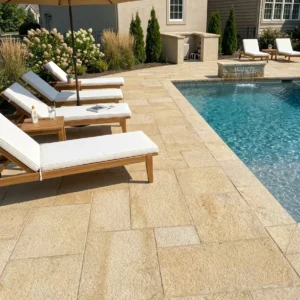
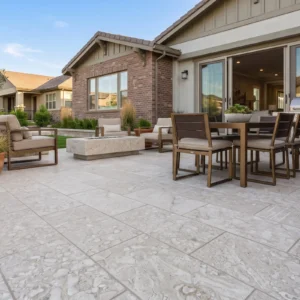
What Worn Limestone Paving Weathering Actually Does to Your Stone
Worn limestone paving weathering isn’t a slow deterioration — it’s a surface transformation driven by calcite dissolution, and understanding that distinction changes how you specify, maintain, and evaluate your installation. The outermost crystalline matrix softens as carbonic acid in rainwater reacts with calcium carbonate, rounding sharp edges and creating that characteristic silky texture experienced specifiers recognize immediately. What most people misread as damage is often a natural densification of the visible surface, where micro-pitting redistributes light in ways that enhance visual depth rather than reduce it.
The rate of that transformation depends heavily on stone density and finish type. Honed surfaces weather more predictably than polished ones because there’s no reflective topcoat competing with the stone’s natural aging. Tumbled finishes, by contrast, are pre-aged — they mimic what decades of foot traffic and seasonal cycling produce naturally, which is why they remain a reliable specification choice for projects where visual consistency matters from day one.
Porosity Is the Single Biggest Variable in Weathering Rate
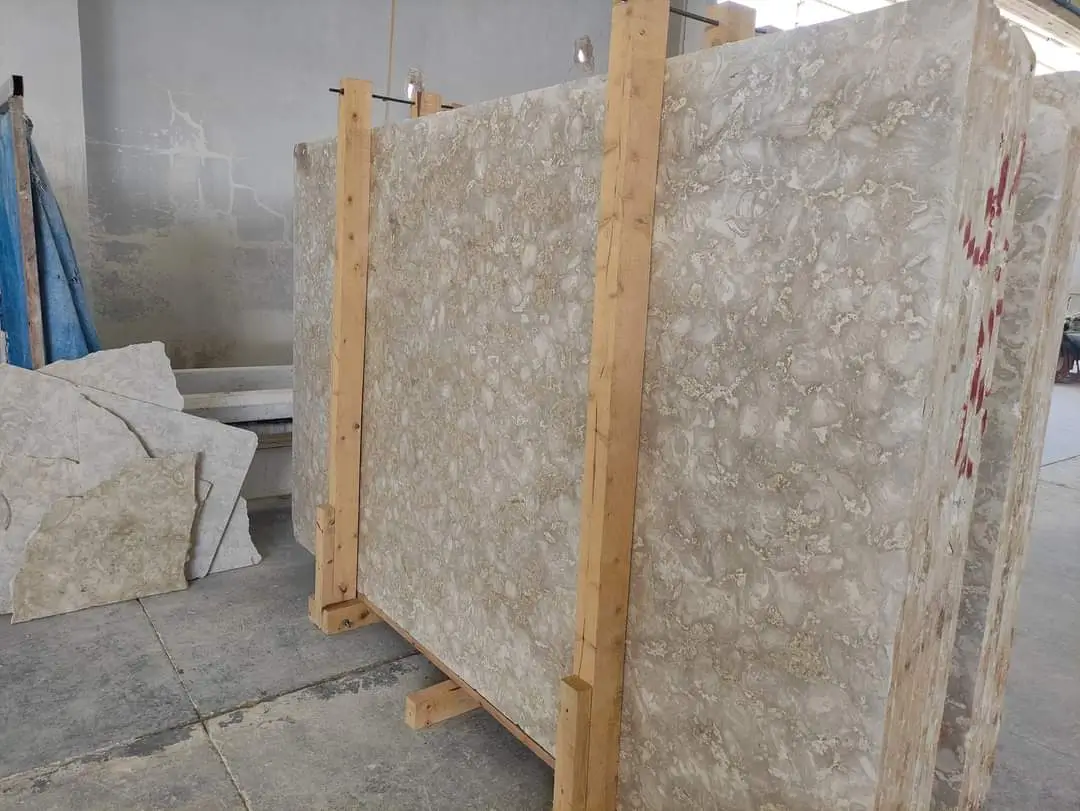
Your stone’s absorption rate — measured in percentage by weight per ASTM C97 — predicts more about its long-term weathering trajectory than almost any other single specification. Dense limestone with absorption values below 3% weathers slowly and evenly, developing a smooth patina over decades. More porous varieties above 7% absorb moisture aggressively, which accelerates freeze-thaw cycling in cold-climate installations and promotes biological growth in humid environments.
- Absorption below 3%: slow, even surface softening — ideal for high-traffic paving
- Absorption 3–7%: moderate weathering with visible surface texture changes over time
- Absorption above 7%: faster surface evolution, requires more frequent sealer maintenance cycles
- Finish type amplifies porosity effects — honed surfaces seal more effectively than sawn, reducing ingress
- Joint width influences moisture entry at slab perimeters, particularly in freeze-thaw regions
According to USGS limestone composition data, the structural variability within limestone formations means that even slabs from the same quarry batch can carry measurable differences in porosity. That’s why at Citadel Stone, we conduct density checks during warehouse intake — not just at source — because batch consistency matters more than spec-sheet averages when you’re covering hundreds of square feet.
How Your Surface Finish Determines the Aging Curve
The finish you specify at installation effectively sets the starting point on a weathering curve that ends at the same place for all limestone — a matte, naturally rounded surface. The question is how fast you travel that curve and whether the intermediate stages suit your project’s visual requirements.
Polished limestone loses its reflective sheen within 3–5 years of outdoor exposure in most conditions. That’s not a product failure — it’s calcite recrystallization responding to UV exposure and moisture cycling. Specifying polished limestone outdoors without clearly communicating this to clients creates expectation problems later. Honed finishes hold their appearance far longer outdoors because they start closer to the material’s natural equilibrium. Brushed finishes are worth serious consideration for projects where the worn, aged look is the end goal — you’re specifying the destination rather than watching the stone arrive there.
- Polished: high initial reflectivity, loses sheen fastest outdoors — 3–5 year transition to matte
- Honed: stable matte appearance, weathers gradually — typically 10–15 year visible change cycle
- Brushed: pre-textured surface that mimics natural aging, maintains consistent appearance
- Tumbled: intentionally aged finish — minimal visible change over time, highly predictable
- Sawn: roughest initial texture, weathers to a softer profile — good for high-slip-resistance specs
Biological Growth: The Weathering Variable Most Specs Ignore
Lichen, algae, and moss colonisation sits in a grey area that most weathering discussions skip entirely. The Natural Stone Institute limestone specifications note that biological growth is a surface phenomenon separate from structural degradation — but it directly affects how worn limestone paving weathering reads visually and whether clients interpret it as aged character or neglect.
Shaded installations in humid climates can develop visible algae films within 18–24 months. This isn’t structural damage, but it does change slip resistance in ways that matter — particularly for pathways and steps. Your drainage design and joint sealing protocol both influence how aggressively biological growth establishes. Joints packed with kiln-dried sand and sealed appropriately suppress moisture retention that algae needs to colonise. Open, unsealed joints in shaded areas are where you’ll see the fastest biological weathering progress.
- Algae develops in low-light, high-moisture zones within 18–24 months on unsealed stone
- Lichen is slower-establishing but harder to remove without affecting surface texture
- Moss colonisation signals drainage failure more often than material failure
- Sealed joints reduce biological entry points significantly — reseal every 3–4 years
- Annual low-pressure rinsing removes early biological films before they bond chemically
Is Limestone Natural Stone Built for Long-Term Outdoor Performance?
It’s a question worth answering directly: limestone is a sedimentary carbonate rock composed primarily of calcite, and yes — it is definitively a natural stone, confirming that is limestone natural stone is not merely a marketing claim but a geological fact, formed over millions of years from marine sediment compression. That origin story matters for performance because it explains limestone’s characteristic behaviour under weathering: it softens rather than fractures, rounds rather than spalls, and develops patina rather than surface delamination.
The Britannica reference on limestone formation confirms that calcite’s crystalline structure gives the material a natural self-levelling quality under abrasion — foot traffic gradually polishes rather than erodes surface integrity. This is what separates limestone from harder igneous stones in weathering discussions: it accommodates surface change gracefully rather than resisting it aggressively. For exterior paving applications, that distinction makes limestone one of the more forgiving natural stone options to specify in climate zones with variable seasonal conditions.
Installation Timing and Its Effect on Long-Term Weathering
Your installation season has a measurable influence on how worn limestone paving weathering progresses in the first critical years. Mortar and adhesive beds that cure under stable temperature conditions — typically between 50°F and 85°F — achieve consistent bond strength across the full slab footprint. Beds cured outside that range develop stress points at edges and corners, which become the first sites of moisture ingress and accelerated localised weathering.
Spring installations offer the most forgiving conditions in most climates — ambient temperatures are rising, thermal cycling is moderate, and morning work windows allow adhesive to set before afternoon temperature peaks. Scheduling truck deliveries for early morning drop-offs in warmer months keeps material temperatures stable before placement; stone left on a flatbed in direct sun for several hours can reach surface temperatures 40°F above ambient, which affects the open time of bed mortars significantly. Avoid placing limestone during the first and last hours of daylight in late summer — thermal gradients between the stone and the setting bed can induce micro-stress that won’t show up immediately but contributes to joint opening within 2–3 freeze-thaw cycles.
- Optimal curing temperature range: 50°F–85°F ambient
- Morning installation windows reduce thermal stress in warm-season projects
- Avoid installation when substrate temperatures fall below 40°F without heated tent protection
- Cold-weather adhesives have adjusted open times — factor this into your joint spacing schedule
- Allow 28-day mortar cure before heavy foot traffic to prevent premature joint failure
Stone Veneer Exterior Applications: Weathering Considerations That Differ from Paving
Stone veneer exterior applications present a distinct weathering profile compared to horizontal paving. Vertical surfaces shed water faster, which reduces sustained moisture contact — but they’re also more exposed to wind-driven rain infiltration at mortar joints, and any water that enters has nowhere to drain. For limestone veneer, this means joint integrity is your primary weathering management variable: failed pointing allows water behind the face, where freeze-thaw expansion can cause spalling that reads as structural failure even when the stone itself is sound.
Specify a nominal 3/8-inch joint width for stone veneer exterior applications and use a mortar mix matched to the limestone’s absorption class. Type S mortar is standard for exterior veneer, but for porous limestone varieties, a lime-rich mix reduces differential movement stress. Your Citadel Stone aged limestone selection for veneer should prioritise lower absorption ratings — below 5% — to reduce moisture cycling stress at the face and back of the panel simultaneously.
Sealing Cycles That Align With Your Stone’s Weathering Stage
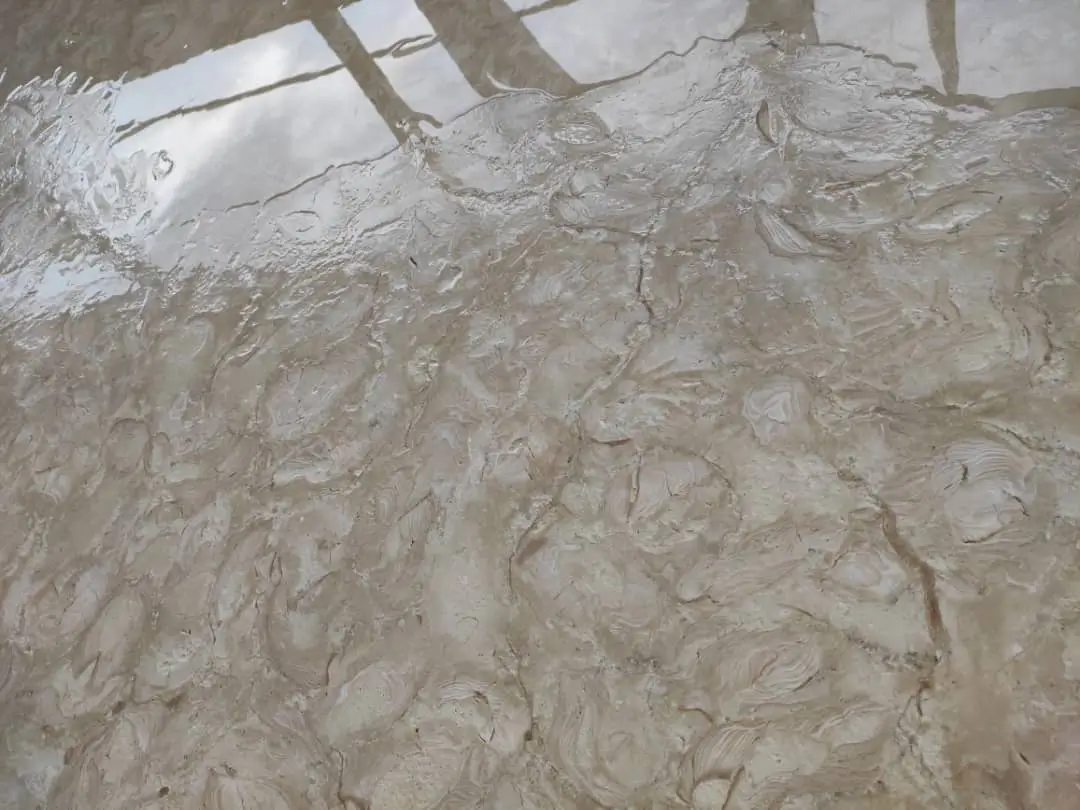
The sealing protocol that suits freshly installed limestone differs from what’s appropriate for stone that’s already 8–10 years into its natural weathering cycle. New stone with a factory finish needs a penetrating impregnator sealer — not a topical coating — applied within 30 days of installation. Topical sealers trap moisture beneath the surface on new installations, which is the fastest path to accelerated surface weathering and localised whitening.
Worn limestone paving weathering that has progressed to a naturally matte, softened surface actually holds penetrating sealers more effectively than new honed stone — the micro-texture increases absorption surface area. Resealing every 3–4 years on exterior applications is a defensible maintenance standard for most limestone types. In high-rainfall zones or heavily shaded installations, shorten that cycle to 2–3 years. Test with a water droplet: if it absorbs within 60 seconds rather than beading, the sealer has depleted and reapplication is due.
- Use penetrating impregnator sealers for all outdoor limestone — avoid film-forming topical coatings
- Apply within 30 days of installation while stone is clean and dry
- Reseal every 3–4 years on standard exterior paving applications
- Shorten to 2–3 years in high-moisture or shaded installations
- Test with a water droplet — absorption within 60 seconds indicates resealing is needed
- Do not seal over contaminated or biologically active stone — clean first, allow full drying
Limestone Natural Stone Straight Edging Stone: Weathering at Exposed Perimeters
Edge zones weather differently than field stone — and that’s consistently where field experience separates a well-specified installation from one that starts showing differential ageing within five years. Limestone natural stone straight edging stone at pathway and patio perimeters faces more aggressive moisture cycling: water runs off field pavers and concentrates at edges, thermal movement is less restrained, and mowing or maintenance equipment can introduce micro-fractures along the face that don’t appear in the interior field.
Specify limestone natural stone straight edging stone at a minimum 2.5-inch thickness for exterior applications — the extra mass provides structural inertia against frost heave and reduces the moisture-to-mass ratio that drives accelerated surface weathering. Set edging on a full mortar bed rather than pedestals or clips, and use haunching concrete on the outer face to resist lateral movement. Edge stone specified at the same density class as the field paving maintains visual coherence as both surfaces weather — mismatched density creates differential patina that reads as a specification error rather than natural character.
Spec Wrap-Up: Managing Worn Limestone Paving Weathering From Day One
Worn limestone paving weathering is a performance characteristic you can manage through specification decisions made before the first slab goes down. Your finish selection, absorption class, joint sealing protocol, and maintenance schedule collectively determine whether the stone ages toward enhanced character or toward maintenance liability. The most durable installations aren’t the ones that resist weathering — they’re the ones specified with the full weathering arc in mind, so every stage reads as intentional rather than incidental. For maintaining the visual quality of your limestone as it ages, limestone cleaning and care guidance covers the practical steps that protect surface integrity without disturbing the natural patina. Citadel Stone maintains warehouse stock across limestone grades selected specifically for exterior performance — lead times for in-stock material typically run 1–2 weeks, giving your project planning schedule a reliable supply anchor. Grey limestone supplied by Citadel Stone is particularly valued for its worn appearance over time, where surface softening often enhances rather than diminishes kerb appeal.
Related reading: is limestone a natural stone · natural limestone colors guide · Natural Limestone Pool Surfaces: Heat, Slip & Comfort.