Limestone’s classification as a natural stone isn’t just academic — it determines how you specify it, how building inspectors review it, and what performance standards apply to every project that uses it. The mineral composition, formation process, and structural characteristics of limestone place it firmly within the sedimentary natural stone category, which carries specific implications for load-bearing applications, code compliance reviews, and long-term maintenance expectations. Understanding the geology behind limestone natural stone helps you make specification decisions that hold up under professional scrutiny.
What Makes Limestone a Natural Stone
Natural stone is defined by its formation through geological processes rather than manufacturing. Limestone meets that definition precisely — it forms through the accumulation and lithification of calcium carbonate material, primarily from marine organisms, shells, and skeletal fragments that settle over hundreds of thousands to millions of years under pressure. That process produces a material with mineralogical consistency, density characteristics, and structural behaviour that distinguishes it sharply from manufactured alternatives like engineered stone or concrete pavers.
The defining characteristic of limestone natural stone is its calcium carbonate (CaCO₃) mineral composition, which typically ranges from 50% to nearly 99% purity depending on the deposit. This composition controls everything from surface hardness to acid sensitivity, and it’s the starting point for every performance evaluation. According to Britannica’s overview of limestone formation and characteristics, the rock’s properties vary considerably based on the organisms that contributed to its formation and the diagenetic processes that followed burial.
That variability is one of limestone’s most practically significant traits. A dense, low-porosity limestone quarried from deep formation layers behaves very differently from a porous, fossil-rich slab quarried closer to the surface — even when both are classified under the same material category. That distinction matters enormously for specification work, and it underscores why confirming whether limestone is natural stone is only the first step in a more detailed evaluation process.
How Limestone Forms: The Geology Behind the Material
Formation happens in two primary ways. Organic limestone accumulates from the skeletal remains of marine creatures — coral, molluscs, foraminifera — that settle on ancient sea floors and undergo compaction and cementation over geological time. Chemical limestone precipitates from calcium-rich waters in environments where supersaturation causes CaCO₃ to crystallise directly. Both pathways produce structurally sound building material, but their internal textures differ significantly under magnification and in the field.
The compaction phase is critical. Lithostatic pressure drives out pore water, reduces void space, and binds grains into a coherent mass. Deeper burial produces denser, harder stone. Shallower or interrupted burial cycles leave more porosity — which is why you see absorption values ranging from below 1% in dense Belgian blue limestone to above 12% in some fossil-bearing varieties from Middle East quarries. That porosity range directly affects your sealing schedule, stain resistance strategy, and freeze-thaw performance expectations.
Recrystallisation under heat and pressure can begin converting limestone toward marble — a metamorphic rock. True limestone, by definition, has not undergone that transformation. The distinction matters when you’re reviewing material certificates: a supplier listing calcite marble as limestone is misrepresenting the material, and the two have different thermal expansion coefficients and cleavage behaviour under mechanical load.
Is Limestone a Natural Resource
Limestone qualifies as a natural resource in both the geological and economic sense. The USGS limestone composition and construction applications data confirms it as one of the most widely extracted sedimentary materials in the United States, with applications spanning construction aggregate, dimension stone, cement production, and agricultural lime. Its availability, extractability, and broad utility meet every standard definition of a natural resource.
For specifiers, this classification carries practical weight. Limestone’s natural resource status means its supply characteristics follow quarry-level variables — deposit depth, seam quality, extraction season, and regional transportation logistics — rather than factory production schedules. Your project timeline needs to account for that. Quarry shutdowns during extreme weather, government-regulated extraction limits, and geological variation between quarry faces can all affect consistency between orders placed months apart.
- Limestone extraction is subject to environmental permitting, which affects quarry availability and lead times for specialty grades
- Natural variation between quarry faces means slab-to-slab colour and fossil density differences are normal and expected
- Premium architectural grades require selective extraction, which commands higher pricing than commodity construction limestone
- Warehouse inventory levels for natural limestone reflect quarry output cycles — checking stock before committing to a project schedule is worth the call
Limestone Composition: Minerals and Density
Calcium carbonate dominates limestone’s mineralogy, but secondary minerals shape performance in meaningful ways. Dolomite (calcium magnesium carbonate) in elevated concentrations produces dolostone, which is harder and more resistant to acid than pure calcite limestone. Clay minerals increase plasticity risk under moisture cycling. Silica content, where present, improves hardness but can create differential weathering patterns that show up years after installation.
Density ranges between 2,000 and 2,750 kg/m³ for most architectural limestone grades. That range puts it well below granite (2,600–2,900 kg/m³) and denser than most manufactured concrete pavers. For structural applications — load-bearing paving, steps, and wall cladding — you’ll need to verify the specific density of your specified grade against the project’s structural load requirements. A 2-inch slab of dense limestone weighs roughly 28–30 lbs per square foot; factor that into both structural design and truck delivery logistics when you’re planning a large installation.
Compressive strength for structural-grade limestone typically falls between 3,000 and 15,000 PSI depending on formation density, with some ultra-dense varieties exceeding that range. For context, standard concrete paving scores around 4,000 PSI — meaning well-specified dense limestone comfortably exceeds that benchmark.
Limestone Natural Stone in Building Code and Structural Specs
Here’s where geology intersects with practice: building codes at the federal and local levels treat natural stone differently from manufactured materials, and limestone’s classification directly affects how your project gets reviewed. The International Building Code Chapter 21 governs masonry applications, while individual jurisdictions layer additional requirements on top — particularly for frost-line depth, seismic zone detailing, and load distribution for stone paving over occupied structures.
For paving applications, most codes defer to ASTM standards for dimension stone. Limestone paving is commonly specified against ASTM C568 (Standard Specification for Limestone Dimension Stone), which grades the material into three classes based on absorption, density, and compressive strength. Your structural engineer will reference these grades when signing off on load-bearing installations. Using a limestone grade below what the spec requires isn’t a paperwork issue — it’s a structural liability that reviewers catch during inspection.
- ASTM C568 Class I (low density): absorption up to 12%, minimum 1,800 PSI compressive strength — appropriate for interior applications without heavy point loads
- ASTM C568 Class II (medium density): absorption up to 7.5%, minimum 4,000 PSI — the workhorse grade for most exterior paving
- ASTM C568 Class III (high density): absorption up to 3%, minimum 8,000 PSI — specifier’s choice for driveways, heavy pedestrian commercial, and load-bearing structural applications
- Freeze-thaw regions require Class II minimum, with Class III recommended for any installation in climates cycling below 20°F regularly
- Seismic detailing requirements may mandate specific mortar bed depths and joint widths beyond standard limestone paving specs
At Citadel Stone, we source limestone against these ASTM classifications as part of our quality review process — every slab batch is checked for absorption and density compliance before it reaches warehouse inventory, which helps you avoid grade substitution surprises mid-project.
Porosity, Absorption, and What They Mean for Performance
Porosity is the most operationally significant characteristic of limestone natural stone for long-term performance planning. The interconnected pore structure in higher-absorption grades allows water infiltration, which creates vulnerability to freeze-thaw spalling, stain penetration, and efflorescence. Managing porosity starts at specification and continues through maintenance cycles.
Your sealing program should align with the grade’s absorption rate. Dense limestone below 3% absorption can tolerate a 3–4 year resealing interval with a quality penetrating impregnator. Medium-density grades at 5–8% absorption need resealing every 18–24 months in exposed outdoor applications, and annually if the installation faces pooling water or de-icing salt exposure. Skipping resealing on porous limestone doesn’t just affect appearance — it allows subsurface saturation that accelerates structural degradation in freeze-thaw cycles.
For projects involving Natural Limestone Paving, surface finish also plays a role in effective porosity. A honed finish opens more surface pores than a polished finish; tumbled and brushed finishes fall in between. Matching your sealing chemistry to the surface finish and absorption rate of the specific limestone grade you’re using is a detail that separates reliable long-term performance from premature stone failure.
Limestone Versus Other Natural Stones: Key Comparisons
Placing limestone natural stone in context alongside granite, travertine, and slate helps clarify where it performs well and where substitution might serve the project better.
- Versus granite: granite is igneous with compressive strengths typically exceeding 20,000 PSI — limestone doesn’t compete on hardness, but offers warmer tones, easier cutting, and lower thermal conductivity for heat-exposed surfaces
- Versus travertine: both are calcium carbonate, but travertine forms through precipitation around hot springs, leaving characteristic voids — limestone is generally more uniform in cross-section, making it preferable for load-bearing applications where void fill isn’t practical
- Versus slate: slate is metamorphic with excellent cleavage planes for flagstone applications — limestone offers broader colour range and better compressive strength for thicker paving applications
- Versus sandstone: sandstone’s silica bonding makes it harder to cut and finish; limestone’s calcite base responds well to honing and polishing machinery, giving fabricators more finish options
The key trade-off with limestone is acid sensitivity. Rain, citrus spills, and acidic cleaning products can etch the calcite surface — a characteristic shared with marble and travertine but absent from granite. Specifying a matte or honed finish mitigates the visual impact of minor etching, but the chemistry remains a maintenance consideration you should communicate to the end user.
Sourcing and What Quarry Origin Tells You
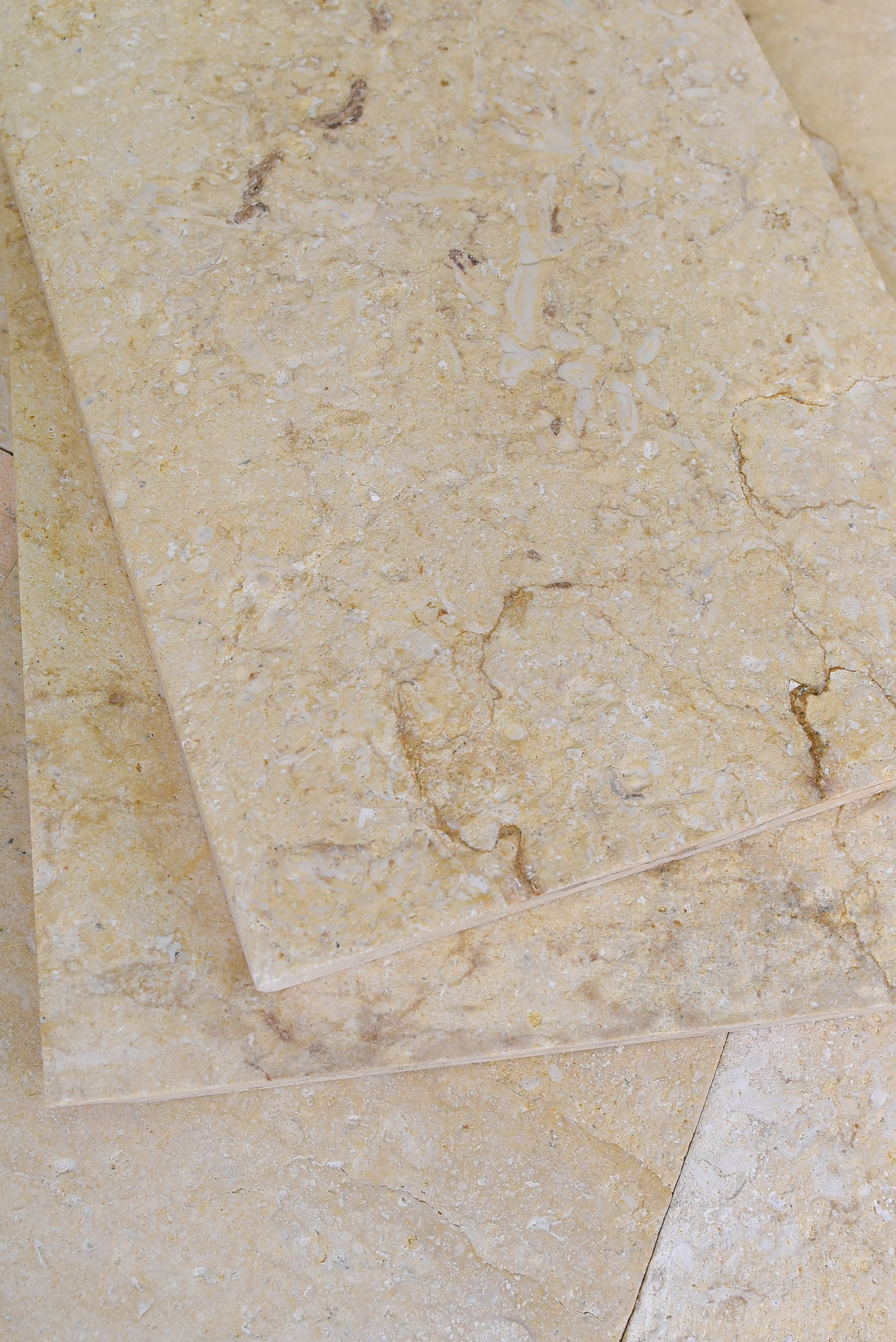
Limestone deposits exist on every continent, but quarry origin shapes material character in ways that lab certificates alone don’t capture. European limestone — French, German, and Portuguese varieties — tends toward tight grain structures and consistent colour due to the geological stability of those formations. Limestone from selected quarries in the Middle East frequently carries visible shell fossil density and warm buff tones that make it highly sought after for architectural cladding. Domestic limestone from the Indiana and Kansas limestone belts offers reliable dimensional consistency and well-documented ASTM compliance history.
Our technical team at Citadel Stone evaluates quarry documentation during sourcing to assess formation depth, extraction method, and batch-level density variation before committing to warehouse stock. That evaluation process matters because two slabs from the same quarry but different extraction faces can vary by 15–20% in absorption rate — a difference that significantly affects specification compliance for Class II and Class III applications.
According to the Natural Stone Institute limestone technical specifications, quarry origin and geological formation depth are among the primary variables that determine finished stone performance in architectural applications. Reviewing the quarry’s geological report alongside the material certificate gives you a more complete picture than the ASTM test results alone.
- Request full material certificates including quarry name, formation depth, and extraction date for any structural limestone specification
- Batch consistency matters more than single-slab test results — ask for representative sampling across multiple slabs from the production run
- Fossil density in limestone affects both aesthetics and surface hardness — high fossil content creates micro-hardness variation that influences finish durability
- Warehouse stock that has been climate-controlled typically shows more stable moisture content than stone shipped directly from outdoor quarry storage
Decision Points
Every specification decision for limestone natural stone traces back to the same geological fundamentals: formation density, mineral composition, and porosity. These aren’t abstract academic factors — they determine which ASTM class applies to your project, what your sealing schedule looks like, and whether your installation holds up under the structural and environmental loads it will face. Confirming that is limestone natural stone and selecting the correct classification before finalising your spec saves expensive remediation work later.
The practical checklist for any limestone specification starts with confirming ASTM C568 grade compliance, verifying absorption rate against your climate zone’s freeze-thaw exposure, and aligning surface finish selection with the maintenance program the end user can realistically maintain. Projects in seismic zones or with elevated point loads should add a structural engineer’s review of compressive strength data against the specific slab thickness specified. Your truck delivery logistics should also account for slab weight at the density you’ve specified — dense Class III limestone in large-format slabs pushes delivery weight planning in ways lighter materials don’t.
As you consider related natural stone applications for your project, it’s worth exploring how sealing protocols vary across different stone types — travertine tile sealing methods offers a useful comparison point, since travertine shares limestone’s calcite base but presents different absorption behaviour due to its distinct formation process. Understanding both materials gives you sharper specification instincts across the full range of calcium carbonate stone options.
Because limestone forms over millions of years under natural pressure, Citadel Stone considers grain consistency and shell fossil density when sourcing each slab.