What Flagstone Patio Design Actually Demands From Your Specification
Flagstone patio design ideas fail or succeed at the specification stage, not the installation stage — the joint width, border coursing logic, and base depth you commit to on paper determine whether the finished surface ages beautifully or shifts, cracks, and bleaches out within a decade. Every aesthetic decision in a flagstone layout maps directly to a structural choice that either holds up or doesn’t, and the gap between a patio that performs and one that doesn’t usually traces to three overlooked details: joint width relative to slab thickness, border restraint method, and base depth specified for the anticipated load.
Your flagstone selection also has to account for how the stone was formed — sedimentary flagstone like bluestone or sandstone splits along natural bedding planes, giving you relatively consistent thickness, while irregular limestone flags can vary by half an inch or more within the same pallet. That variance isn’t a defect; it’s a characteristic you design around, not against. According to flagstone sedimentary rock characteristics and paving use, natural cleavage planes in sedimentary stone are what make hand-splitting viable and give flagstone its distinctly layered aesthetic.
Flagstone Patio Border Design: Defining the Edge Without Losing the Field
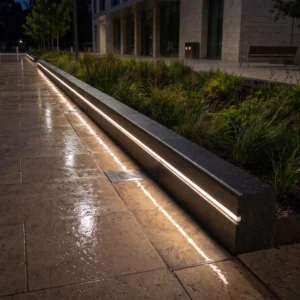
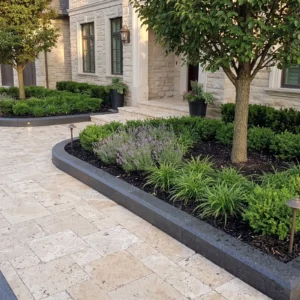
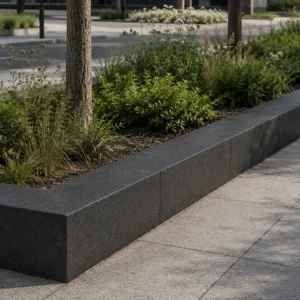
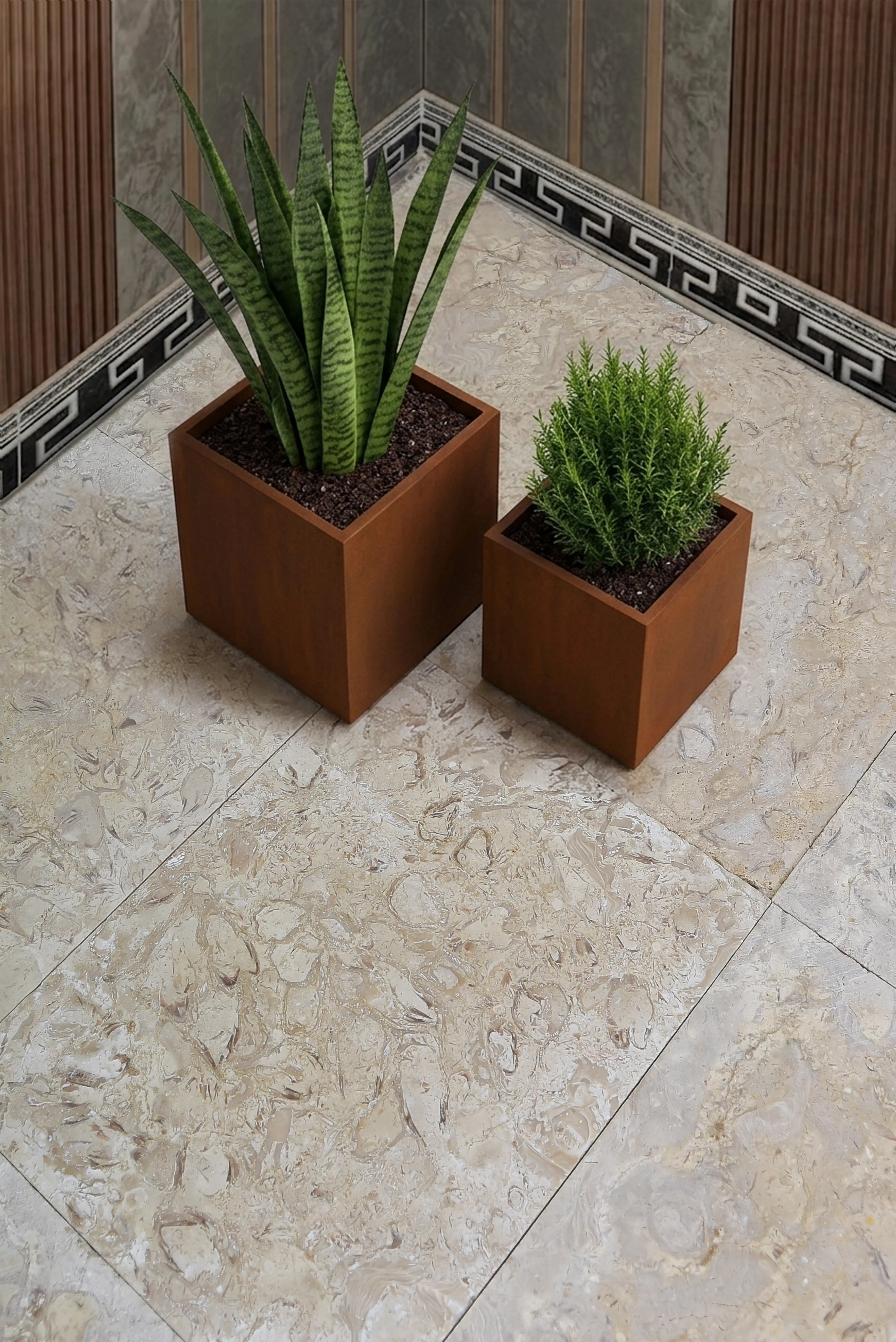
The border is where most flagstone patio projects either gain or lose their visual authority. A well-specified flagstone patio border does two things simultaneously — it provides a clean geometric frame that anchors the irregular field stones, and it acts as a structural restraint that prevents lateral migration of the field course over time. Specifying the border as a continuous course of uniform-thickness flags (typically 2 to 2.5 inches) in a contrasting tone or finish creates visual definition without requiring a separate edging material.
For the flagstone patio border to do its structural job, it needs to be set in concrete haunch or a rigid mortar bed rather than dry-laid — even when the field course is dry-set. This is a detail that gets skipped more often than it should. A dry-set border in a sandy aggregate base will creep outward as the field stones settle, and within two or three seasons you’ll see gaps opening at the perimeter that let edge stones tip inward. The ASLA natural stone and flagstone outdoor paving guidance consistently emphasizes perimeter restraint as foundational to long-term paving stability.
For a design that reads as intentional rather than incidental, consider running your border course perpendicular to the patio’s dominant axis — a technique called soldier coursing. Your border stones align end-to-end along the patio’s length, creating a directional rhythm that complements the random geometry of the field. Citadel Stone flagstone borders available in consistent nominal thicknesses make this kind of coursed border achievable without hand-grinding each piece to match.
Flagstone Patio Steps: Proportion, Overhang, and Safety in One Detail
Flagstone patio steps are where design ambition meets serious technical constraint. The riser-to-tread ratio is non-negotiable from a safety standpoint — a 6-inch riser paired with a 14-inch tread is the comfortable standard for outdoor residential use, and deviating from that relationship by more than a half inch creates a stumble condition that users detect without being able to articulate why. The proportional discomfort is real and it accumulates fatigue over repeated use.
Tread overhang is a detail that separates finished steps from amateur ones. A 1 to 1.5-inch nosing projection — where the tread stone overhangs the riser face — creates a shadow line that reads clearly in low-angle morning and evening light. That shadow line isn’t decorative; it’s the visual cue that tells the user where the step edge is. Without it, the step blends into the face and the edge becomes ambiguous, particularly for older users or anyone carrying something.
- Tread thickness for flagstone patio steps should be 2.5 to 3 inches minimum — anything thinner risks flexural failure under point loading at the nosing edge
- Steps wider than 5 feet benefit from a structural support pier at the midpoint beneath the tread to prevent center deflection
- The tread surface finish should be consistent with the patio field — a honed tread paired with a split-face field creates a texture discontinuity that looks unresolved
- Verify that your flagstone patio steps source from the same stone batch as the field pavers — color variation between steps and field is one of the most common complaints in completed projects
Joint Width and Material Performance in Flagstone Patio Design
Joint width in flagstone patio design isn’t purely aesthetic — it’s a performance specification that interacts with your base type, the stone’s absorption characteristics, and the thermal cycling your installation will experience. Narrow joints of 0.5 to 0.75 inches work well in stable, arid conditions where minor thermal expansion is the only movement driver. Wider joints of 1 to 1.5 inches give you the buffer needed in environments where day-to-night temperature swings of 40 to 60 degrees Fahrenheit are common, because that range of thermal cycling generates measurable cumulative stress at stone interfaces.
Here’s what most flagstone patio design guides don’t tell you about freeze-thaw exposure: the joint fill material matters as much as the joint width. Polymeric sand rated for freeze-thaw cycling locks tightly enough to resist frost heave displacement but remains slightly flexible under thermal expansion — it’s a different product from standard jointing sand and the performance difference over five to ten seasons is significant. Standard dry-swept sand washes out within two winters in freeze-thaw regions, leaving open joints that collect debris and accelerate biological growth between stones. The Natural Stone Institute’s dimension stone guidance addresses how pore structure and joint behavior interact under repeated thermal cycling, and those principles apply directly to outdoor flagstone installations.
Outdoor Patio Paver Ideas That Leverage Flagstone’s Natural Character
The most compelling outdoor patio paver ideas with flagstone lean into irregularity rather than fighting it. Random ashlar patterns — where you mix two or three flag sizes in a structured but non-repeating layout — read as sophisticated because the eye detects an underlying order without being able to predict the next piece. This is visually distinct from true random layouts, which can look unsettled and busy, and from rigid grid patterns, which can look institutional and flat.
Mixing flagstone with a secondary material is one of the outdoor patio paver ideas that generates the most visual impact per dollar. Consider running a 6-inch wide band of gravel or decomposed granite between flagstone sections — this creates a permeable drainage channel that doubles as a design element. Alternatively, incorporating planted seams where flagstone pavers are spaced 4 to 6 inches apart and planted with low ground cover creates a softscape-hardscape integration that’s difficult to achieve with any other paving material.
- Combining large-format flags (18 inches and above) with a border course of smaller cobble-scale pieces creates a visual scale gradient that makes medium-sized patios read larger
- Using a contrasting stone species for accent strips — a dark basalt strip through a lighter limestone field, for example — creates a clean organizing line without requiring complex cutting
- Blending honed and natural-cleft finish flags in the same field adds textural depth and is particularly effective on shaded patios where light contrast is lower
- Incorporating a central medallion cut from the same flagstone material but in a circular or geometric format creates a focal anchor that the random field radiates from
Base Preparation: The Specification Decision That Drives Everything Else
Your flagstone patio’s base depth determines whether all of the design work above it performs or fails. The standard residential specification — 4 inches of compacted aggregate base over geotextile fabric — is adequate for foot traffic in stable soil conditions. For patios in clay-heavy soils or areas with significant freeze-thaw cycling, that standard is undersized. Clay soils expand by 5 to 9 percent volumetrically during freeze events, and a 4-inch base doesn’t provide enough thermal buffer to prevent differential heave between adjacent flags.
In demanding soil and climate conditions, an 8-inch compacted aggregate base with a 1-inch bedding sand course is the correct specification. The additional base depth isn’t just about drainage — it moves the freeze-thaw action zone below the stone interface, so expansion and contraction happen in the base material rather than at the stone joints. According to USGS flagstone and dimension stone paving data, dimensional stability under repeated thermal stress is one of the primary performance criteria for natural stone paving in outdoor applications. Your stone selection and your base specification need to be designed together, not independently.
Sealing and Long-Term Maintenance for Flagstone Patios
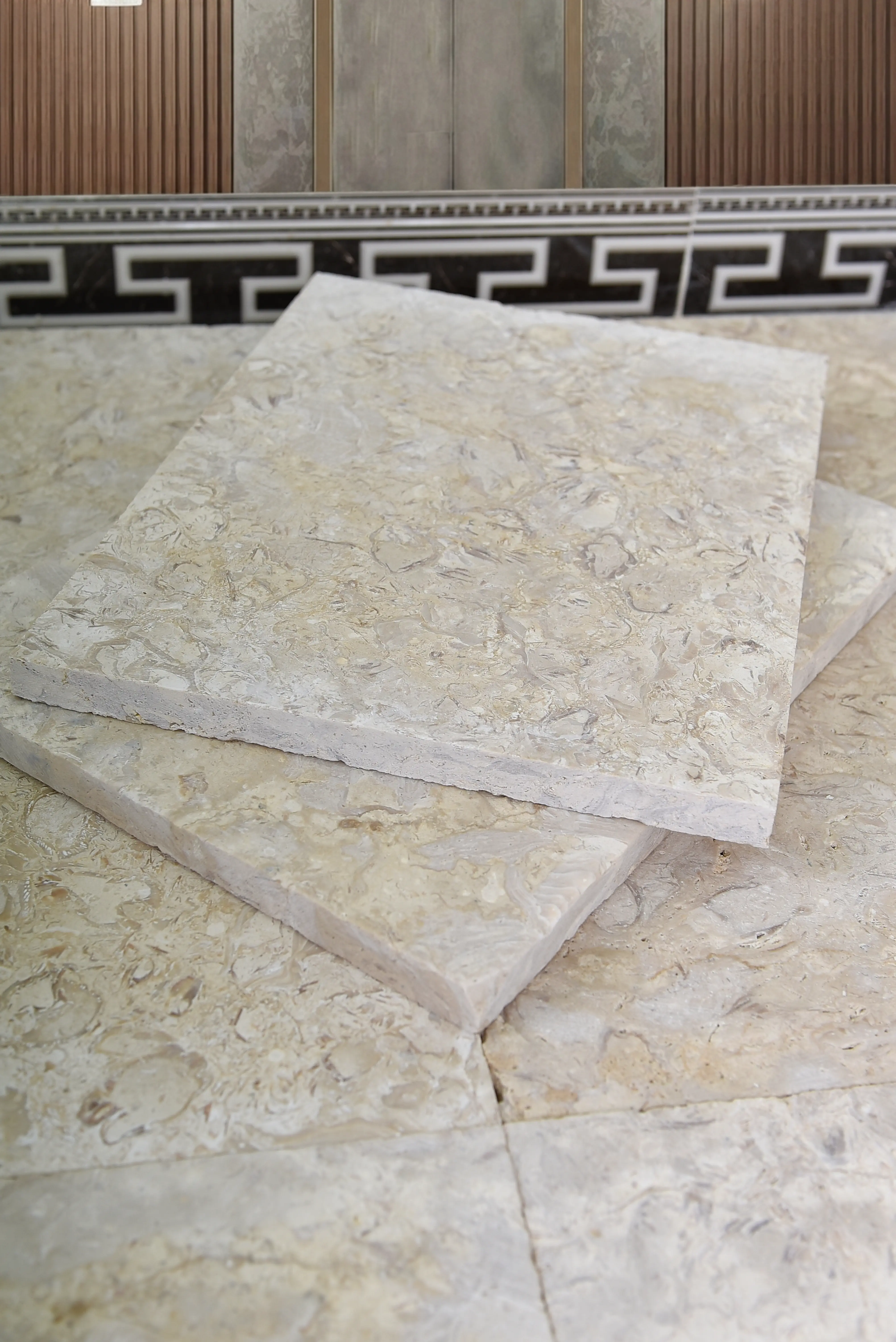
Sealing is where flagstone patio design transitions from construction to stewardship, and the product category matters as much as the application schedule. Penetrating silane-siloxane sealers are the correct choice for outdoor flagstone — they don’t form a film on the surface, so they don’t alter the natural-cleft texture or create a slip risk when wet. Film-forming acrylic sealers, which are frequently recommended at retail supply counters, trap moisture beneath the surface in humid conditions and accelerate spalling in freeze-thaw environments. That’s a well-documented failure mode, not a rare edge case.
Application frequency depends on the stone’s absorption rate. Dense flagstones like bluestone and hard sandstone typically need resealing every 3 to 5 years. More porous varieties like certain limestone flags may need attention every 18 to 24 months. The field test is simple: drop a tablespoon of water on the unsealed surface. If it absorbs within 3 to 4 minutes, the stone is ready to accept sealer. If it beads, the existing sealer is still active. At Citadel Stone, we recommend testing before every application rather than following a fixed calendar — stone absorption behavior changes with weathering and previous sealer chemistry in ways a fixed schedule doesn’t account for.
- Clean the patio thoroughly with a pH-neutral stone cleaner before sealing — acid-based cleaners etch calcium-rich stones like limestone flagstone and open the pore structure unevenly
- Apply sealer when surface temperatures are between 50 and 85 degrees Fahrenheit — application outside this range causes uneven penetration and premature failure
- Two thin coats outperform one heavy coat in every application scenario — the first coat primes the stone, the second seals it
- Document your sealer product and batch number — consistency in chemistry between applications prevents incompatibility reactions
Ordering, Logistics, and Warehouse Planning for Your Flagstone Project
Flagstone patio projects have a logistics reality that most design articles skip entirely: natural stone pallets are heavy, bulky, and variable in coverage yield, and the gap between your ordered quantity and your actual coverage can be significant if you haven’t accounted for cuts, waste, and pattern requirements. Order 15 percent above your calculated square footage for a random pattern installation — more for patterns with tight geometric constraints that require frequent cutting. For a project requiring a specific stone batch for color consistency between field flags and border course, verify warehouse availability before finalizing your design, because matching a batch after the fact is difficult once original inventory cycles through.
Truck access is a practical constraint that affects your pallet delivery options. Flagstone pallets typically weigh 2,000 to 3,500 pounds, and standard delivery trucks require a reasonably level drop zone within 50 to 75 feet of the installation area. If your project site doesn’t have that access, factor in the cost of a crane-assist delivery or a smaller-vehicle split shipment. Citadel Stone ships nationally, and our warehouse teams can advise on pallet configuration and truck requirements for sites with access constraints — it’s a conversation worth having before your delivery date, not after the truck arrives.
Flagstone Patio Design: Pulling the Specification Together
Flagstone patio design ideas that hold up over time are the ones where the aesthetic decisions and the technical specifications are made together, not sequentially. Your border coursing needs a rigid restraint detail. Your step treads need minimum thickness and a proportioned nosing. Your joint fill needs to match your thermal exposure range. And your base depth needs to reflect your soil conditions, not a generic residential standard. The Natural Stone Institute outdoor patio stone selection guide reinforces this integrated approach — material selection and installation detailing are inseparable in natural stone performance. As you finalize your flagstone patio design, exploring complementary hardscape elements can sharpen your overall project specification; budget-conscious patio stone options covers how to achieve high-end results without overextending your material budget. Integrating Citadel Stone flagstone steps with the patio field using the same stone batch keeps color and texture consistent across the entire outdoor space.
Related reading: how to install a flagstone patio · how to clean a limestone patio · how to seal a limestone patio.