

Columnar basalt rock presents a specification challenge that most field professionals encounter once and never forget: the columns themselves are the structural logic, and if you don’t design around that geometry, you’ll fight the material every step of the way. The vertical jointing that gives columnar basalt its iconic appearance also dictates how it behaves under point loads, how moisture moves through stacked installations, and how it responds to seismic and thermal forces that regional codes are increasingly written to address. Understanding that relationship — between the natural fracture pattern and the built environment — is what separates a competent basalt specification from one that fails quietly over its first decade.
What Columnar Basalt Rock Actually Is
The columns form as lava cools and contracts. Thermal stress propagates cracks perpendicular to the cooling surface, and when conditions are right, those cracks intersect at roughly 120-degree angles, producing the characteristic five- and six-sided prisms that make columnar basalt one of the most immediately recognizable geological formations on the planet. The process isn’t random — it’s thermodynamic geometry expressing itself in volcanic material, and it leaves behind a stone with consistent mineralogy, tight grain structure, and a hardness that reflects basalt’s igneous origins. According to USGS basalt volcanic rock properties and composition, basalt is predominantly composed of plagioclase feldspar, pyroxene, and olivine, with the dense, interlocking crystal structure that makes it so demanding to cut and so rewarding once installed.
What makes columnar basalt distinct from other basalt forms is the directionality built into its structure. The column’s long axis represents the cooling front, and that axis carries implications for how slabs cut from columnar material behave differently from those cut from massive flows. You’re specifying not just a rock type but a structural orientation — and that distinction matters when you move from the cliff face to the floor tile.
Geological Formation and Mineral Character
Columnar basalt emerges from relatively shallow, fast-spreading lava flows where the surface-to-depth cooling gradient is steep and uniform. The grain size stays fine because rapid cooling limits crystal growth — a property that translates directly into the dense, low-porosity surface you see in calibrated tile. Basalt volcanic rock formation and construction properties confirms that this fine-grained crystalline texture is a distinguishing characteristic of the rock class, one that makes basalt significantly less porous than sedimentary alternatives under the same environmental exposure. The cracking that splits a cooling flow into columns is explained step by step in how basalt columns form.
The mineral hardness of basalt sits well above most sedimentary stones. That hardness influences fabrication choices — diamond tooling wears faster on dense basalt than on limestone or travertine — and it shapes the finish options available to you. A honed finish on basalt reads differently than honed limestone; the tighter grain produces a surface with a more uniform, almost metallic quality that architects frequently specify for contemporary interior flooring. The low absorption rate also means staining is less of a first-year concern than it would be with travertine or certain limestones, though proper sealing remains good practice in kitchen and commercial settings.
How the Column Geometry Translates to Cut Stone
Specifiers who encounter basalt rock columns for the first time sometimes assume the tiling industry simply ignores the columnar form and quarries basalt like any other igneous rock. The reality is more nuanced. When fabricators cut perpendicular to the column’s long axis, the resulting tile face shows the tight, uniform grain that makes basalt desirable as a floor finish. Cut parallel to the axis — along the column’s length — and the material expresses a directional character that some architects use intentionally in wall cladding or feature panels. The reason so many columns end up six-sided is covered in why basalt forms hexagons.
- Cross-column cuts yield calibrated tiles with consistent surface texture and predictable thickness tolerance
- Longitudinal cuts reveal the column’s growth structure and suit accent and vertical applications
- The joint lines between adjacent columns in natural formations correspond to natural cleavage planes — fabricators who understand this orientation make fewer waste cuts
- Thickness specification matters: tiles cut too thin from columnar material lose the structural benefit of the interlocking grain and become brittle under point loads
Your tile specification should always confirm which cutting orientation the fabricator uses and what tolerance is held on calibration. A poorly calibrated tile from dense basalt creates installation problems that no amount of adhesive adjustment fixes cleanly — the material doesn’t flex to accommodate variation the way softer stones sometimes can.
Finish Options and Surface Texture
The finish you choose on columnar basalt fundamentally changes how the material reads in a space, and it affects practical performance in ways worth understanding before you commit a specification. Basalt takes several finishing methods well, and each leaves a distinctly different surface character.
- Honed finish: a fine, matte surface that suppresses the stone’s natural sheen; widely specified for contemporary interiors and commercial corridors
- Polished finish: brings out basalt’s dark, near-black depth; highlights any natural variation in the mineral matrix; suited to low-traffic interior feature areas
- Bush-hammered finish: mechanical texturing that opens the surface and leaves a rough, pitted texture; commonly specified for exterior horizontal surfaces where surface character affects how water sheets
- Flamed finish: high-temperature torching causes differential expansion at the grain boundaries, producing an open, coarse texture; used on exterior paving and steps
- Sandblasted finish: a uniform, fine roughness achieved by abrasive blast; intermediate between honed and bush-hammered in terms of surface openness
The finish is also the primary variable in wet-surface behaviour. Under ANSI A326.3 — the current wet-measured standard that replaced the ASTM C1028 static test withdrawn in 2014 — finish selection is the specification lever you control. A flamed or bush-hammered texture performs very differently from polished in wet conditions, and your finish specification is the appropriate place to document that design intent. If you need tested data for a specific finish, request the test report from your supplier; Citadel Stone can provide reports on request for its basalt tile range.
Structural and Code Considerations for Basalt Installation
Basalt’s density and brittleness interact with base design in ways that code minimums don’t always anticipate. The International Building Code and local amendments set minimum base depths for frost lines, but basalt’s stiffness means it transmits point loads through to the substrate more directly than flexible paving systems. A base that meets the frost-line minimum for the region but doesn’t account for uniform support under a rigid, dense tile will develop stress fractures at the tile edges over time.
Seismic zones add another dimension. In regions governed by ASCE 7 seismic provisions, wall-cladding applications of basalt require assessment of the stone’s weight against the anchorage capacity specified in the structural drawings. Basalt’s density means that even modestly dimensioned cladding panels carry significant mass — a factor your structural engineer needs from the stone supplier’s test report, not from a generic density table.
- Verify frost-line depth for the project region and specify base aggregate depth to exceed the freeze-thaw movement zone, not just meet the statutory minimum
- For exterior horizontal applications, ACI 318 or local equivalents govern the structural slab beneath; basalt does not compensate for an under-designed substrate
- Edge restraints for basalt paving should be engineered to the material’s weight and the anticipated traffic loading — standard plastic edging is not adequate for dense igneous tiles in vehicular applications
- Seismic detailing for wall-mounted basalt panels requires fabricator-supplied physical-property data; request the test report for compressive and flexural modulus, which vary by quarry source
Load-bearing calculations for basalt flooring over structural spans are worth a conversation with your structural engineer early in the design phase. The material’s mass is a real variable, and the sooner it enters the dead-load calculation, the fewer surprises arise at the permit stage. The Natural Stone Institute igneous stone paving technical standards provide a useful reference framework for stone classification and specification practice that supports code-compliance submissions.
Basalt Tile Applications: Interior and Exterior
The range of environments where columnar basalt performs well is broader than its dramatic cliff-face origins might suggest. Interior floor applications are the most common entry point — the material’s low porosity and consistent colour make it a reliable specification for commercial lobbies, hospitality spaces, and high-traffic residential floors. The colour stability of dark basalt outperforms many alternatives over years of exposure to cleaning chemicals, UV, and foot traffic, because the mineralogy doesn’t bleach or mottle the way some lighter sedimentary stones do.
Exterior applications require more careful finish and base specification, but columnar basalt handles outdoor environments in most climate zones well. Its low water absorption reduces freeze-thaw vulnerability relative to higher-porosity stones, though you should still specify a penetrating sealer for exterior horizontal surfaces in climates with significant winter temperature swings. Pool surrounds, covered terraces, and exterior commercial plazas are all proven contexts. For interior flooring projects, our basalt floor tiles are calibrated to consistent thickness tolerances that simplify large-format installation and reduce lippage risk during levelling.
Vertical applications — feature walls, bathroom surrounds, kitchen splashbacks — are where the material’s colour depth and finish versatility earn particular attention. A polished basalt wall panel in a hospitality bathroom reads as genuinely luxurious without relying on vein patterns or surface variation that can look dated. The stone makes its statement through density and uniformity rather than decorative complexity.
Installation Variables That Matter in the Field
Dense, fine-grained basalt requires specific adhesive selection. Standard C1 thin-set mortars may not provide adequate bond strength for large-format basalt tiles on demanding substrates — specify a C2 or better deformable adhesive, particularly for wall applications or any format above 600mm in either dimension. The low absorption rate of basalt means bond develops almost entirely at the adhesive-tile interface rather than through any suction into the stone, so back-buttering technique and adhesive coverage are critical points to supervise.
- Expansion joints should be placed at intervals determined by your thermal movement calculation for the specific site — don’t default to a generic interval without checking the site’s expected temperature range
- Grout colour selection matters more with dark basalt than with lighter stones — a mismatched grout reads immediately against the uniform dark field
- Cutting dense basalt requires continuous-rim diamond blades with adequate water cooling; dry-cutting creates micro-fractures at cut edges that propagate under load
- Acclimate tiles to site temperature before installation; basalt’s low coefficient of thermal expansion still means dimensional variation between cold delivery and warm site conditions affects joint width
- Check substrate flatness to a tighter tolerance than you would for a flexible paving system — basalt will not conform to substrate variation, and hollow spots under large tiles become stress points under dynamic loading
Delivery scheduling for basalt is worth discussing with your supplier early, particularly for large commercial volumes. Your site’s access constraints — turning radius, weight limits on access roads, offloading equipment — should be confirmed before the delivery date is finalised. Citadel Stone arranges and manages delivery from our selected quarries, and lead times are quoted with the order so your programme has accurate material windows to plan around.
Performance Testing and What to Request from Your Supplier
Physical-property figures for basalt vary by quarry source, cooling history, and mineral composition — which is exactly why a specification that relies on generic values rather than supplier test reports introduces risk. The properties to request, and the ASTM methods that govern them, include compressive strength (ASTM C170), modulus of rupture (ASTM C99), water absorption (ASTM C97), and abrasion resistance (ASTM C241 for stone subjected to foot traffic). Request the full test report, not a summary data sheet, so you can confirm the test was conducted on material from the actual source, not a generic basalt reference sample.
For wet-surface applications, ANSI A326.3 is the current dynamic coefficient of friction standard measured under wet conditions. Finish is the specification variable — specify the finish, request the test report for that finish from the supplier, and let the test data inform your decision rather than assuming a finish category performs uniformly across all basalt sources. The test report is available on request from Citadel Stone for the specific finishes stocked at our selected quarries.
Decision Points
Your columnar basalt rock specification resolves into a sequence of decisions, and the sequence matters: quarry source and test data first, then cutting orientation and finish, then base and adhesive design, then code compliance review. Skipping or reversing that sequence is where most specification errors originate. The material rewards careful upfront work — once correctly installed on a sound substrate with the right adhesive and appropriate finish for the application, it delivers decades of service life with minimal intervention beyond periodic sealing on the interval your sealer manufacturer states.
The column geometry that formed over thousands of years of volcanic cooling is what gives this stone its character and its performance logic. Understanding that geometry — and designing your specification around it rather than around generic igneous stone assumptions — is the distinction between a basalt project that ages well and one that develops edge fractures and lippage within its first few years. For a closer look at how columnar basalt’s mineral character continues through different volcanic rock forms, vesicular basalt and its tile characteristics explores a related formation that presents different porosity and surface considerations worth reviewing before finalising your stone selection.
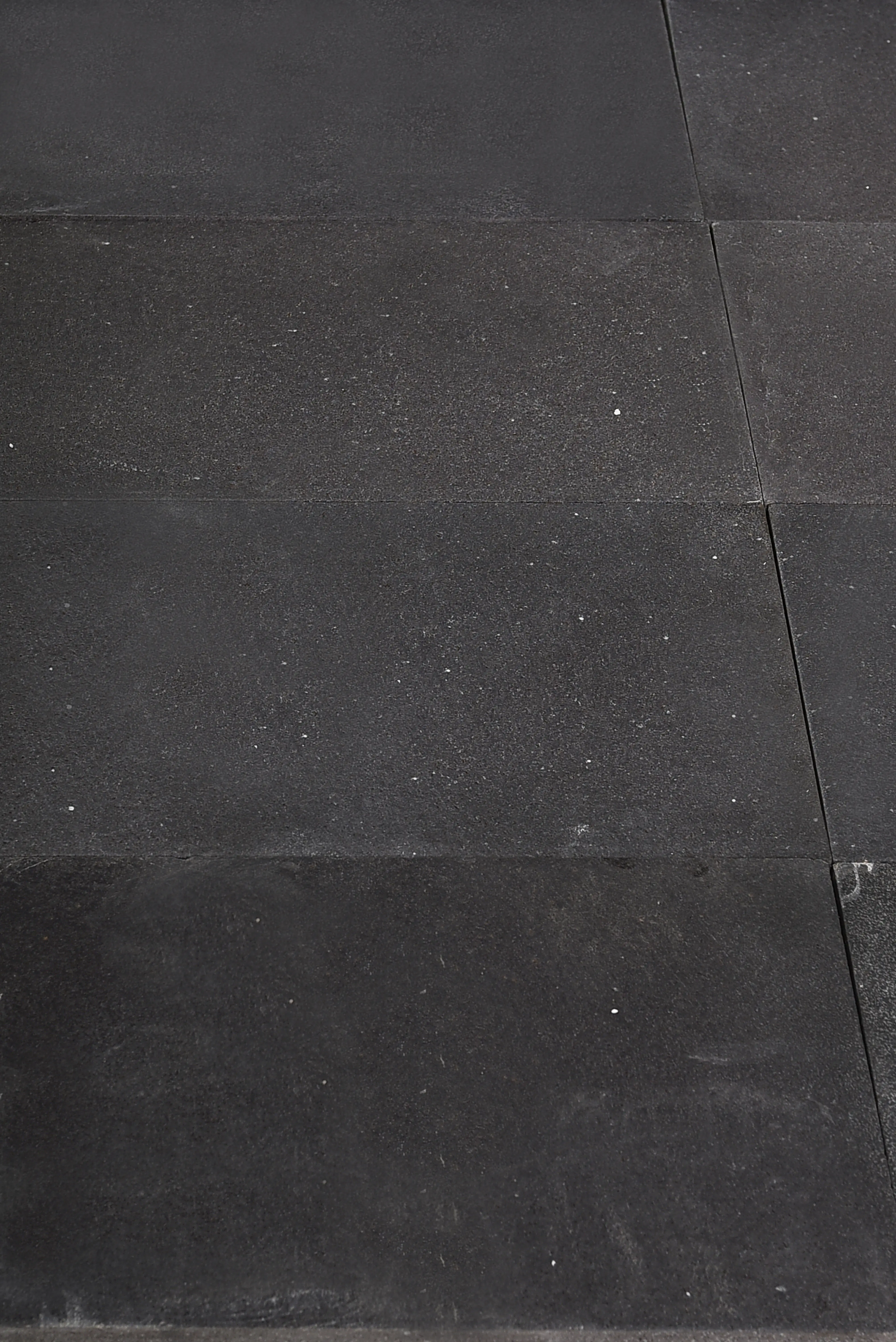
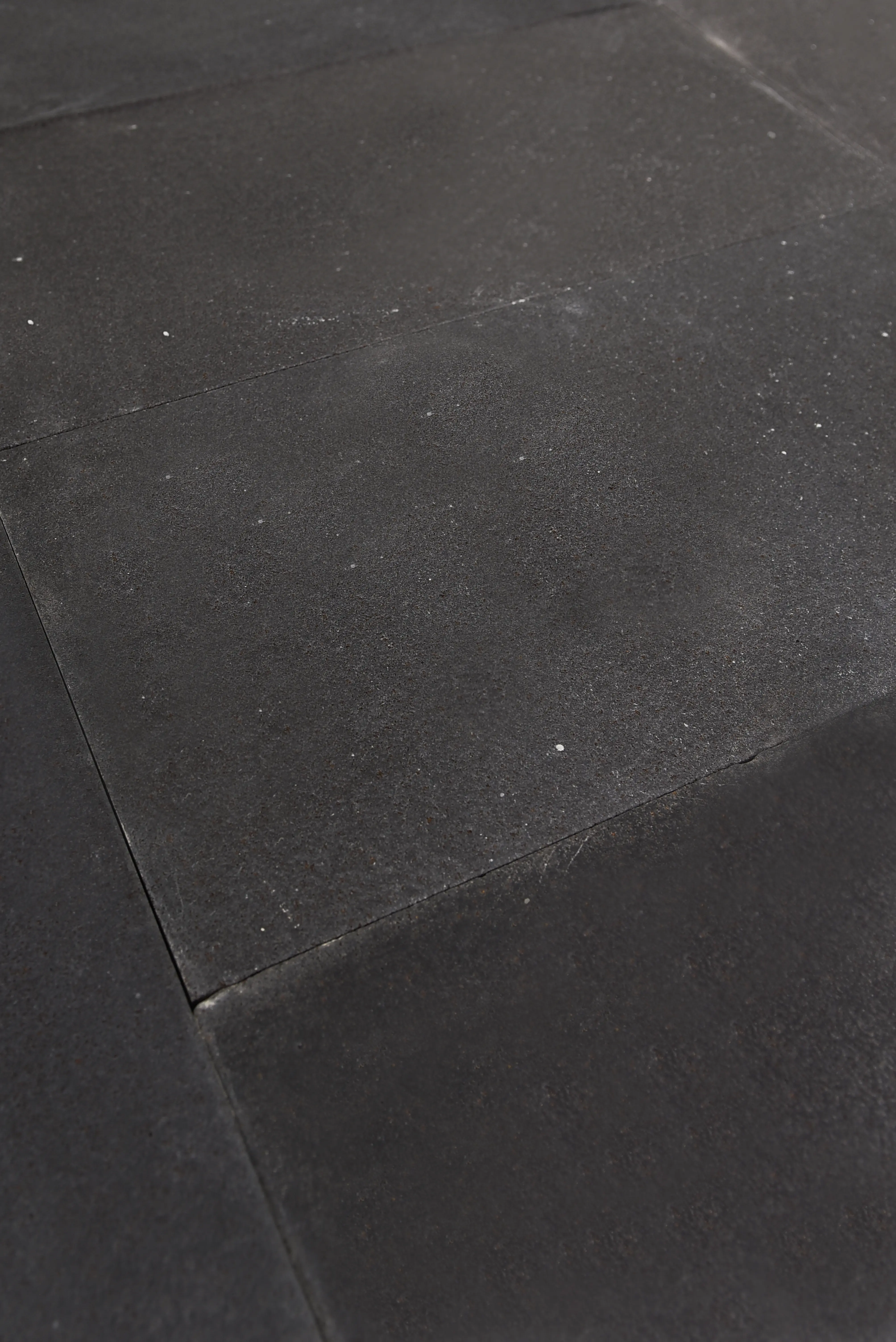
Basalt from our selected Middle East quarries shares the fine grain seen in columnar cliffs, translated into calibrated floor tiles.
Related reading: choosing grey basalt tile · what is basalt rock type · Basalt Mosaic Tile Ideas for Showers and Backsplashes.