

The geometry behind why basalt forms hexagons is one of those questions that looks simple on the surface but opens into a rich body of physics, thermodynamics, and structural mechanics the deeper you push. Columnar jointing — the process that produces the iconic hexagonal patterns you see in formations like the Giant’s Causeway or Devil’s Postpile — governs how finished basalt tile behaves in real-world applications, from its dimensional consistency to how it responds to mechanical stress. Understanding the science isn’t just academic; it shapes how you specify, install, and expect the material to perform over decades of service.
What Is Columnar Jointing?
Columnar jointing is the process by which cooling lava contracts and fractures along orderly, repeating geometric planes. As a basalt lava flow loses heat from its upper and lower surfaces, internal thermal stress builds — and the rock relieves that stress by cracking. The fractures propagate inward from multiple cooling fronts simultaneously, and the geometry that emerges is governed by one principle: the system finds the most efficient way to fill a plane with minimum crack-surface energy. What the stone looks like once it is quarried and sawn is covered in our guide to columnar basalt rock.
The result is a polygon tessellation dominated by hexagons. Hexagons pack a plane perfectly, share crack surfaces between adjacent columns, and distribute stress uniformly across the formation. You’ll occasionally see four-, five-, or seven-sided columns in real outcrops — these occur where local cooling rates varied — but the hexagon is the equilibrium solution the system gravitates toward. According to USGS basalt volcanic rock properties and composition, basalt is among the most widespread volcanic rock types on Earth, and its columnar formations appear wherever lava flows cool slowly enough to allow the fracture network to develop fully.
The Physics of Hexagonal Cracking: Why Basalt Forms Hexagons
Thermal contraction in a cooling solid creates tensile stress perpendicular to the direction of heat loss. In a flat lava flow, heat escapes upward and downward, so the primary tensile stress runs horizontally — meaning the cracks that relieve it propagate vertically. The crack network that forms is essentially a two-dimensional problem: what polygon pattern minimizes total crack-surface area while relieving stress everywhere in the plane?
Mathematical analysis of crack propagation in contracting sheets consistently points to 120-degree junction angles as the stable endpoint. Three cracks meeting at 120 degrees form a Y-junction, and a plane tiled by Y-junctions produces hexagons. Squares and triangles are geometrically possible, but they require 90-degree or 60-degree junctions that carry higher residual stress — the system evolves away from them. The hexagonal outcome in why basalt forms hexagons is therefore not a coincidence or a curiosity; it’s the minimum-energy solution to a thermomechanical boundary problem.
Your specification work benefits from understanding this. The regularity of the hexagonal column cross-section means that basalt cut perpendicular to the column axis — the cut used for hexagonal basalt tile formation — produces faces with highly consistent geometry. The natural fracture planes are the template; fabrication follows the rock’s own internal logic.
How Cooling Rate Determines Column Size
Column diameter is directly related to cooling rate. Slower cooling allows the thermal gradient to extend deeper into the flow before fractures initiate, producing larger-diameter columns. Rapid cooling — common at the top of thin flows or near water contacts — generates narrower columns with tighter spacing. This matters for tile production: columns that cooled slowly at depth yield large, stable cross-sections, while faster-cooled zones near flow margins may produce more variable geometry. For the full sequence, including the colonnade and entablature layers of a single flow, see columnar jointing explained.
At our selected quarries, the basalt selected for tile applications typically comes from mid-flow zones where cooling was controlled and column geometry developed fully. The dimensional consistency you see in finished hexagonal basalt tile products traces directly to that geological position within the original flow. When you’re reviewing samples, column-face tiles cut from well-developed formations show tighter dimensional tolerances than tiles cut from disturbed or rapidly cooled margins.
- Slow-cooled interior zones: larger column diameters, more uniform hexagonal geometry, tighter tile tolerances
- Fast-cooled surface zones: narrower, less regular columns, higher dimensional variability in finished tile
- Contact zones near groundwater: possible irregular fracturing, not suitable for dimension tile production
- Deep flow core: densest material, highest compressive performance — test report on request from your supplier
Basalt Composition and Why It Cracks So Cleanly
Basalt’s mineral composition plays a supporting role in how cleanly columnar joints form. The rock is fine-grained — individual crystals are microscopic — because the melt cooled too quickly for large crystals to grow. That fine grain structure means the rock has no preferred cleavage plane at the mineral scale, so fractures propagate through the matrix without being deflected by large crystal boundaries. The crack follows the thermal stress field, not the mineralogy. This produces the clean, planar joint faces that make basalt columns so geometrically precise.
Coarser-grained igneous rocks — granite, for instance — fracture less predictably because individual feldspar and quartz crystals influence crack paths. Basalt’s homogeneous fine grain is one reason why hexagonal basalt tile formation yields such consistent geometry. As Britannica’s basalt volcanic rock formation and construction properties notes, the dense, fine-grained texture of basalt gives it high mechanical strength relative to its mass — a characteristic that extends directly into its performance as a finished tile under point loads and impact.
From Geology to Tile: The Fabrication Connection
The path from columnar outcrop to finished Basalt Hexagon Tile follows the rock’s own geometry. Quarrying targets the column faces — the flat, hexagonal cross-sections exposed where columns fractured apart naturally or were split during extraction. Sawing perpendicular to the column axis produces the tile face; sawing parallel to it produces the tile thickness. Because the column geometry sets the face dimensions, hexagonal basalt tiles have a more direct relationship between natural formation and finished product than almost any other stone format.
Your specification should account for the fact that column diameter varies between formations and even within a single quarry zone. The nominal tile size you order is cut to that dimension from column faces, so understanding the source formation’s typical column diameter helps you anticipate the dimensional range. Citadel Stone cuts basalt tile to order at our selected quarries, which means the nominal dimensions are held to the agreed specification rather than to whatever column face happened to be available.
- Column face cut: produces the hexagonal tile face — geometry comes from the natural formation
- Column-axis cut: determines tile thickness — specifier controls this dimension
- Honed finish: opens the fine-grained surface slightly, revealing the dense, dark basalt matrix
- Bush-hammered or flamed finish: adds surface texture by mechanical or thermal treatment of the tile face
- Natural cleft: follows the original joint plane — surface relief reflects the formation’s fracture texture
Structural Performance Under Mechanical Stress
The columnar joint structure that answers why basalt forms hexagons also has direct consequences for how finished basalt performs under mechanical loading. Dense, fine-grained basalt carries high compressive loads without deformation — test report on request from your supplier specifying the relevant ASTM test method. The interlocking geometry of hexagonal tiles, when properly installed over a rigid base, distributes point loads across multiple tile faces simultaneously rather than concentrating stress at individual units.
This load distribution characteristic becomes particularly relevant in applications exposed to wind-driven storm events and impact loading. Hail impact, wind-blown debris, and the cyclic mechanical stress of wind-driven rain against a tiled surface all represent dynamic loading scenarios. The dense matrix of basalt is highly resistant to surface fracture under these conditions — far more so than softer sedimentary stones of comparable thickness. Joint integrity under wind-driven rain deserves specific attention: basalt’s low absorption rate means water uptake through the tile face is minimal, but joint compound selection and edge restraint design still govern long-term performance where storm exposure is regular. The Natural Stone Institute’s igneous stone paving technical standards address the broader performance characteristics of dense igneous materials in demanding applications.
- Edge restraint strength must account for lateral wind load transfer — hexagonal tile arrays need continuous perimeter restraint, not just spot fixing
- Joint compound flexibility matters in storm-exposed locations where thermal cycling and mechanical vibration occur together
- Tile thickness specification should come from a point-load calculation for the application, not from a general rule of thumb
- Impact resistance is high in dense, fine-grained basalt — but test report values should be confirmed by your supplier for the specific formation
Finish Selection and Surface Texture
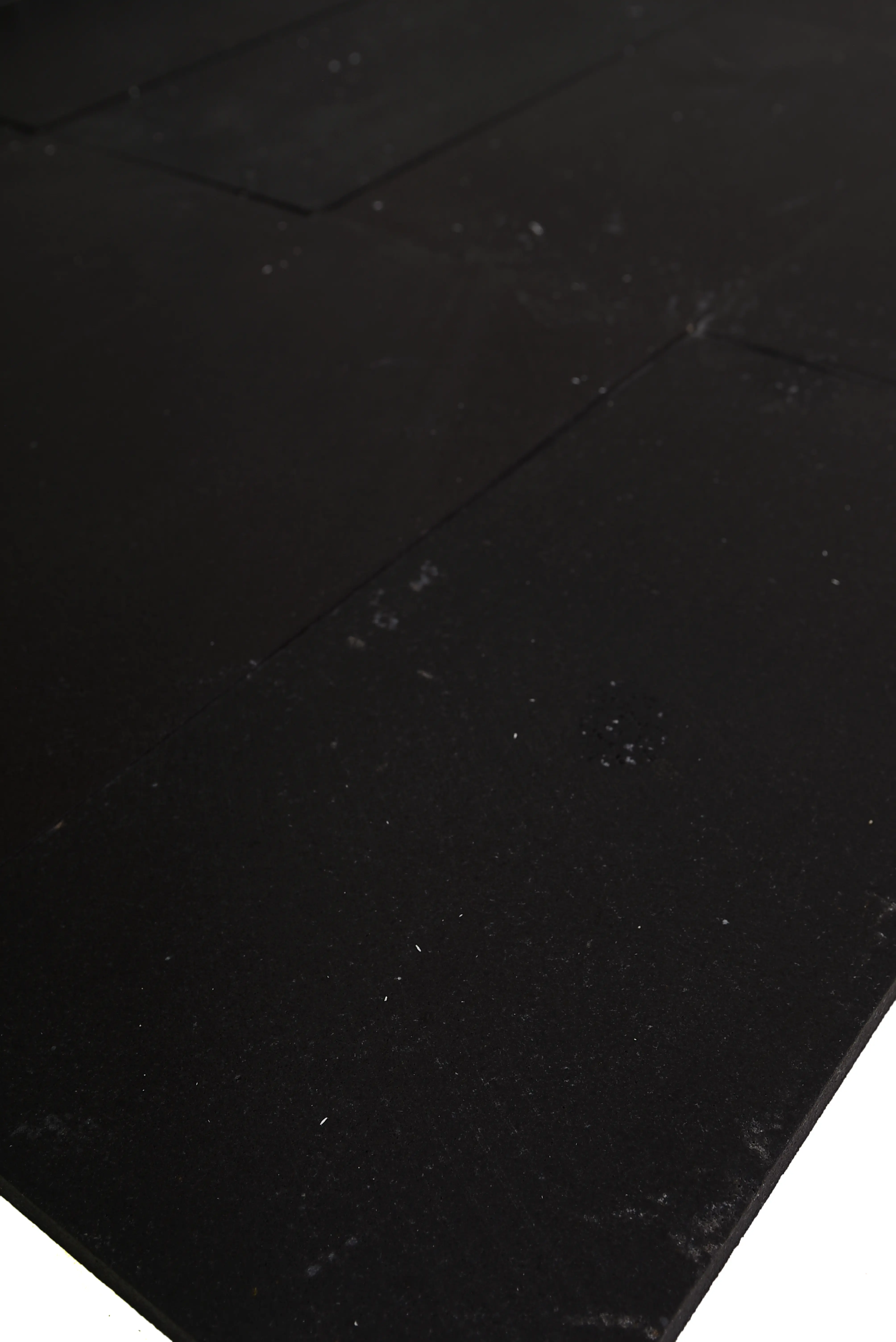
Surface finish is the primary variable governing slip resistance in basalt tile, and the relevant test standard is ANSI A326.3, measured wet. The finish determines surface texture — and that texture is what the test measures. A honed finish leaves a smooth, closed surface with minimal texture relief. A bush-hammered or flamed finish leaves an open, matte texture with measurable surface irregularity. A natural cleft finish preserves the original fracture plane’s topography, which varies by formation. If a tested value for a specific finish exists, the test report is available on request from your supplier — no figure is published here, because the finish is the variable, and the right finish choice depends on your specific application and loading conditions.
For wet-area applications — pool surrounds, exterior walkways in rain-exposed climates — specify the finish type alongside the tile format. The two decisions are linked: hexagonal basalt tile formation geometry affects grout joint density across the field, and more grout joints per square foot introduce more edge texture variation into the overall surface. That’s a consideration most specifications skip, but it meaningfully affects how the installed surface behaves underfoot in wet conditions.
Specifying Hexagonal Basalt Tile for Your Project
Your specification for hexagonal basalt tile should address several interdependent variables. Tile size affects joint density, installation complexity, and the visual scale of the hexagonal pattern. Thickness is a structural decision, not an aesthetic one — derive it from your point-load calculation and confirm it against the supplier’s test report. Finish governs surface texture, maintenance interval, and behavior under wet conditions. And formation source affects dimensional consistency, colour range, and the density of the stone itself.
Delivery planning for large-format or volume basalt tile orders requires early coordination. Your project’s access constraints may affect offloading logistics and should be confirmed with Citadel Stone at the order stage — lead times and delivery arrangements are quoted with the order, not guaranteed as standing stock availability. Stone cut to order at the quarry means you’re specifying to the formation, which is the right way to approach a material where geological origin governs finished performance.
- Confirm nominal tile size against your layout drawing — hexagonal formats require careful perimeter planning to minimize cut waste
- Specify finish in writing on the order document, not just verbally — honed, bush-hammered, flamed, and natural cleft are distinct finishes with distinct performance profiles
- Request the test report for absorption and compressive strength from your supplier — do not rely on published generic ranges for a material where formation-to-formation variation is real
- Confirm access and offloading provisions before the delivery date is fixed — palletized stone at volume requires level ground and appropriate lifting equipment
- Account for tile-to-tile colour variation within a formation — basalt is not uniform across a flow, and natural variation in iron content affects tone
Parting Guidance: Working With Basalt Hexagon Geometry
The science of why basalt forms hexagons is directly traceable from lava flow thermodynamics to the tile in your specification. Columnar jointing is not a decorative accident — it’s a physical inevitability, and understanding it gives you a clearer picture of what you’re working with: a material whose geometry, density, and fracture character are all expressions of the same cooling event. That understanding should inform how you evaluate samples, write your finish specification, plan your installation base, and anticipate long-term performance under mechanical and weather loading.
As you work through your broader hardscape material selections, surface finish choices and stone tone decisions often interact across different material types on the same project. The granite paver color and finish selection resource covers how tone, veining, and finish interact across another dense igneous material — useful context when coordinating basalt with other stone elements on the same project. Because columnar jointing creates natural structural regularity, Citadel Stone draws on this geology when selecting basalt from our selected Middle East quarries for finished tile applications.