

Vesicular basalt rock carries a structural variable that most tile specifications treat as cosmetic — and that oversight is where projects go wrong. The voids you see in a vesicular section are not surface blemishes; they are remnants of gas bubbles trapped during lava cooling, and their size, density, and connectivity directly govern how the finished tile performs under load, moisture cycling, and mechanical stress. Getting this material right means reading the void pattern before you write the spec, not after the tile arrives on site.
What Vesicular Actually Means in Basalt
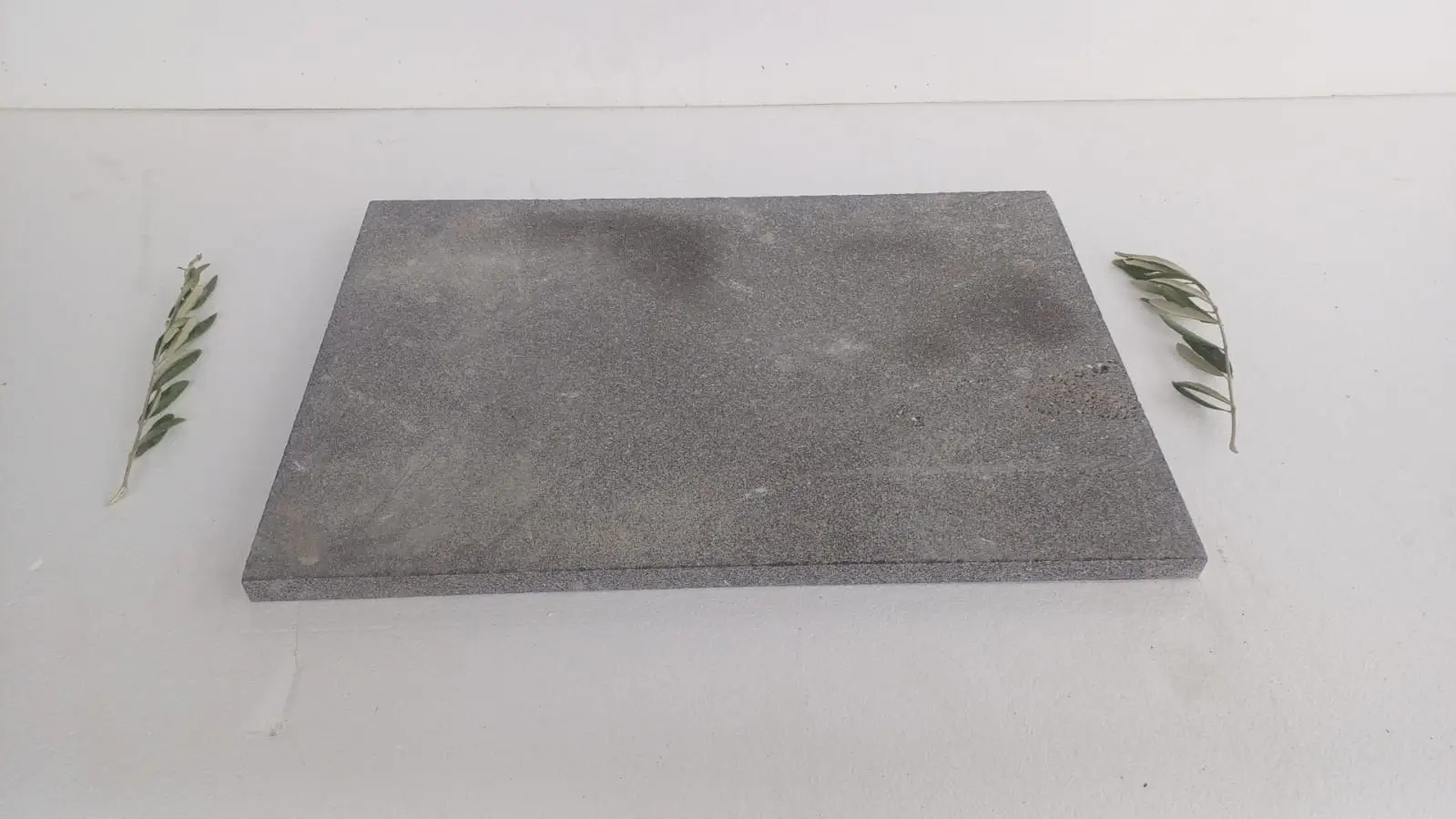
Basalt forms when low-silica magma erupts and cools rapidly. The speed of that cooling determines the crystal size — which stays microscopically fine in basalt — but it also traps dissolved gases that were under pressure in the magma chamber. As pressure drops during eruption, those gases expand into bubbles. Cool fast enough and the bubbles freeze in place, leaving spherical to elongated voids called vesicles. The result is vesicular basalt rock: a dense igneous matrix punctuated by pores that range from pinhole scale to cavities you can fit a fingertip into.
The distinction matters for tile specification because not all voids behave the same. A tight, isolated vesicle — fully enclosed by the surrounding groundmass — behaves differently from an interconnected void network that allows moisture to migrate through the tile body. Interconnected porosity is the property that drives absorption performance, and it varies widely even within a single quarry block. That is why requesting an absorption test result under ASTM C97 matters: the number the lab returns reflects whether the void structure is isolated or communicating, and that tells you far more than a visual inspection can.
Porphyritic Basalt and Why Texture Type Changes Your Spec
Porphyritic basalt is a textural variant where larger crystals — phenocrysts — are set into the fine-grained groundmass. You will sometimes find porphyritic and vesicular textures in the same flow: phenocrysts near the base of a lava unit where cooling was slower, vesicles near the top where gas escape was most active. For tile selection, this matters because a porphyritic section typically signals slightly slower cooling and a denser groundmass between the phenocrysts, while a heavily vesicular zone near the flow top can carry higher void content and more variable absorption.
The practical implication is straightforward: where a project calls for tight dimensional tolerance and uniform absorption across a run of tiles, quarry selection and block-level quality control become essential. Specifying the acceptable void density — not just the material name — in your tender documents gives the supplier a measurable target rather than a subjective one. At Citadel Stone, our technical team advises clients to include a void-density acceptance criterion in the stone specification, based on a review of the test report before the order is confirmed.
Amygdaloidal Basalt: When Voids Fill In
Amygdaloidal basalt is the next stage along from vesicular: the original gas cavities have been partially or fully filled by secondary minerals — commonly calcite, quartz, zeolites, or chlorite — that precipitated from hydrothermal fluids long after the lava cooled. The filled cavities are called amygdales, and they alter the tile’s behaviour in ways that are easy to miss on a surface inspection.
- Calcite-filled amygdales can react with acidic cleaning products, creating localised etching that looks like dull patches after the first service wash
- Quartz or chalcedony fills are harder than the surrounding groundmass and can create differential wear lines visible on polished finishes under raking light
- Chlorite fills tend to be soft and can pop out under point loading, leaving shallow craters that trap debris
- The fill mineral’s colour often contrasts with the basalt groundmass, producing a patterned surface that can be specified deliberately as a design feature — or can be inconsistent enough to require strict batch control
Distinguishing amygdaloidal basalt from purely vesicular material before tile cutting allows you to match the finish and the application correctly. A honed finish on amygdaloidal material can be striking, but it demands that the fill minerals be hard and well-bonded — a point worth confirming with a petrographic report on request.
Void Density and Tile Thickness: The Structural Relationship
Here is what most specifiers miss when working with vesicular basalt rock: void content reduces the effective cross-section of a tile under flexural load. A tile that appears to be a standard nominal thickness may carry a void fraction that reduces its load-bearing capacity below what that thickness would suggest in a solid section. The ASTM C880 flexural strength test is the correct method to evaluate this — and the result should come from a sample cut from the actual quarry block, not from a generic basalt reference.
For floor tile in high-traffic applications, the relationship between void content and flexural performance governs minimum thickness more than the tile’s nominal dimensions do. NSI stone tile specifications confirm that flexural testing under ASTM C880 is the industry-standard method for this evaluation. Your specification should call for the test report from the actual supply batch, not from a generic material reference, because void distribution is quarry-block-specific in vesicular material.
Finish Selection and How Vesicles Read at the Surface
The finish you specify determines how much of the void structure is visible and tactile at the tile surface. Each finish interacts with the vesicular texture differently, and choosing between them is a technical decision, not purely an aesthetic one.
- A sawn finish cuts straight through vesicles, leaving them open at the surface — the tile reads as textured, matte, and characterful, with void openings that will accept a penetrating sealer readily
- A honed finish removes saw marks and produces a smooth, low-sheen surface; fine vesicles may close slightly under grinding pressure and resin-fill during processing, reducing surface void expression
- A flamed finish produces a coarse, open texture by thermal spalling — vesicles at or near the surface tend to open further under the heat shock, increasing surface texture and open area
- A brushed or aged finish creates a worn matte texture and can leave vesicle edges lightly rounded, which softens the visual character without significantly altering absorption
For exterior applications — particularly in locations exposed to wind-driven rain — a sawn or flamed finish with open vesicles requires attention to joint design. Water under wind pressure will find any path through a tile assembly, and open surface voids that connect to the tile body can allow moisture ingress at rates higher than a visually similar non-vesicular stone. Specifying a quality penetrating sealer and ensuring that bed joints are fully filled eliminates most of this risk at installation.
Projects involving basalt tile pavers in exposed positions benefit from reviewing USGS basalt volcanic rock properties to understand how the igneous matrix responds to freeze-thaw cycling in cold climates. The dense groundmass of basalt generally performs well in freeze-thaw conditions, but interconnected vesicular porosity changes that picture — which is why absorption testing under ASTM C97 is the right pre-specification step, not an optional one.
Sealing Vesicular Basalt: What the Void Structure Demands
Sealing vesicular basalt rock tiles follows a different logic than sealing a dense igneous tile with minimal surface porosity. The void structure means the tile can accept more sealer volume than the surface area alone suggests — but it also means an impregnating sealer that does not fully penetrate to the void walls will leave pockets of unsealed stone within the tile body.
The correct approach is to use a penetrating, solvent-carried impregnator sized for the absorption profile of the specific tile batch. Apply a test panel first on the actual tile, allow full cure, and check whether a water drop beads uniformly — not just at the centre of a sawn face but also at the void openings. Re-seal on the interval the sealer manufacturer states, because the open texture of vesicular tiles can deplete sealer at the surface faster than a comparable honed dense basalt would. Explore our low-porosity basalt range if your project calls for tightly controlled absorption and minimal visible gas pockets across the entire tile face.
Wind Loading, Storm Events, and Edge Integrity for Vesicular Basalt Rock
Basalt tile installations in exposed positions face a mechanical stress pattern that goes beyond static load: wind-driven rain, hail impact, and pressure differentials across a tiled surface all load the installation dynamically. Vesicular basalt rock in this context carries two considerations that solid-body basalt does not.
- Vesicles at tile edges create stress concentration points under impact — hail or wind-driven debris striking a tile edge near a void can initiate fracture from that point rather than from the face centre
- Wind-driven rain at positive pressure forces water into open surface voids at rates that exceed still-water absorption — joint sealant integrity and bed joint fill become the primary defence, not the tile’s absorption rating alone
- Edge restraint systems for exterior basalt tile paving need to account for the slightly lower edge-to-edge contact area that vesicular tiles present compared to dense tile of the same nominal dimensions
- Hail impact resistance for tile is assessed under ASTM C1301 for modulus of rupture — the test report from the actual batch, not a generic value, is the specification document
The dense groundmass of basalt — even in vesicular sections — provides meaningful impact resistance compared to softer sedimentary alternatives. According to Britannica’s basalt rock formation data, the fine-grained interlocking crystal structure of basalt contributes to its characteristic hardness and resistance to mechanical stress. That structural quality holds across the full range of vesicular basalt rock, provided the void fraction stays within the range the test report confirms as acceptable for the application.
Ordering, Batch Control, and Delivery Planning
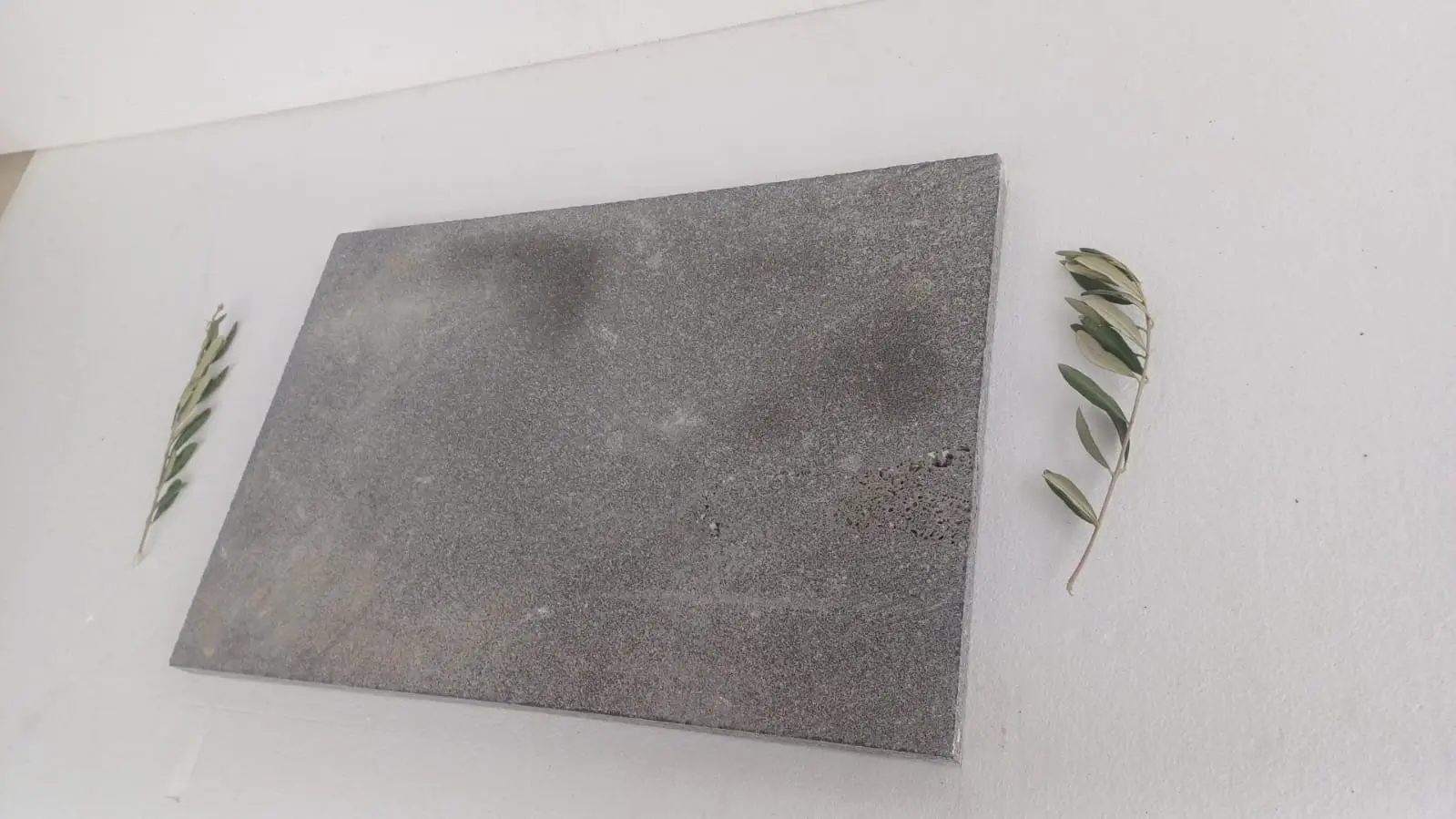
Vesicular basalt tiles require tighter batch management than a uniform dense stone, because void distribution is not constant across a quarry block or across different blocks from the same quarry. Your procurement documents should specify the acceptable void density range and require that the supply batch matches the approved sample — not just the material name. Citadel Stone cuts to order from our selected quarries, which allows void-density criteria to be incorporated into the cutting brief before production begins rather than applied as an inspection filter at the receiving dock.
Delivery planning for basalt tiles follows standard dimensional-stone logistics: your project’s access constraints and offloading arrangements are confirmed before the delivery date, and lead times are quoted with the order. Basalt’s weight per unit area is meaningful for larger format tiles — factor this into your structural deck design for elevated terraces and confirm load ratings before specifying tile dimensions above standard sizes.
Getting Vesicular Basalt Rock Specifications Right
Vesicular basalt rock is a technically specific material, and the specification decisions that determine performance — void density, finish type, absorption testing, sealer selection, joint fill integrity, and batch control — are made well before the tile reaches the installation. Getting the test reports from the actual supply batch, writing the void-density acceptance criteria into your tender documents, and matching the finish to the void expression and the application environment are the steps that separate an installation that ages gracefully from one that requires remedial work inside its first decade. Understanding how the volcanic matrix forms and why certain flow zones produce more uniform tile material than others provides the geological grounding that makes those decisions easier — basalt formation and tile suitability covers that geological context in detail. Stone for nationwide projects is cut to order from selected quarries in the Middle East, chosen for minimal visible gas pockets.
Related reading: basalt tiles problems · porcelain alternatives to natural basalt · cast basalt vs natural basalt tiles.