

Introduction to Basalt and Concrete Pavers
Let’s start with the basics. What are these materials, where do they come from, and how are they typically used?
What Are Basalt Pavers?
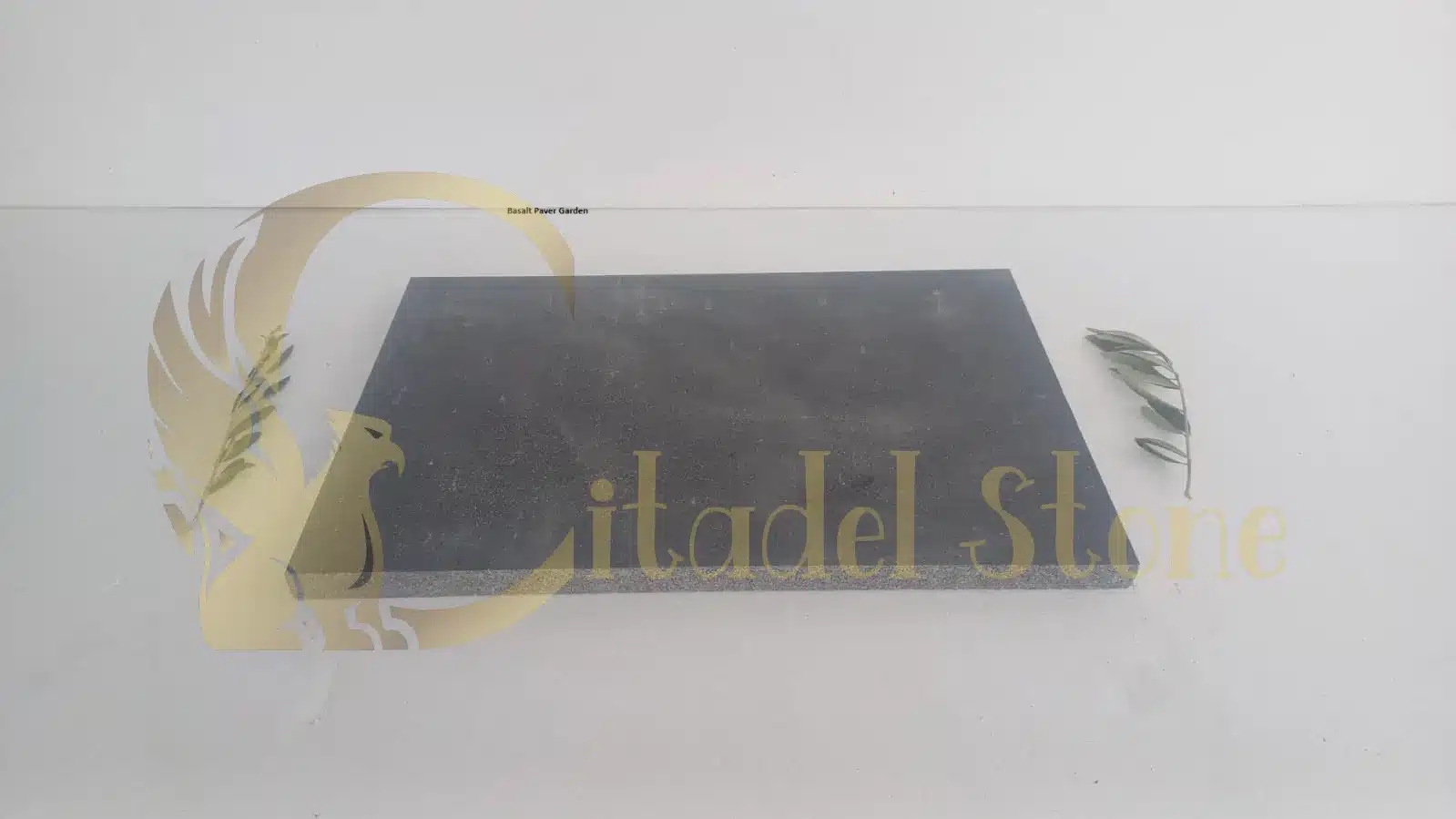
Basalt is a volcanic rock formed when lava cools and solidifies deep within the Earth. This natural stone is quarried, cut into slabs, and shaped into pavers prized for their strength and dark, elegant look. You’ll often spot basalt pavers in upscale driveways, patios, and walkways where durability and sophistication are key.
What Are Concrete Pavers?
Concrete pavers, by contrast, are man-made. They’re crafted by mixing cement, sand, and aggregates, pouring the blend into molds, and letting it harden. These pavers are budget-friendly and versatile, popping up in everything from cozy garden paths to sprawling commercial plazas.
Both options have their fans, but how do they stack up in a hardscape material showdown? Let’s dive into the details.
Cost Comparison: Basalt Pavers vs. Concrete Pavers
Cost is a make-or-break factor for most projects. Here’s how basalt vs. concrete cost plays out across initial expenses, installation, and long-term value.
Initial Material Costs
Basalt Pavers: Being a natural stone, basalt carries a higher upfront price. Expect to pay $10 to $20 per square foot, depending on thickness, finish, and sourcing.
Concrete Pavers: These are more wallet-friendly, typically ranging from $5 to $10 per square foot. Fancy designs or colors might nudge the price closer to basalt’s range.
Installation Labor
Basalt Pavers: Installing natural stone takes expertise—cutting and laying basalt is labor-intensive. Labor costs hover between $10 and $15 per square foot.
Concrete Pavers: Lighter and often interlocking, concrete pavers are quicker to install, keeping labor costs at $8 to $12 per square foot.
Long-Term Value
Basalt Pavers: With a lifespan stretching beyond 50 years, basalt offers exceptional value over decades, especially in tough conditions.
Concrete Pavers: These last 25 to 30 years on average, but repairs or replacements might add up, especially in high-traffic or extreme weather zones.
Here’s a quick list of cost takeaways:
Basalt costs more upfront but saves over time.
Concrete is cheaper initially but may need more reinvestment.
Your budget and timeline will steer this choice.
Durability Analysis: Basalt Pavers vs. Concrete Pavers
When it comes to paver durability comparison, you need a material that stands the test of time. Let’s compare compressive strength, freeze/thaw resistance, and wear.
Compressive Strength
Compressive strength is how much weight a paver can take before cracking—think cars on a driveway or heavy foot traffic.
Basalt Pavers: In the 100–300 N/mm² class typical for dense basalt (lot certificate on request), basalt shrugs off heavy loads.
Concrete Pavers: Manufactured to ASTM C936, which requires an average of at least 8,000 psi — concrete holds up well for most homes but isn’t as tough as basalt.
Freeze/Thaw Resistance
In cold climates, water can seep into pavers, freeze, expand, and cause cracks—a process called freeze/thaw cycling.
Basalt Pavers: Low porosity (tiny gaps in the material) means basalt absorbs less water, making it nearly immune to freeze/thaw damage.
Concrete Pavers: More porous by nature, concrete is at risk unless treated with sealants or designed for cold weather.
Wear Over Time
Basalt Pavers: This stone resists scratches, fading, and erosion, keeping its polish for decades.
Concrete Pavers: Concrete can chip, fade, or wear down faster, especially under constant use or UV exposure.
Durability at a glance:
Basalt is the champ for load-bearing and weather resistance.
Concrete performs well but needs more care in harsh conditions.
Aesthetic Differences: Basalt Pavers vs. Concrete Pavers
Your outdoor space should look as good as it performs. Let’s explore aesthetic paver options like color, texture, and design flexibility.
Color Ranges
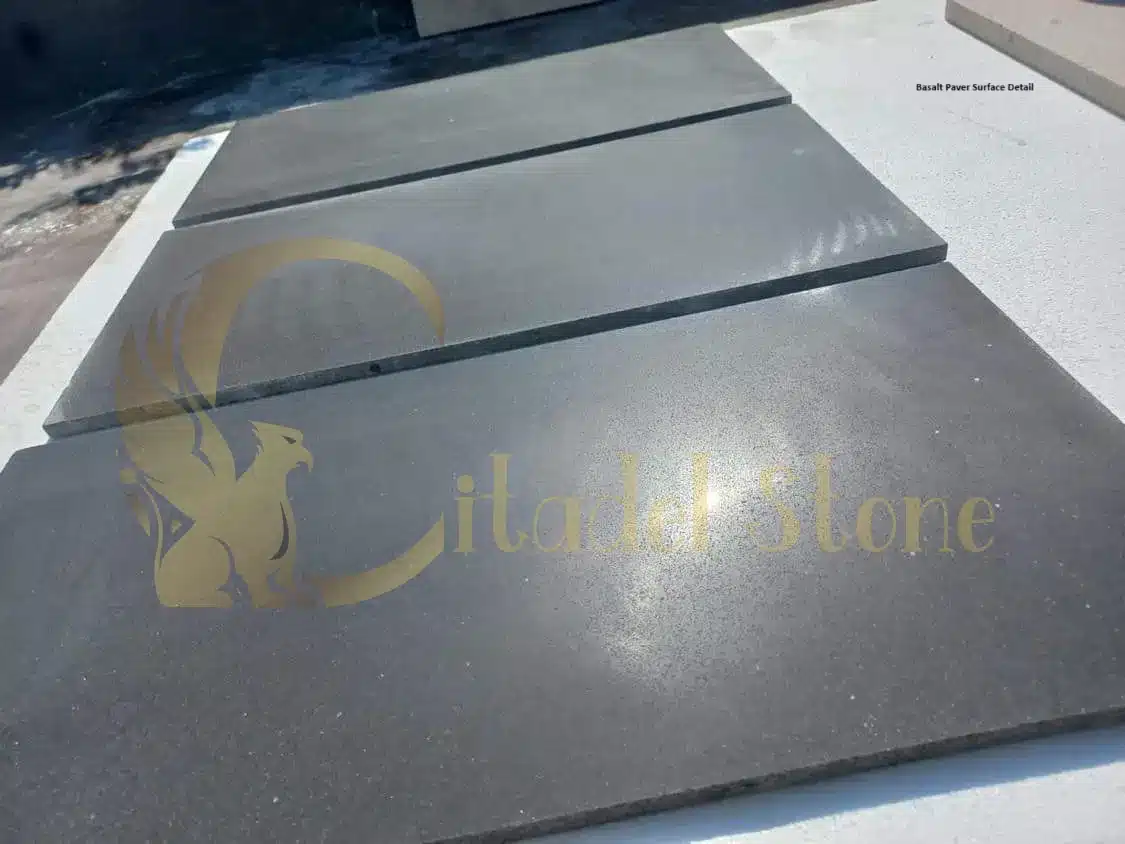
Basalt Tiles: Expect deep grays to blacks—think sleek and timeless. These hues come straight from nature, giving a consistent, upscale vibe.
Concrete Pavers: You name the color, concrete can deliver. From muted earth tones to bold reds, it’s all about customization.
Textures
Basalt Pavers: Finishes range from smooth (honed) to grippy (flamed) or rustic (split), adding tactile charm.
Concrete Pavers: Molded to mimic stone, brick, or wood, concrete offers a texture for every taste.
Pattern Flexibility
Basalt Pavers: Typically cut into squares or rectangles, basalt shines in classic layouts like herringbone or basketweave.
Concrete Pavers: With endless shapes and sizes, concrete lets you get creative with intricate patterns or modern grids.
Visual highlights:
Basalt brings natural elegance.
Concrete offers unmatched variety.
Installation Considerations: Basalt Pavers vs. Concrete Pavers
A solid install sets the stage for paver success. Here’s what you need to know about prepping and placing both types.
Base Preparation
Basalt Tiles USA: Heavier and sturdier, basalt demands a thick, compacted base of gravel or sand—crucial for load-bearing areas.
Concrete Pavers: A similar base works, but their lighter weight and interlocking options can speed things up.
Edge Restraint
Both Pavers: Edges keep everything in place. Use plastic, metal, or concrete curbs for either material to prevent shifting.
Jointing Methods
Basalt Pavers: Fill gaps with sand or mortar for a firm, lasting hold.
Concrete Pavers: Polymeric sand—hardening when wet—is a popular choice to LOCK concrete pavers tight.
Installation tip: Concrete might be more DIY-friendly, while basalt benefits from pro precision.
Maintenance & Longevity: Basalt Pavers vs. Concrete Pavers
How much upkeep will your pavers need? Let’s look at cleaning, sealing, and repairs.
Cleaning
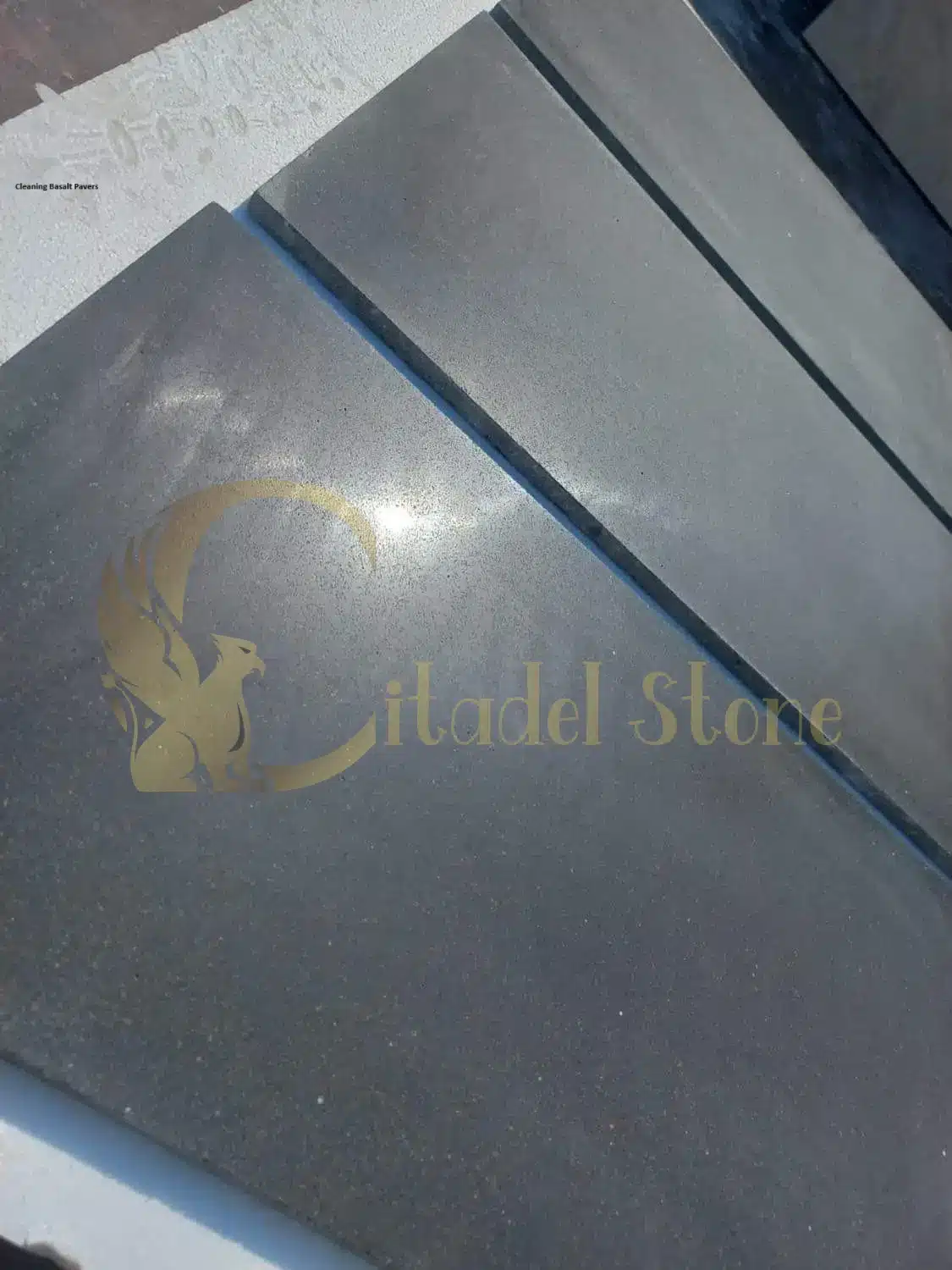
Basalt Tiles in the USA: A quick rinse or mild soap scrub keeps basalt pristine—it’s naturally tough on stains.
Concrete Pavers: More cleaning is needed to fight stains, especially on porous surfaces.
Sealing
Basalt Pavers: Optional sealing boosts color and protection but isn’t a must.
Concrete Pavers: Sealing is a smart move to block stains and fading.
Stain Resistance
Basalt Pavers: Low porosity shrugs off spills like oil or wine.
Concrete Pavers: Stains sink in easier, so act fast or seal well.
Repair Practices
Both Pavers: Swap out damaged pieces individually. Basalt’s natural variation might make matching trickier.
Basalt wins for low-maintenance longevity; concrete needs a bit more TLC.
Environmental Impact: Basalt Pavers vs. Concrete Pavers
Going green matters. Let’s weigh the eco-footprint of both.
Embodied Carbon
Embodied carbon is the CO2 released during production.
Basalt Pavers: Minimal processing keeps basalt’s carbon low.
Concrete Pavers: Cement-heavy concrete pumps out more CO2.
Recyclability
Basalt Pavers: Reusable but not recycled in the traditional sense.
Concrete Pavers: Crushable and recyclable into new concrete.
Lifecycle Assessment
Basalt Pavers: A 50+ year life means less replacement waste.
Concrete Pavers: Shorter lifespan increases environmental churn.
Basalt edges out as the greener pick.
Use Cases & Application Scenarios: Basalt Pavers vs. Concrete Pavers
Where do these pavers shine? Here are some real-world examples.
Residential Patios
Outdoor Basalt Tiles: Perfect for a luxe, lasting retreat.
Concrete Pavers: Affordable and customizable for cozy vibes.
Commercial Walkways
Basalt Pavers: Handles crowds with style and strength.
Concrete Pavers: Cost-effective for big spaces.
Pool Surrounds
Basalt Pavers: Slip-resistant and cool underfoot—poolside perfection.
Concrete Pavers: Versatile but may need extra treatment for safety.
Match your project to the paver’s strengths.
Choosing the Right Paver for Your Project
Ready to decide? Use this checklist:
Budget:
Concrete for short-term savings.
Basalt for long-term payoff.
Performance Needs:
Basalt for heavy duty or harsh weather.
Concrete for lighter use.
Aesthetic Goals:
Basalt for natural class.
Concrete for bold variety.
Your priorities—cost, toughness, or looks—will point the way.
Real Orders, Real Deliveries
We only publish projects we have actually supplied. See our Las Vegas white limestone delivery — two containers, 6,884 sq ft, 32 crates, shipped door to door — and how we supplied Creative Environments in Arizona with 21 containers across a 70,000+ sq ft installation: white limestone pavers and tiles, shellstone and Ocean Reef pavers.
Had Citadel Stone material installed on your project? Send us your photos and we will feature the work here, with your permission.
Comparing Basalt vs. Concrete Pavers: A Region-by-Region Breakdown
In this “Regional Structure” section, you’ll see how basalt and concrete pavers stack up across nine U.S. regions. We break down each area’s material availability, climate impacts, cost differentials, durability factors, and aesthetic strengths, so you can choose the right paver type for your project.
Northeast
New England (CT, ME, MA, NH, RI, VT)
In New England, true basalt pavers are rare—most come shipped from the Northwest at a premium. Concrete pavers, however, are produced locally in Vermont and Massachusetts, offering lower delivery costs. Severe freeze/thaw cycles test both materials: basalt’s inherent density resists cracking, while high‑quality concrete formulas with air‑entrainment additives can match that durability. Aesthetically, basalt brings a natural, dark tone that contrasts sharply with New England’s light sands, whereas concrete offers customizable colors and textures to mimic local fieldstone.
Availability:
Basalt: Limited; long‑haul freight adds 20–30%
Concrete: Abundant; local plants within 100 miles
Durability:
Basalt: Naturally frost‑resistant
Concrete: Requires air‑entrainment and proper sealers
Cost:
Basalt: $15–$20/sq ft delivered
Concrete: $8–$12/sq ft installed
Aesthetic:
Basalt: Rustic, dark hues
Concrete: Wide palette, replicates local stone
Middle Atlantic (NJ, NY, PA)
The Middle Atlantic benefits from Pennsylvania quarries that occasionally run small basalt batches, reducing freight premiums. Concrete paver manufacturers in New Jersey supply most metro‑area demand. Winters here are milder near the coast, but inland snowmelt still challenges paver joints. Basalt edges remain sharp over time, while concrete can chip under heavy freeze without proper joint stabilization. For color, basalt’s deep charcoal fits industrial loft conversions; concrete offers brick‑red and buff tones popular in suburban patios.
Availability:
Basalt: Moderate; limited local runs
Concrete: High; multiple NJ/PA plants
Durability:
Basalt: Excellent abrasion resistance
Concrete: Good, with polymer‑modified mixes
Cost:
Basalt: $14–$18/sq ft
Concrete: $9–$13/sq ft
Aesthetic:
Basalt: Contemporary, sleek lines
Concrete: Traditional brick and cobble looks
Midwest
East North Central (IL, IN, MI, OH, WI)
Basalt must be trucked in from western quarries, incurring freight surcharges, while concrete pavers are made locally—in Illinois and Ohio—at scale. The region’s severe freeze, salt exposure, and heavy snow demand high‑performance mixes. Basalt’s low porosity naturally sheds water, minimizing freeze‑thaw damage. Modern concrete pavers with integral dyes and sealers can approach basalt’s performance, but may require more frequent resealing. Visually, basalt’s uniform dark tone suits industrial‑style patios; concrete gives you earth‑tones that blend with rural farmsteads.
Availability:
Basalt: Low; 300+ mile haul
Concrete: Very high; plants in Chicago corridor
Durability:
Basalt: Superior freeze‑thaw resistance
Concrete: High, with regular maintenance
Cost:
Basalt: $16–$22/sq ft
Concrete: $7–$11/sq ft
Aesthetic:
Basalt: Monochrome, modern
Concrete: Rustic, varied tones
West North Central (IA, KS, MN, MO, NE, ND, SD)
No local basalt sources here—pavers come from Colorado or Washington, adding freight costs. In contrast, concrete paver production in Missouri and Kansas keeps material costs down. This region’s temperature extremes (sub‑zero winters, hot summers) and occasional flash floods favor basalt’s thermal stability, though premium concrete mixes with polymer fibers also perform well. Basalt delivers a contemporary slate‑gray look; concrete offers prairie‑inspired reds and browns to match farmland aesthetics.
Availability:
Basalt: Very low; long‑haul transport
Concrete: High; regional plants
Durability:
Basalt: Highly resistant to thermal stress
Concrete: Good, with fiber reinforcement
Cost:
Basalt: $17–$23/sq ft
Concrete: $8–$10/sq ft
Aesthetic:
Basalt: Industrial chic
Concrete: Warm, organic palettes
South
South Atlantic (DE, DC, FL, GA, MD, NC, SC, VA, WV)
In the humid South Atlantic, concrete pavers dominate via plants in Georgia and Virginia. Basalt must be imported, raising costs. High humidity, heavy summer rains, and occasional hurricanes test paver joints. Basalt’s density resists moisture intrusion, but concrete pavers with polymer‑modified cement and sealed joints hold up admirably. Aesthetically, basalt’s dark surface contrasts with lush tropical plantings; concrete’s buff and terracotta shades echo traditional southern architecture.
Availability:
Basalt: Minimal; coastal freight adds 25%
Concrete: Very high; GA/VA production hubs
Durability:
Basalt: Excellent moisture resistance
Concrete: High, with sealed joints
Cost:
Basalt: $18–$24/sq ft
Concrete: $8–$12/sq ft
Aesthetic:
Basalt: Dramatic, modern
Concrete: Classic southern charm
East South Central (AL, KY, MS, TN)
Local quarries in Tennessee rarely produce dimensioned basalt, so most shipments come from Montana or Oregon. Conversely, concrete plants in Alabama and Kentucky supply the region. The area’s consistent rainfall and mild winters mean both materials fare well, but basalt’s minimal maintenance edge appeals to homeowners seeking low‑upkeep. Concrete pavers deliver broader color selections to match historical brick facades, while basalt offers a sleek, contemporary finish.
Availability:
Basalt: Low; interstate freight
Concrete: High; local manufacturing
Durability:
Basalt: Requires little upkeep
Concrete: Good, with periodic sealing
Cost:
Basalt: $16–$20/sq ft
Concrete: $7–$11/sq ft
Aesthetic:
Basalt: Minimalist, sleek
Concrete: Traditional, versatile
West South Central (AR, LA, OK, TX)
Texas paver yards occasionally stock small basalt lots, but large orders still come from the Mountain West. Concrete pavers here are mass‑produced in Dallas and Houston. With harsh UV exposure and sporadic heavy rains, both materials must be UV‑stable and well‑sealed. Basalt’s color holds under sun better than some concrete dyes, but premium concrete blends with UV inhibitors can keep pace. Visually, basalt’s charcoal tones suit modern ranch designs; concrete’s red and tan mixes complement traditional brick homes.
Availability:
Basalt: Moderate; Texas yards in Dallas
Concrete: Very high; Houston/Dallas plants
Durability:
Basalt: Superior UV stability
Concrete: High, if UV-treated
Cost:
Basalt: $15–$19/sq ft
Concrete: $8–$12/sq ft
Aesthetic:
Basalt: Contemporary ranch
Concrete: Warm, traditional
West
Mountain (AZ, CO, ID, MT, NV, NM, UT, WY)
This region offers the best domestic basalt supply—from Colorado and Montana quarries—reducing delivery surcharges. Concrete pavers are also produced locally in Colorado and Utah. You’ll face freeze/thaw at elevation, monsoon rains, and high UV. Basalt’s natural density excels under these stresses, while concrete pavers need polymer and air‑entrainment tech. Aesthetically, basalt fits alpine modernism; concrete offers earth‑tones that blend with red‑rock canyons.
Availability:
Basalt: High; regional quarries
Concrete: High; local plants
Durability:
Basalt: Exceptional all‑weather performance
Concrete: Very good, with modern additives
Cost:
Basalt: $12–$16/sq ft
Concrete: $7–$10/sq ft
Aesthetic:
Basalt: Mountain‑modern
Concrete: Natural, canyon‑inspired
Pacific (AK, CA, HI, OR, WA)
West Coast basalt comes from Oregon and California quarries, making it competitively priced against concrete pavers, which are produced statewide. Heavy rainfall in the Northwest and seismic concerns in California demand stable bedding and proper jointing. Basalt’s rigidity resists settling, while concrete pavers must be installed with flexible joint compounds in quake zones. Aesthetically, basalt’s dark palette matches Pacific‑Northwest minimalism; concrete’s light greys and tans complement mid‑century California style.
Availability:
Basalt: Very high; OR/CA quarries
Concrete: Very high; plants in all coastal states
Durability:
Basalt: Excellent stability under seismic shift
Concrete: Good, with flexible joints
Cost:
Basalt: $13–$17/sq ft
Concrete: $8–$12/sq ft
Aesthetic:
Basalt: Pacific‑modern
Concrete: Mid‑century coastal
By comparing basalt and concrete pavers through each region’s lens, you can balance cost, durability, and aesthetic to select the best product—tailored to your local environment and design vision.
Why Citadel Stone?
At Citadel Stone—bridging local expertise and national stone supply capacity, we’ve got your back with top-tier basalt and concrete pavers. Explore our basalt paver selection for enduring elegance or dive into our concrete paver catalog for versatile value. Let’s build something beautiful—and built to last—together.