Granite pool deck pavers present a specification challenge that most project managers underestimate until they’re standing at the edge of a completed deck wondering why the layout looks off — the material’s natural variation in veining and tone means your pattern selection has to account for visual rhythm across the full surface, not just within a single paver. Tile size, joint width, and running direction all interact with granite’s inherent movement to produce a result that either reads as intentional or reads as chaotic. Getting the layout right starts well before the first paver is set.
Why Granite Works on Pool Decks
Granite is an intrusive igneous rock — it cooled slowly beneath the earth’s surface, which is why its interlocking crystalline structure is so dense. The Natural Stone Institute granite overview provides a useful reference on how that mineralogy translates to durability characteristics worth understanding before you specify. For a pool deck environment, that density matters because it limits how readily the stone takes on moisture through its pore system, though absorption performance varies by finish and by the individual quarry source. Always request the relevant ASTM test report from your supplier rather than relying on general claims.
Granite’s crystalline matrix also gives it a dimensional stability that plays well with pool chemistry exposure. Chlorinated water, UV loading across full-sun deck positions, and the thermal cycling between night and midday temperatures all stress a paving surface over time. Granite pool deck pavers have accumulated decades of service life in demanding outdoor environments, and the pattern of failures you see in granite pool decks is almost always traced to base preparation or joint detailing — not to the stone itself.
One detail that catches specifiers off guard: granite’s relatively low absorption doesn’t mean you skip sealing. An impregnating sealer protects the surface from mineral staining and pool chemical deposits that would otherwise accumulate in the micro-surface texture over time. The interval for reapplication depends entirely on the sealer manufacturer’s recommendation for outdoor pool environments — follow that guidance, not a general rule of thumb.
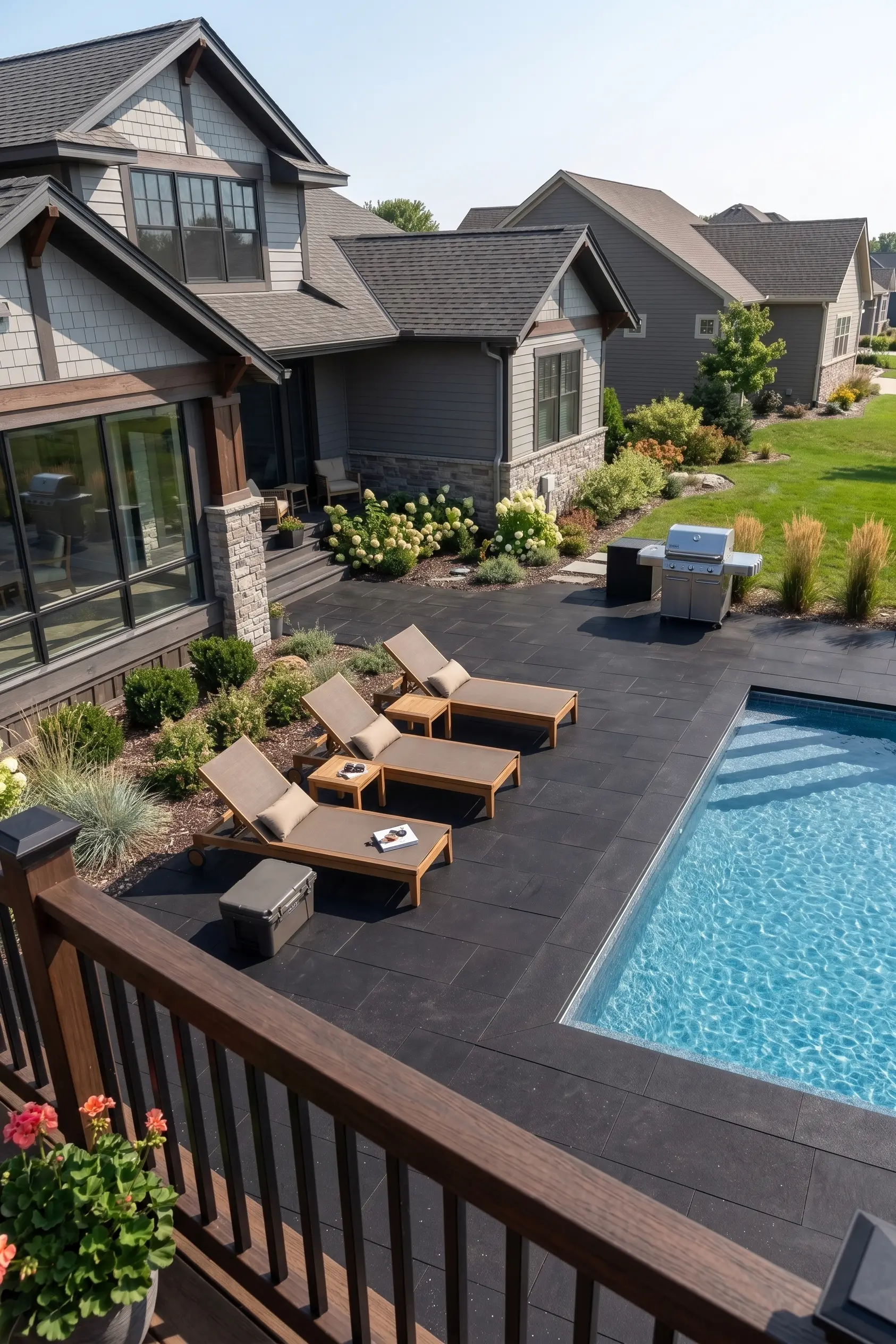
Standard Paver Sizes and What They Mean for Your Layout
Your size selection shapes the entire visual character of the deck, and it also determines your cutting waste, your setting bed requirements, and how much time your installer spends on layout geometry. These aren’t interchangeable decisions — each size range carries trade-offs you need to weigh before the order is placed.
- 12 × 12 in (305 × 305 mm): the workhorse format for pool decks with tight curves or irregular perimeters — the smaller module gives your cutter more flexibility at the pool edge without excessive material loss
- 16 × 16 in (406 × 406 mm): a middle-ground format that reads as substantial on medium-sized decks without overwhelming narrow side runs
- 18 × 18 in (457 × 457 mm): suits decks with long straight runs where you want the surface to feel expansive; requires a flatter, more precisely prepared base because the larger format reveals substrate variation more readily
- 24 × 24 in (610 × 610 mm): the large-format option that creates a clean, contemporary read — demanding on base preparation tolerances and on the cutting precision your fabricator can hold
- 12 × 24 in (305 × 610 mm): a rectangular format that lends itself to a stacked or running bond pattern; the proportion creates strong directional movement that benefits long, linear decks
- Mixed modular kits (e.g., 12 × 12, 12 × 24, and 24 × 24 combined): create a versailles-style or ashlar layout that breaks the surface into a more informal, Mediterranean character
Thickness specification for pool deck applications typically runs at 1¼ in (approximately 30–32 mm) for pedestrian-only decks on a properly prepared base. For areas adjacent to the pool edge where concentrated point loads from pool equipment or frequent high-traffic occur, confirm thickness requirements with your project engineer — the base design, not the stone alone, determines structural adequacy.
Pattern Options That Work with Granite’s Natural Character
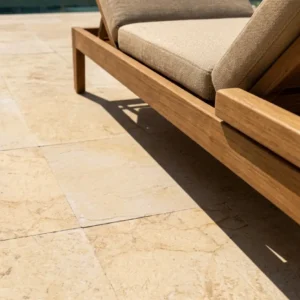
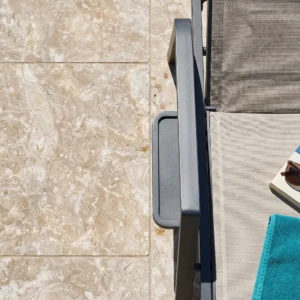
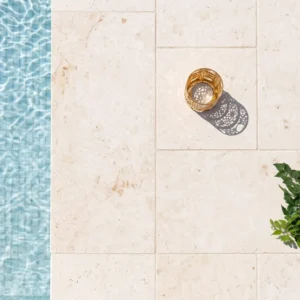
Granite pool deck pavers don’t behave like porcelain tile in a pattern context. The natural variation in veining direction, crystal size, and background tone means that certain patterns amplify that variation in a way that reads as rich and intentional, while others fight it and produce a restless, busy surface. Here’s what field experience shows about which patterns work:
Running Bond
The running bond — offset by half the paver length — is the most forgiving pattern for granite’s natural variation. The staggered joints draw the eye along the length of the deck rather than stopping it at each individual paver, which reduces the visual impact of color variation between units. It’s particularly effective with rectangular formats like 12 × 24 in, where the long axis of the paver reinforces the directional movement. On a deck that runs parallel to the pool’s long edge, running bond in that same direction reads as a continuation of the water’s geometry.
Stack Bond
Stack bond — joints aligned in both directions — creates a formal, grid-like surface that suits contemporary pool designs. The trade-off is precision: continuous joint lines reveal any variation in paver sizing more readily than a running bond does. Your fabricator’s dimensional tolerance becomes critical here. For granite specifically, stack bond works best with a honed or brushed finish where the color tone is more uniform across the face of each paver. Highly veined granite in a stack bond can feel fragmented.
45-Degree Diagonal
A diagonal layout rotated 45 degrees from the pool edge creates a dynamic surface that works particularly well on square decks where a straight bond would emphasize the boxy proportions. The geometry also directs water toward drainage channels naturally — though deck slope and drainage design remain the contractor’s specification, not a function of pattern choice alone. The cost implication is real: a diagonal layout increases cutting waste at the perimeter by a meaningful margin, which affects your material order quantity and your total stone cost.
Ashlar and Mixed Modular Patterns
An ashlar layout — combining two or three paver sizes in a repeating random-set pattern — suits larger decks where a single-size grid would feel monotonous. The visual complexity of the pattern is a strength here because it absorbs granite’s natural color variation rather than fighting it. You need a fabricator who can hold consistent thickness across multiple formats so the finished surface is level across size transitions. At Citadel Stone, we cut granite pavers to order in multiple formats from the same slab run, which keeps thickness consistent across a mixed-module set.
Choosing the Right Finish for a Pool Deck
Finish selection for any pool environment requires you to think about the texture the stone presents underfoot in a consistently wet condition. For pool decks, wet steps, and slopes, choose a bush-hammered finish. For other outdoor paths, bush-hammered or brushed in the coarsest grit both work; check a sample.
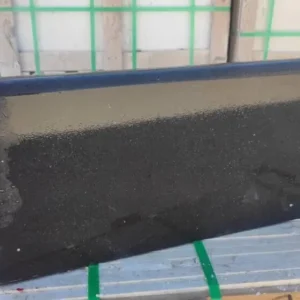
A bush-hammered finish on granite creates a fractured, open texture across the surface of each paver. It’s the result of mechanical impact that breaks the crystal faces, leaving a matte, slightly dimpled profile. That texture profile is what makes it appropriate for consistently wet pool environments — the surface condition is structurally different from a polished face. How a specific finish performs for a given application is governed by ANSI A326.3, which measures wet, and finish type is the key variable. No published slip figures are available; request test documentation from your supplier and evaluate finish samples in wet conditions before finalizing your specification.
A brushed finish in 36 or 80 grit suits pool surrounds and covered terrace areas adjacent to the pool house. The coarser grits leave a more open, matte texture; finer grits approach a smoothness that becomes less suitable for continuously wet zones. Check a sample in the site conditions before specifying. You can explore our granite paver options to review available formats and finishes before making your final selection.
Layout Planning, Drainage Slope, and Joint Design
Your deck layout plan has to solve three problems simultaneously: visual pattern, drainage geometry, and joint behavior under thermal cycling. Miss any one of them and you’ll see the consequences within the first two or three seasons.
- Deck slope for drainage runs at approximately ¼ in per foot (about 2%) away from the pool edge and toward perimeter drains — this is the contractor’s specification and should be set in the base, not corrected by varying mortar bed depth under individual pavers
- Joint width for granite pool deck pavers typically runs at ⅜ to ½ in (approximately 10–12 mm) for sand-set applications; mortar-set applications with non-sanded grout follow the grout manufacturer’s joint width specification
- Expansion joints are required at field-to-structure transitions, at all changes of plane, and at regular intervals across the field — your structural engineer or the tile council installation standards guide the spacing calculation based on the coefficient of thermal expansion of the specific granite and the climate’s temperature range
- Corner and edge cuts at the pool coping interface require precision — an irregular gap at the pool edge reads immediately and is difficult to correct after setting
- Field layout strings must be set from a true baseline before any paver is placed; the pool shell itself is rarely perfectly square and should not be used as the layout reference line
The ASTM C615 standard for granite dimension stone is the reference specification your project documents should cite when requiring dimensional tolerance and physical property testing — ask your supplier to confirm which ASTM methods apply to the specific granite you’re specifying and request the test report.
Cost Factors, Regional Pricing, and Budget Planning
Granite pool deck pavers carry a material cost that varies more by sourcing distance and finish than most buyers anticipate. The stone itself is dense and heavy, which means freight cost as a share of total project cost climbs quickly when the material is moving long distances. For projects in inland regions far from port-of-entry points, freight on a full pallet of granite pavers can add a meaningful percentage to the landed cost — a variable that rarely shows up in the per-square-foot quote until you’re looking at the final invoice.
Your budget planning should separate the material cost from the installation labor cost explicitly, because the ratio between them shifts significantly by market. In high-cost labor markets, specifying a larger paver format reduces the number of pieces your installer sets and cuts, which can offset the higher per-unit cost of the larger stone. In lower-cost labor markets, the calculation runs differently and a smaller modular format may give you more design flexibility without meaningful labor cost penalty.
- Material cost per square foot reflects stone type, finish, thickness, and paver format — larger formats cost more per piece but fewer pieces cover the same area
- Cutting waste runs higher on diagonal patterns and irregular perimeter decks — add a minimum of 10–15% to your area calculation for rectangular patterns and 15–20% for diagonal layouts
- Freight is quoted with the order; lead times reflect quarry production and logistics, and both should be confirmed early in the project schedule
- Installation labor for granite pool decks on a mortar-set concrete base runs at a premium over sand-set work because of the precision required at the pool coping interface and at drainage transitions
- Sealer cost is recurring — budget for reapplication on the interval your sealer manufacturer states, typically every two to four years in full-sun pool environments depending on the product
Projects where the pool deck granite is specified early in the design phase consistently come in closer to budget than those where the material is selected after other costs are fixed. Locking the format, finish, and source early gives your supplier time to confirm availability and quote freight accurately — delivery scheduling for a large granite order benefits from lead time that a last-minute specification can’t accommodate.
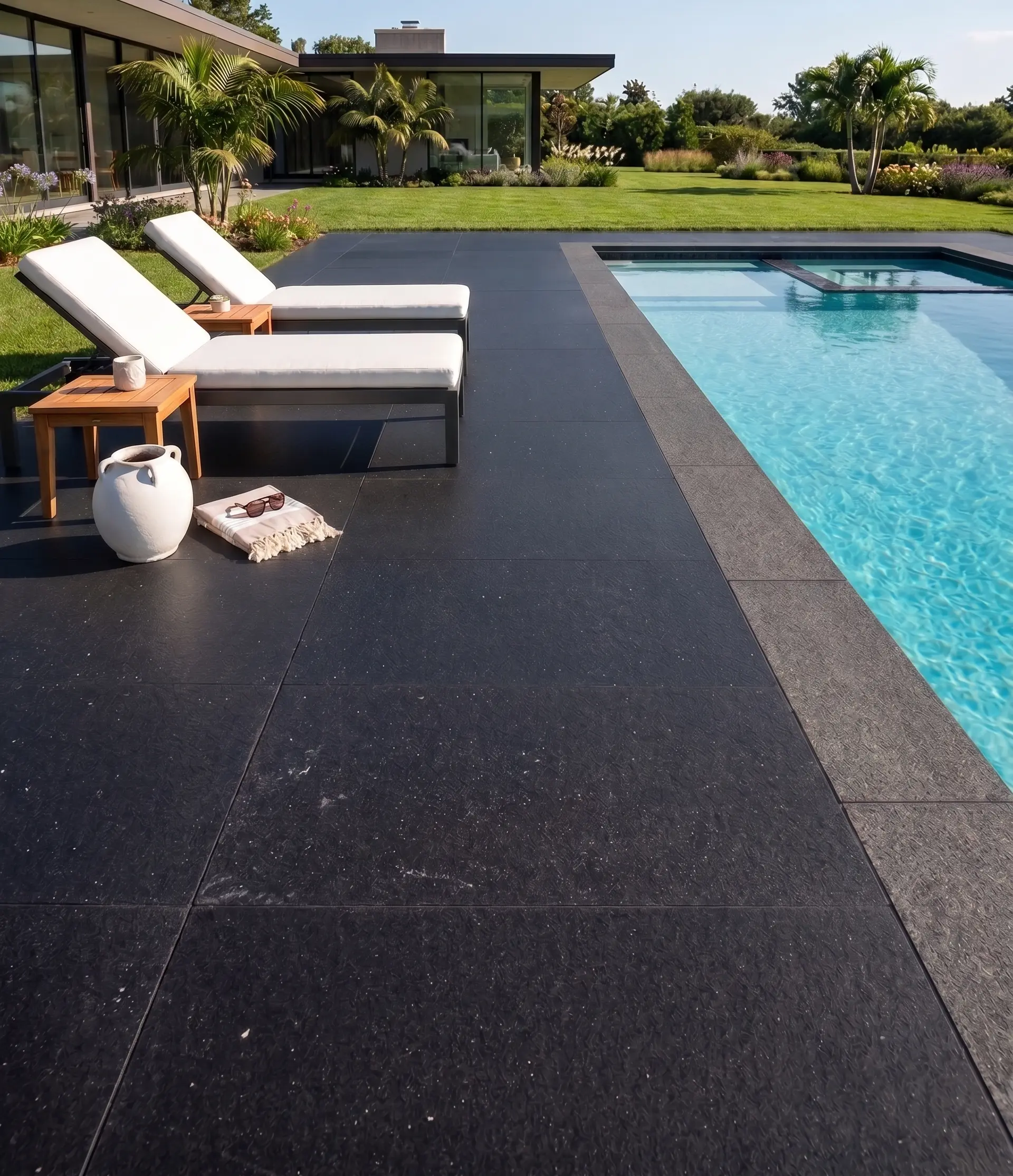
Base Preparation and Setting Methods
The base is where pool deck installations succeed or fail — and granite pool deck pavers are unforgiving of base deficiencies because the stone’s density amplifies any differential settlement into a visible edge or a rocking unit. Your base specification needs to match the paver format, the site drainage conditions, and the concrete substrate condition before a single paver goes down.
Concrete Substrate Requirements
Most pool deck granite is mortar-set over an existing or new concrete slab. The slab must be structurally sound, free of active cracks, and sloped correctly for drainage before the setting bed is applied. Any crack in the substrate will reflect through the setting mortar and into the paver surface within a few thermal cycles — a crack isolation membrane is the standard remedy for existing slabs with hairline or dormant cracks. New slabs should cure fully per the concrete manufacturer’s recommendation before granite is set over them.
Sand-Set Applications
Sand-set granite pool deck pavers are an option for decks where drainage is designed into the base rather than through surface slope alone. The application requires a compacted aggregate base of adequate depth for the site’s soil conditions and frost depth where applicable. Sand-set work allows for individual paver replacement without disturbing the surrounding field, which is a maintenance advantage on large decks. The trade-off is that joint sand settles and migrates in high-rainfall or high-irrigation environments and requires periodic refilling and re-compaction to maintain the surface level and joint integrity.
Ordering, Delivery, and On-Site Handling
Granite pavers for pool decks ship on pallets, and a full pallet of 1¼ in granite paver is substantial weight. Your site access plan needs to account for where the delivery vehicle can reach and where pallets can be staged without blocking pool deck work zones. Offloading arrangements and access constraints should be confirmed with your supplier before the delivery date — Citadel Stone coordinates delivery logistics with each order so that staging requirements are factored into the schedule early.
Granite pavers for pool decks also benefit from sorting on delivery. Natural stone variation means individual pallets can shade slightly from one another, particularly in gray and silver-toned granites where the background crystal mix shifts between quarry runs. Blending pavers from multiple pallets during installation — rather than setting one full pallet before opening the next — distributes any tonal variation across the surface evenly. This is a step most experienced stone installers do automatically, but it’s worth including in your project specification so it doesn’t get skipped under schedule pressure.
The USGS dimension stone production data provides context on the scale and distribution of granite supply in the US market — useful background when you’re evaluating sourcing options and understanding why regional pricing varies as much as it does.
Expert Summary
Getting granite pool deck pavers right comes down to decisions made well before the installation begins: size format matched to deck scale and perimeter geometry, pattern selected to work with the stone’s natural variation rather than against it, finish appropriate to a consistently wet outdoor surface, and base preparation that the finished paver size and site drainage actually demand. The materials perform well across decades of service in pool environments when the specification is complete — the failure modes you’ll encounter in granite pool decks trace almost exclusively to under-specified bases, missed expansion joints, or finish selections that weren’t vetted for wet outdoor conditions.
Your total project cost is shaped as much by freight distance, format choice, and installation method as it is by the stone price per square foot — and the projects that stay on budget are the ones where those variables are resolved at the specification stage rather than the procurement stage. For related specification depth on square-format granite layouts, granite square paver layouts and sizing covers how format decisions carry through from the plan to the finished surface. Through our own fabrication services, Citadel Stone cuts granite pavers to the sizes and formats a pool deck layout calls for.
Related reading: granite paver thickness · Granite Stepping Stones: Sizes, Spacing and Setting · granite vs porcelain pavers.