Why Edge Restraint Defines Installation Longevity
Edge restraint is the single most under-specified component in any paving and edging stones guide, and yet it’s the detail that determines whether your installation holds its geometry for twenty years or starts creeping outward within the first frost cycle. The physics are straightforward: unconfined pavers experience lateral thrust from traffic loads, thermal cycling, and ground movement, and without a rigid perimeter boundary, joint sand migrates progressively outward until the surface becomes unlevel and structurally compromised. Your specification needs to treat edge restraint not as an accessory but as a structural element equal in importance to the base course beneath the stone.
Material Families and Their Edge Behaviour
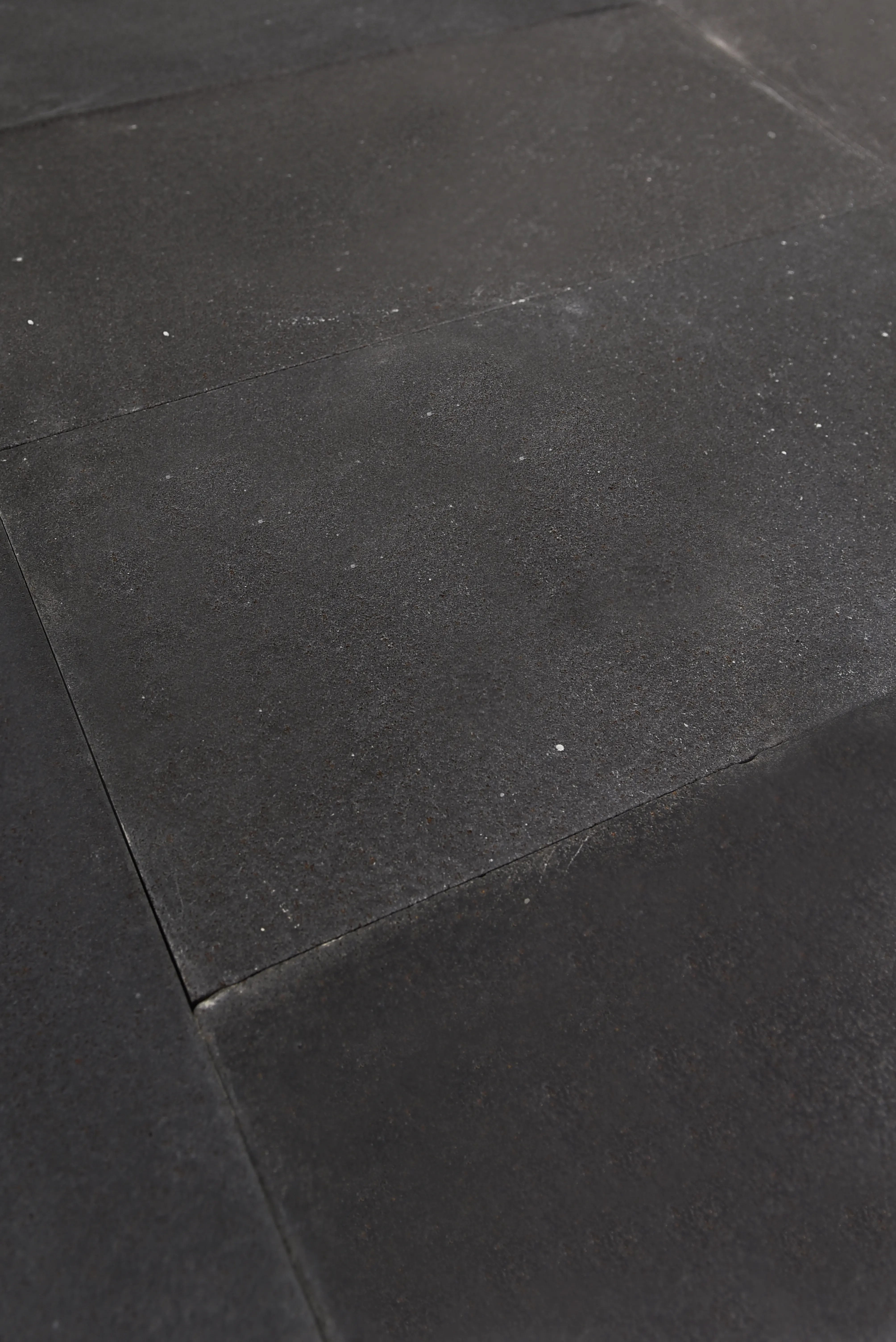
Natural stone paving and edging stones behave differently at the perimeter depending on their modulus of rupture and their thermal expansion coefficient. Granite-based materials, with a thermal expansion coefficient around 4.7 × 10⁻⁶ per °F, generate significant cumulative lateral force across a large paved area, meaning your edge restraint anchorage must be deeper and spaced more tightly than you’d need for a softer sedimentary stone. Limestone and travertine expand more gradually, but their greater porosity means moisture absorption at the perimeter creates freeze-thaw spalling precisely where the edge condition concentrates stress.
- Granite setts: high compressive strength above 19,000 PSI, but high lateral thrust during thermal expansion — spec heavy-gauge steel restraint with 12-inch spikes on 18-inch centres
- Limestone pavers: more forgiving thermally, but frost-susceptible at exposed edges — use L-profile aluminium with a drip-lip detail that keeps moisture away from the stone face
- Travertine: open-pore structure absorbs water at cut edges — a continuous edge restraint with a back-fill mortar bed behind the restraint flange significantly reduces moisture infiltration
- Basalt and hard volcanic stone: extremely dense, low absorption, but brittle at thin edges — avoid sharp-nosed restraint profiles that concentrate point loads on 1-inch-thick perimeter pieces
Understanding which material family you’re working with shapes every edge decision downstream, from restraint profile selection through to jointing sand type at the perimeter run.
Base Preparation: The Foundation of Edge Stability
Your edge restraint is only as reliable as the compacted base it’s anchored into. A common field error is installing a premium steel or aluminium edge profile into an under-compacted base — the restraint then migrates with the base rather than holding the paving. For residential paving and edging stone installations, your compacted aggregate base should reach 95% modified Proctor density before any restraint stakes are driven, verified with a plate compactor pass count appropriate to your aggregate gradation.
The aggregate base depth matters too. For pedestrian applications, a 4-inch compacted base over a stable subgrade is a reasonable starting point, but that number climbs to 6–8 inches once you introduce vehicular loads or clay-rich subgrade soils that swell seasonally. According to NSI natural stone paving standards, base preparation requirements vary substantially with the stone type and intended load, and the perimeter condition always warrants the more conservative specification within any given project. Your edge restraint stakes need to penetrate beyond the compacted aggregate and into undisturbed subgrade — a minimum of 3 inches into native material — or cyclic loading will slowly walk them out of position.
Drainage Design and How Water Behaviour Affects Your Edge Detail
Here’s what most specifiers miss when detailing garden stones and paving layouts: the edge restraint is also a drainage control point. Water running across a paved surface reaches the perimeter and must go somewhere — and if your edge detail doesn’t account for that discharge, you’ll get hydrostatic pressure building behind the restraint flange during heavy rain events, gradually undermining the aggregate base directly adjacent to the edge.
Installations in regions that experience intense precipitation cycles face particular risk: the volume of water reaching the edge zone in a single event can be significant in areas with monsoon-type or high-intensity seasonal rainfall. Designing a 1% cross-fall minimum into your paved surface, directing water toward a channel drain set just inside the perimeter restraint, relieves that pressure rather than allowing it to accumulate. For permeable installations using open-jointed natural stone paving and edging stones over a free-draining aggregate base, the drainage dynamic is more forgiving, but your edge restraint still needs weep slots or a gap-profile system to allow lateral drainage without undermining the restraint’s structural function.
- Set edge restraints with the bottom flange below the bedding sand layer, not level with it — this prevents water from tracking under the restraint and saturating the base
- In freeze-thaw climates, use a restraint profile with an integral drainage channel to prevent ice formation behind the flange
- For drought-cycle regions, account for subgrade shrinkage — clay soils can pull away from restraint stakes during dry periods, creating a gap that allows lateral paver movement
- Inspect edge restraint weep openings annually and clear any sediment accumulation before heavy rain seasons begin
Circular Paving Stones and the Edge Restraint Challenge
Circular paving stones present the most demanding edge restraint scenario you’ll encounter in residential hardscape work. The geometry means your perimeter restraint must follow a continuous curve, and conventional rigid-panel systems simply don’t bend to the required radius without kinking — which creates stress concentration points that fail under frost heave or cyclic loading. Flexible-section aluminium restraint systems designed specifically for radial layouts are the correct specification here, and you should look for profiles that allow 12-inch radius curves without pre-cutting.
The joint geometry in a circular layout also amplifies edge movement risk. Fan-pattern joints converge at the perimeter, which means the outermost pavers are essentially wedge-shaped — they have no mechanical interlock preventing them from sliding radially outward. Your edge restraint for circular paving stones must be staked at a maximum 12-inch spike interval, not the 18–24 inches acceptable in straight-run applications. At Citadel Stone, we consistently advise clients specifying circular patterns to detail a continuous mortar haunch behind the restraint flange in addition to mechanical anchorage — it’s the belt-and-braces approach that eliminates callback risk entirely.
Restraint Profile Selection by Application
The market offers four primary restraint profile categories, and matching the right profile to your application is not a minor detail — it’s a specification decision that directly affects your 20-year performance outcome. Plastic snap-together systems are tempting from a cost standpoint, but their spike-holding capacity in sandy or loamy subgrades is genuinely inadequate for anything beyond decorative garden edging. For structural paving and edging stone installation carrying vehicle or sustained pedestrian loads, you need galvanised steel or heavy-section aluminium.
- Galvanised steel (16-gauge, 4-inch depth): the workhorse for vehicular applications — spec 10-inch spikes at 12-inch centres in any subgrade with less than 80% compaction
- Heavy-section aluminium (6063 alloy): preferred for pool surrounds and salt-exposed environments where steel corrosion is a long-term concern
- Plastic composite systems: acceptable only for lightweight garden stones and paving borders not subject to vehicular or heavy sustained loads
- Precast concrete kerb profiles: the most durable option for driveway applications, but require a separate concrete footing and add significant cost
- Mortared natural stone edging: appropriate for formal garden layouts — limestone or granite edging stones set in a full-bed mortar provide both an aesthetic and a structural boundary simultaneously
Your choice of restraint profile should be documented in the project specification before materials are ordered — changing systems mid-project after the paving installation is underway creates alignment problems and typically forces a partial stone reset at the perimeter.
Specifying Natural Stone Edging for Project Performance
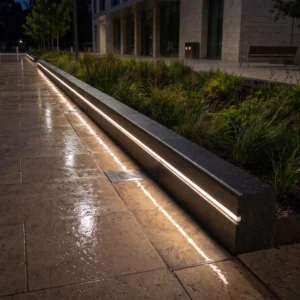
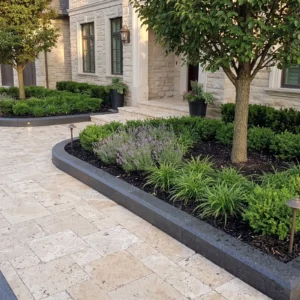
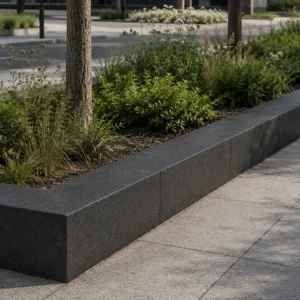
Natural stone edging — limestone kerb sections, granite cobble borders, or basalt setts used as a perimeter row — functions simultaneously as aesthetic definition and mechanical restraint. The specification challenge is that natural stone edging performs very differently depending on how it’s set. A dry-laid granite cobble border set in compacted sand has almost no restraint value for the interior paving; it’s aesthetic only. The same granite cobble set in a full mortar bed on a concrete footing becomes a genuine structural restraint capable of holding a 4-inch natural stone paving field under vehicular loading.
For projects where the aesthetic goal is a natural stone edge matching the paving material, specify the edging units at a minimum 4-inch thickness, set in Type S mortar on a concrete footing that extends at least 6 inches below the finished base level. According to USGS dimension stone production and construction data, granite remains the preferred material for structural kerbing applications in the USA due to its abrasion resistance and compressive strength exceeding 19,000 PSI. You can browse paving edging from Citadel Stone to identify matching stone families that maintain visual continuity between the field paving and the structural perimeter.
Joint Sand Management at the Perimeter
Polymeric joint sand behaves differently at the perimeter zone than it does in the field interior, and this distinction matters more than most installation guides acknowledge. At the perimeter, joint sand is exposed to higher water velocity during rain events, greater UV exposure at the edge face, and the direct mechanical stress of lawn equipment and foot traffic stepping on and off the paved surface. Spec a high-binder-content polymeric sand specifically rated for perimeter and edge applications — standard field polymeric sand has insufficient tensile strength to resist the peel forces at an open edge.
The installation sequence also matters: compact and fully set your edge restraint before you introduce the bedding sand layer, then introduce the polymeric joint sand in two passes rather than one. The first pass fills joints to 75% depth and is lightly compacted and dampened; the second pass brings joints to the specified depth 1/8 inch below the chamfer. This two-pass method prevents voids directly adjacent to the restraint flange — voids in that location are the origin point of most perimeter migration failures. According to ASLA guidance on natural stone hardscape and permeable surfaces, proper joint filling directly at the edge boundary is critical for long-term surface stability and drainage performance.
Ordering and Logistics for Edging Stone Projects
Your edge restraint and edging stone order needs to be placed alongside your field paving material, not after. A mistake that causes real project delays is treating edge restraint as a site-supply item that can be sourced locally once the main stone arrives. In reality, if you’re specifying natural stone edging — granite setts, limestone kerb sections, or basalt border pieces — those need to be quarried, cut, and shipped as part of the same natural stone paving and edging stones order to ensure colour and finish consistency.
Citadel Stone maintains national warehouse inventory that allows field paving and matching edging stone to ship from the same stock batch, which eliminates the colour variation problem that plagues multi-shipment projects. Truck delivery scheduling for combined paving and edging orders typically requires 48 hours advance notice to coordinate pallet staging — plan your site-access logistics accordingly, particularly on residential jobs where truck turning radius constrains where pallets can be dropped. Lead times from warehouse to site typically run 5–10 business days for stocked profiles, compared to 6–8 weeks for imported custom stone, so verifying warehouse availability before you commit to a project timeline is worth doing early in the specification process.
What Matters Most in Your Paving and Edging Stones Specification
Every element of this paving and edging stones guide converges on a single design principle: the perimeter condition determines the long-term performance of the entire installation, not the field. You can execute a technically perfect stone installation — correct base depth, proper bedding sand, premium natural stone — and still face premature failure if the edge detail is under-specified. The restraint profile, the anchorage depth, the joint sand management at the boundary, and the drainage geometry at the perimeter all need to be designed together, not assembled piecemeal.
As you develop your full hardscape specification, consider that edge performance and environmental sustainability aren’t separate concerns. permeable and eco-friendly paving options explores how open-joint natural stone systems integrate drainage and permeability directly into the paving design — a dimension worth reviewing before you finalise your edge and base specification. Without a proper edge restraint, even a well-screeded Citadel Stone patio will migrate outward at the perimeter as joint sand shifts with seasonal ground movement.
Related reading: how to cut paving stones · how to lay paving stones · preparing ground for paving stones.