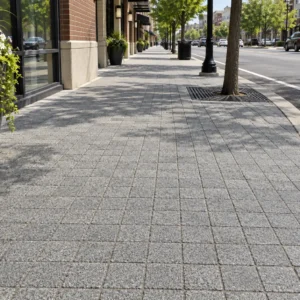
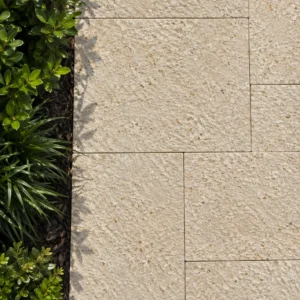
What Permeable Actually Means for Your Paving Project
Eco friendly paving stones perform as a stormwater management system only when the joint configuration and sub-base are engineered together — the stone itself is the structural component, not the drainage mechanism. A solid-set limestone or basalt slab with tight mortar joints performs no better than concrete from a stormwater standpoint, while the same material laid with open joints and a permeable sub-base can redirect 80–90% of rainfall back into the ground rather than into municipal drainage systems. That distinction shapes every technical decision that follows.
You’ll want to think about permeability as a system, not a feature. The stone contributes hardness, durability, and thermal performance. The sub-base — typically a compacted angular gravel layer between 6 and 12 inches deep depending on load class — does the actual water management work. Getting both right is what separates a genuinely sustainable installation from one that just uses natural materials as a marketing claim.
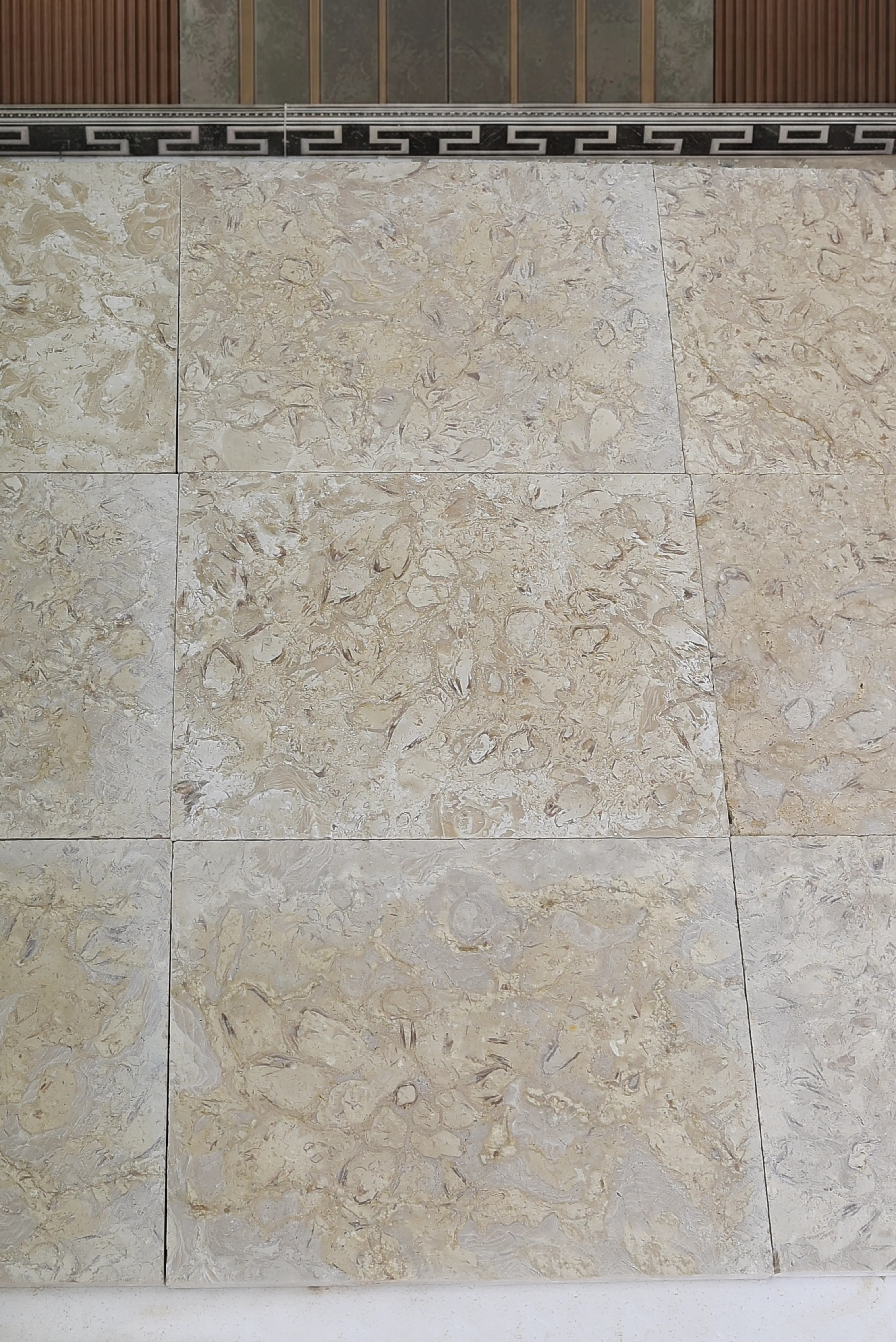
Natural Stone Options Worth Specifying for Eco Friendly Paving
Not every natural stone suits a permeable installation equally. Your material choice interacts directly with joint width tolerances, edge stability under point loads, and long-term sand retention — all of which affect how well the system maintains its drainage performance over time.
- Limestone pavers in the 2–3 inch thickness range offer excellent compressive strength (typically 4,000–8,000 PSI depending on density) and hold joint edges cleanly over freeze-thaw cycles when properly bedded
- Basalt provides exceptional hardness (Mohs 6–7) and very low absorption rates, making it ideal for high-traffic permeable applications where joint fines need to stay stable
- Travertine works well in moderate-traffic residential settings but requires you to account for its higher void content — select filled-and-honed grades for permeable applications rather than unfilled stock
- Granite setts handle driveway-level loads comfortably and maintain tight dimensional tolerances, which keeps joint spacing consistent across large installations
- Irregular flagstone delivers the most natural aesthetic but demands more careful base preparation since variable thickness creates differential settlement risk in open-jointed systems
The aggregate paving stones category — meaning natural stone set over a free-draining angular gravel base without mortar locking the joints — represents the highest-performing eco option across all these materials. According to Natural Stone Institute stone variety technical data, natural stone materials maintain structural integrity under cycling load conditions that would compromise engineered alternatives, which matters particularly in open-jointed configurations where edge support is reduced.
Sub-Base Specification: Where Drainage Performance Is Decided
The sub-base specification is where most eco friendly paving stone installations succeed or fail. You’re not just creating a stable platform — you’re engineering a water management layer that has to function reliably for 20-plus years under thermal cycling, load variation, and organic material infiltration from above.
For residential permeable applications, your minimum sub-base depth should be 6 inches of compacted angular gravel (typically ¾-inch clean crushed stone), sitting over a geotextile membrane that prevents subgrade soil migration upward without restricting drainage downward. For driveways or any zone taking vehicle loads, increase that to 10–12 inches and evaluate your native soil’s infiltration rate before finalizing depth — clay-heavy subgrades may require a deeper aggregate column or lateral drainage channels to prevent hydrostatic pressure buildup beneath the pavers.
- Use angular, not rounded, aggregate — rounded stone compacts poorly and migrates laterally under load, creating settlement in the paver layer above
- Your bedding layer should be 1 inch of coarse bedding sand or fine crushed aggregate, not fine-washed sand, which migrates into sub-base voids under water flow
- Maintain joint width between 3mm and 8mm depending on stone type — narrower than 3mm restricts drainage; wider than 8mm allows bedding material to surface-migrate
- Specify jointing aggregate rather than polymeric sand for truly permeable installations — polymeric sand reduces infiltration rates by up to 60% as it cures
Paving and Stones Ideas That Actually Work Environmentally
The most effective sustainable layouts combine material selection with intelligent surface geometry. Permeable and eco-friendly paving stones perform best when the layout actively encourages water to move vertically rather than shunting it laterally to the nearest edge or drain.
Consider a running-bond or herringbone pattern rather than stack bond for driveway applications — the interlocking geometry distributes load across more joint interfaces, which reduces individual joint stress and maintains the open-jointed structure under repeated wheel load. For garden paths and patio zones, a stepping stone approach with planting pockets between larger format stones creates the highest infiltration ratio of any configuration — sometimes exceeding 95% of rainfall absorbed on-site.
- Sloping your overall surface no more than 1–2% toward planted beds rather than drains keeps water on-site and directs it toward root zones
- Combining large format eco-friendly paving stones with crushed aggregate infill panels creates visual interest while maximizing the permeable footprint
- Edging with natural stone kerb or cobble border locks the permeable field and prevents lateral migration of jointing aggregate without compromising drainage
- Installing a dry-laid border of smaller cobbles around permeable field areas creates a natural filter zone that reduces fine sediment entry into the sub-base
For projects that need to balance aesthetics with water management, explore our open-jointed stone paving options — they’re specified for exactly this kind of performance-first application where drainage and durability need to coexist.
Seasonal Timing: When to Schedule Your Installation
Permeable stone installations have a narrower installation window than most buyers realize. Sub-base compaction, bedding layer stability, and jointing aggregate settlement all depend on conditions that vary significantly through the year — and getting the timing wrong can undermine a technically correct specification before the first rainfall test.
The practical sweet spot for most installations falls in the 45°F–80°F (7°C–27°C) ambient range. Below 40°F, angular gravel sub-base compaction becomes inconsistent because frozen or near-frozen aggregate doesn’t consolidate uniformly, leaving voids that appear fine until the first spring thaw. Above 90°F, your bedding sand can dry and shift before the pavers are seated, which creates micro-settlement across large fields — particularly visible in late afternoon when thermal expansion is at its peak.
- Schedule large paving areas for morning starts when possible — thermal expansion in the stone is at its minimum, joint spacing reads accurately, and you avoid the late-afternoon alignment drift that occurs when the same stone expands 1–2mm across a 20-foot run
- Avoid scheduling final jointing aggregate sweep-in during high-wind days — fine aggregate scatters and joint fill depth becomes inconsistent
- In freeze-thaw regions, complete all installation at least 6 weeks before first frost so sub-base can achieve full consolidation before thermal cycling begins
- Spring installation in cold climates requires waiting until nighttime temperatures are consistently above freezing — a single overnight freeze after sub-base placement but before paver installation can disrupt compaction
- In hot, dry climates, dampen the sub-base before bedding layer placement during summer installs — this prevents premature moisture loss that reduces bedding layer stability during the paver placement phase
Delivery timing connects to installation windows too. Verify warehouse stock availability at least 4–6 weeks ahead of your scheduled start date — natural stone paving is heavy freight, and truck scheduling for full-pallet deliveries to residential sites often needs 2–3 weeks of lead time even when inventory is confirmed. Planning your installation window backward from a weather-optimal date gives you a realistic procurement schedule.
Thermal and Climate Performance of Natural Stone Paving
Natural stone’s thermal behavior is one of its most underappreciated eco credentials. Dense materials like basalt and granite absorb daytime heat and release it gradually after sunset, which moderates localized surface temperature in ways that impact plant health, barefoot comfort, and the urban heat island effect at the microsite level.
Lighter-colored limestone and travertine reflect a higher proportion of solar radiation — typically 40–60% reflectance compared to 10–20% for dark asphalt surfaces. This reduces peak surface temperatures by 20–30°F in direct sun, which in turn reduces heat re-radiation into adjacent structures and planting zones. The ASLA permeable surface and low-impact material guidance identifies permeable natural paving as one of the highest-performing sustainable surface options precisely because it combines stormwater infiltration with reduced thermal mass accumulation in dense urban settings.
- White and buff limestone paving reduces cooling load on adjacent structures compared to dark highly resistant surfaces
- Basalt and dark granite absorb more heat but redistribute it slowly, which benefits installations in climates where frost heave is the primary durability concern — stored heat moderates overnight temperature drops at the surface
- Open-jointed permeable installations reduce ambient surface temperature compared to solid-set equivalents of the same material because the joints allow airflow and evaporative cooling from the sub-base moisture
Sourcing and Quality: What to Verify Before You Order
Material sourcing directly affects the long-term performance of eco friendly paving stones, and not all supply chains are created equal. You’re specifying a natural material that varies by quarry, by seam within a quarry, and by the processing standards applied before it reaches your project site.
At Citadel Stone, we source our permeable paving stone products from verified quarries including locations in Portugal, Turkey, India, and selected quarries from the Middle East, applying warehouse-level quality checks for dimensional consistency, absorption rate, and surface finish uniformity before any stock ships to project sites. That process matters because dimensional variation above ±3mm in thickness creates bedding inconsistency in permeable installations — each millimeter of variation translates directly to a joint height mismatch that accelerates jointing aggregate loss under pedestrian and vehicle loads.
- Request absorption rate data for any stone specified in permeable applications — materials with absorption above 6% (by weight, per ASTM C97) may require sealing that compromises infiltration
- Verify that the stone is calibrated (mechanically cut to consistent thickness) rather than gauged only — calibrated stone reduces on-site thickness variation from ±5mm to ±1.5mm, which matters greatly for permeable bedding layer performance
- Confirm country of origin and quarry certification where possible — consistency in geology across a single quarry seam produces more uniform color and density than blended multi-quarry lots
- Check warehouse lead times relative to your installation window — stock availability is often seasonal for popular formats, and truck delivery scheduling for stone pallets to residential sites requires 2–3 weeks of advance coordination
According to USGS dimension stone production and use data, natural dimension stone is one of the most durable construction materials in documented use, with service life expectations that far exceed engineered concrete alternatives when material quality is correctly specified and verified at intake.
Maintenance That Protects Long-Term Permeability
The single biggest threat to permeable paving stones isn’t wear — it’s jointing material loss and sub-base contamination from organic debris. Your maintenance protocol needs to address both without compromising the open-jointed structure that makes the system perform.
Annual inspection of joint fill depth is non-negotiable. Jointing aggregate settles and compacts in the first 12–18 months after installation as the sub-base reaches full consolidation. You’ll typically need one top-up application of jointing aggregate in year two, then biennial checks thereafter. Never use polymeric sand as a replacement fill in systems originally specified as permeable — it cures into a semi-rigid matrix that blocks infiltration and can also trap moisture under the bond line, accelerating freeze-thaw damage in cold climates.
- Remove organic debris — particularly compacted leaf accumulation — before it decomposes into fine particulate that silts joint channels and reduces infiltration by 30–50% over 5 years
- Use low-pressure washing (below 1,200 PSI) rather than high-pressure blasting to clean the surface — high pressure dislodges jointing aggregate and displaces bedding layer material at joint edges
- Inspect edging restraints annually — if perimeter stones shift outward, the entire field can spread laterally, widening joints beyond the functional range and accelerating bedding loss
- Avoid applying penetrating sealers to the entire surface of permeable installations; if sealing is required for stone protection, apply only to the paver surface and mask joints to preserve infiltration
Proper maintenance also extends to understanding what surface cleaners are safe for both the stone and the sub-base biology. For a practical guide on caring for your installation without damaging the material, safe power washing techniques for stone pavers covers the pressure thresholds and nozzle angles that protect joint integrity during cleaning cycles.
Getting Eco Friendly Paving Stones Right: What Every Specification Needs
Specifying eco friendly paving stones well comes down to treating the installation as a system — material, sub-base, joint specification, and maintenance protocol all work together. Your stone selection sets the visual character and structural baseline; the sub-base and joint configuration determine whether the installation genuinely manages stormwater or just uses natural material as an aesthetic choice. Those are different things, and the specification decisions you make at the design stage are what separate them.
The ASTM natural stone testing and quality standards provide a solid technical baseline for absorption, compressive strength, and freeze-thaw durability verification — specifying to those benchmarks gives you defensible performance criteria regardless of which natural stone material you select. Citadel Stone maintains national warehouse inventory across key stone formats so your project timeline doesn’t get compressed by supply delays in critical installation windows. Compared to solid poured surfaces, Citadel Stone aggregate paving reduces surface runoff volume noticeably by routing water directly into a prepared gravel sub-base.
Related reading: natural stones for paving · Paving Stones for a Fire Pit: Safe Build Guide · laying circular paving stones.