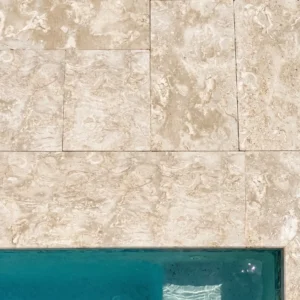
The material decisions you make in the first hour of specifying a natural stone paving project will determine whether the installation still looks sharp at the 25-year mark or starts showing premature joint failure within a decade. This natural stone paving guide covers the full specification chain — from quarry type to finish selection to field installation details — so every decision in the sequence is defensible, not just the aesthetic ones. Stone type, finish selection, and dimensional tolerances interact in ways that aren’t obvious until you’ve watched a few jobs come apart, and the variables compound quickly once you factor in base conditions, traffic loads, and sourcing constraints.
Understanding Your Natural Stone Options
Your first fork in the road is stone family, and it’s worth treating this as a structural decision, not an aesthetic one. Each family has a fundamentally different mineralogical composition that governs everything downstream — absorption rate, thermal expansion, compressive strength, and how the surface responds to wear. According to NSI stone variety technical specifications, these distinctions are well-documented in industry standards, but they’re rarely translated into plain language for project decision-making.
Limestone sits at the accessible end of the density spectrum, with compressive strengths typically ranging from 4,000 to 20,000 PSI depending on formation tightness and fossil content. The variation within limestone is wider than most specifiers expect — a dense oolitic limestone from Middle East quarries can outperform a soft domestic sedimentary stone by a factor of three in freeze-thaw resistance. That spread matters enormously when you’re comparing bids based on stone name alone.
Granite is the workhorse of heavy-traffic paving. Compressive strength runs from 19,000 to 30,000 PSI in well-tested specimens, water absorption sits below 0.4%, and the interlocked crystalline structure resists abrasion in a way that no sedimentary stone can replicate. The trade-off is thermal conductivity — granite surfaces heat up faster and hold heat longer, which affects barefoot applications and any context where surface temperature is a user comfort factor.
- Travertine: calcium carbonate base, open-pore structure moderates surface temperature, absorption rates 0.5–3.0% depending on fill treatment
- Basalt: fine-grained igneous stone, compressive strength 25,000–45,000 PSI, minimal absorption, excellent for heavy commercial use
- Bluestone: dense sandstone or siltstone variant, strong in flexure, holds a sharp arris well for step and coping applications
- Limestone: broad performance range, always verify density class and absorption before specifying for wet or freeze-thaw environments
- Granite: highest abrasion resistance of the common paving stones, ideal for driveways and high-pedestrian zones
- Flagstone: typically refers to format rather than stone family — confirm the parent stone to assess performance rather than relying on the generic label
Stone Finish Types and How They Perform in the Field
Finish selection controls three things simultaneously: slip resistance, maintenance burden, and long-term appearance. Most specifiers understand the aesthetic dimension — honed looks refined, tumbled looks rustic — but the performance implications of each finish choice are where natural stone paving projects succeed or fail in demanding conditions.
A sawn finish is the baseline. The diamond blade leaves a moderately textured surface with a Coefficient of Friction (COF) typically in the 0.5–0.7 range when dry. That’s acceptable for standard pedestrian paving but marginal for pool surrounds or any application where wet conditions are routine. The sawn face is relatively tight, which limits absorption on naturally porous stones like limestone and travertine.
Honed takes the sawn surface further through a series of abrasive passes until the texture is smooth but matte. It’s the finish where you feel the stone quality most acutely — any voids, soft spots, or filling inconsistencies become apparent under the abrasive sequence. For natural stones for paving in commercial applications, honed finishes require a sealer application cycle starting pre-installation to prevent the open surface from staining during grouting. Many installers skip this step and spend hours chasing grout shadows after the fact.
- Sandblasted: opens the grain, increases COF significantly, good for ramp and pool deck applications, accelerates absorption — seal promptly
- Bush-hammered: textured by repeated impact, highly slip-resistant, suits heavy-traffic public spaces, removes surface gloss permanently
- Flamed: high-heat treatment causes crystal expansion on granite, produces a heavily textured surface, changes colour rendering noticeably
- Tumbled: edge-softened and surface-aged through drum tumbling, produces a weathered aesthetic, slightly irregular thickness requires flexible adhesive bed
- Brushed: wire or abrasive brush passes produce an aged texture with softer grip than bush-hammer, popular for travertine and limestone pool pavers
- Polished: mirror surface, COF below 0.4 when wet — never specify for outdoor use without a subsequent grip finish treatment
The interaction between finish and stone family matters more than most product data sheets communicate. A flamed finish on granite produces a dramatically different tactile result than a flamed finish on limestone because the crystal structures respond differently to the heat cycle. Request a sample in your specified finish before locking in the order, not after.
Thickness, Format, and Load Capacity Specifications
Thickness decisions are engineering calls masquerading as aesthetic ones. The format and dimension of your stone paving stones directly affects load distribution across the base, maximum span between support points, and your exposure to breakage risk during installation and service. Per USGS dimension stone production data, natural stone paving accounts for a substantial share of dimension stone use in the USA — and the spec failures that drive replacement orders typically trace to undersized thickness, not material quality.
For standard residential foot-traffic paving, 30mm (1.25 inches) is the functional minimum in hard stones like granite or dense basalt. For limestone and travertine in the same application, move to 40mm to account for the lower modulus of rupture. Driveways with regular vehicle access demand 50mm minimum regardless of stone type, and heavy commercial applications or areas with articulated vehicle loads should go to 80mm or specify engineering stone in a structural format.
- Residential foot traffic: 30mm hard stone, 40mm soft stone — minimum
- Light vehicle access (cars, occasional delivery): 50mm across all stone types
- Regular heavy vehicle or forklift traffic: 80mm minimum, verify modulus of rupture for the specific stone batch
- Pool coping: 30–40mm in the face section, 50mm return — nosing overhang should not exceed 50mm without structural support underneath
- Steps and treads: 50mm minimum for residential, 80mm for commercial — longer spans between riser supports increase breakage risk sharply at thinner sections
Format — the plan dimensions of each stone piece — interacts with thickness through the span-to-depth ratio. A 600mm x 600mm slab in 30mm limestone has a span-to-depth ratio of 20:1, which is pushing the limit for any stone with a modulus of rupture below 1,500 PSI. Specifying natural stones for paving in large formats without adjusting thickness upward is one of the most common field errors in high-end residential paving projects.
Base Preparation: Where the Installation Actually Lives or Dies
Here’s what most specifiers miss: the stone is the least variable part of a natural stone paving system. Quarry-sourced natural stone has been hardening for millions of years — it doesn’t change. The base beneath it changes constantly, responding to moisture, freeze-thaw cycles, root pressure, and traffic loading. Your installation’s lifespan is determined almost entirely by what happens below the stone surface.
A minimum 100mm compacted crushed aggregate base is the starting point for residential applications. In clay-heavy soils or any area with a high water table, extend that to 150mm and add a geotextile separation fabric between the subgrade and aggregate. The fabric prevents fine clay particles from migrating upward into the aggregate over time, which is the mechanism behind the slow-motion settlement that produces lippage at joints five to seven years post-installation.
Bedding layer selection depends on your stone type and installation method. A dry-laid system uses a 30–40mm sand or fine aggregate bedding layer that allows minor adjustment and provides some drainage tolerance. A mortar-bed system locks the stone rigidly, which suits large-format slabs and any application where precision level is critical — but it requires full base integrity, because mortar beds don’t accommodate differential settlement gracefully. As outlined in ASLA outdoor paving material guidance, permeable base systems also offer environmental performance advantages that increasingly factor into landscape specification decisions.
Budgeting for Natural Stone Paving: Freight, Sourcing, and Labor Variables
Your total project cost breaks into three unequal buckets — material, installation labor, and logistics — and the relationship between them shifts significantly depending on where you source stone and how your site is accessed. Understanding this breakdown prevents budget surprises that typically surface at the invoice stage rather than the estimate stage.
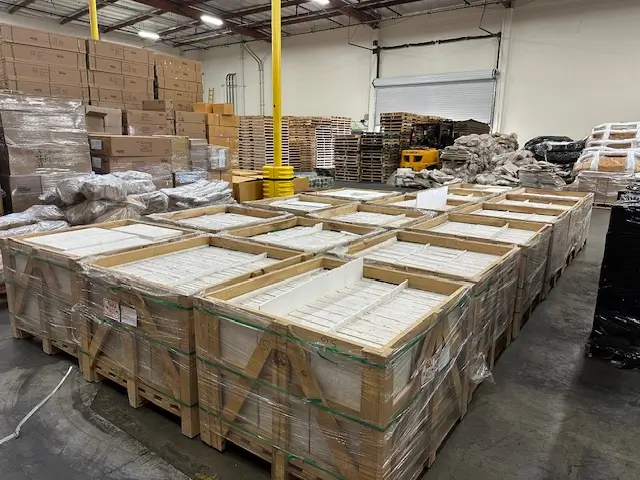
Material cost for paving stones in garden and landscape applications ranges from $8–$15 per square foot for standard limestone or travertine, up to $18–$35 per square foot for premium bookmatched granite or large-format basalt in specialty finishes. Those figures are at the point of supply — your delivered cost adds freight, which is where geography introduces real variance. Truck delivery of stone pallets is volume-sensitive: a full truck load of stone from a national warehouse distributes freight cost efficiently across the square footage, while a partial pallet order absorbs the same base freight across far fewer square feet. Ordering to minimize partial-load freight, especially for projects over 500 square feet, is one of the most straightforward ways to compress your material-delivered cost.
- Full truckload orders typically bring freight to $1.50–$3.00 per square foot depending on distance and access
- Partial pallet or partial truckload orders can push freight above $5.00 per square foot on smaller orders
- Specialty formats (large slabs over 1200mm, custom edge profiles) require blanket-wrap truck delivery at premium rates
- Site access constraints — low clearance, steep grades, narrow entries — may require a smaller truck at higher per-mile cost
- Labor-to-material cost ratio typically runs 60:40 for complex natural stone work, shifting to 50:50 on simpler formats
Sourcing decisions also affect lead time, which carries its own project cost. Stone drawn from selected quarries from the Middle East and consolidated through a national warehouse typically ships within two to three weeks of order confirmation. Direct-import orders bypass warehouse stock but introduce six to ten week lead windows that can stall project schedules and create cascading labor cost overruns. Citadel Stone carries warehouse stock of core stone types precisely to compress that window for time-sensitive projects. For our natural stone paving range, stock availability across finishes and formats is updated continuously so you can plan your procurement timeline with confidence.
Value engineering in natural stone paving usually comes from format decisions, not material substitution. Dropping from a 600mm x 900mm random-length slab format to a modular 400mm x 400mm grid in the same stone type can reduce labor time by 30–40% because the installer works from a fixed template rather than solving a dimensional puzzle on site. The material cost per square foot often increases slightly for modular formats, but the labor saving more than compensates on projects over 200 square feet.
Sealing Protocols and Long-Term Surface Maintenance
Sealing natural stone paving is not optional on any porous stone in an outdoor setting — the question is which sealer type, what application interval, and how to manage the sealed surface over time. Getting this wrong costs more in remediation than the sealer itself.
Penetrating impregnating sealers are the professional standard for outdoor paving. They enter the stone’s pore structure and repel water and oil without forming a surface film, so they don’t change the stone’s texture or COF — critical for any slip-rated application. Topical film sealers create a surface layer that produces a wet look but degrades under UV exposure and foot traffic, eventually delaminating in patches that look far worse than unsealed stone. Use topical sealers only where you can commit to annual reapplication and are comfortable with the altered surface appearance.
- Apply first sealer coat before grouting — this protects the surface from grout staining during the wet setting period
- Apply second coat 24–48 hours after grout cure, before opening the surface to foot traffic
- Maintenance interval: every 2–3 years for residential foot-traffic surfaces, annually for high-traffic commercial or pool surrounds
- Test sealer effectiveness with the water-bead test — if water absorbs rather than beads within 60 seconds, reseal immediately
- On tumbled or heavily textured finishes, increase sealer volume by 15–20% — the texture holds more sealer per square foot
Cleaning methodology is as important as sealer type. Alkaline cleaners above pH 10 will strip penetrating sealers from limestone and travertine in a single application — a common mistake when site supervisors reach for whatever concrete cleaner is on the truck. Specify pH-neutral stone cleaners explicitly in your maintenance documentation so the downstream cleaning crews don’t inadvertently shorten your sealer lifespan by half.

Joint Design, Expansion Gaps, and Drainage Integration
Joint design is the element most often treated as a cosmetic decision — grout colour, width, flush or recessed — when it’s fundamentally a structural and drainage decision. Joints that are too tight accumulate moisture, restrict thermal expansion, and produce edge spalling on stones with higher expansion coefficients. Joints that are too wide collect debris, flex under point loading, and degrade the visual continuity of the paving field.
The practical starting point for stone paving joints is 3mm in controlled internal applications and 5–8mm in external paving where thermal cycling applies. In environments with temperature swings greater than 60°F between summer peak and winter low, move to 8–10mm joints in large-format slabs to absorb the differential expansion without building compressive stress at edges. Granite’s thermal expansion coefficient runs approximately 7–9 × 10⁻⁶ per °C — at a 600mm slab dimension and a 35°C temperature swing, that’s roughly 0.14mm of movement per slab. Multiply that across a 10-metre run of paving and you accumulate nearly 2.5mm of total expansion that needs somewhere to go.
Expansion joints — full breaks in the stone field filled with a flexible backer rod and sealant — should be placed at every 4–5 metres in mortar-bed installations and at any change of direction, level transition, or junction with a building structure. Many specifiers default to the 6-metre expansion joint interval from generic tile standards, but that figure was developed for internal floor tiles in climate-controlled environments. Outdoor natural stone paving in exposed settings operates under far greater thermal load, and the shorter interval pays for itself in avoided remediation costs.
Slip Resistance Requirements and Safety Specification
Slip resistance for outdoor natural stone paving is governed by COF values that vary not just by stone finish but by the specific interaction between stone surface micro-texture and contaminant type. A bush-hammered granite surface with a dry COF of 0.8 can drop to 0.45 when contaminated with pool algae — still above the minimum 0.42 threshold in many commercial standards, but uncomfortably close in a barefoot pool environment where children are running.
The relevant standard for most commercial outdoor applications is ANSI A326.3, which specifies the wet dynamic coefficient of friction (DCOF) test method. Request ANSI A326.3 wet DCOF test results for any stone specified in pool surround, ramp, or step applications. Finish-level data alone — “tumbled” or “sandblasted” — doesn’t satisfy this requirement in a defensible specification document, and it won’t satisfy an insurance carrier reviewing a slip-and-fall claim.
- Residential patio and garden paving: dry COF above 0.5 — most natural finishes comply
- Pool surrounds and wet areas: wet COF above 0.6 — sandblasted, bush-hammered, or brushed finishes typically required
- Ramps: wet COF above 0.8 — flamed granite or heavily textured basalt, confirm with test certificates
- ADA-compliant pathways: surface firmness and stability standards apply in addition to slip resistance
- Steps and treads: leading edge nosing should contrast visually and maintain grip finish — do not polish or hone the nosing zone
Sourcing Quality Control and What to Verify Before Delivery
Stone sourced from reputable quarries still requires verification at the supply stage, because quarry output varies within a single production run based on formation depth, cutting position within the block, and seasonal moisture content during extraction. At Citadel Stone, we inspect incoming stone at the warehouse level against colour, finish consistency, dimensional tolerance, and surface integrity before it enters the available inventory — because discovering a batch variance after it’s been set in mortar costs everyone significantly more than catching it on the loading dock.
The specification checks you should require before accepting a delivery include dimensional tolerance (typically ±1mm on calibrated stone, ±2mm on non-calibrated), finish consistency across the batch sample, absorption test results for porous stones, and compressive strength certification for any structural application. These aren’t bureaucratic boxes — they’re the data points that determine whether your installation meets its design life or falls short of it.
- Request quarry origin documentation and batch number for traceability on large orders
- Inspect 10% of crates on delivery for edge chipping, surface scratching from pallet strapping, and moisture damage
- Compare delivered stone against approved sample for colour range — natural variation is expected, but the range should fall within the agreed sample envelope
- Verify thickness with a calliper on a 5% sample pull — under-thickness stone on a rigid mortar bed creates differential stress concentration at joint edges
- Check warehouse documentation for any hold or quality flag on the specific lot before delivery confirmation
Stone drawn from selected quarries from the Middle East — particularly the dense limestone and travertine formations from that region — consistently produces tight dimensional tolerances because the formations are geologically stable and the extraction methods are well-established. That said, batch consistency should still be verified against your approved sample, particularly for colour-sensitive applications like pool surrounds or feature paving where tonal uniformity matters visually.
Getting Your Natural Stone Paving Specification Right
A natural stone paving guide ultimately comes down to decisions made in sequence — stone family determines the performance envelope, finish determines the surface behaviour, thickness determines load capacity, and base preparation determines whether any of those choices matter at the 15-year mark. Miss a step in that chain and the downstream consequences compound.
Your specification should document all four layers explicitly: stone family and density class, finish with COF test data for any wet-area application, minimum thickness by traffic zone, and base depth with compaction specification. A one-page spec sheet that covers those four items will prevent more field problems than any amount of post-installation remediation. Freight and sourcing decisions belong in the spec too — ordering in quantities that allow full truck delivery, confirming warehouse stock before scheduling installation crews, and building a one-to-two week buffer for quality checks will keep your project timeline intact.
As you work through your paving specification, solid groundwork is the non-negotiable precondition that makes everything else perform as designed — our guide on getting the ground ready for stone walks through the base preparation sequence that underpins every durable installation. Choosing between a seating-area slab and a path stone involves thickness and finish decisions that Citadel Stone’s material guides walk through in practical detail.
Related reading: How to Cut Paving Stones Cleanly: Tools & Tips · How to Lay Paving Stones Step by Step.