What the permit process actually requires
Building rules on Bonaire have applied in their current form since 1 July 2017, under the Wet VROM BES, the Housing, Spatial Planning and Environment Act BES, together with the BES Bouwbesluit, which sets general standards for structural safety, user safety, fire safety and accessibility. A bouwvergunning is issued by the bestuurscollege, and the decision must be made within sixteen weeks of the application, extendable once by up to eight weeks.
- Conflict with the spatial development plan is a stated ground for refusal.
- A missing monument permit is also a stated ground for refusal.
- Failure against aesthetic or building-code requirements is a third.
- The governing plan is the Ruimtelijk Ontwikkelingsplan Bonaire, adopted by the island council on 8 October 2010 and revised since.
The monuments on the south coast
Bonaire carries protected monuments, among them the small houses on the south coast, on the route toward the Pekelmeer salt pans, in the white group at White Pan and the ochre group at Orange Pan. They date from 1850, they hold official protected monument status, and they stand as memorials to enslaved salt workers. They are not a design reference, and nothing on a paving specification should treat them as one. Where a project sits anywhere near them, the correct first step is to establish the consent position, not to look for a visual cue. The wider point holds across the island: a listed structure changes what is permitted on the ground around it, and that is a question for the authority rather than for the designer.
Coral stone is not a specification option
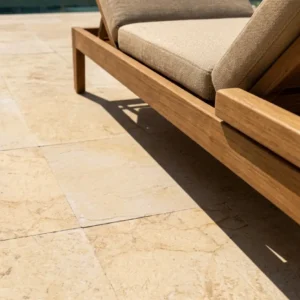
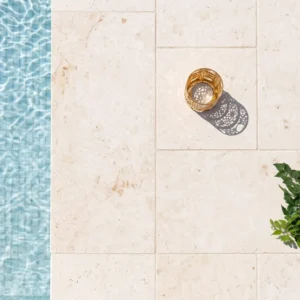
Historic construction in this part of the Dutch Caribbean used stone cut from the coastal limestone formations. That material can no longer be taken. Collecting coral, shells, sand or other natural material is an offense, with fines cited between 100 and 500 dollars depending on quantity, and a permit from the Bestuurscollege is required to remove living or dead material within the marine park. Imported limestone is the lawful modern route to a durable, light-toned wearing surface, and that is the honest way to frame it. It is not offered as a copy of anything, and a specification that leans on resemblance is starting from the wrong place. Choose the stone for what it has to do underfoot.
Read the building before you pick a stone
Do not assume what an older Bonaire property is made of. Establish it on site, because the fabric around a floor may be render over block, timber, coral limestone masonry, later concrete, or a combination added over decades.
- Photograph the wall base in raking light to see the real color and texture, not the painted tone.
- Check what the existing ground surface is and whether any part of it is itself protected.
- Find out whether the property or its plot carries a monument listing before drawings are issued.
- Record levels at thresholds, since older buildings rarely present a consistent one across a frontage.
Units that sit quietly beside older fabric
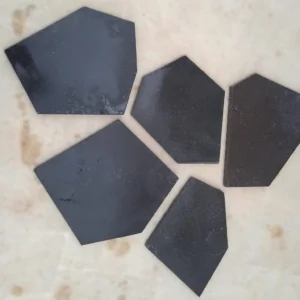
Once the constraints are known, the material question becomes narrow rather than open ended. Large sawn panels tend to argue with irregular older walls, while smaller units follow uneven perimeters and absorb the out-of-square geometry that older buildings almost always have. That argues for small cobble units laid by hand rather than a machine-set grid, with a face texture that does not read as glossy.
- Keep the unit small enough to close against a wall that is not straight.
- Choose a face that scatters light rather than reflecting it.
- Match the joint character to the surrounding surfaces instead of defaulting to a tight modern joint.
- Keep new work reversible where the consent conditions call for it.
What goes in the file
Permit decisions run to a fixed clock, so an incomplete submission costs weeks rather than days.
- Layout drawings showing extent, levels, falls and the junction with existing fabric.
- The material specification, including format, depth, finish and origin.
- Drainage and sediment control, which matters because the marine park boundary is the high-water mark.
- Any monument consent, obtained before rather than alongside the building application.
Language, register and who reads the file
Dutch is the official language on Bonaire, and permit paperwork sits inside a Dutch administrative system rather than a British or American one. Papiamentu is recognized and is what people speak day to day; it is a creole with Portuguese, Spanish, Dutch, English and West African roots. Money is the simpler half: the island has used the US dollar since 1 January 2011, so a specification priced by a US supplier needs no currency conversion at all.
Getting material to a sensitive site
Sensitive sites reward predictable deliveries, and Bonaire is well placed for that. A weekly service leaves Port Everglades on Saturday and reaches Kralendijk on Thursday, a five-day direct sailing, and the port works around the clock with a container terminal, handling equipment and warehousing. There is no import duty, and ABB applies at 8% on imported goods, calculated on the customs value plus insurance plus transport. You can read how we support Bonaire specifications before the permit file goes in. Get the consents settled early and the stone becomes the easy part of a heritage job.