The island keeps a wild side. The east coast – Toiny, the Grand Fond shore, the headlands where the surf spot everyone calls the Washing Machine churns – takes the trade wind first-hand and full-strength, and it builds differently because of it. Villas out here trade the sheltered anses’ softness for drama: green slopes dropping to a white-fringed sea, wind that never entirely stops, and a building specification with its collar turned up. Stone is the material that thrives on this coast, and the rules for using it are worth setting down.
Wind as the First Client
Everything on the east coast is designed for a client who never signs anything: the wind. It carries salt mist far inland of the surf line, drives rain horizontally when squalls cross, worries every loose edge and lifts anything unfixed. The design response is settled: mass over lightness, fixing over laying, texture over polish, and a landscape architecture that works with the wind’s lines instead of pretending calm. Terraces sit low and braced into the slope; walls do double duty as windbreaks; and the palette leans on stone precisely because the wind cannot argue with it.
The Salt-Mist Specification
Salt reaches surfaces here that never see a wave, and the specification answers island-wide rules at their strictest:
- Low-absorption density everywhere outdoors – the mist is constant, so the stone’s pores must be closed to it.
- Textured finishes throughout; the polish register does not survive the east coast’s wet mornings.
- Marine-grade fixings, rails and edge steel – the wind decides what corrodes, and it chooses cheerfully.
- A fresh-water rinse regime with real coverage, because the mist falls on everything, not just the sea-facing rail.
Uplift: The Detail the Coast Enforces
The wind-coast’s signature failure is uplift – copings, caps and loose furniture leaving in the first serious blow – and its signature discipline is the fixing schedule. Wall caps and pool copings are mechanically fixed as well as bedded; pergola and shade-structure bases are cast into the stonework rather than perched on it; and exposed terraces are furnished with mass or not at all. hardscape engineered for storm country sets out the full engineering logic, and the east coast applies it as everyday practice rather than storm preparation.
Building the Lee
The wild coast’s luxury is the engineered lee – the outdoor room that the wind passes over. Walls, levels and planting conspire to make it: a terrace dropped half a level below the wind line, a stone wall exactly high enough to lift the flow, a windward planting band that breaks the gust before it reaches the table. The craft is old – the island’s dry-stone walls were making lees for goats and gardens centuries ago – and the modern version simply does it with engineering numbers and better furniture.
The Green Slope Register
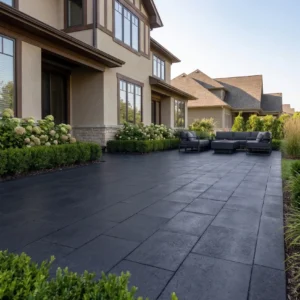
The east runs greener than the leeward island – the wind delivers its moisture as well as its salt – and the landscape register follows: stone paths threading windswept green, walls holding terraced gardens that the gusts prune naturally, and a palette where pale limestone reads brilliantly against the deep slope color. Planting choices lean native and wind-schooled, and the stone work frames rather than fights the coast’s own aesthetic – which is, after all, why the client bought here.
Working the Exposed Lanes
Construction logistics take the wind seriously too: crane and lift days are planned against the forecast, crated stone stages in the lee of structures rather than on open ground, and anything sheet-like – packaging, covers, cut tents – is secured with east-coast respect. Delivery scheduling keeps the margin the exposed lanes demand, and experienced crews simply build the wind into the day plan the way wet-country crews build in the rain.
The Windward Pool
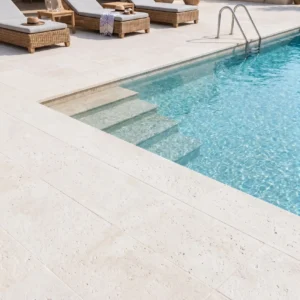
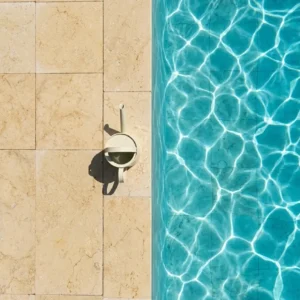
A pool on the wind coast is a different machine from its leeward cousins. The wind works the water all day – evaporation runs high, spray leaves the basin on every gust, and the heating bill of an unprotected pool reads like a weather report. The design responses stack: pools sit low in the terrace with wind walls taking the first force, covers earn their cost back in months and their housing is designed into the surround from the start, and the coping specification doubles down on fixing – mechanically anchored, always, because the wind that lifts a wall cap will happily test a pool edge. Deck drainage works harder too, catching wind-thrown water before it streaks the leeward face of the surround. None of it argues against building the pool: a sheltered basin glittering against the wild sea is the east coast’s definitive image, and the properties that engineer it properly own a drama the calm coast cannot stage. The engineering is simply the price of the theater, payable once, at specification time.
The Coast That Keeps You Honest
The east coast is the island’s honesty test: every shortcut shows, every fixing is audited by the next blow, and every terrace that holds its lee earns evenings the sheltered coast cannot match. The dry-latitude version of the same discipline is mapped in landscape lessons from a drier latitude, and the two coasts agree on the fundamentals. Fix everything, close the stone’s pores, build the lee – and the wild east pays out the best drama on the island for decades.
Glass, Rails and the Salt Ledger
The wind coast’s views demand transparent edges – glass balustrades, tensioned rails, the hardware that lets a terrace end in sky – and every one of those interfaces lands on stone. The junction detailing is where windward projects earn their keep.
- Base channels and post fixings are cast or cored into the stone edge with marine-grade everything; the wind tests each fitting personally.
- Glass panels sit clear of stone faces so movement never grinds an edge – the gap is a specification, not a tolerance slip.
- The salt ledger is real: glass on this coast is washed weekly or it is frosted by season’s end, and the wash water drains across the stone below, which is detailed to take it.
- Rail bases get drip clearance so the streak line falls on gravel, not the terrace face.
The transparent edge done properly disappears twice – visually into the view, and practically into a maintenance routine the household barely notices. Done casually it becomes the terrace’s permanent project. The difference is decided entirely at the drawing stage, in the junction details nobody photographs.
What the record actually says about this coast
The eastern shore has a documented benchmark. The National Hurricane Center report on Hurricane Irma records a peak intensity of 155 knots reached on 5 September 2017 about 70 nautical miles east-southeast of Barbuda, following a 70-knot strengthening in 48 hours that only around one in thirty Atlantic systems achieves, and category five status held for roughly 60 hours, the second longest such stretch on record. Saint Barthelemy sat in the southern eyewall and suffered significant damage, with French assessments putting economic losses above 480 million dollars. Anything specified for this coast is specified against that.
- Assume a direct eyewall passage rather than a glancing edge
- Mechanical restraint on every coping, nosing and edge unit
- Continuous edge restraint so one lost unit cannot unzip a field
- Nothing loose left on an exposed terrace during a watch
- Spare stock held on the island so repairs start immediately
The rest of the year is relentless rather than dramatic
Between storms this shore simply never gets a rest. Trade winds run onshore for most of the year, spray carries well inland, and surfaces are wetted with salt far more often than they are rinsed by rain. That attacks the assembly rather than the stone: fixings corrode, bedding softens, joints open and units begin to rock. The season itself is well documented, with the National Hurricane Center climatology putting the Atlantic season from June through November and the peak on September 10, which is exactly when nothing should be left unfinished.
- Non-ferrous fixings throughout, with no mixed metals in contact
- Joints designed to drain and be refilled rather than sealed shut
- Low-absorption units anywhere within reach of spray
- External works completed before the peak weeks each year
Choosing wind coast stone for the exposed east
The windward brief rewards conservatism at every level: dense material, modest units, restrained edges, honest falls and a repair path a small crew can follow without plant. Built that way, a terrace here becomes a maintenance item rather than a liability.
- Modular formats a two-person crew can lift and reset
- Granular or open bedding that can be reworked after a storm
- Services looped with slack so a damaged edge can be rebuilt
- An annual inspection written into the property calendar
Our St Barths stone supply guide sets out the formats, finishes and lead times that suit this island. On the wild side the sea sets the maintenance schedule, so the specification has to agree with it in advance.