Visitors assume every Caribbean island is lush. Turks & Caicos corrects them within the first taxi ride: this is a dry archipelago — low rainfall, no rivers, scrub-and-sand terrain that glitters rather than drips. Fighting that reality with thirsty lawns and tropical borders means a life sentence of irrigation on desalinated water. Working with it produces something better: the stone-structured dry garden, which happens to be one of the most elegant landscape styles in the world and is almost custom-made for these islands.
The dry-garden logic
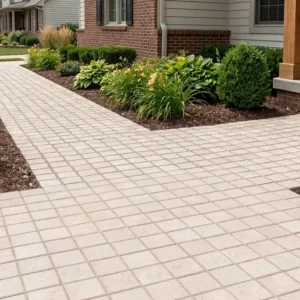
Where water is precious, hardscape earns a larger share of the plan and planting becomes curated rather than carpeted. The composition flips from the lush-island model: stone and gravel form the garden’s permanent fabric — terraces, paths, sitting courts, raked gravel fields — and plants appear as deliberate events within it, each chosen to live on what the sky provides. The result reads serene rather than sparse when the hard elements carry real design intent: generous stepping slabs set in gravel, low stone edges drawing rooms on the flat ground, a single specimen tree given its own paved apron. TCI’s flat, bright terrain suits this graphic clarity exceptionally well.
Gravel and slab, the working partnership
The dry garden’s workhorse surface is the gravel field crossed by stone. Pale gravel bounces heat less than continuous paving, drains instantly, asks for no water ever, and makes a satisfying acoustic threshold — you hear arrivals. Through it run the walking lines: large-format slabs at a comfortable stride, flush with the gravel so feet and furniture move easily. A weed membrane beneath the gravel is the difference between a crisp field and a maintenance argument; a firm sub-base under the slabs keeps the walking line true. Stone mulch — a gravel dressing over planting beds — cuts soil evaporation around the specimens, which is the dry gardener’s version of generosity.
- Pale gravel for the open field, because it drains instantly and reflects rather than stores heat.
- Stone slabs on the lines people actually walk, sized so a stride lands mid-slab.
- A stabilized edge between the two, so gravel stays in the field and off the paving.
- Membrane below the gravel where planting is sparse, and omitted where roots need to run.
Planting that belongs
The planting palette writes itself from what already thrives: sculptural agaves and aloes, silver-leaved coastal shrubs, sea grape trained as tree or hedge, frangipani for scent and silhouette, native thatch palms for height. Every one of them looks better against stone than against lawn — dry-climate plants evolved beside rock, and the pairing reads as natural because it is. Design-wise the rule is few species, repeated with confidence, each given space to show its form against a calm gravel or stone ground. This is also the lowest-maintenance planting philosophy available on the islands: no irrigation network to fail, no mowing, no weekly gardener dependency for a villa that stands empty between visits.
Sun, glare and the comfort map
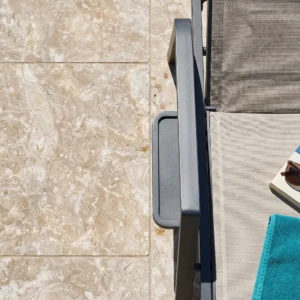
A dry garden is an open garden, and TCI’s light is fierce, so the design must manage brightness deliberately. All-white ground surfaces at midday produce genuine glare; the remedy is tonal mixing — cream and beige gravels rather than pure white, mid-toned stone in the largest fields, the brightest material reserved for shaded courts and evening terraces where it performs beautifully. Shade itself becomes the garden’s luxury: a pergola, a sail, a generous tree, each casting its comfort over a stone sitting area. The finish choice matters too — honed and brushed surfaces scatter light where polished would flash it back.
Keeping a dry garden
Maintenance is light but not zero, and it is pleasingly mechanical: rake and top up gravel annually, renew the weed membrane’s edges where planting expands, sweep wind-blown sand off slab lines after big blows, and prune the specimens for silhouette once or twice a year. No irrigation timers, no turf disease, no daily watering bills on RO water. For owners abroad most of the year it is the only garden style that looks composed on the day they land without a staff presence in between — and for rental villas it photographs with the same graphic confidence it shows in person. The TCI stone guide covers the materials; the courtyard-and-path thinking from greener islands translates here with the water simply designed out.
- Rake and top up the gravel once a year, before the season rather than after it.
- Renew the membrane edges wherever planting has expanded past its original line.
- Sweep wind-blown sand off the slab lines after every big blow.
- Prune the specimens for silhouette once or twice a year, and leave them alone in between.
When rain does come: harvesting the rare gift
A dry island values its rain in inverse proportion to the amount it receives, and the stone garden can be plumbed to catch the gift. Design the falls of terraces and paths so their runoff finishes in planting basins rather than soakaways — a shallow gravel-dressed depression at a specimen tree’s drip line stores a downpour where roots can drink it for days. Stone-lined runnels can carry roof and terrace water visibly to these basins, turning a five-minute shower into a small landscape event and every hard surface into a catchment. Cistern overflows deserve the same thinking: route them to the garden’s thirstiest corner instead of wasting them to ground. None of this requires irrigation hardware — it is grading, gravel and intent, built once when the stone goes down. In a climate where every millimeter counts, a garden that drinks its own runoff is measurably more generous than its rainfall says it should be, and the stonework is what makes the arithmetic work.
Shade trees for a dry island
The dry garden’s one non-negotiable luxury is shade, and on a low-rainfall island the trees that provide it deserve strategic selection. The proven performers are the coastal natives and long-naturalized stalwarts: sea grape, grown as a broad multi-stem, casts generous shade and shrugs both drought and salt; native thatch palms deliver height and movement on almost no water; frangipani earns its place with sculpture and scent though its shade is lighter; and the classic broad canopies — where space and a little establishment watering allow — become the garden’s living pavilions. Placement is a stone decision as much as a planting one: a shade tree belongs where its afternoon shadow lands on the sitting court, which is a simple study with a compass and an honest hour in July. Give each tree a gravel-dressed basin that harvests what rain does fall, respect the root-versus-paving distances that keep future terraces flat, and accept the one honest trade of tree-over-stone: leaf drop, swept weekly, in exchange for ten degrees of afternoon mercy. Young trees need patient establishment watering for their first seasons — the single water investment a dry garden should happily make, because a mature shade canopy is the only garden feature that makes a hot island measurably kinder every year it ages.
Choosing the stone for a low-water garden
A dry garden puts stone under conditions most gardens do not: full sun for most of the day, almost no shade cover, and long dry spells broken by short, heavy rain. Material selection has to answer that rather than a catalog photograph. The Natural Stone Institute records that limestone absorption spans from under one percent to above ten, and that dolomitic stone generally shows higher density, lower absorption and better abrasion resistance.
- Low-absorption stone on the paths, so a downpour dries evenly rather than blotching.
- Higher abrasion resistance where grit blown off the gravel field acts like sandpaper underfoot.
- Pale tones throughout, since surface temperature is the difference between a used path and an avoided one.
- Acid-sensitive stone kept away from fertilizer routes and citrus planting.
- One stone family across paths, steps and seating so the garden reads as a single idea.
Laying paths that survive a dry season and a downpour
The failure mode in a dry garden is not wear; it is movement. Ground that shrinks for months and then takes a sudden soaking will find any weakness in the way paving was laid. The choice of setting system decides how much of that movement reaches the stone, and this guide to detailing stone paving lays out the options.
- Sand-set paving where the path can flex and individual slabs can be lifted and relaid.
- Mortar-set construction reserved for steps, seat walls and anywhere stability governs.
- Pedestal systems where a terrace sits over structure and free drainage is the point.
- Compacted base depth matched to the traffic, not to the thickness of the stone.
- Falls that send water into planting basins rather than off the property.
Where the water actually goes
Rain on a dry island is a resource, not a nuisance, and the hardscape is the largest collector on the site. Directing it deliberately costs nothing at design stage and is expensive to retrofit.
- Terrace and path falls aimed at planting basins rather than soakaways.
- A shallow gravel-dressed depression at the drip line of each specimen tree.
- Roof runoff routed through the garden before it leaves the plot.
- Overflow paths planned for the rare heavy event, so basins do not scour.
- Gray water kept clear of stone paving, where residue shows quickly in strong light.
Dry island landscaping that stays green on little water
The trick is not to fight the climate but to change the ratio. Let stone and gravel do most of the ground plane, spend the water budget on a small number of well-placed specimens, put shade where people actually sit, and catch every drop of rain the roof and terraces collect. Gardens built this way look composed in June and still look composed in October, which is more than an irrigated lawn can claim here. If the hard surfaces are still being chosen, the format and finish thinking in our guide to stone supply across Turks and Caicos is the natural next step. Spend on shade and stone, ration the water, and a dry garden looks generous all year.