Roseau occupies one of the region’s tightest urban sites: the capital pressed onto a river-mouth fan between the Caribbean Sea and mountains that rise like a green wall a few streets inland, its historic grid of creole townhouses running from bayfront to botanic gardens, with the Roseau River — placid or ferocious by the hour — cutting the town’s northern edge. The capital’s ground works harder than almost any in the cluster, and its stone story is the island’s urban chapter. Here is the riverside-capital guide.
The fan-delta predicament
The city sits on the river’s own deposits, and its urbanism answers the geometry: streets draining seaward on falls the rain-country arithmetic would respect, the river’s flood profile governing everything within reach — the Maria rebuild re-armored the banks after the storm sent the river through the town — bridge approaches and revetments on ghaut-grade armor, and the mountain’s runoff transiting the capital on engineered paths: Roseau’s first infrastructure is drainage, and its pavements are the system’s lid.
Creole-townhouse streetscape
The capital’s architectural voice is the creole register: stone ground floors and timber uppers under steep gables, verandahs and jalousies over narrow pavements, and a grid that photographs like nowhere else in the region. Street craft serves the ensemble: pavements on the working-heritage balance, thresholds negotiating a town where every ground floor trades, the ensemble-restraint discipline under the painted timber, and repairs matched so the streetscape ages together — the capital’s charm is cumulative, and its ground keeps the account.
- Keep the stone base and timber upper relationship rather than replacing it.
- Use lime-compatible mortars where new work meets historic masonry.
- Match coursing to the surviving buildings on the same street.
- Keep interventions reversible, since the fabric is what carries the value.
Cruise days on the bayfront
The ships berth against the town itself — the bayfront’s sea wall doubling as promenade and dock apron — and cruise arithmetic runs at point-blank range: gangways delivering thousands directly into the grid on the surge-management craft, the working-capital balance between excursion flows and market-town business, vendor and taxi economies on district-duty ground, and the excursion pivot: Roseau is the gateway to the trail-and-falls product, and the bayfront’s job is launching the island’s wilderness day from a heritage doorstep.
The gardens and the green wall
The town ends uphill in the Botanic Gardens — the region’s finest, laid out in the 1890s, complete with the famous bus-crushed-by-baobab from Hurricane David as involuntary sculpture — and the gardens run the capital’s soft register: walks on the canopy-ground craft, event lawns for the national calendar, and the garden-evening register for the capital’s gentlest hours. Above them the mountains take over — the green wall that gives Roseau its backdrop and its weather, and the hillside disciplines governing the residential slopes that climb until the rainforest says stop.
- Design the uphill routes for constant runoff from the slope above.
- Keep gradients walkable, because this town is crossed on foot.
- Provide shade along the longer routes rather than only at destinations.
- Detail the junction between street and garden so neither dominates.
Market-town metabolism
Roseau’s daily life runs through its markets — the produce market’s dawn economy on working-grade floors, Saturday’s full-island convergence, the small-premises fabric threading every street — and the farm economy arriving nightly from the heights. The capital is the island’s exchange; its ground handles produce crates and cruise sneakers with the same honest surfaces, and the specification never forgets which came first.
Serving the riverside capital
Roseau’s work blends flood armor, heritage streetscape, cruise duty and market honesty on the cluster’s tightest site — supplied on the island logistics line through a port that is also the front door. The island supply guide serves the capital’s registers with the town’s own pragmatism: armor where the river rules, restraint where the creole ensemble does, duty grades where the thousands walk — because the capital between the mountain and the sea wall has no ground to waste, and every square meter works two jobs minimum.
Stitching the banks: the capital’s crossings
Roseau’s river splits the capital, and the town’s bridges are its most hard-working civic stone: the crossings that stitch the historic core to the northern districts carry the capital’s commute, its market traffic and its flood history in the same spans. The engineering chapter is the Maria curriculum’s signature subject — the storm turned the river into the town’s destroyer, and the rebuilt crossings answer with cleared spans sized for debris-laden flood flows, armored abutments on the scour-protection logic, and approach levels that respect what the river proved it could reach. The civic chapter rides above: crossings as promenade — pedestrian widths that make the bridge a walk rather than a gauntlet, balustrades at lean-and-look height over the water that is, most days, the capital’s prettiest feature — and the junctions where bridge meets bank knitted into the riverside walk’s ground.
The river’s edges complete the system: bank revetments doing their armor work in dressed stone that the town can also sit on, the riverside market’s steps and landings where the water is neighbor rather than threat, and the maintenance rhythm the geography writes — channels kept clear of the debris that becomes battering ram at flood, inspections after every serious rain, the wealth-and-hazard doubleness managed in the capital’s most visible cross-section.
For the town’s people the crossings are simply how Roseau works — the school run, the market morning, the evening stroll all funnel over the water — and their quality is felt rather than discussed, which is civic stone’s highest compliment. The river will keep testing; the rebuilt spans were designed knowing it; and the capital’s two banks hold together on exactly that knowledge, poured, armored and walked daily.
What protection applies in the capital
Roseau operates under a statutory heritage regime. The Physical Planning Act 2002 allows the Authority to compile lists of buildings of special architectural or historic interest and requires 60 days notice before demolition, alteration or extension that would seriously affect character, permits Building Preservation Orders where a building or group matters for landscape, architectural, cultural or historical heritage, and defines adjoining land as extending 100 feet landward from the spring high water mark or 50 feet from a cliff top.
- Establish the listing status of every frontage before designing.
- Allow the 60 day notice period on any work touching listed fabric.
- Expect a preservation order to be possible on a group as well as a building.
- Read the 100 foot coastal line on any bay front parcel.
- Keep new work reversible where historic fabric is involved.
Choosing stone for a wet, salty, busy town
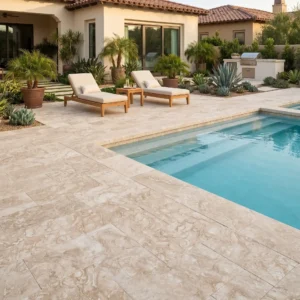
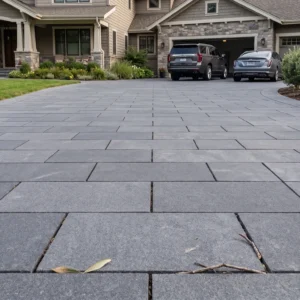
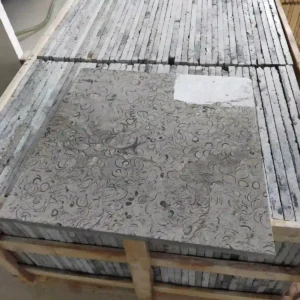
Roseau puts a surface between a river, a sea wall and a cruise berth, which is a demanding combination. The reference from the Natural Stone Institute on limestone gives the properties that decide survival: absorption running from below one percent to above ten across the family, dolomitic varieties denser with lower absorption and higher abrasion resistance, and the whole family vulnerable to alteration by mild acids.
- Specify low absorption anywhere the sea wall spray reaches.
- Prefer dolomitic material on the routes cruise crowds actually use.
- Keep acidic cleaners off the maintenance schedule entirely.
- Expect algae on the shaded southern streets and plan the finish for it.
A capital between a river and a sea wall
The old town sits on a narrow shelf with the Roseau River on one side and the sea on the other, which means the ground plane is managing water from two directions at once. Add a mountain immediately behind delivering runoff downhill and the drainage design becomes the main event.
- Design for water arriving from uphill as well as from the sea.
- Keep the river edge clear rather than building tight against it.
- Route surface water into the existing system rather than adding new outfalls.
- Expect the whole ground plane to be underwater occasionally and detail for it.
Riverside capital stone between ravine and reef
Roseau is a listed streetscape on a narrow shelf, managing a river, a sea wall and a mountain behind it. Confirm the listing position, allow the notice periods, keep absorption low and design the ground plane as a drainage system first. Our Dominica stone supply guide sets out the formats, finishes and lead times that suit this island. The town has flooded and rebuilt more than once, and the surfaces laid now are the ones that decide how the next one goes.