Nevis perfected a hospitality genre the luxury world keeps rediscovering: the plantation inn — the old estate great house and its grounds reborn as a small hotel, sugar-mill ruins in the gardens, afternoon tea on stone verandahs, and a guest book that reads like a diplomatic register. The island’s inns are institutions running decades deep, their craft is the adaptive-reuse chapter at its most intimate, and their ground — terraces, ruins, gardens, approaches — is where the genre’s magic is actually stored. Here is the inn-tradition guide.
The great-house register
The inn’s heart is the conserved great house, and its ground runs heritage-first: verandah and terrace stone maintained on the manor-conservation manners, thresholds worn by two centuries of arrivals kept worn — the patina is the product — dining terraces on the long-service craft where dinner runs to candlelight, and the stewardship humility governing every intervention: guests pay for the centuries; the works must never spend them.
Ruins as the garden’s soul
The inns’ signature is inhabited archaeology: mill towers holding honeymoon suites, boiling-house walls framing the pool court, aqueduct arches over the garden walk — the arrest-not-restore philosophy executed at hospitality polish, with structural honesty hidden in the romance: stabilization engineered and documented, guest safety threaded through old fabric on the visitor-duty disciplines, lighting on the heritage-night register that lets ruins glow without costume. The ruin in the garden is the inn’s entire brochure; its keeping is the estate’s first budget line.
- Stabilize historic fabric before converting anything inside it.
- Keep new services surface-run and reversible rather than chased into old walls.
- Match new stone to the original coursing rather than to a modern module.
- Design the guest route so the ruin is the arrival experience.
Garden ground at inn pace
The estates’ grounds run the genre’s slow theater: arrival drives climbing through old estate walls, garden paths on the canopy-and-orchard registers under mango and mahogany the estates planted, croquet-lawn and tea-terrace formality holding the colonial-garden inheritance honestly, and the vervet negotiation conducted with inn-country grace — the troops are morning entertainment at breakfast distance and managed reality everywhere else. The pace is the product: ground built for strolling, nothing hurried, every surface an invitation to stay another night.
Small-inn operations, estate scale
Behind the romance runs the small-hospitality honesty at estate acreage: few keys carrying full operations, service circulation on working-grade ground threaded invisibly through gardens, the seasonal-works rhythm compressing maintenance into soft-season windows, and the wedding-and-event economy — the ruins photograph like nothing else in the region — on the celebration-infrastructure model scaled to estate intimacy. The inn earns like a boutique and maintains like a monument; its calendar is the reconciliation.
- Sequence the disruptive trades into the first weeks of the closure.
- Pre-cut and pre-sort material before the window opens.
- Hold matched stock on island so a repair never waits for a shipment.
- Zone the property so a wing can be handed back independently.
The Nevisian setting
The genre is inseparable from its island: Nevis Peak’s green cone above every garden, the spring-country wellness inheritance feeding spa ambitions, Pinney’s sand a shuttle ride below for the beach day, and the island’s protective planning culture — the Nevisian register — keeping the scale the inns depend on. The tradition survives because the island does; every inn is a vote for keeping Nevis Nevis.
Serving the tradition
Inn work runs the cluster’s most delicate procurement: conservation-matched stone for the great houses and ruins, working grades hidden behind the romance, garden registers at strolling pace, and the federation supply line timed to soft-season windows. The islands’ supply guide serves the genre with its own manner — matched, documented, unhurried — because the plantation inn sells the one thing that cannot be built new: time, standing in a garden, wearing stone. The job is keeping it standing, beautifully, for the next guest book.
The inn’s kitchen garden: provisioning from the estate
The plantation inn’s dining reputation increasingly grows in its own grounds, and the estate kitchen garden is the genre’s most charming working infrastructure. The program suits the acreage: raised and in-ground beds supplying the kitchen’s herbs, salads and island vegetables; the estate’s mature fruit — mango, breadfruit, soursop planted by earlier centuries — harvested into the menu; and the defended-enclosure craft applied at working scale, because a producing garden in troop country is either walled or shared. The ground craft runs the working-heritage register: paths on honest stone at barrow width, the potting and wash-down corner draining properly, beds edged in the estate’s coursing so the garden reads as the grounds’ working chapter rather than an allotment annexe, and the porous-ground logic keeping the mountain’s rain banked where the roots want it.
The hospitality layer is the garden’s second harvest: the garden tour folded into the inn’s slow theater — guests walked through before dinner to meet the menu — the chef’s-table narrative earning its provenance honestly, cooking classes and cocktail botanicals extending the program, and the kitchen’s scraps closing the loop through the compost the farm-economy instinct would recognize. Staffing folds into the estate’s rhythm — the gardener’s morning ahead of the heat, harvest before service, the quiet-season replanting on the soft-window logic.
The economics read small and compound: menu costs trimmed, the dining story differentiated in a market where every inn has ruins but not every inn has radishes, and the guest review’s favorite paragraph reliably featuring the garden. The estates always fed themselves; the inns that resume the habit serve the tradition twice — on the plate, and in the grounds’ working truth kept visibly alive.
The masonry language these buildings speak
An estate inn is built in a documented island tradition. The World Heritage listing for Brimstone Hill Fortress National Park describes construction in dressed basalt blocks with a rubble core, with local limestone used for quoins and for facing around doorways and embrasures, stone quarried on the middle and lower slopes of the hill, across a 15.37 hectare property inscribed in 1999 and built over roughly a century from the 1690s. Estate buildings on Nevis follow the same grammar at domestic scale.
- Expect a rubble core behind a dressed face rather than solid masonry.
- Reserve finer limestone for openings and corners, as the original work does.
- Repair like with like, since a hard modern patch fails around softer stone.
- Read the coursing before ordering, because it sets every dimension.
- Treat the basalt and limestone pairing as the house style, not a choice.
What the regulations expect of an estate property
Nevis sets its own rules and they reach the garden as well as the building. The Nevis Physical Planning and Development Control Regulations 2021 require waterfront buildings to stand at least 120 feet from the high water mark at every point, set a development buffer of at least 16 feet from the edge of a ghaut and 30 feet from a pond, prohibit filling a pond without the Director permission, and require a heritage assessment where a site is judged historically significant.
- Establish the ghaut buffer before laying out terraces or parking.
- Keep the 120 foot waterfront line in mind on any coastal estate parcel.
- Expect a heritage assessment on a property with standing estate fabric.
- Leave ponds and their buffers alone rather than seeking to fill them.
Refurbishing a hotel that only has twelve rooms
Estate inns are small, and that changes the economics of everything. A wing out of service is a large share of the revenue, so the works window is short and the phasing has to be precise. It also means a repair has to match perfectly, because a guest sees the whole property in a single walk.
- Phase by wing so the property never closes completely.
- Match material exactly, since the whole estate is visible in one walk.
- Keep a matched reserve for the life of the building, not just the contract.
- Design details a small in-house team can maintain without a specialist.
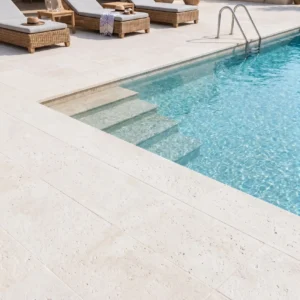
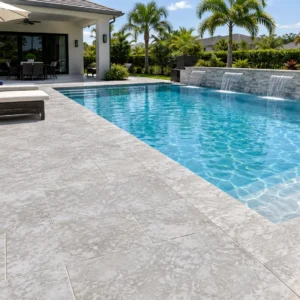
Plantation inn stone at the scale Nevis works in
A Nevis estate inn is a heritage building running as a small business, and both facts constrain the specification. Match the basalt and limestone tradition, respect the ghaut and waterfront buffers, phase by wing, and hold a matched reserve for the long term. Our St. Kitts and Nevis stone supply guide sets out the formats, finishes and lead times that suit this federation. The ruins are why guests book, so the stonework should read as care rather than as renovation.