The Grenadines’ small hotels serve a clientele no other market quite has: sailors ashore — charter crews wanting one night off the boat, cruising couples provisioning and laundering, regatta fleets booking by the dozen, and the overlap trade of land visitors chasing the chain’s sailing atmosphere. The yachtie guesthouse is its own hospitality genre, and its stonework serves salt-crusted arrivals and harbor-view breakfasts in equal measure. Here is the genre’s guide, written for the chain that invented it.
The guest who arrives by dinghy
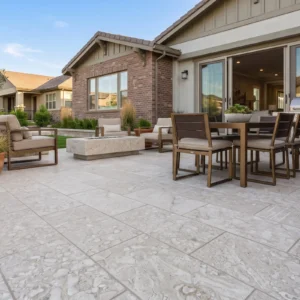
The genre’s defining arrival is waterborne: guests landing at the town jetty or the property’s own dock, salt-damp with bags in dry sacks, reading the establishment from the waterline up. The welcome sequence runs the dinghy-to-deck rules at hospitality pitch — textured landing steps, a gear-friendly route to reception, the rinse point that says this house understands boats — and first impressions form on surfaces: the harbor-front terrace visible from the anchorage is the listing photo working around the clock, and its stone reads seaworthy or tired from fifty meters.
- A landing and approach that reads well from the waterline, because that is the first impression.
- Textured surfaces from jetty to reception, walked by salt-damp feet.
- Somewhere to set a dry sack down that is not the floor.
- A rinse point before the interior, so salt stops at the threshold.
- Lighting on the whole route, since arrivals happen after dark more often than not.
Salt-crusted hospitality cycles
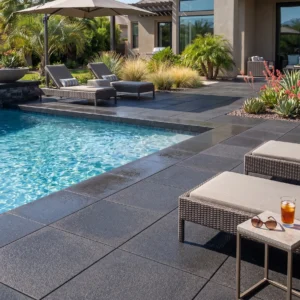
Yachtie guests run distinctive duty cycles: showers that rinse a passage’s salt (wet rooms on the full drainage discipline working overtime), laundry service as headline amenity with its working-yard stone behind the scenes, gear drying across every rail and surface — designed for rather than fought — and the bar-terrace evenings where three boats’ crews merge into one story-swapping table. Surfaces specify for the cycle: forgiving mid-tones, hose-friendly falls, furniture-proof edges and the barefoot-luxury register running at guesthouse warmth rather than villa polish.
The harbor-view breakfast economy
The genre’s revenue heart is the morning terrace: crews planning passages over coffee, the anchorage panorama as the menu’s first item, and the breakfast-service rules tuned to sailing rhythms — early service for dawn departures, tables sized for crew conferences, charts-and-guidebooks tolerance built into the furniture plan. The stone brief matches: dead-level fields for the laptop-and-coffee spread, morning-sun orientation studied as seriously as any sunset economics, and the harbor-facing edge composed for the photograph every guest takes on departure morning.
Regatta capacity, village scale
The chain’s event weeks — Bequia’s Easter above all — fill every bed and test every surface: the regatta-proof standard applies at guesthouse scale, with gathering terraces running redline evenings, stair and path circuits absorbing crowds in party shoes, and the overnight reset that returns breakfast standards by dawn. Properties specify to their biggest week knowingly — crowd-grade density on the social surfaces, attic stock for the season’s inevitable chips — and collect the dividend across the quiet months when the same surfaces host couples and calm.
- Gathering terraces specified for redline evenings rather than average ones.
- Stair and path circuits that absorb crowds in party shoes.
- An overnight reset that returns the property to breakfast condition.
- Drainage that clears a squall during a full house.
- Spare units held so damage from the busiest week is fixed before the next.
Small-island operations, guesthouse economics
Chain guesthouses run on the community fabric — family staff, village suppliers, maintenance by the island’s own hands — and their stone strategies match: phased upgrades through the freight calendar in low-season windows, batch continuity across years of one-terrace-at-a-time improvement, spares stored against the two-sailing replacement reality, and documentation simple enough for a family operation to actually keep. The economics reward the patience: each upgraded frame lifts the rate the anchorage pays, and the compounding is visible in the chain’s best-loved houses.
The genre’s reward
Done properly, the yachtie guesthouse becomes chain infrastructure: the recommended stop in every cruising guide, the shore night crews plan around, the establishment whose harbor terrace is part of the anchorage’s identity. Stone carries the promise — seaworthy surfaces, composed views, decades of salt-crusted welcomes absorbed gracefully — and the chain supply guide outfits the genre at its own scale: modest consignments, honest freight, finishes that read from the waterline. The sailing world keeps its addresses carefully; the houses built this way stay on the list.
The compound behind the counter: living where you host
Most Grenadines guesthouses are homes wearing a trade, and the architecture that keeps hosts sane is the compound plan: family quarters and guest world sharing a plot without sharing a life. The dividing line is drawn in ground as much as walls — a family yard screened from the guest terrace by planting and level change, a private entrance that lets the household come and go unobserved, laundry and kitchen zones sized for both worlds but circulating from the family side, and the small sacred spaces — the owner’s morning bench, the children’s corner — positioned where the guest map simply does not go. Stone does the quiet enforcement: paths that lead guests naturally to their world, thresholds that read private without a sign, courts that give the family their own outdoor room a full working season cannot invade.
The economics justify the drawing time. Host burnout closes more small guesthouses than competition does, and the compound plan is the burnout defense: a household that can retreat runs hospitality as a rhythm rather than a siege, keeps its standards through the long season, and lasts the decades the genre’s reputations are built on. The plan also survives success — when the extension adds rooms, the family side holds its ground because it was drawn as ground, not leftover.
Guests, for their part, feel the arrangement as warmth rather than distance: hosts who live well host well, and the compound’s hospitality is the sustainable kind — genuine at breakfast because it was off duty at midnight. For the chain’s family operators, the lesson is worth stating plainly: build your own house first, in the same stone and to the same standard as the guests’, and the business will be the better half of a good life rather than the whole of a hard one.
Grip where wet feet meet a commercial floor
A guesthouse serving sailors runs the wettest floors in hospitality, and the duty of care does not scale down with the property. This account of friction testing on stone walking surfaces explains the standard and its limits.
- ANSI A326.3 measures dynamic coefficient of friction and supports testing in place.
- The 0.42 benchmark applies to level interior surfaces walked on wet, which covers showers and thresholds.
- No exterior threshold is specified, so terraces, jetty approaches and steps need judgment.
- Polished finishes fail and have no place in this genre.
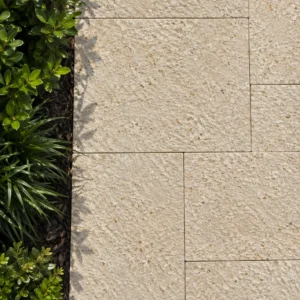
- Coarser honed finishes test better and cope with salt film.
The values a small property should still ask for
Buying thirty square meters does not mean buying blind, and the datasheet costs nothing to request. The Natural Stone Institute publishes the scope of methods used in dimension stone testing.
- ASTM C1353 for abrasion resistance on the terrace and the arrival route.
- ASTM C97 for absorption and density, which drives salt and sunscreen staining.
- ASTM C880 for flexural strength on steps and any unsupported edge.
- ANSI A326.3 for slip resistance on the finish actually being laid.
- The batch reference recorded so a later phase matches the first.
Phasing an upgrade around a sailing season
These properties cannot close, and the season decides when anything can happen at all.
- Works confined to the quiet months between charter seasons.
- One zone per season, delivered completely rather than three half-finished.
- Cutting done off site, since guests are sleeping above the work.
- Materials landed before the works window opens, not during it.
- A finish date with a real buffer before the first regatta booking.
Grenadines guesthouse stone for island and estate projects
This genre sells warmth, a view and a hot shower after a passage, and the surfaces that deliver all three are a short list: a grippy arrival route from the waterline, a breakfast terrace that survives a regatta week, a wet room that drains properly, and formats a local crew can repair between seasons. Spend there first and the rest can wait a year. Where the harbor town frontage sets the tone, our Bequia harbor stone guide covers it. Solve the walk from the dinghy and the review writes itself.