

Limestone’s compressive strength typically ranges from 4,000 to 20,000 PSI depending on formation density — and that single variable determines whether your garden installation holds up for eight years or thirty. Choosing limestone for gardens isn’t just a visual decision; it’s a structural and chemical one that most buyers only discover after the first winter cycle or after acid-forming mulch starts etching the surface. The right limestone grade for a patio surround behaves completely differently under foot traffic than the same material used as loose fill or dry-stacked edging, and conflating those applications is the most expensive mistake you can make at the specification stage.
Why Limestone Works in Garden Settings
Natural limestone brings a thermal mass advantage that most synthetic alternatives simply can’t replicate. The material absorbs heat slowly during the day and releases it gradually through the evening, which benefits adjacent plantings in cooler seasons by moderating overnight soil temperatures around bed edges and pathways. That thermal buffering is a genuine performance feature, not a marketing point.
Limestone’s calcium carbonate base also interacts with soil pH in a way that can subtly benefit alkaline-preferring plants over time. Surface weathering releases trace calcium into the surrounding ground, which is worth noting if your garden design incorporates lavender, rosemary, or other Mediterranean species near stone borders. It’s a modest effect, but one that experienced landscape architects factor into their plant palettes when specifying limestone edging at scale.
According to Natural Stone Institute limestone properties and specifications, the material’s porosity coefficient varies significantly between dense fossiliferous limestone and softer oolitic varieties — a distinction that directly affects how the stone handles freeze-thaw cycling, staining from organic material, and long-term finish retention. You need to know which formation type you’re buying before you commit, not after delivery.
Limestone Grades and Formation Types
The formation type you specify shapes everything — finish durability, slip resistance, maintenance frequency, and long-term color consistency. Dense limestone (also called hydraulic or hard limestone) has an absorption rate typically below 3%, which makes it well-suited for wet or freeze-thaw regions. Softer oolitic limestone can absorb up to 12%, which accelerates surface degradation if it’s used in applications it isn’t rated for.
Here’s the breakdown that matters for garden applications:
- Dense fossiliferous limestone: absorption rate 1–4%, compressive strength 8,000–20,000 PSI, suited for high-traffic patios, pathways, and coping edges
- Oolitic limestone: absorption rate 5–12%, compressive strength 4,000–8,000 PSI, better suited for decorative edging, low-traffic stepping stone runs, and dry-stacked walls
- Travertine-adjacent limestone: distinctive vein patterns, moderate absorption, requires void filling before exterior use or moss colonises the surface within two to three seasons
- White limestone rocks and pale buff formations: high solar reflectance (typically 55–70%), reduces heat island effect in paved garden areas — a genuine performance benefit in direct sun
The USGS has extensively documented limestone composition and construction applications, confirming that formation origin drives performance variation far more than surface finish alone. Specifiers who rely on finish appearance rather than formation data make costly material swaps mid-project.
Limestone Patio Stone Selection Criteria
Selecting limestone patio stone for garden use requires you to work through four criteria in sequence — application load, drainage geometry, finish selection, and thickness specification. Skipping any one of those creates a problem you’ll diagnose after installation, which is always more expensive than solving it during specification.
For application load, differentiate clearly between a pedestrian garden patio, a vehicle-adjacent path, and a purely decorative border. A pedestrian patio with occasional furniture requires a minimum 1.25-inch nominal thickness in dense limestone. Add a seating area with heavy planters and you should move to 1.5-inch minimum. Vehicle-adjacent applications need a full 2-inch slab supported by a compacted aggregate base of no less than 6 inches.
Drainage geometry is where most residential garden projects fail long-term. Your base layer needs a 1–2% cross-slope toward a positive drainage outlet. Without that, water pools beneath the stone during high-precipitation events, undermines the bedding layer, and initiates the rocking and settlement cycle that looks like a material failure but is actually a base failure. The limestone is rarely the problem — the substrate almost always is.
- Pedestrian pathways: 1.25-inch nominal thickness, 4-inch compacted gravel base, 1-inch bedding sand
- Patio slabs with furniture load: 1.5-inch nominal thickness, 6-inch compacted gravel base, 1-inch bedding sand
- Stepping stone runs in lawn: 1.5–2-inch thickness, set 1.5 inches below turf grade to avoid mower strike damage
- Dry-stacked garden wall coping: dense limestone only, minimum 3 inches thick, overhang no more than 1 inch from wall face
White Limestone Rocks in Garden Design
White limestone rocks occupy a distinctive functional role that goes beyond aesthetics. Their high albedo — the technical measure of solar reflectance — keeps adjacent soil cooler in summer, which benefits shallow-rooted perennials planted near stone-edged beds. Field performance data consistently shows surface temperatures 10–18°F lower on pale limestone compared to dark igneous alternatives under equivalent sun exposure.
The challenge with white limestone rocks in garden settings is organic staining. Leaf tannins, iron-rich mulch, and algae colonisation all discolor pale stone faster than darker alternatives, and the contrast makes staining more visually obvious. You can manage this effectively with a penetrating silane-siloxane sealer applied before first use and reapplied every two to three years. That sealer schedule adds a maintenance cost you need to factor into the project budget from day one.
White limestone also tends to show efflorescence — the mineral salt migration that creates white haze on surface finishes — more visibly than warmer buff or grey tones. It’s not a structural problem, but it’s a cosmetic issue that surprises homeowners who weren’t warned. The solution is a pH-neutral masonry cleaner applied in the first season, after which efflorescence typically stabilises as the stone’s moisture equilibrium normalises.
Finish Options and Performance Trade-Offs
The finish you specify on limestone for gardens changes the material’s slip resistance, maintenance requirements, and longevity simultaneously. There’s no universally correct finish — the right choice depends on the specific application and the user population for that space.
- Sawn finish: smooth, consistent thickness, lower slip resistance when wet — suitable for covered patios or areas with positive drainage and a textured anti-slip additive in sealer
- Honed finish: fine surface texture, moderate slip resistance, shows scratches over time in high-traffic zones — the default for most residential garden patios
- Tumbled finish: rounded edges, naturally aged appearance, excellent slip resistance from surface micro-texture — preferred for informal garden pathways and pool surrounds
- Brushed or antiqued finish: directional surface texture, good wet grip, hides efflorescence better than polished alternatives — well-suited for steps and ramp transitions
- Natural cleft or split face: maximum texture, irregular surface profile — best reserved for dry-stacked walls and rock garden features, not flat paving
Slip resistance is codified under ASTM testing protocols. For garden applications, target a Dynamic Coefficient of Friction (DCOF) of 0.42 or higher when wet — the threshold most building codes reference for outdoor pedestrian surfaces. Tumbled and brushed finishes typically clear this comfortably. Honed finishes hover right around the threshold, so sealer selection matters considerably for honed limestone patio stone in wet applications.
Budgeting for Limestone: Sourcing and Project Costs
Material cost is only one component of your real project budget, and in many markets it’s not even the dominant one. Freight distance from the supply warehouse to your site is a significant cost variable — natural stone is heavy, and trucking rates are distance-sensitive. A project sourced from a national supplier with warehouse inventory near your region can reduce freight to a fraction of what you’d pay importing equivalent material from an overseas quarry on a per-project basis.
Understanding the material-to-labor cost ratio in your specific market changes how you approach value engineering. In labor-intensive markets, specifying thicker, larger-format slabs that install faster per square foot can reduce total project cost even when material unit cost is higher. A 24×24-inch slab covers four times the area per set compared to a 12×12-inch tile — the labor savings on a 500-square-foot patio can offset the premium on larger-format material entirely.
Freight timing also affects project scheduling in ways that cascade into cost. You can check warehouse stock availability before committing to a start date — if your specified material is in stock at the nearest distribution point, your truck delivery window shrinks to days rather than weeks. Citadel Stone maintains national warehouse inventory that typically reduces lead times to one to two weeks, compared to the six to eight week import cycle most custom-order projects face. That scheduling certainty has real value when subcontractor costs are fixed-date commitments.
For budget planning, use these rough material-only benchmarks as starting points and adjust for your freight distance and quantity:
- Standard honed limestone patio stone pavers (1.25-inch): moderate price tier, widely available in national warehouse stock
- Large-format slabs (24×24 or 24×48, 1.5-inch): premium material cost, but labor savings on large installations can justify the difference
- Tumbled limestone cobbles for accent borders: premium per-square-foot but used in small quantities — typically a minor line item in the overall budget
- White limestone rocks for decorative fill or mulch replacement: priced by the ton, freight-sensitive given weight — confirm truck access to your site before ordering bulk quantities
The ASLA guidance on landscape material selection and construction consistently highlights total lifecycle cost — not just material purchase price — as the relevant budget metric for hardscape specification. Factor in sealing, cleaning, and potential joint sand replacement over a 20-year horizon when comparing limestone against lower-cost synthetic alternatives.
For a comprehensive look at the broader selection available for garden and patio applications, the Citadel Stone garden stone range covers thickness options, finish variants, and paver formats suited to the full range of residential and commercial garden projects.
Installation: Base Preparation and Joint Detailing
Base preparation is non-negotiable for limestone in garden settings, and the single most common reason for premature failure. The material itself is forgiving across a wide range of conditions — but only when it’s supported correctly. Without proper compaction and drainage, even the densest limestone will rock, settle, and crack within a few seasons.
Your base build-up for standard pedestrian garden paving should follow this sequence:
- Excavate to 10–12 inches below finished paving grade to accommodate sub-base, base, bedding, and stone thickness
- Compact subgrade to a minimum 95% Proctor density — skip this step and every layer above it becomes unreliable
- Install 6 inches of crushed aggregate (¾-inch clean or well-graded base rock) in two 3-inch lifts, compacting each lift with a plate compactor
- Place 1-inch bedding layer of coarse washed concrete sand — screeded level and NOT re-compacted before laying stone
- Lay limestone patio stone with consistent joint spacing of 3/8 to 5/8 inch — tighter joints in dense paving, wider joints in informal tumbled or irregular work
- Fill joints with polymeric sand, compacting it to 95% of joint depth — leaving joints underfilled is the leading cause of ant colonisation and weed germination in garden paving
Thermal expansion in limestone runs approximately 4.4 × 10⁻⁶ per °F, which is lower than concrete but still significant across large paved areas. For patio installations exceeding 15 feet in any direction, include a soft joint (expansion joint filled with flexible backer rod and sealant rather than rigid mortar) every 12–15 feet. Skip the expansion joints on a large patio and you’ll see compression cracking within the first two to three years as the slab heats in summer.
Sealing, Maintenance, and Long-Term Care
Limestone in garden environments faces a specific set of stressors that sealed indoor limestone doesn’t encounter: UV exposure, freeze-thaw cycling, leaf tannin staining, iron from mulch and soil, and biological growth from algae and moss. Your maintenance protocol needs to address all of these to achieve the 20–30 year performance lifecycle that dense limestone is genuinely capable of.
The sealer you choose determines your maintenance frequency more than anything else. Penetrating silane-siloxane impregnators are the correct choice for outdoor limestone — they don’t form a film on the surface (which would trap moisture and peel under UV exposure), they reduce water absorption by 80–90%, and they maintain the stone’s natural appearance. Topical coatings are a common mistake in residential garden projects — they look good initially, then yellow and flake within two to three seasons of UV exposure.
- Apply penetrating sealer to clean, dry stone before first use and allow 48 hours cure time before foot traffic
- Reapply every two to three years — test the sealer’s effectiveness annually by dropping water on the surface; if water no longer beads, reapply
- Clean with a pH-neutral stone cleaner annually — avoid vinegar, citrus cleaners, and anything acidic, which etch limestone’s calcium carbonate surface
- Address biological growth (algae, moss) with a diluted quaternary ammonium biocide — not bleach, which leaves chlorine residues that damage adjacent plantings
- Replace joint sand every five to seven years as polymeric sand breaks down from UV exposure and water infiltration
One detail that rarely makes it into standard maintenance guides: reseal the cut edges of limestone pavers after any field cutting during installation. The saw blade exposes fresh, unsealed limestone face on every cut edge, and those edges are the first point of moisture ingress and freeze-thaw spalling. A quick brush application of sealer to each cut edge before installation takes minutes and meaningfully extends the stone’s working life at its most vulnerable points.

Common Mistakes and How to Avoid Them
Most limestone garden installation failures trace back to a short list of avoidable decisions. The pattern repeats across residential and light commercial projects with enough consistency that it’s worth cataloguing them directly.
- Specifying soft oolitic limestone for high-traffic areas: it’s tempting because the price point is lower, but you’ll replace it in eight to ten years instead of getting the 25-year performance that dense limestone delivers
- Skipping the sub-base compaction: the bedding sand and stone above it are only as stable as what’s underneath — compaction shortcuts always show up eventually
- Using acidic cleaners on limestone: a single application of a common household cleaner can etch the surface finish permanently — train every maintenance crew member on this before they touch the stone
- Laying stone directly on undisturbed native soil in freeze-thaw regions: soil frost heave will dislodge pavers every winter without exception — the compacted aggregate base is what insulates the bedding layer from frost movement
- Neglecting to seal before first use: unprotected limestone in a garden environment will absorb staining from organic debris in the first autumn leaf fall — that first season’s exposure sets the staining baseline for the material’s life
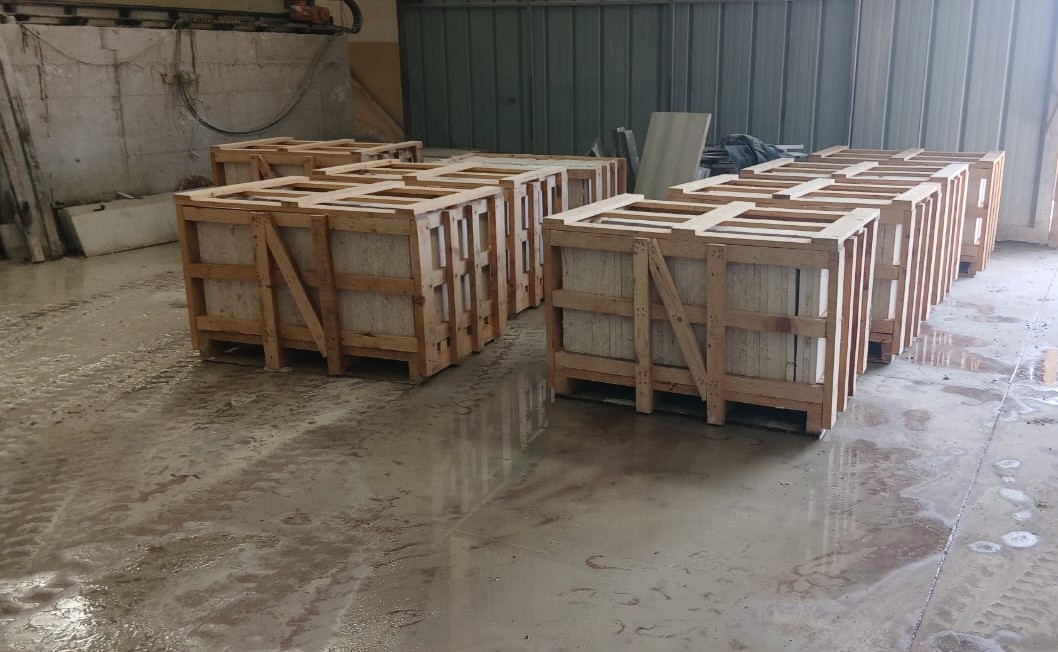
- Ordering without confirming truck delivery access: natural stone arrives on pallets on flatbed trucks, and if your site doesn’t have adequate truck access, you’ll pay for a crane lift or a labour-intensive hand-carry — confirm site access logistics before your delivery date
Choosing limestone for gardens also means understanding that the material is reactive to its environment in ways that non-reactive synthetics are not. That reactivity is part of what gives it its character — the way it weathers, develops patina, and integrates into a planted landscape over time. But it does require you to manage the conditions around it rather than treating it as a maintenance-free surface.
Limestone Garden Specification: Getting It Right
The decisions that define a successful limestone garden installation converge on a small number of variables: formation type matched to application load, base preparation executed to compaction spec, finish selection calibrated to wet slip resistance requirements, and a sealer protocol established before first use. Get those four right and choosing limestone for gardens delivers one of the most durable and rewarding natural materials available — according to Britannica’s geological documentation of limestone characteristics, its structural properties when properly specified are consistent with centuries of proven use in demanding exterior applications.
Budget planning benefits significantly from early sourcing decisions. Freight distance from the supply warehouse, truck delivery logistics, and the material-to-labor ratio in your specific market all affect total project cost more than the per-square-foot material price alone. Confirming warehouse stock availability before locking in a project start date protects your schedule against the delays that derail fixed-cost subcontractor arrangements.
At Citadel Stone, we work directly with specifiers and homeowners to match formation type, finish, and thickness to the actual conditions of each project — not just the aesthetic brief. The technical consultation at sourcing stage is where most specification errors get caught before they become field problems. As you refine your garden stone specification, complementary stone detailing can inform the full project picture — bullnose limestone edging profiles and safety covers edge treatment options that complete a well-specified limestone garden installation. When edging raised beds or framing planting areas, the limestone forms available through Citadel Stone offer a range of textures and densities worth comparing before purchase.
Related reading: How Limestone Weathers Outdoors Over Time · flagstone patio vs pavers · how to build a paver patio.