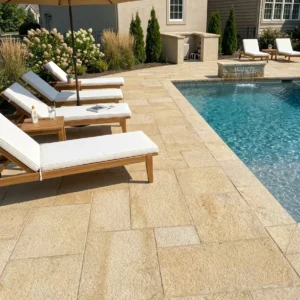
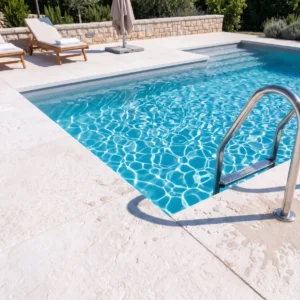
What Weathering Actually Does to Limestone
How limestone weathers outdoors is less about dramatic failure and more about a slow, cumulative process that reshapes the stone’s surface chemistry before it ever affects structural integrity. The calcium carbonate matrix that gives limestone its character is mildly soluble — not in water alone, but in the carbonic acid that forms when rainwater absorbs atmospheric CO₂. That’s the mechanism driving surface recession, and it’s why you’ll notice texture changes long before you see dimensional loss. According to NSI limestone technical specifications, outdoor limestone typically recedes at rates between 0.01 and 0.04 mm per year depending on rainfall acidity and surface finish — barely perceptible in a single season, but meaningful across a decade.
The mineral composition of your specific limestone slab matters more than most buyers realize. Dense, low-porosity varieties like Belgian Blue or hard French limestone weather at the slower end of that range. More porous oolitic limestones — the kind quarried in high volumes for their warm, creamy tones — absorb more moisture and react more readily with acidic precipitation. Your material choice at the specification stage is the single biggest lever you have over long-term surface condition.
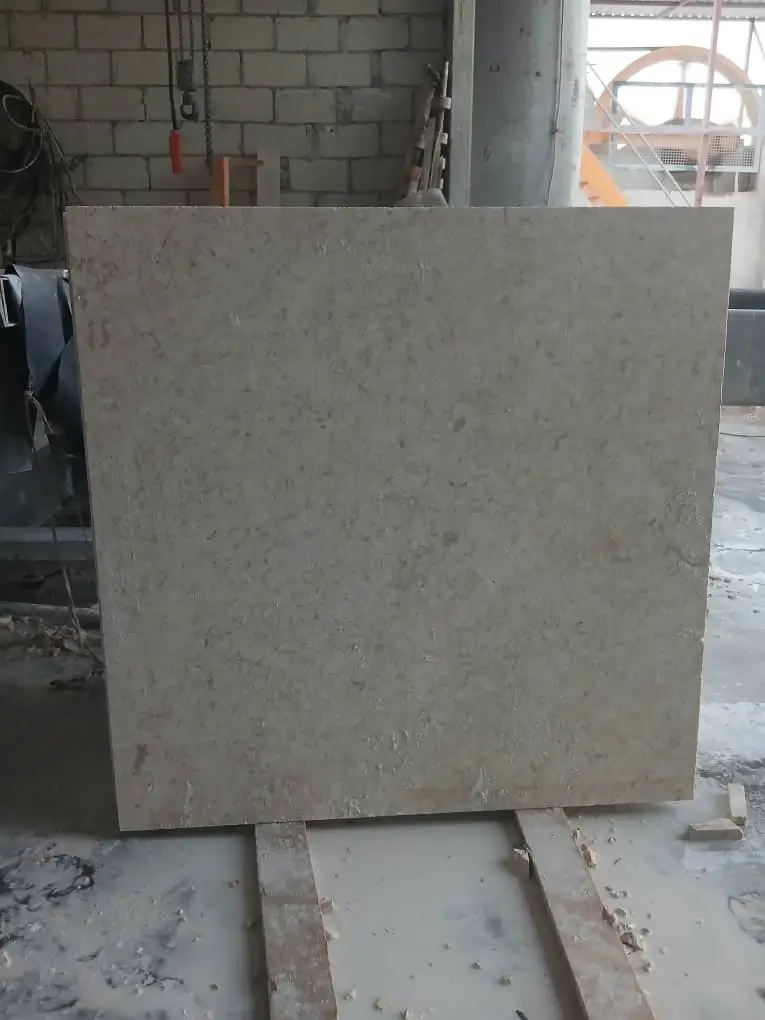
Surface Finish and Its Effect on Weathering Rate
The finish you specify shapes how limestone weather exposure plays out year after year. A honed surface has its micropores partially closed by the grinding process, which slows initial moisture uptake compared to a sawn or sandblasted finish. That said, the protective effect of honing is temporary — within three to five outdoor seasons, natural weathering reopens surface texture differences enough that honed and sawn slabs of the same stone converge toward similar absorption rates.
- Polished finishes offer the most initial protection but show acid etching most visibly — you’ll see dull patches within two seasons on exposed horizontal surfaces
- Honed finishes balance moderate protection with a forgiving aesthetic — minor etching blends into the matte surface rather than standing out
- Bush-hammered and tumbled finishes accept weathering most gracefully — the pre-aged texture means natural surface recession reads as continued patina, not damage
- Sawn finishes weather fastest in the first three years, then stabilize once the saw marks erode to a consistent micro-texture
The practical implication: for exposed horizontal paving that will see standing water and UV simultaneously, bush-hammered or tumbled limestone pavers are the most forgiving long-term choice. Polished limestone belongs on sheltered vertical applications or interior floors where chemical weathering is minimal. As USGS limestone composition data confirms, calcite-dominant limestones are particularly reactive to mild acids, reinforcing why finish selection directly governs the visual trajectory of your installation.
Patina Development: What to Expect and When
The patina timeline for outdoor limestone follows a fairly predictable arc, though the exact pace depends on your stone’s density and the acidity of rainfall in your region. Here’s what the weathering of limestone typically looks like across the first decade of outdoor exposure:
- Years one to two: Surface opens up — saw marks or hone scratches smooth out, the stone takes on a slightly softer visual texture, and lighter tones begin to shift toward warm ivory or silver-grey depending on mineral content
- Years three to five: Biological growth becomes the dominant visual factor — algae, lichen, and moss colonize shaded areas, adding green and black toning that many owners find attractive but some consider maintenance issues
- Years six to ten: A stable patina establishes itself — the stone surface has reached equilibrium with its environment, dimensional loss is negligible, and the visual character is essentially fixed unless active maintenance intervenes
- Beyond ten years: Surface recession continues but is imperceptible without precision measurement; structurally, well-specified limestone pavers remain fully serviceable for 40 to 60 years under normal pedestrian loads
Most owners are surprised to find that the ten-year patina is actually more beautiful than the original sawn surface — the visual warmth and depth that develop through natural weathering of limestone are part of what makes this material so valued in landscape architecture. The key is accepting that you’re specifying a living surface, not a static one.
Moisture Absorption and Freeze-Thaw Performance
Moisture is the primary driver of how limestone weathers outdoors in cold climates, and the two critical metrics your specification must address are water absorption rate and freeze-thaw resistance. According to Britannica’s limestone formation and characteristics, limestone’s interconnected pore structure allows moisture ingress that, in freeze-thaw regions, creates internal pressure as water expands approximately 9% upon freezing. That expansion, repeated across hundreds of freeze-thaw cycles annually, is what causes spalling, surface delamination, and in severe cases, structural fracture.
Your freeze-thaw specification should require an ASTM C170 compressive strength minimum of 4,000 psi for pedestrian paving and an absorption rate below 3% by weight for any stone used in regions with more than 25 freeze-thaw cycles per year. Limestone pavers that meet both thresholds — and there are excellent varieties that do — perform reliably in demanding winter conditions without the spalling issues that plague lower-density alternatives.
- Dense limestones with absorption below 1.5% are appropriate for the most severe freeze-thaw exposures
- Medium-density limestone (1.5–3% absorption) performs well in moderate freeze-thaw climates with proper sealing every three to five years
- High-absorption limestone (above 3%) should be restricted to warm, dry climates or sheltered vertical applications where freeze-thaw cycling doesn’t apply
- Base drainage specification is equally critical — free-draining aggregate beneath limestone paving prevents water from pooling at the stone underside, which is where freeze-thaw damage typically initiates
Biological Weathering: Managing Algae, Lichen, and Moss
Biological growth is the most visually active form of weathering limestone experiences outdoors, and it’s the variable that most often drives maintenance decisions. Algae establish within the first two years on north-facing or shaded surfaces — they’re not structurally damaging at early stages, but they create slip hazards and, if left unchecked, can host lichen that mechanically anchors into the stone surface.
Lichen is where biological weathering crosses from aesthetic to structural concern. The rhizines (anchoring structures) of lichen penetrate up to 2 mm into porous limestone, physically disrupting the grain structure as the organism grows. Removal of mature lichen requires careful technique — pressure washing alone tears surface material along with the organism. A low-concentration biocide application followed by gentle mechanical removal after a two-week dwell time is the professional approach. Your maintenance schedule should include an annual inspection and biocide application every two to three years in humid environments, regardless of whether visible growth is present.
For outdoor limestone paving in shaded courtyards or under tree canopies, specifying a tumbled or brushed finish rather than honed significantly reduces biological adhesion — the micro-texture doesn’t provide the stable film of moisture that smooth finishes do in low-airflow areas. This is a detail that experienced specifiers build into their finish selection from the outset, rather than addressing reactively after growth appears.
Sealing Strategies That Actually Affect Weathering Rate
The sealing decision is one of the most debated topics in limestone specification, and the honest answer is nuanced. A quality penetrating silane-siloxane sealer reduces moisture absorption by 60–75% in the first year after application — which directly slows both chemical and freeze-thaw weathering. For limestone pavers in high-rainfall or freeze-thaw regions, sealing is genuinely protective rather than cosmetic. For limestone in hot, dry climates, the benefit is largely preventive against staining rather than weathering mitigation.
Explore Citadel Stone outdoor limestone options to compare density ratings and absorption specifications across available varieties — these numbers directly determine which sealing protocol your project requires. At Citadel Stone, we evaluate each incoming limestone shipment for absorption rate before it enters warehouse inventory, which means you’re getting documented performance data rather than generic supplier estimates when you request technical sheets.
- Apply sealer only to clean, dry stone — moisture trapped beneath a sealer accelerates, rather than prevents, biological growth
- Penetrating sealers (silane-siloxane chemistry) are appropriate for exterior horizontal surfaces — they don’t alter surface texture or sheen
- Topical sealers create a surface film that traps moisture underneath in outdoor applications — avoid them for paving
- Reapplication intervals range from three to five years for penetrating sealers on pedestrian paving — earlier in high-traffic or high-UV environments
- Test water-bead behavior annually — when water no longer beads and absorbs within 10 seconds, reapplication is due
Cost Factors, Sourcing, and Project Budgeting for Limestone
Weathering performance and project budget are more connected than many buyers initially recognize. Specifying a denser, lower-absorption limestone variety typically carries a 15–25% material premium over standard oolitic grades — but the long-term maintenance cost differential often justifies that premium within the first decade. Lower-density limestone that requires resealing every two years, biocide treatment annually, and earlier refinishing adds up to a substantial ongoing cost that rarely appears in the initial project estimate.
Freight distance is a real budget variable for limestone projects. National suppliers with established warehouse networks can typically deliver within one to two weeks and absorb the logistics overhead into consistent pricing — whereas regional stone yards often quote limestone sourced from distant quarries with freight costs itemized separately, making accurate budgeting difficult until you’re deep into the procurement process. For large-scale projects, the material-to-labor cost ratio matters: limestone’s relatively fast installation pace (compared to irregular flagstone or mosaic work) keeps labor costs proportional, but only when your truck delivery is scheduled correctly to avoid job-site idle time. Coordinate your truck delivery window with the installation crew’s schedule — a full pallet of limestone sitting exposed on an unprotected sub-base for three days before installation begins absorbs moisture that affects adhesive bond strength in mortar-set applications.
Value engineering decisions also intersect with weathering performance. Choosing a thinner-profile limestone (20 mm versus 30 mm nominal) to reduce material cost is reasonable for sheltered patios on stable sub-bases, but creates real risk in freeze-thaw regions where the thinner section provides less thermal mass buffer between the freezing front and the mortar bed. Your specification thickness should be driven by load and climate requirements, not budget pressure alone.
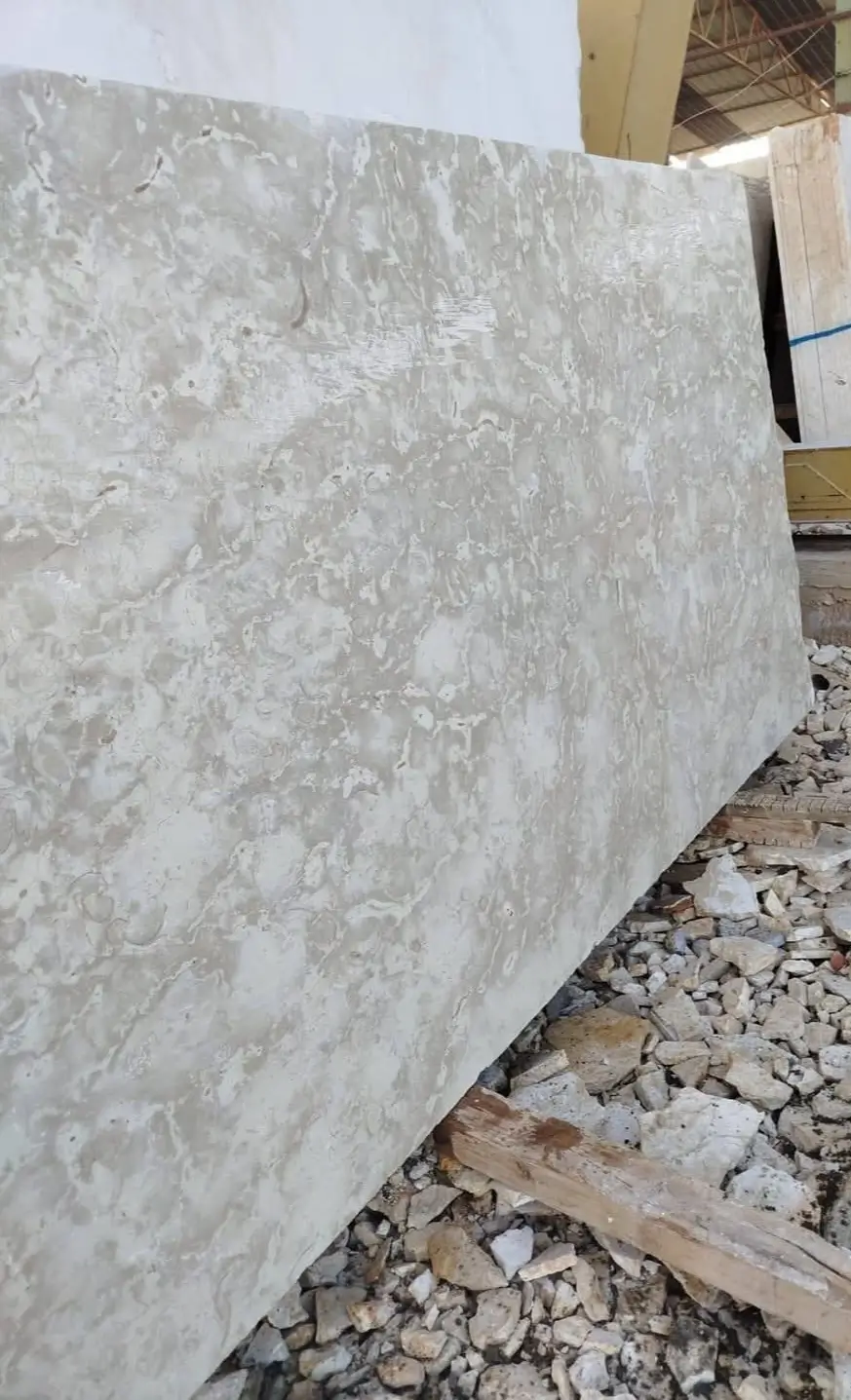
Long-Term Maintenance That Keeps Weathered Limestone Performing
Your maintenance approach after installation determines how gracefully limestone weather effects accumulate rather than degrade the installation. The most effective long-term strategy combines preventive sealing with prompt attention to the two early warning signs that signal accelerating deterioration: joint sand loss and surface spalling around edges.
Joint sand loss in sand-set limestone paving allows water to pool at the paver underside — exactly where freeze-thaw damage initiates. Inspect joint fill annually and top up with polymeric joint sand before winter in any freeze-thaw climate. For mortar-set installations, monitor grout lines for hairline cracking — a crack wider than 1.5 mm allows water ingress that undermines the bond layer and, in freeze-thaw conditions, causes progressive lifting of adjacent pavers.
- Pressure washing is appropriate at low pressure (below 1,200 psi) using a fan nozzle — high-pressure pencil jets erode surface calcite and accelerate acid weathering by opening fresh reactive material
- Acidic cleaners are incompatible with limestone — avoid vinegar, citric cleaners, and any product with a pH below 6.0; use pH-neutral stone cleaners only
- Re-honing is a legitimate restoration option for heavily weathered or stained horizontal surfaces — a professional diamond-pad hone at 400 grit restores surface flatness and removes biological staining without affecting dimensional tolerances
- Surface grinding beyond 400 grit is rarely necessary for outdoor limestone and risks removing the patina layer that protects the stone from further acid attack
Getting Outdoor Limestone Specifications Right
Specifying limestone for outdoor use is a decision that rewards patience and rewards preparation in equal measure. How limestone weathers outdoors isn’t a problem to be solved — it’s a process to be managed, and the decisions you make at the specification stage determine whether that process produces a stone that grows more beautiful or one that demands constant intervention. Density, finish, drainage, sealing frequency, and joint maintenance all operate as a system: weaken any one element and the others compensate imperfectly. Nail all five and you have an installation with a realistic 40-plus-year service life.
For buyers comparing material formats, it’s also worth considering how limestone pavers compare to crushed limestone for outdoor spaces — the two serve fundamentally different structural roles, and understanding which format suits your project conditions matters before committing to either. crushed versus paver limestone comparison covers the performance and cost distinctions worth reviewing before your final specification decision. Understanding patina development helps buyers make informed choices, and Citadel Stone stocks limestone varieties with documented outdoor performance across diverse climate conditions.