

The structural distinction between sintered stone vs quartz comes down to how each material handles stress at the molecular level — and that gap in performance shows up faster than most specifiers expect. Sintered stone is formed under extreme heat and pressure without binders, producing a fully vitrified panel with near-zero porosity and a coefficient of thermal expansion that holds stable across a wide temperature range. Quartz engineered surfaces, by contrast, rely on a resin matrix that accounts for roughly 7–10% of total volume, and that resin is the material’s Achilles heel in outdoor and high-heat applications.
How Each Material Is Made
Your understanding of sintered stone vs quartz starts with the manufacturing process — because the process defines every downstream performance characteristic. Sintered stone is produced by compacting natural mineral particles under pressures exceeding 15,000 PSI and temperatures above 1200°C, then firing until the particles fuse into a single dense mass. No adhesives, no resins, no fillers. The result is a slab with water absorption rates typically below 0.1%, which classifies it as vitrified under standard ceramic and stone testing protocols.
Quartz engineered stone follows a different path. Manufacturers — broadly categorized as quartz stone manufacturers — combine 90–93% ground quartz aggregate with 7–10% polymer resin and pigment, then compress and cure the mixture under vacuum. The surface is consistent, the pattern repeatable, and the dimensional tolerances are tight. But the resin component fundamentally limits the material’s thermal ceiling and UV resistance in a way that sintered stone simply doesn’t face.
- Sintered stone firing temperature: 1200°C+ — vitrification is complete and irreversible
- Quartz resin content: 7–10% by volume — the phase most vulnerable to UV degradation
- Sintered water absorption: typically below 0.1% — meets porcelain tile absorption Class BIa
- Quartz water absorption: typically 0.1–0.3% — adequate for countertops, marginal for prolonged outdoor exposure
- Sintered surface hardness: Mohs 6–7 depending on mineral blend
- Quartz surface hardness: Mohs 7 for quartz aggregate, but resin matrix lowers effective scratch resistance
Outdoor Performance: Where the Difference Becomes Critical
The sintered stone vs quartz debate sharpens considerably once you move the application outdoors. Quartz manufacturers are transparent about this: most major quartz stone manufacturers explicitly void warranties for exterior applications because UV radiation degrades the polymer resin, causing yellowing, micro-cracking, and eventual delamination at the aggregate-resin interface. You can find this buried in specification sheets, but it’s worth reading before committing to a material selection for patio or pool-adjacent surfaces.
Sintered stone manufacturers, by contrast, produce panels specifically rated for exterior use. The vitrified body doesn’t react to UV exposure — there’s no organic component to break down. Surface temperatures on sintered panels can climb above 140°F in direct sun without causing structural change, while quartz panels at similar temperatures begin showing resin softening above 120°F. For countertop applications in shaded or climate-controlled kitchens, this distinction rarely matters. For outdoor kitchens, pool surrounds, or exterior cladding, it’s the specification decision that determines service life.
- Quartz UV resistance: limited — resin degrades under prolonged direct UV exposure
- Sintered UV resistance: excellent — fully inorganic composition, no UV-reactive components
- Quartz max recommended surface temperature (most manufacturers): 120°F sustained
- Sintered thermal stability: rated to 300°C+ without structural compromise
- Outdoor warranty coverage: most quartz manufacturers exclude exterior applications entirely
- Sintered outdoor certification: standard for most major sintered stone manufacturers
Countertop Applications: Where Quartz Holds Its Ground
Your interior countertop specification is a different calculation entirely. For kitchen islands, bathroom vanities, and laundry surfaces in climate-controlled environments, quartz engineered stone performs exceptionally well and offers practical advantages that sintered stone doesn’t always match. The resin matrix gives quartz its chip-resistance edge — it absorbs minor impact energy rather than fracturing cleanly through like a fully vitrified sintered panel.
Quartz also wins on pattern consistency. Synthetic stone manufacturers producing quartz surfaces can replicate a specific veining pattern across every slab in a batch, which matters enormously when you’re running a continuous countertop through a large kitchen with multiple pieces. Sintered stone has improved significantly in this area, but natural mineral variation still creates slight batch-to-batch differences that can frustrate designs requiring exact pattern matching. For most residential countertop work, this distinction is minor — for high-end commercial installations with hundreds of linear feet, it’s worth discussing with your supplier before ordering.
- Quartz chip resistance: superior — resin matrix absorbs impact without through-fracture
- Sintered chip resistance: good at 12mm+, more vulnerable at thinner 6mm profiles
- Pattern consistency across quartz batches: excellent — resin-bound manufacturing controls variation
- Heat resistance at countertop: quartz adequate below 120°F; sintered handles direct pan contact without trivet protection
- Stain resistance: both materials perform well for kitchen use when surfaces are sealed or vitrified
- Maintenance: quartz requires no sealing; sintered requires no sealing — both are effectively maintenance-free indoors
Thickness, Slab Format, and Fabrication Realities
Specifying sintered stone vs quartz countertops for outdoor or countertop use requires careful thought about thickness and slab format from the start of the design process — because the fabrication constraints are different for each material. Quartz slabs are typically available in 20mm and 30mm thicknesses for countertop work, with 20mm being the standard residential specification and 30mm used for commercial applications or waterfall edge details.
Sintered stone runs thinner. Large-format sintered panels are commonly available in 6mm, 12mm, and 20mm. The 6mm profile is designed for cladding and furniture applications; the 12mm works for countertops with proper substrate support; the 20mm is the outdoor paving and step specification. Cutting and edge profiling sintered stone requires diamond tooling rated for fully vitrified porcelain — standard quartz fabrication equipment works, but blade wear accelerates, and fabricators need to adjust water cooling rates to prevent thermal shock at cut edges. According to NSI fabrication standards, surface hardness and vitrification level are the two variables that most affect tooling selection for engineered stone fabrication.
- Standard quartz countertop thickness: 20mm residential, 30mm commercial — limited large-format options
- Sintered slab formats: commonly up to 126″ × 63″ in 12mm and 20mm profiles
- Sintered 6mm panels: require full substrate bonding — not freestanding
- Fabrication tooling: both materials require diamond blades, but sintered demands higher-grade tooling
- Waterfall edge feasibility: easier with quartz at 20–30mm; sintered requires mitered joints at thinner profiles
- Leadtime from warehouse for large-format sintered: typically 2–4 weeks depending on color and thickness
Subgrade and Soil Considerations for Outdoor Sintered Stone
The sintered stone vs quartz decision for outdoor paving — particularly 20mm sintered panels in patios or pool surrounds — brings subgrade stability into the specification picture in ways that interior countertop work never does. Sintered stone’s rigid, fully vitrified body performs excellently in compression but has limited flexural tolerance. A subgrade that shifts seasonally, whether from expansive clay, sandy profiles, or caliche horizons common in arid regions, will transmit differential movement directly into the panel surface.
A mechanically stabilized subbase is essential — typically 150mm of compacted crushed aggregate over a geotextile separator — before any outdoor sintered paving installation. In areas with expansive clay soils, that specification should increase to 200mm, and incorporating a geogrid layer helps bridge soft spots. The ASTM standards for dimension stone testing cover compressive strength but don’t address the dynamic loading that differential subgrade movement creates in outdoor panels — that gap requires field engineering judgment, not just a specification sheet review. According to ASTM testing standards, flexural strength testing under ASTM C648 is the closest proxy for evaluating sintered panel performance under differential subgrade load. At Citadel Stone, we regularly advise clients on subbase requirements before their truck deliveries are scheduled, because getting this right at the ground level protects the entire installation above it.
- Minimum compacted aggregate subbase for outdoor sintered: 150mm — increase to 200mm over expansive soils
- Sandy or loose subgrade: requires mechanical compaction to 95% Proctor density before panel installation
- Caliche and rocky subgrade: requires scarification and re-compaction — rigid subgrade beneath thin sintered panels amplifies point load stress at joints
- Joint spacing for outdoor 20mm sintered: 3–5mm movement joints every 3–4 linear meters to accommodate thermal cycling
- Setting bed: polymer-modified thinset rated for large-format vitrified tile — not standard cement mortar
- Drainage gradient: minimum 1.5% slope away from structures — sintered’s near-zero absorption means surface water moves entirely as sheet flow
How Sintered Stone Manufacturers Differ From Quartz Producers
The manufacturing infrastructure behind these two material types diverges significantly, and that divergence affects supply chain reliability, product consistency, and technical support quality. Sintered stone manufacturers operate high-temperature kilns that require substantial capital investment and precise process control. The entry barrier is high, which means the market has fewer, larger producers — brands like Dekton, Neolith, Fiandre, and Lapitec dominate the category globally. Product consistency across batches is excellent because kiln parameters are tightly controlled by industrial process systems.
The quartz countertop market, by contrast, hosts a broader range of synthetic stone manufacturers — from premium European producers to high-volume domestic fabricators. Quality variation between manufacturers is real and measurable. Resin content, quartz aggregate grading, pigment UV stability, and curing process control all vary, and those variations show up in real-world performance over 5–10 years of service. When evaluating quartz suppliers, ask specifically for water absorption test data, resin content percentage, and UV exposure test results from an independent lab. Explore our sintered and quartz surface range to see how we vet manufacturer specifications before stocking any material in our warehouse.
- Sintered market: dominated by 5–8 major global producers — batch consistency is high
- Quartz market: broader supplier base — quality ranges widely between manufacturers
- Key quality questions for quartz suppliers: resin content %, UV resistance testing, absorption data
- Sintered quality indicators: water absorption below 0.1%, fired density, flexural strength (ASTM C648)
- Lead times from manufacturer to warehouse: sintered typically longer due to kiln scheduling — plan 6–10 weeks for special orders
- Standard stock availability: quartz countertop slabs tend to have shorter warehouse lead times for standard colors
Cost, Value, and Lifecycle Analysis
Material cost alone rarely tells the full story in a sintered stone vs quartz comparison — lifecycle cost is where the real difference emerges. Quartz countertop slabs in mid-range colors typically run $60–90 per square foot installed. Sintered stone in equivalent sizes and formats runs $80–130 per square foot installed, with large-format thin panels at the lower end and thick outdoor-rated profiles at the higher end. The premium for sintered reflects both higher raw material costs and the greater tooling wear during fabrication.
For interior countertop applications in shaded kitchens, that premium is harder to justify on pure performance grounds — quartz delivers comparable results at lower cost. The lifecycle equation shifts outdoors. Quartz used in exterior applications — even in regions without severe freeze-thaw cycling — typically shows resin degradation within 5–8 years of UV exposure, requiring full replacement. Sintered stone in comparable outdoor conditions should deliver 25–35 years of service with no maintenance beyond occasional cleaning. Factor replacement cost into your client conversations — especially for outdoor kitchens and pool surrounds where the quartz-to-sintered price gap disappears entirely when you amortize over a realistic service life.
- Quartz installed cost range: $60–90 per square foot for residential countertops
- Sintered installed cost range: $80–130 per square foot depending on format and thickness
- Outdoor quartz service life: 5–8 years before UV-related resin degradation becomes visible
- Outdoor sintered service life: 25–35 years with standard maintenance
- Interior countertop: quartz offers better cost-performance ratio for standard kitchens
- Outdoor patio, cladding, or pool surround: sintered’s lifecycle advantage offsets the higher initial cost in most project scenarios
Project Planning, Ordering, and Logistics
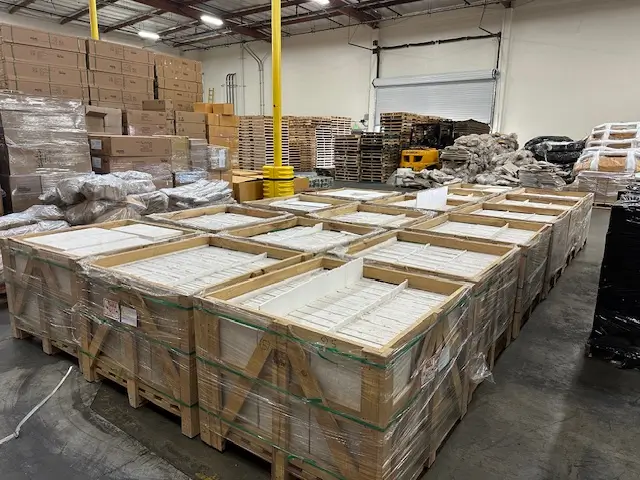
Project timeline planning should account for meaningful differences in how these two material types move through the supply chain. Standard quartz countertop slabs in popular colors are typically available from warehouse stock with 1–2 week lead times nationally. Large-format sintered stone panels, especially in 20mm outdoor profiles or specialty colors, often require 4–8 weeks from confirmed order to delivery — and that includes truck scheduling for oversized slab shipments, which need flatbed or specialized stone transport rather than standard freight.
Citadel Stone maintains warehouse stock of both sintered and quartz surfaces with nationwide delivery capability, which compresses lead times significantly compared to direct factory ordering. Even so, if your project requires a specific sintered color in large format quantities, verifying warehouse availability before committing to a client timeline is non-negotiable. Truck delivery scheduling for large-format sintered panels also requires site access planning — these panels are heavy, and unloading often requires a forklift or dedicated stone-handling equipment at the delivery point. Build that logistics reality into your project schedule from day one rather than discovering it during the delivery window.
- Standard quartz warehouse lead time: 1–2 weeks for popular colors and thicknesses
- Large-format sintered lead time: 4–8 weeks for special orders, 1–3 weeks for warehouse stock items
- Truck delivery requirements for sintered slabs: flatbed or stone-specific transport — confirm site access and unloading equipment in advance
- Order quantity: sintered panels are sold by the slab or square foot with minimum order quantities — confirm before specifying in drawings
- Waste factor: allow 15–20% for sintered due to large-format panel sizing and cut complexity; 10–15% is typical for quartz
Final Perspective on Sintered Stone vs Quartz
The sintered stone vs quartz decision isn’t a question of which material is better — it’s a question of which material fits the application, the budget, and the service life expectation you’re working with. For interior countertops in climate-controlled environments, quartz is a rational choice: it’s durable, consistent, available in an enormous range of patterns, and competitively priced. For outdoor paving, pool surrounds, exterior cladding, or any surface with sustained UV exposure, sintered stone’s inorganic vitrified body makes it the technically correct specification — full stop.
The projects where specification errors happen most often are the ones where quartz is extended into outdoor applications because the surface looks right without checking the technical data sheet. That’s a 5–8 year mistake dressed up as a cost saving. Conversely, specifying sintered stone for a simple shaded interior kitchen countertop where quartz would perform identically adds cost without adding performance. Match the material to the environment and the performance requirement — and get the subgrade right for any outdoor sintered installation before the first panel arrives on the truck. As your project expands into related stone applications, understanding how hardscape materials perform at water’s edge is equally important — our article on pool coping material selection covers how stone choices perform in wet and high-UV environments. Understanding how sintering differs from quartz binding helps buyers working with Citadel Stone match the right surface to countertop versus outdoor patio applications.
Related reading: manufactured vs natural stone veneer · engineered vs natural stone.