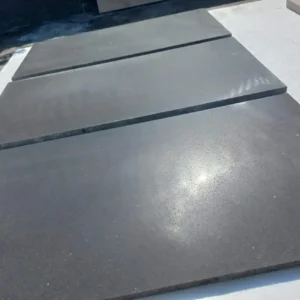
Deciding where to buy travertine pavers is deceptively straightforward on the surface — you search, you call, you order. The real complexity surfaces when you realise that channel choice dictates stone quality, lot consistency, lead time, and what happens when a pallet arrives short. Most buyers find this out mid-project, which is the worst possible time.
Understanding the Travertine Supply Chain
Your sourcing decision sits upstream of every other project variable. Travertine moves through several distinct channels before it reaches your site, and each channel represents a different trade-off between price, consistency, and accountability. Understanding those trade-offs before you commit an order is what separates a smooth project from an expensive correction.
- Direct importers quarry or select stone at origin, control grading before it ships, and carry matched lots for large runs — this is the channel with the fewest hands between the stone and your project
- Domestic distributors buy from importers and add a margin layer, but the better ones carry consistent stock in tight grade ranges and can turn small orders faster
- Box-store and home improvement retailers stock travertine pavers at accessible price points, but lot control is inconsistent and the selection depth rarely supports projects above a few hundred square feet
- Online marketplaces aggregate multiple sellers, so colour and finish matching across separate orders is genuinely unreliable — a known field problem when phases get split across seasons
The channel that fits your project depends on order volume, finish specification, and how much schedule risk you can absorb. Large commercial and estate projects almost always benefit from going further upstream.
What to Look for in a Travertine Paver Supplier
Your supplier’s ability to hold a consistent specification across multiple pallets is the single most important credential to verify before you buy. Travertine is a sedimentary calcium carbonate stone whose density, pore structure, and veining shift meaningfully between quarry blocks — even within the same quarry face. A supplier who cannot confirm that your order ships from a single matched lot is a liability risk, not a source.
According to Natural Stone Institute travertine properties and outdoor suitability, travertine’s open pore structure and variable absorption characteristics are inherent to the material — a supplier who understands these properties will grade and fill pavers consistently rather than mixing open-vein and filled product in the same shipment. Ask specifically how they handle lot continuity for large orders.
- Request a sample from the actual lot that will ship — not a display board that represents an idealised colour range
- Ask whether the stone is filled and honed, unfilled, or brushed, and confirm that the finish specification matches across every pallet
- Verify that thickness tolerance is held within a stated range — field cutting to compensate for thickness variation adds labour cost and delays
- Confirm that the supplier can provide a test report on request covering absorption, compressive performance, and freeze-thaw cycling — ASTM C1527 is the relevant dimension stone standard for travertine
- Ask about lead time from order to delivery, and whether a partial delivery is possible if your installation schedule is phased
The reference standard for travertine dimension stone is ASTM C1527 travertine dimension stone standard specifications. A supplier who references this standard when discussing physical properties is operating at a professional level — one who cannot cite it at all is worth questioning.
Grades, Finishes, and Why They Matter Before You Order
Travertine pavers are graded by vein pattern, fill quality, and colour consistency. Premium grade carries tight, predictable veining and close colour matching across the lot. Standard grade is wider in variation and suits projects where some movement in tone and pattern reads as natural character rather than inconsistency. Knowing which grade your project actually needs — and paying for precisely that — avoids both overspend and disappointment.
Finish choice is equally consequential and needs to be locked before you order, not adjusted on site. A honed finish produces a smooth, matte surface with closed pores; a tumbled finish leaves an open, matte texture with rounded edges and an aged character; a brushed finish opens the pore slightly and softens the surface without the rounding that tumbling produces. These are not interchangeable aesthetically or practically, and suppliers do not typically accept returns on correctly filled orders where the finish was changed post-commitment.
- Honed: smooth, consistent sheen, works well in formal settings and interior-adjacent outdoor spaces
- Tumbled: textured, aged appearance, suits informal and Mediterranean-influenced designs
- Brushed: mildly textured with a natural open-pore character, sits between honed and tumbled in tone
- Unfilled: raw open voids, suited to specific design applications — requires sealing and maintenance discipline from day one
For slip resistance on wet outdoor surfaces, the current standard is ANSI A326.3, measured wet — the earlier ASTM C1028 static test was withdrawn in 2014. Finish is the primary variable affecting a stone’s behaviour on that test. If wet-surface performance is a project requirement, ask your supplier whether a test report is available and specify that the finish must match the tested sample.
Ordering and Installation Timing: Making the Calendar Work for You
One of the genuinely underestimated parts of knowing where to buy travertine pavers is timing the purchase to align with your installation window. Travertine pavers set in mortar or adhesive are subject to the same thermal and moisture constraints as any natural stone installation — and the setting material’s temperature window, not the paver itself, is usually the binding constraint on when you can work.
Most polymer-modified mortars have an optimum application range, and working outside that range changes open time, coverage, and bond development. In cold-weather months, early-morning temperatures can push adhesive below its minimum working range even when midday conditions feel comfortable — a detail that catches a lot of crews who schedule by the forecast high rather than the site temperature at placement time. In peak-heat periods, afternoon substrate temperatures on dark or sun-exposed base materials can shorten open time to the point where back-buttering outpaces your ability to set stone cleanly.
- Schedule mortar work for morning hours during warm months — substrate temperatures tend to be most stable in the two-to-three-hour window after the dew point clears
- In cool seasons, monitor the substrate temperature independently of air temperature — concrete and aggregate bases retain cold longer than ambient conditions suggest
- Allow for cure time before foot traffic — most polymer-modified systems need a full cure cycle before the stone is loaded, and rushing this step is a common cause of early bond failure
- If your project spans late autumn into early winter, factor cure time into your delivery schedule so the stone is set before hard-freeze risk arrives
Delivery scheduling matters here too. Travertine pavers arriving on site during a cold snap need covered storage if the mortar system you’re using has a substrate minimum — setting on a frozen base is a straightforward path to debonding. Confirming delivery timing with your supplier as part of the order process avoids that scenario entirely. Truck access to the site should also be verified in advance; a delivery that can’t get within reasonable offloading distance of the work area creates handling damage risk on stone that may already be at temperature-sensitive staging.
What “Nearby” Actually Means for Natural Stone Sourcing
The search for travertine pavers nearby is understandable — you want to see the stone, reduce freight cost, and minimise lead time. The practical reality is that natural travertine is quarried from a limited number of deposit regions globally, and the stone available through a local yard is almost always imported material that passed through a national distributor before reaching the local level. Buying locally doesn’t bring you closer to the source; it adds a channel step between you and the importer who controls lot consistency.
That said, local yards serve a genuine purpose for small orders, sample viewing, and projects with fast-turn requirements. The decision framework is straightforward: for projects under roughly 200 square feet with flexible colour matching, a local yard is often practical. For larger projects where lot continuity and finish consistency are non-negotiable, a national importer with direct sourcing and cut-to-order capability is the more reliable path.
- Local yards: convenient for small volumes, sample access, and emergency top-up orders; less reliable for large matched lots
- National importers: stronger lot control, wider finish and thickness range, better suited to phased or large-scale projects
- Hybrid approach: buy the bulk order from a national source and hold back a small surplus for future repairs — this is standard practice on any well-run project
At Citadel Stone, we quarry, template, manufacture, and arrange delivery directly, which means the specification you agree at order stage is what ships — there is no intermediary adjusting grade or finish between the quarry and your project site. You can review our travertine paver selection to see available finishes and formats before calling to discuss lot requirements.
Thickness, Format, and Base Compatibility
Specifying travertine paver thickness without referencing your base design is one of the more common sourcing errors in the field. The two variables are linked — a thicker paver on a correctly designed aggregate base behaves very differently from the same paver on an undersized or unstable base. Your supplier should be able to discuss typical thickness ranges for different applications, and you should know your base specification before the conversation starts.
The USGS limestone and travertine natural mineral formation data confirms that travertine’s sedimentary origin creates inherent variation in density and pore distribution between layers — this is why thickness tolerance matters as a procurement specification, not just a cosmetic one. Pavers that vary significantly in thickness within a pallet create lippage risk at joints and complicate mortar bed levelling.
- Residential patio and walkway applications: discuss standard thickness ranges with your supplier for the specific format you are ordering — formats vary and thickness is a function of both the quarry cut and the finish process
- Driveway and vehicle-overrun applications: require a heavier specification — confirm the thickness and base design with a structural engineer if load calculations are in scope
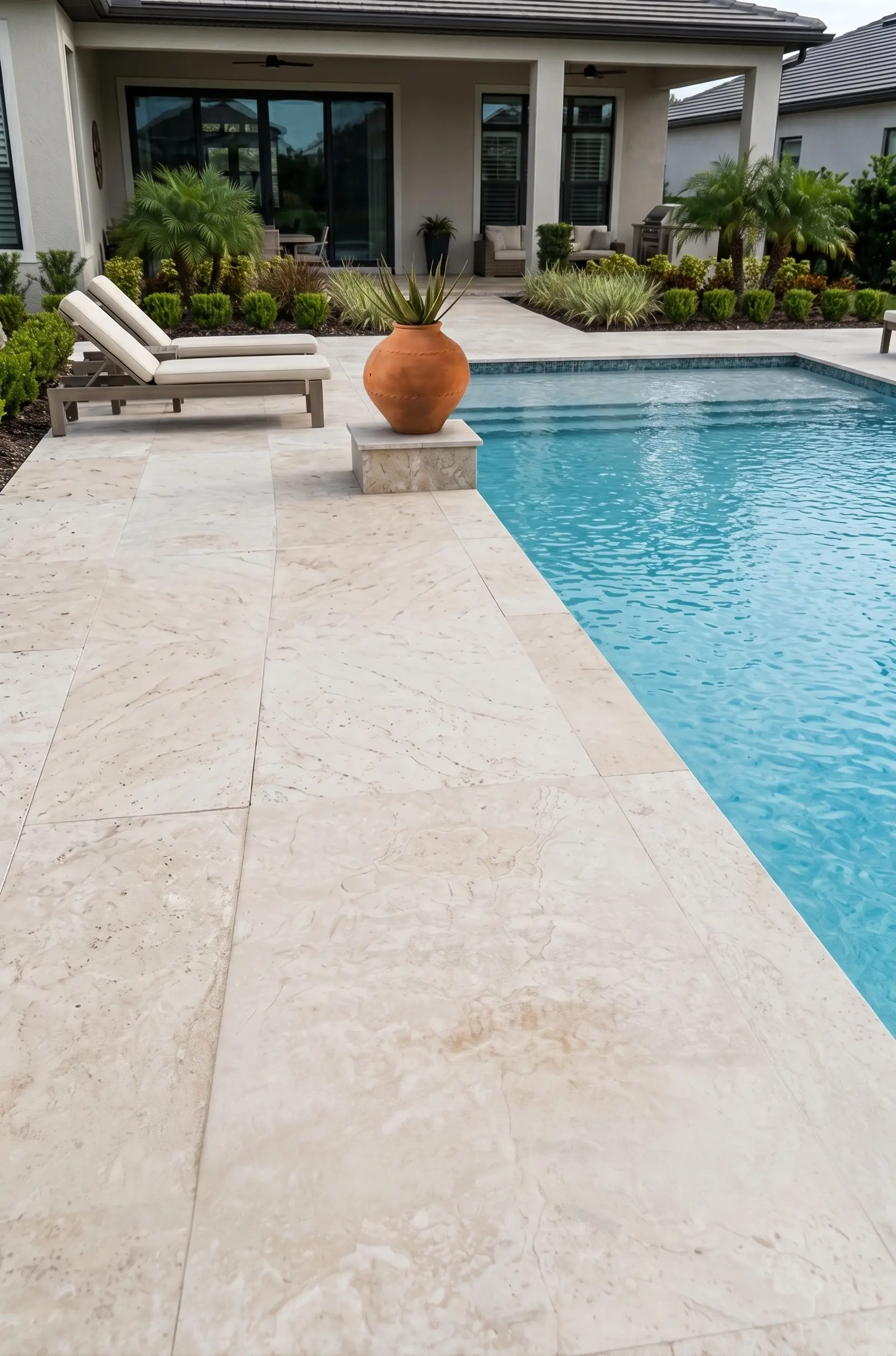
- Pool deck surround: discuss format size relative to expansion joint spacing, particularly for large-format pavers where thermal movement across the slab becomes more significant
- Stair treads and coping applications: thickness tolerance is especially tight here — confirm that the supplier can hold the dimensional precision your installation detail requires
Format selection also affects how your order ships. Larger format pavers are heavier per piece and more susceptible to edge chipping in transit if pallets are not crated and strapped correctly. Ask your supplier how pavers are palletised — interleaved foam or cardboard between pieces is standard practice for honed finishes, and the absence of it is a red flag on finish quality arriving intact.

Sealing, Maintenance, and What Your Supplier Should Tell You
A good travertine supplier doesn’t stop at delivery — they should be able to give you clear guidance on sealing protocol, maintenance interval, and product compatibility for the finish you ordered. This isn’t promotional content; it’s part of understanding the material you’re sourcing.
Travertine is calcium carbonate and reacts to acidic contact — citrus, certain cleaning agents, and some pool chemicals will etch a honed surface. Sealing does not prevent all etching, but a penetrating impregnator reduces the rate of absorption and gives you more time to act before staining sets. The sealer manufacturer’s stated reapplication interval varies by product and exposure level — follow that interval, not a generic rule of thumb. An outdoor pool deck in a high-UV environment may need resealing more frequently than a sheltered patio in a mild climate.
- Penetrating impregnators are the standard choice for travertine — they do not change the surface appearance and allow the stone to breathe while reducing liquid absorption
- Topical sealers can create a sheen that alters the honed finish character — confirm this is your intent before specifying a topical product
- Fill maintenance for unfilled travertine is ongoing — grout and caulk in the voids need periodic inspection and replacement, particularly in freeze-thaw climates where thermal cycling works fill material loose
- Avoid pressure washing at high PSI on filled pavers — it removes fill and opens voids faster than normal weathering
Your supplier should be able to confirm whether the fill material used in their pavers is colour-matched and epoxy-based or cement-based — this matters for long-term colour stability and for the maintenance products you specify. Citadel Stone’s technical team is available to discuss finish-specific sealing recommendations when you’re confirming your order specification.
Logistics, Lead Times, and On-Site Delivery Planning
The logistics side of where to buy travertine pavers deserves as much attention as the material selection itself. Natural stone is heavy, palletised freight — it moves on flatbed or curtainsider truck, and your site needs to accommodate that reality. Lead times are quoted with the order and reflect current production and shipping status at our selected quarries; they are not a standard published figure, and they shift with demand, shipping schedules, and project queue.
Your project’s truck access constraints directly affect delivery scheduling. A tight residential street with overhanging trees and no turning radius for a full-size delivery vehicle creates a planning problem that needs solving before the stone ships, not when the driver calls from the end of the road. Confirm offloading arrangements — forklift, crane, or manual offload — before the delivery date so the pallet configuration matches your site capability.
- Request a pallet weight and dimension sheet from your supplier when placing the order — this lets you confirm your offloading equipment capacity in advance
- If you are splitting delivery across project phases, confirm that the supplier can hold remaining pallets from the same lot — mixing lots across phases is a colour-matching risk
- Build a surplus of around 10% into your order calculation to cover cutting waste, breakage, and future repair needs — this is standard practice and far easier to order upfront than to source as a matched top-up later
- Confirm whether the delivery includes kerbside drop or site placement — this affects your labour planning for the day the stone arrives
Lead time awareness is especially important when seasonal installation timing is a factor. If your installation window opens in early spring, ordering in mid-winter gives you a reasonable buffer for production and shipping. Ordering when the window is already open creates schedule pressure that almost always translates to either a rushed installation or a delayed project start.
Final Recommendations
Knowing where to buy travertine pavers comes down to matching your project’s scale, specification precision, and schedule to the right supply channel — and then verifying that channel’s capability before you commit the order. The questions that matter most are about lot consistency, finish accuracy, test report availability, and logistics realism. A supplier who can answer those questions clearly and specifically is operating at the professional level your project deserves.
Take the time to review travertine’s material characteristics alongside your sourcing decision — understanding what the stone actually is informs every specification choice that follows. For broader context on how travertine forms and how finish choices affect its behaviour in outdoor applications, travertine formation and finish types covers the material fundamentals in useful depth. Sourced from our selected quarries in the Middle East, Citadel Stone stocks travertine in consistent lots for large orders.
Related reading: how thick are travertine pavers · travertine paver cost per square foot · how to seal travertine pavers.