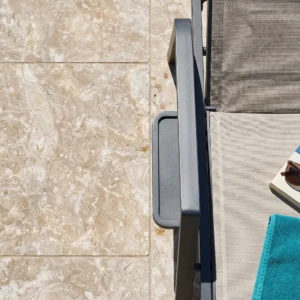
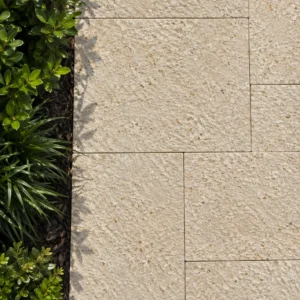
Travertine crazy pavers reward designers who understand what the irregular format actually demands — not just aesthetically, but structurally. The random joint geometry that makes a crazy-paved path visually compelling also creates a more complex load distribution than a grid layout, and how you handle that complexity determines whether the surface stays tight and level for decades or begins rocking within a few seasons. Getting the base right, the mortar bed depth consistent, and the edge restraint genuinely locked in are the decisions that set everything else up for success.
What Crazy Paving Actually Means for Travertine
The term “crazy paving” describes a random, irregular layout where pieces of varying sizes and shapes are assembled like a mosaic without a repeating grid module. For travertine, the format plays to one of the stone’s strongest visual characteristics — its natural colour variation and surface veining. Each irregular piece reads differently, and when assembled well, the result has an organic quality that manufactured patterns struggle to replicate. At the same time, travertine crazy pavers are still dimension stone: they’re cut to a thickness specification and selected for consistent face quality, so you’re working with a calibrated material even if the plan shapes are free-form.
The layout philosophy for crazy paving differs from regular formats. You’re working with a kit of parts rather than a module, which means sorting pieces by size before you start and building the layout from the larger anchor pieces outward. Tight joints and minimal concrete fill between pieces is the mark of skilled work — wide, filled gaps signal that the pieces weren’t sorted carefully enough before laying began.
Surface Finish Options for Crazy Pavers
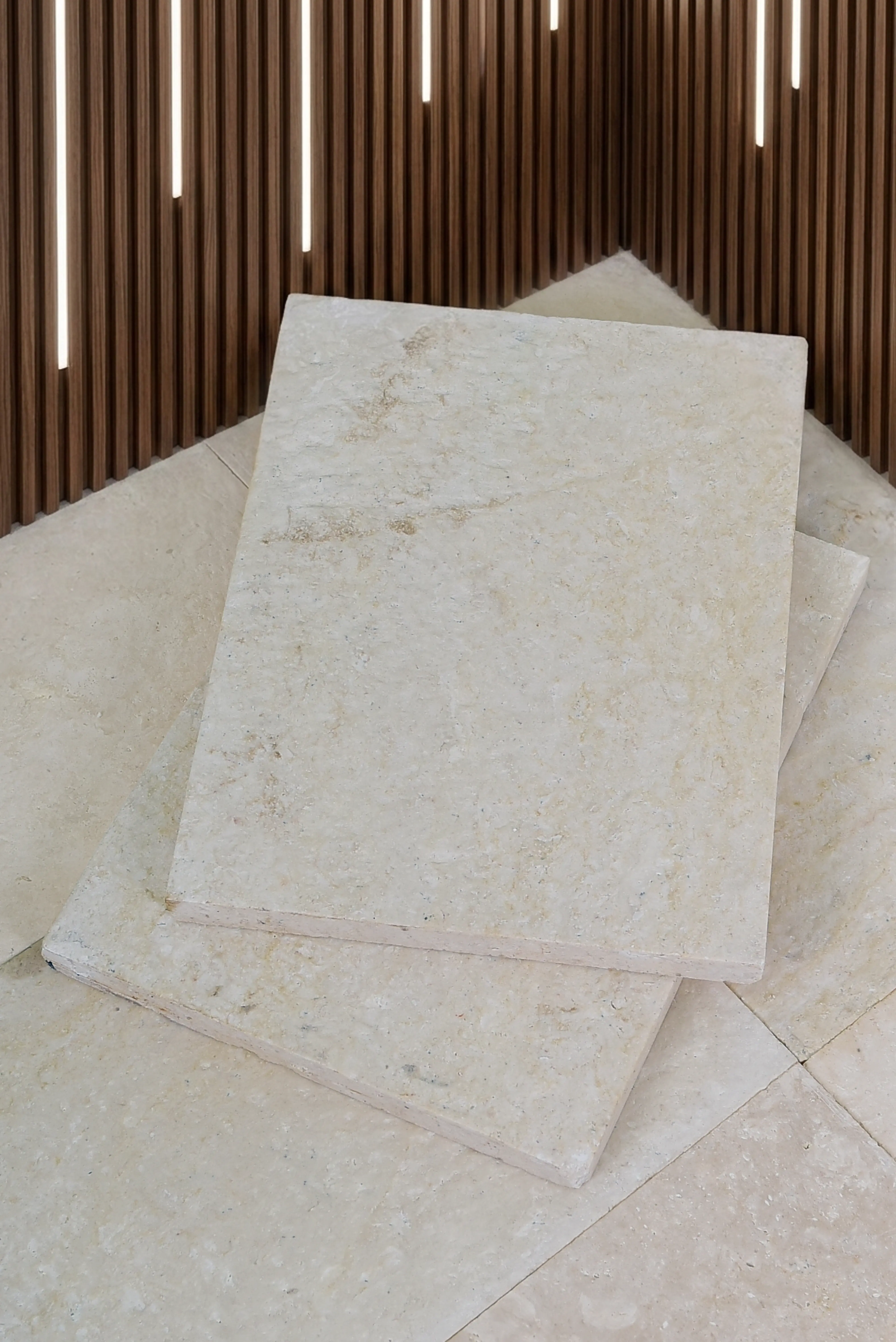
Travertine crazy pavers come in several finishes, and your finish choice affects texture, colour depth, maintenance interval, and how the surface reads underfoot in wet conditions. The primary options are tumbled, honed, and brushed — each delivers a different character.
- Tumbled finish leaves an open, matte texture with softened edges and a worn, aged appearance that suits cottage-style gardens and informal pathways naturally
- Honed finish produces a smooth, flat face with a low sheen — colour reads more consistently and the surface is easier to clean, but the texture is less open than tumbled
- Brushed finish falls between the two, with a lightly textured face created by wire or abrasive brushing that opens the pore structure slightly without the full tumbled rounding
- Split-face pieces carry a rougher, more natural fractured texture — less common in crazy-pave residential work but used in some garden and water-feature settings
For a natural paving context, especially where travertine pavers with grass will fill the joints, a tumbled or brushed finish tends to integrate better visually than a smooth honed surface. The slightly open texture also means the stone reads as part of a planted, softscape composition rather than as a hard surface that happens to have grass between the joints.
Designing with Grass Joints
One of the most popular design moves with travertine crazy pavers is filling the irregular joints with low-growing grass or ground cover rather than mortar or jointing compound. Done well, the result sits somewhere between a paved path and a planted area — the stone provides the walking surface, the grass softens the overall footprint. Done poorly, it becomes a maintenance burden within one growing season.
The joint width matters here more than it does with a mortared layout. You’ll need consistent joint gaps of a workable size — narrow enough that the stone reads as the dominant material, but wide enough for a soil depth that sustains root growth. Creeping thyme, baby’s tears, and dwarf mondo grass are all practical choices because they tolerate foot traffic reasonably well and don’t need frequent cutting. According to ASLA guidance on permeable surfaces and landscape materials, planted joint systems in natural stone paving also support surface drainage and reduce runoff compared with fully mortared alternatives — a genuine performance benefit, not just an aesthetic one.
The base construction method changes when you’re targeting grass joints. A rigid mortared bed under each stone is still the right structural approach for the pieces themselves, but the joints are left unpointed and filled with a loam and grit mix at a depth that supports plant establishment. The stone pieces need to be set slightly proud of the finished grass height so mowing or trimming doesn’t constantly catch the stone edges.
Base Preparation and Structural Requirements
The irregular plan geometry of travertine crazy pavers makes base preparation more critical, not less. A grid-format paving layout distributes load across a consistent joint pattern; irregular pieces transfer load through contact areas that vary significantly from piece to piece. A sub-base that isn’t properly compacted and graded will show movement unevenly — one large anchor piece stays flat while smaller surrounding pieces rock, and the visual effect of a well-sorted crazy-pave layout degrades quickly. Travertine pavers installation over an underprepared sub-base is one of the most common sources of early movement in otherwise well-chosen materials.
- Compact the sub-base to a consistent depth across the entire area before any bedding goes down — low spots under large anchor pieces are the primary source of early movement
- Use a screeded mortar or sand-cement bed rather than loose sand for travertine crazy pavers, since the varying piece weights need a stable, consistent bearing surface
- Check levels from multiple reference points as you work — irregular pieces don’t give you the natural alignment check that a grid format provides
- Allow adequate cure time before foot traffic, particularly for mortared joints or grass-jointed layouts where plant establishment pulls moisture from the setting bed
For a deeper look at how travertine performs outdoors, the Natural Stone Institute covers porosity and absorption characteristics that directly affect base and sealing decisions for paving applications.
Edge Restraint, Wind Events, and Long-Term Durability
Here’s a detail that gets skipped more often than it should: edge restraint for crazy-paved layouts. Because the perimeter pieces in an irregular layout have highly variable plan shapes, their contact with the next piece and with the boundary condition is inconsistent. A large edge piece may have good mechanical interlock with its neighbours; a small triangular filler piece at the perimeter may have almost none. In exposed locations — open gardens, coastal settings, areas subject to wind-driven rain and storm events — that variability becomes a structural vulnerability.
Wind-driven rain under sustained storm conditions creates hydrostatic pressure at joints and beneath edge pieces, particularly where the mortar bed is thin or where the grass joint system has left voids adjacent to paving edges. Pieces that weren’t fully bedded, or where the mortar didn’t achieve full coverage under an irregular underside, are most at risk of lifting or shifting. Setting travertine crazy pavers with a solid mortar bed — checking that coverage extends to the piece perimeter and not just the centre — closes this vulnerability before it develops. A concrete or proprietary edge restraint at the perimeter boundary locks the outer run of pieces and prevents the progressive loosening that starts at the edge and works inward over time after repeated storm cycles. The ASTM C1527 standard for travertine dimension stone covers the physical property testing relevant to outdoor durability, and requesting the test report from your supplier gives you the absorption and flexural data that governs how the stone responds to wet-cycle loading.
For exposed garden settings, the finish selection also plays a role in how the surface weathers through hail and impact events. Tumbled travertine edges have already absorbed the mechanical rounding that a sharper-edged honed piece would experience gradually through impact — the tumbled format is effectively pre-weathered, which means storm-driven debris and hail impacts produce less visible edge damage over time than they do on crisp-edged honed pieces.
Layout Ideas for Different Settings
The creative latitude in a crazy-pave layout is genuine, and it’s worth thinking through the different ways the format can work before you start sorting pieces on site.
- Pathway through a planted border: use larger anchor pieces as the primary stepping zone and let smaller fill pieces tighten the composition — grass or thyme joints reinforce the planted setting
- Courtyard or terrace feature: a crazy-pave section surrounded by a regular-format border in the same travertine gives you the visual interest of the irregular layout with a clean, ordered frame
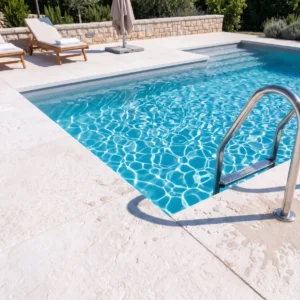
- Pool surround with curved edges: the irregular format navigates curves and non-orthogonal pool shapes without the cut waste that grid formats generate — a practical advantage as well as a visual one
- Garden stepping area: set the pieces as a loose random composition with generous grass joints, prioritising the planted look over tight stone coverage — works well where foot traffic is light and seasonal
- Transition zone: travertine crazy pavers used as a transition between a regular paved terrace and a lawn area create a softscape gradient that neither a hard edge nor a loose gravel border achieves
To browse the full range of formats available, our random-shaped travertine pieces include the irregular cuts suited to crazy-pave compositions in both garden and courtyard settings.
Colour and Tone Selection for Crazy Paving
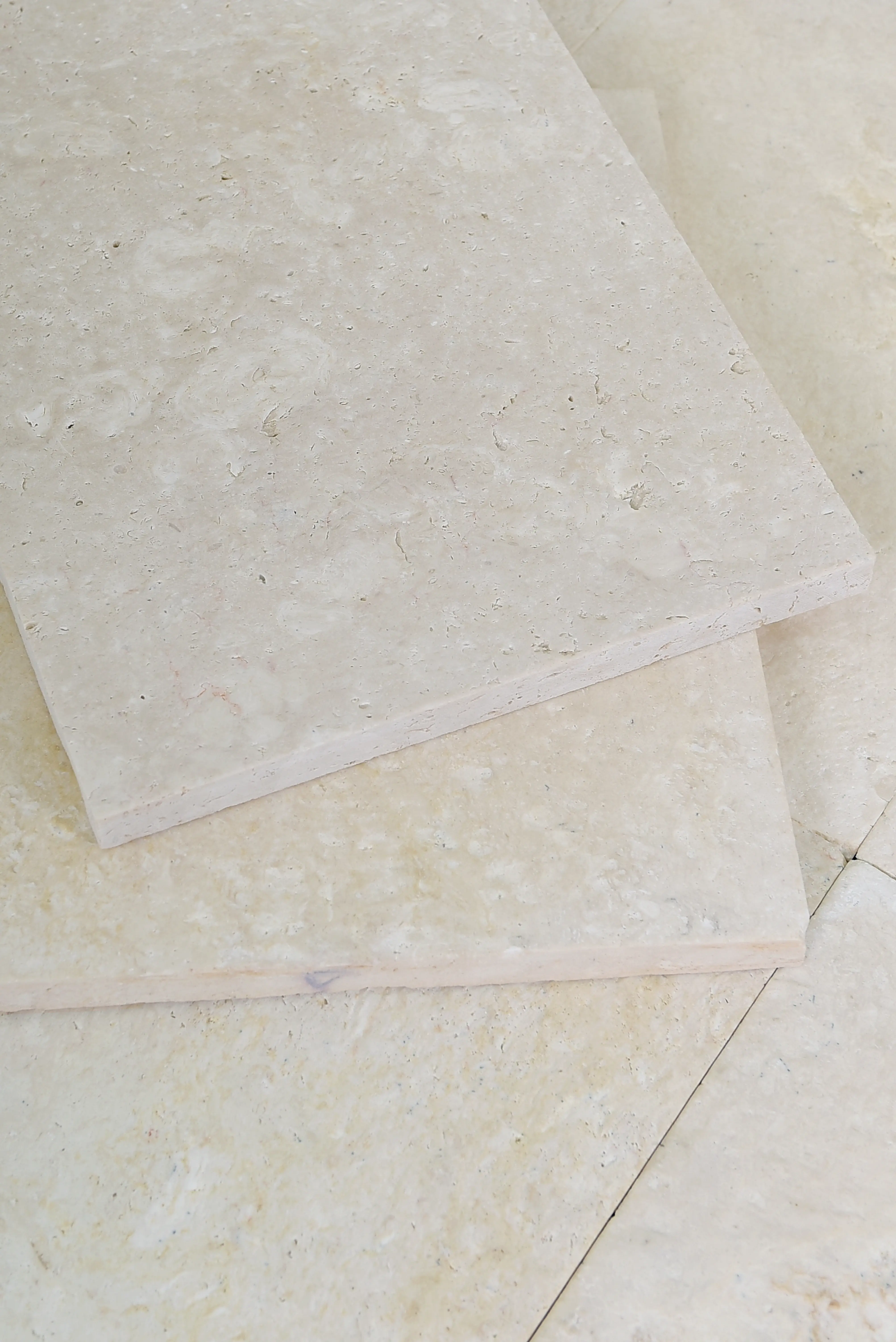
Travertine’s natural colour palette runs from ivory and cream through walnut and gold to darker noce tones, and within any single consignment you’ll see variation across the pieces. For a crazy-pave layout, that variation is an asset rather than a problem — the tonal movement across the assembled surface is part of what gives the format its character. The practical question is how much variation you want and whether your project setting calls for a warm or cool tonality.
- Ivory and cream tones read cooler and lighter, working well with white render, limestone copings, and planted borders that feature silver or grey-green foliage
- Walnut and gold tones read warmer, pairing naturally with terracotta, timber, and deep green planting
- Noce-toned travertine, the darkest of the common range, creates more contrast with grass joints — the dark stone and the green reads as a strong two-tone composition
At Citadel Stone, our technical team can walk you through consignment samples so you select the tone batch that matches your project’s wider material palette before the order is confirmed.
Sealing and Ongoing Maintenance
Travertine is a calcium carbonate stone with an open pore structure, and outdoor crazy-pave installations benefit from sealing on the interval your sealer manufacturer specifies. For travertine pavers with grass joints, sealing is particularly important at the stone face because soil migration from the joint system can stain the stone surface over time if the pore structure is left open. A penetrating impregnator is the standard approach — it doesn’t change the surface appearance significantly, preserves the open texture of a tumbled or brushed finish, and makes routine cleaning more effective.
Travertine is reactive to acidic cleaning products because of its calcium carbonate base — avoid vinegar-based or citrus-based cleaners entirely. For ongoing maintenance in a grass-jointed layout, you’re managing both the stone surface and the planted joint, which means weeding out unwanted seedlings before they establish root systems that disturb the mortar bed beneath the stone pieces.
Delivery scheduling for travertine crazy pavers should account for site access constraints. Truck access to garden settings — particularly rear gardens — affects offloading logistics, and confirming access dimensions before the delivery date is arranged avoids delays on site. Lead times are quoted with the order confirmation.
What Matters Most
The success of a travertine crazy-pave layout comes down to decisions made before the first piece is set: base preparation, edge restraint specification, finish selection relative to the planting approach, and sorting the piece kit carefully so the composition builds from anchor pieces outward. Travertine pavers installation carried out over a properly compacted, consistently bedded sub-base with solid edge restraint delivers decades of service life — the irregular format is not structurally compromised by the random geometry when the groundwork is done correctly. The visual result — whether grass-jointed for a softscape look or tightly pointed for a courtyard — reflects that preparation directly. Keeping up with sealing and maintenance on the interval your sealer supplier states protects the surface long-term. For guidance on cleaning protocols and maintaining travertine in an outdoor setting, travertine paver care and cleaning covers the practical steps in detail. Sourced at our selected Middle East quarries, Citadel Stone crazy pavers pair well with grass joints for a softer landscape look.
Related reading: travertine pavers french pattern · driveway travertine pavers · How to Cut Travertine Pavers Without Chipping.