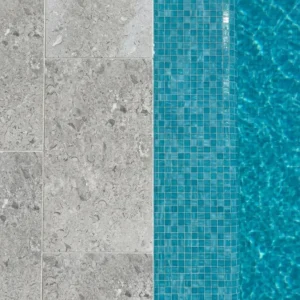
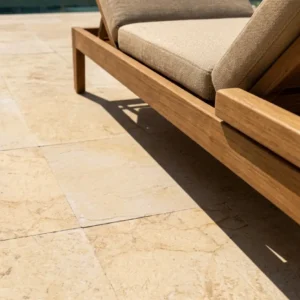
What Cool Underfoot Actually Means
Stone does not make a room cold. It draws heat away from bare skin faster than timber or vinyl, then holds that lower temperature through the hottest part of the afternoon. In the Virgin Islands, where a breeze off the water is still the primary cooling strategy in most houses, that difference registers every time somebody walks in barefoot from the terrace. A dense floor tile sits close to the temperature of the slab and the shaded air around it, and it stops re-radiating warmth back into the room once the sun drops. The comfort argument for stone is physical rather than decorative, which is exactly why it survives contact with an island climate.
Heat Arrives Through the Roof First
Be honest about where the heat is actually coming from before you choose a floor. Stone can only manage the load that reaches it.
- Roof and ceiling gains dominate in low, spread-out villas, and no floor fixes an uninsulated roof deck.
- Unshaded west-facing glass will overwhelm any surface material by mid-afternoon.
- Cross ventilation between windward and leeward walls does more for comfort than any single product.
- Deep overhangs and shaded verandas keep direct sun off the floor plane entirely.
- Dark paving immediately outside open doors keeps radiating warmth inward well into the evening.
Where those fundamentals are handled, a pale interior floor finishes the job quietly and permanently.
Tone, Light and the Virgin Gorda Palette
The Baths on Virgin Gorda are the Territory’s most recognized natural landmark: rounded granite boulders of feldspar and quartz, weathered warm and pale at once, with daylight cutting through the gaps between them. That protected park of roughly seven acres is a landscape to be left entirely alone, never a material source, but it is an excellent brief for tone. Interiors that sit comfortably beside it tend to use warm pale floors, generous unit sizes and matte surfaces rather than high shine. Choosing pale flooring that stays cool in that register keeps a villa quiet inside while the view does the work outside.
Density, Absorption and Salt-Laden Air
Thermal comfort is only half the specification. Island air carries salt across the whole territory, and open doors bring it indoors with everything else.
- Ask for water absorption figures on the batch you are buying, not a generic range for the stone type.
- Denser material resists salt crystallization in the surface pores near thresholds and door lines.
- Interior tile can be thinner than exterior paving, but the bedding must still be full and voidless.
- Consistent calibration keeps joints tight, and tight joints trap far less airborne grit.
Those four questions separate a supplier who knows the material from one who is simply reselling a pallet.
Hillside Access and Delivery Planning
Tortola is steep, and housing is scattered across hillsides on narrow switchback roads. That terrain shapes deliveries more than most overseas owners expect.
- Confirm what size truck can physically reach the site before the container is booked.
- Plan a staging area within reach of a pallet jack or a small machine.
- Break large orders into deliverable lots rather than one impossible drop.
- Allow time for onward inter-island delivery from Tortola to Virgin Gorda, Anegada or Jost Van Dyke.
- Remember that traffic here drives on the left while most trucks are left-hand drive imports.
Landed Cost in US Dollars
The Territory uses the US dollar, so there is no conversion step and no exchange exposure between quote and invoice. There is also no VAT, no sales tax and no general consumption tax here, which removes a cost layer that most eastern Caribbean markets carry. Imports are not free of charge, though: duty is assessed by HS code under the Customs Management and Duties Act, 2010, and trade declarations are filed online through CAPS, the Customs Automated Processing System. Cargo clears at a designated customs station, with Port Purcell in Road Town handling commercial freight. Tropical Shipping runs a direct service from Palm Beach, Florida into Purcell, sailing Fridays and arriving Thursdays on a six-day transit, so US-origin cargo does not need to pass through a hub port; confirm the current schedule when you book. The team at our Virgin Islands supply desk can walk a specification through those steps with you.
Who Signs Off on the Specification
Development permission in the Territory runs under the Physical Planning Act, 2004, and the route it takes is worth knowing before anything is ordered.
- The Town and Country Planning Department reviews the application and carries out a site visit.
- The Planning Authority, rather than the department itself, makes the final decision.
- Applications are processed in line with the Land Development Control Guidelines of 1972.
- A locally registered architect or surveyor has to file on the owner’s behalf.
That last point matters for material choices, because the person filing is usually the person writing the finish schedule. Overseas owners who send data sheets and small samples to that professional early tend to get the floor they actually wanted.
Starting Small and Testing First
Order a small piece, put it down in the room it is meant for, and look at it at midday and again at dusk. Walk on it barefoot after the sun has been on the terrace all afternoon. Wet it and watch how the tone shifts, because a wet floor near an open door is a normal condition here rather than an edge case. Comparing two candidates side by side in the actual light beats any photograph taken somewhere else. Ask the questions early, test the stone on site, and the floor will still be quietly doing its job long after the build is forgotten.