Tortola’s West End gathers the territory’s prettiest habit into one harbor: Soper’s Hole’s rebuilt waterfront running its beloved color tradition — gingerbread balconies and saturated facades over a working marina — where ferries land, charters provision and the sheltered hole holds boats as it has since privateer days. The West End’s renaissance carries lessons in tradition-forward rebuilding, and its ground plane tells the story. Here is the color-tradition waterfront’s guide.
Color as heritage infrastructure
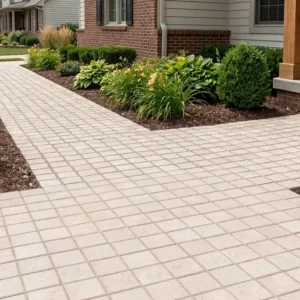
The Hole’s architecture performs the territory’s visual signature: Caribbean-vernacular buildings in fearless palettes, trim and fretwork carrying the melody, and the post-2017 rebuild recommitting to the tradition deliberately — color as continuity when so much needed remaking. Ground-plane design serves the performance on the painted-city principles at village scale: warm neutral stone letting facades lead, low-sheen surfaces under saturated walls, and the discipline that keeps the ground from competing in a composition where buildings are the flowers and paving the vase.
The working hole
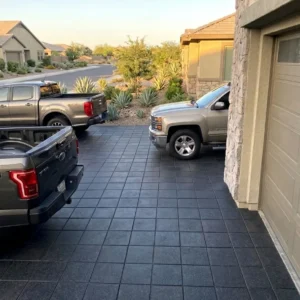
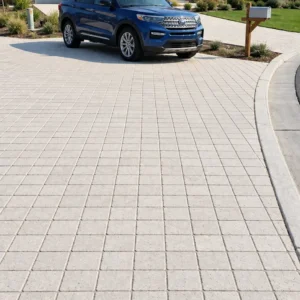
Beneath the postcard, Soper’s works: ferry terminal traffic binding the territory to its neighbors, charter-base turnarounds on the fleet-coordination rhythms, fuel and provisioning docks serving the west’s cruising grounds, and the marina village’s daily commerce. The ground plane zones honestly per the working-waterfront truth: quay-grade surfaces where trolleys and ferry crowds process, dressed utility infrastructure through the village core, spill-wise detailing at the fuel line, and hospitality polish where the color tradition hosts its visitors — one composition, duty-graded beneath.
- Design for wheeled luggage as the dominant load, not for occasional foot traffic.
- Keep the route from berth to road continuous in one material so nobody hunts for the way.
- Use larger units on the main line of travel and save detail for the edges.
- Provide covered waiting areas paved in the same family so the space reads as one place.
Ferry-gate manners
As a territory port-of-entry, the West End processes arrival’s full ceremony — customs queues, taxi negotiations, the first impressions travelers carry up-island — and its civic surfaces run the gateway registers at village warmth: crowd-capable walks that never feel institutional, shaded waiting on seat-height walls, luggage-wheel tolerance throughout, and the accessibility courtesy of a gate everyone’s grandmother uses. The color tradition does the welcoming; the stone just makes sure nobody stumbles during it.
Sheltered-water living
The Hole’s protected anchorage rings itself with the territory’s gentlest waterfront homes — the lagoon-register rules in BVI dress: dock-front terraces at flat-water ease, sunset moorings as the evening’s furniture, dinghy commutes to the village for bread and gossip. Properties here compose for the harbor’s theater — the ferries’ punctuation, the charter fleet’s weekend ballet — with the evening-box principles at hole scale, and detail for the sheltered exposure: salt as air not assault, wake as the working wave, marine-grade fixings still law.
Rebuild lessons, village scale
The West End’s recovery modeled tradition-forward rebuilding: structures remade to post-2017 standards inside heritage silhouettes, color recommitted as identity, commerce phased back so the village never stopped being itself, and the ground plane renewed on recovery-era economics — decades-choice durability, repairable unit construction, spares against the next test. The result reads seamless to visitors and hard-won to residents: the prettiest habit, rebuilt to outlast.
- Take the color palette from what stood before rather than from a current catalog.
- Match scale to the existing frontages, since a large new plane breaks a village elevation.
- Rebuild in materials that can be repaired locally rather than replaced wholesale.
- Keep the waterfront line continuous, because gaps read as damage long after the work is done.
Joining the composition
West End projects inherit the composition’s rules: palettes that let the color tradition lead, ground surfaces on the vase discipline, working zones honest beneath village charm, and the small-harbor manners of a community that rebuilt itself watching. The territory supply guide serves the register with its particular kit — warm neutrals, duty-graded surfaces, gateway-grade civility — delivered through the Hole’s own working docks. The territory’s prettiest habit has room for good neighbors; the price of admission is knowing whose show it is.
Paint above, stone below: how the postcard stays painted
Soper’s Hole’s color is a maintenance achievement wearing a heritage costume. The village’s painted timber lives in marine air that tests coatings annually, and the settlement’s postcard survives on a two-material logic the whole waterfront quietly runs: renewable color above, permanent stone below. The timber tier repaints on a rolling cycle — hurricane season’s end is the traditional window, sun and salt damage assessed, the palette’s blues and corals refreshed before the charter winter’s photographs — while the stone tier underneath asks only its wash-down: plinths, steps, quay edges and floor slabs carrying the wear the paint never could, and framing the color with the pale constancy that makes it sing.
The division writes the budget’s honesty. Paint is an operating cost, planned and annual; stone is capital, spent once; and the village’s businesses learned the allocation by experience — every surface that could be moved from the paint column to the stone column (thresholds, wainscot-height splash zones, dock edges, the floors themselves) reduced the yearly bill and improved the postcard’s durability between cycles. The rebuild years proved the split at scale: the painted tiers went and returned brighter; the stone tiers held the village’s ground and its levels, and reconstruction bolted back onto them. New work in the Hole follows the settled formula, and visiting owners can read it straight off the frontage: whatever the sea touches or feet wear is stone; whatever the camera loves is paint; and the line between them is drawn one comfortable step above the spray.
For premises owners the operational note is worth keeping: schedule the paint window, hold the palette’s records as carefully as stone batches, and let the wash-down rhythm serve both tiers — because the postcard is a system, and systems stay beautiful by design, not luck. The Hole has run this one for decades; joining it is as simple as respecting the line.
Why West End is treated as a place, not a plot
Soper’s Hole and the wider West End sit inside a planning framework that thinks in settlements. The National Physical Development Plan sets a hierarchy in which Road Town, Spanish Town, Belle Vue and The Settlement are Primary Settlement Areas carrying the fullest mix of uses, with towns and villages taking a similar range minus industry, the countryside restricted to small-scale development, and the remaining islands and cays limited to focused development integrated with their natural setting. It also names protection of the cultural heritage of the territory as a core goal, which is precisely what a painted waterfront is.
- Read the frontage as a public elevation, because that is how policy and visitors both read it.
- Keep new work subordinate to the existing rhythm of openings, colors and roof lines.
- Expect heritage character to carry real weight in a settlement area rather than being advisory.
- Design ground surfaces as civic space rather than as the leftover between buildings.
- Assume the quay is used by residents, ferry passengers and crews all at once, every day.
Bedding a quay that never closes
A working waterfront cannot be rebuilt in one closure, which makes the setting method a programming decision as much as a technical one. The overview from Use Natural Stone on paving detailing sets out mortar-set on a rigid base, sand-set on compacted aggregate and pedestal-set over structure. On a quay that carries trolleys, deliveries and a ferry crowd, the right answer is usually a hybrid, zoned so each area can be lifted independently.
- Sand-set the general field so sections can be lifted and reinstated overnight.
- Mortar-set only the heavily loaded lines where trolleys and vehicles run constantly.
- Set the zone boundaries on visible lines so a repair looks intentional rather than patched.
- Restrain every edge properly, because a waterfront field with a loose edge migrates within a year.
Color and scale on a painted waterfront
The West End tradition is strong color on buildings above a quieter ground plane. That relationship is what makes the place photograph the way it does, and it is easily broken. Paving that competes with the facades flattens the whole composition, while paving that is too fine in scale disappears under a crowd.
- Keep the ground plane low in chroma so the buildings stay the color event.
- Choose formats generous enough to remain legible when the quay is busy.
- Use a single tone family across the whole frontage rather than changing at property lines.
- Let texture rather than color provide interest, since texture survives weathering better.
Waterfront village stone that carries the West End character
A village waterfront is a shared room. The paving that works here is quiet in tone, generous in scale, zoned so it can be repaired without closing the quay, and chosen to sit beneath a painted elevation rather than compete with it. Our British Virgin Islands stone guide sets out the formats, finishes and lead times that suit this territory. Get the ground plane right at Soper’s Hole and the buildings above it do all the talking, which is exactly how it should be.