

Basalt is pronounced buh-SALT in most American English: two syllables, with the stress on the second, and that second syllable sounds just like the word salt. You will also hear BAY-salt, and BASS-alt is the usual British form. All three are understood on a supplier call or at a stone yard. Once the word itself is settled, the terms that travel with it matter more. A basalt quote or specification names a finish, a format and often a stone type, and each of those words changes what is being ordered. The basalt glossary below gives every term a plain one-line meaning.
How to Pronounce Basalt — and Why It Matters
The standard American basalt pronunciation is written /bəˈsɔːlt/ in phonetic symbols: a short, unstressed buh, then a stressed salt with the final t sounded. Saying it cleanly matters most when you specify out loud — in a site meeting, or reading a line item back from a tender — because it keeps the conversation on the details that decide the order.
- Most common in the US: buh-SALT /bəˈsɔːlt/ — stress on the second syllable
- Also heard in the US: BAY-salt /ˈbeɪsɔːlt/ — stress on the first syllable, listed in US dictionaries as a variant
- Usual British form: BASS-alt /ˈbæsɔːlt/ — first-syllable stress with a short a, also heard in the US
- Related word: basaltic, said buh-SALT-ik, meaning made of or containing basalt
Spelling note: the word is spelled b-a-s-a-l-t, with one s and no e at the end. Basolt, bassalt and basalte are common misspellings that can send a search or an email in the wrong direction. The name reached English through Latin basaltes, which is generally traced to a copyist’s misreading of basanites, an old name for a hard, dark touchstone.
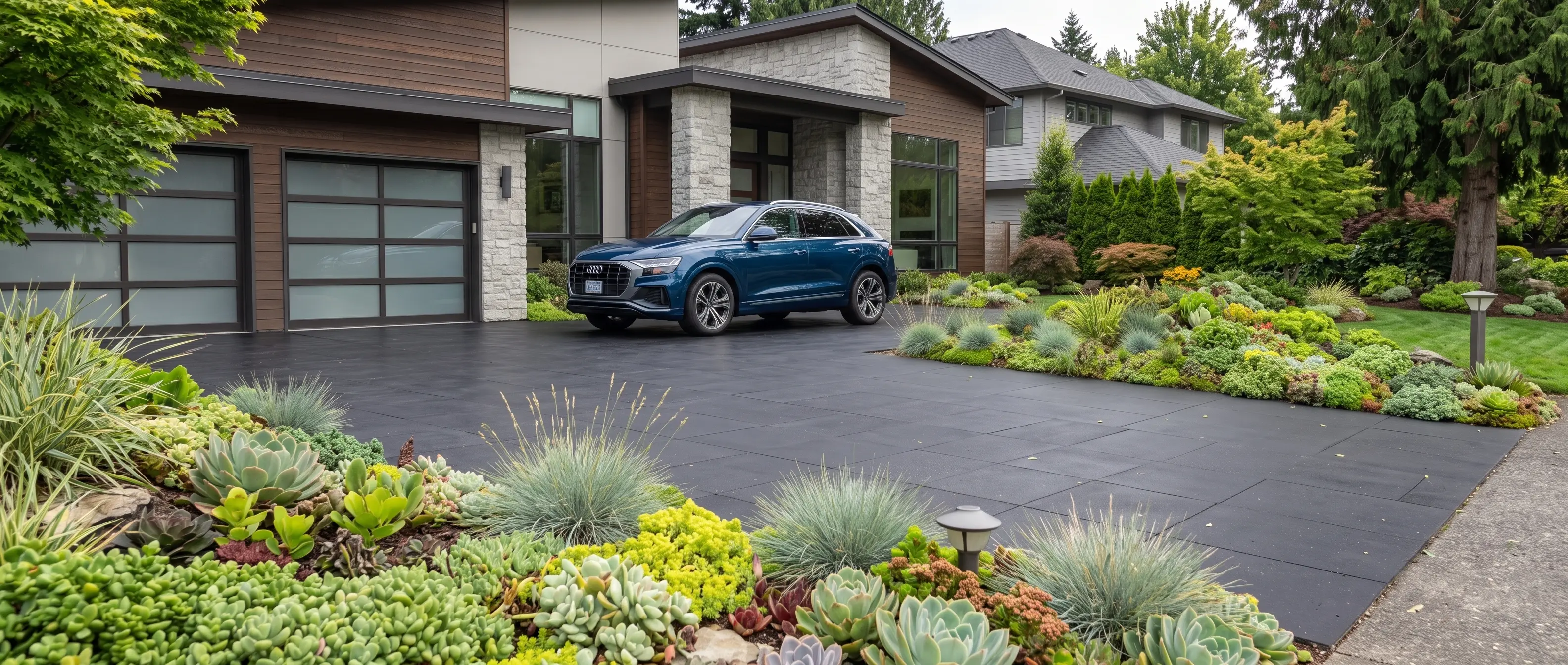
What Basalt Actually Is — The Geology Behind the Name
Basalt is a fine-grained extrusive igneous rock formed when low-viscosity lava erupts, spreads, and cools rapidly at or near the earth’s surface. The rapid cooling prevents large crystals from developing, which is why a cut face of basalt looks almost glassy compared to the coarse-grained texture of granite. That uniformity in crystal structure is what gives basalt tiles their consistent colour and tight surface — no large mineral pockets to create colour variation the way feldspar does in granite.
Most of the stone terms in this glossary trace back to that origin. According to Britannica’s basalt geological entry, the rock’s mineral composition — primarily plagioclase feldspar, pyroxene, and olivine — is what drives both its characteristic dark colouring and its high bulk density relative to sedimentary alternatives.
Basalt Finish Terms on a Quote
The finish is the treatment given to the visible face of the stone. It is usually the first word after the material name on a quote, and it decides how the surface looks, how it feels underfoot and how it takes a sealer.
- Honed: ground flat to a smooth matte face without polishing; it shows basalt’s natural grey-to-charcoal tone with no mirror shine.
- Polished: ground further to a reflective gloss; on floors, specify it for dry indoor areas only.
- Flamed (thermal): the face is heated with a torch so the surface crystals fracture, leaving a coarser texture and a slightly lighter tone than a honed face from the same stone.
- Brushed: worked with abrasive brushes to a softly textured face that sits between honed and bush-hammered, for a gentler, aged look.
- Bush-hammered: struck with a multi-point hammer head to give an even, pitted texture with higher relief and more tonal variation.
- Sawn: the face left as it comes off the saw — flat, with faint saw marks and a light texture.
- Tumbled: pieces turned in a drum with abrasives so the edges and corners soften into a worn, older look.
As a working rule: bush-hammered for pool decks, wet steps and slopes; brushed for outdoor paths; honed for indoor floors. The finish also changes how a sealer behaves, so check the sealer maker’s guidance for the exact finish you have specified. For projects using our honed basalt floor tiles, the tight surface produced by the honing process makes it straightforward to achieve a consistent sealer penetration depth across the field.
Basalt Format Terms: Tiles, Pavers, Setts, Slabs and Coping
The format is the shape and thickness the stone is cut to. Two quotes for the same basalt in the same finish can describe very different products if the format words differ.
- Tiles: thinner flat units for indoor floors and walls, set in adhesive or mortar on a prepared base.
- Pavers: thicker flat units for outdoor paving such as patios, paths, pool decks and pedestrian areas. For a driveway, specify pavers at least 5 cm (2 in) thick, mortar-bonded to a reinforced concrete slab.
- Setts (cobbles): small, deep blocks with sawn or split faces, laid in rows or patterns; cobbles is often used for the same thing, or for rounder, tumbled pieces. For a driveway, setts or cobbles should be at least 3.5 in deep.
- Slabs: large sawn pieces of stone, bigger than standard tiles, used for large-format floors, wall panels, steps and other custom pieces.
- Coping: the units that cap the edge of a pool, step or wall, usually with a finished front edge such as a rounded bullnose or a softened, eased edge.
Every format is quoted with a nominal thickness: the stated size that the cut pieces are made to, within an agreed tolerance. On large-format floors, uneven thickness shows up as lippage, where one edge stands proud of its neighbour.
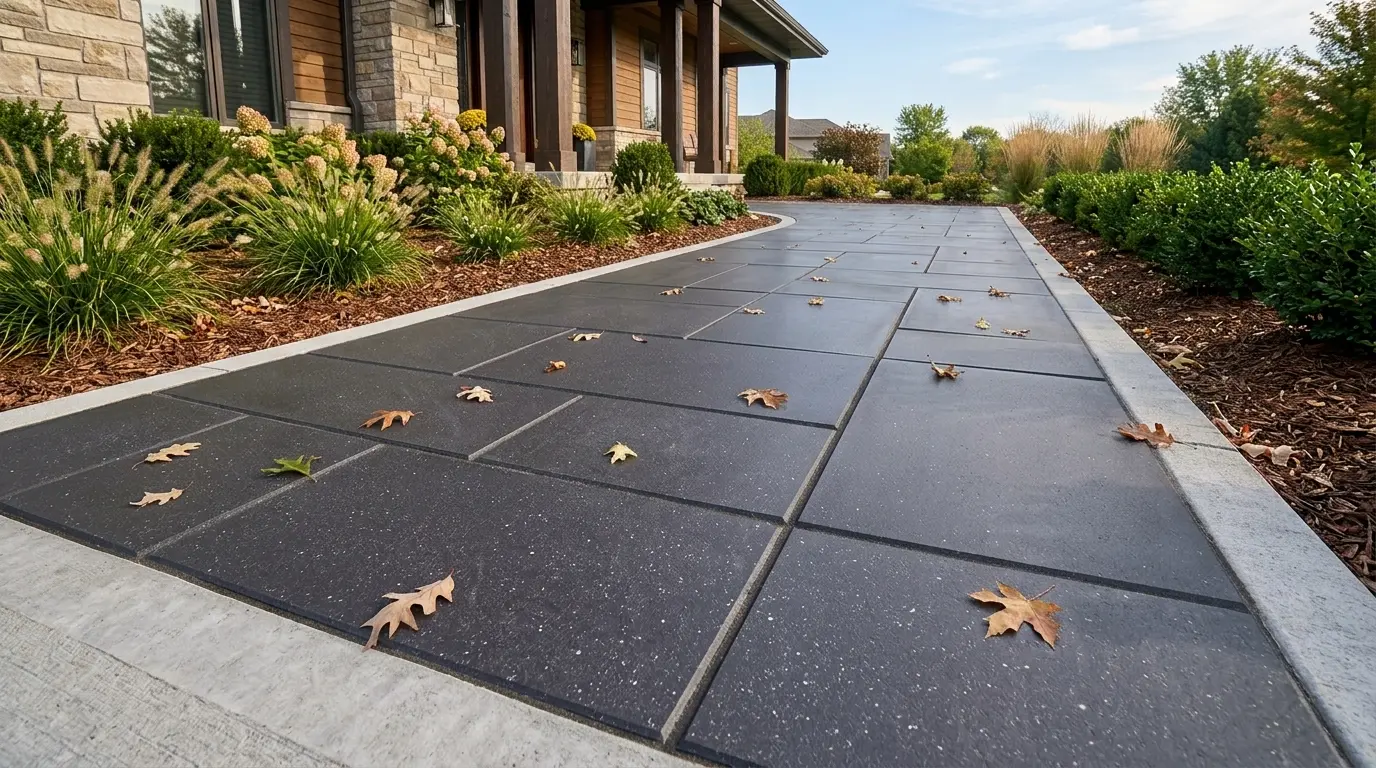
Basalt Stone Terms: Fine-Grained, Dense, Vesicular and Columnar
These words describe the stone itself rather than how it is cut or finished. They turn up in product descriptions, datasheets and geology notes.
- Igneous, extrusive: formed from molten rock; extrusive means it cooled from lava at or near the surface rather than deep underground.
- Fine-grained: the mineral crystals are too small to see with the naked eye because the lava cooled quickly, which is why basalt shows an even colour without large flecks.
- Dense: little pore space inside the stone, so it is heavy for its size and takes in less water than many sedimentary stones.
- Vesicular: peppered with small holes called vesicles, left by gas bubbles trapped as the lava cooled; a vesicular face reads as pitted rather than solid.
- Columnar (columns of basalt): the five- and six-sided prisms that form as a thick lava flow cools and contracts, as at the Giant’s Causeway in Northern Ireland or along the Columbia River Gorge.
- Flood basalt: vast layered sheets of basalt built up from many lava flows across a wide area.
For more on that last term, flood basalt geology and tile consistency covers the formation process and why it produces the uniform surface properties that make basalt reliable across large floor installations.
Specification Terms That Travel With Basalt
A written specification names the material (basalt), the finish, the format, the nominal thickness and the performance properties that matter for the use. A few property and installation terms come up again and again:
- Compressive strength: how much crushing load the stone carries before it fails.
- Flexural strength (modulus of rupture): how much bending load a piece takes before it breaks, the figure that matters most for thinner units.
- Water absorption: how much water the stone takes in, given as a percentage of its dry weight.
- Movement joint: a flexible joint left in a paved or tiled field so the installation can expand and contract without cracking.
- Penetrating sealer: a sealer that soaks into the surface pores rather than forming a film on top.
For a short, neutral background on the rock itself, the USGS basalt volcanic rock properties page is a useful companion to the definitions above. For plain descriptions of the other stone types a specification may set beside basalt, see the Natural Stone Institute’s guide to stone varieties.
Parting Guidance on Basalt Specification
Say it buh-SALT, then put the terms to work: name the material, the finish, the format and the thickness on every quote request, so you and your supplier are reading the order the same way. Sourced direct from our selected quarries in the Middle East, our honed basalt tiles are selected for uniform surface texture.
Related reading: How Basalt Rock Forms and Why It Suits Tiles · vesicular basalt rock · Columnar Basalt Rock: From Cliffs to Floor Tiles.