

Flood basalt formations produce something that most igneous sources simply cannot replicate at scale: laterally continuous lava sheets deposited in rapid, successive flows that cool under near-identical conditions. That uniformity at the point of formation is precisely what drives consistent tile color and hardness across an entire quarried batch of flood basalt. Understanding the geology behind this process isn’t academic — it directly informs how you specify, order, and install basalt tile with confidence.
How Flood Basalt Forms — and Why Formation Controls Consistency
Flood basalt eruptions differ from typical volcanic events in both scale and character. Rather than explosive central-vent activity, fissure eruptions release enormous volumes of low-viscosity mafic lava across broad geographic zones, sometimes covering hundreds of square kilometres in a single flow episode. Each flow cools slowly relative to its thickness, creating a mineralogically homogeneous cross-section that quarrying cuts through perpendicular to the flow direction.
The mineral composition — predominantly plagioclase feldspar, pyroxene, and olivine — locks into a fine-grained interlocking crystalline texture as the melt solidifies. That interlocking structure is what gives finished basalt tile its characteristic density and resistance to abrasion. Where the cooling rate was most uniform, the crystal size distribution tightens, and colour variation from tile to tile becomes minimal. This is the geological basis for specifying flood basalt when a project demands visual predictability across large floor areas.
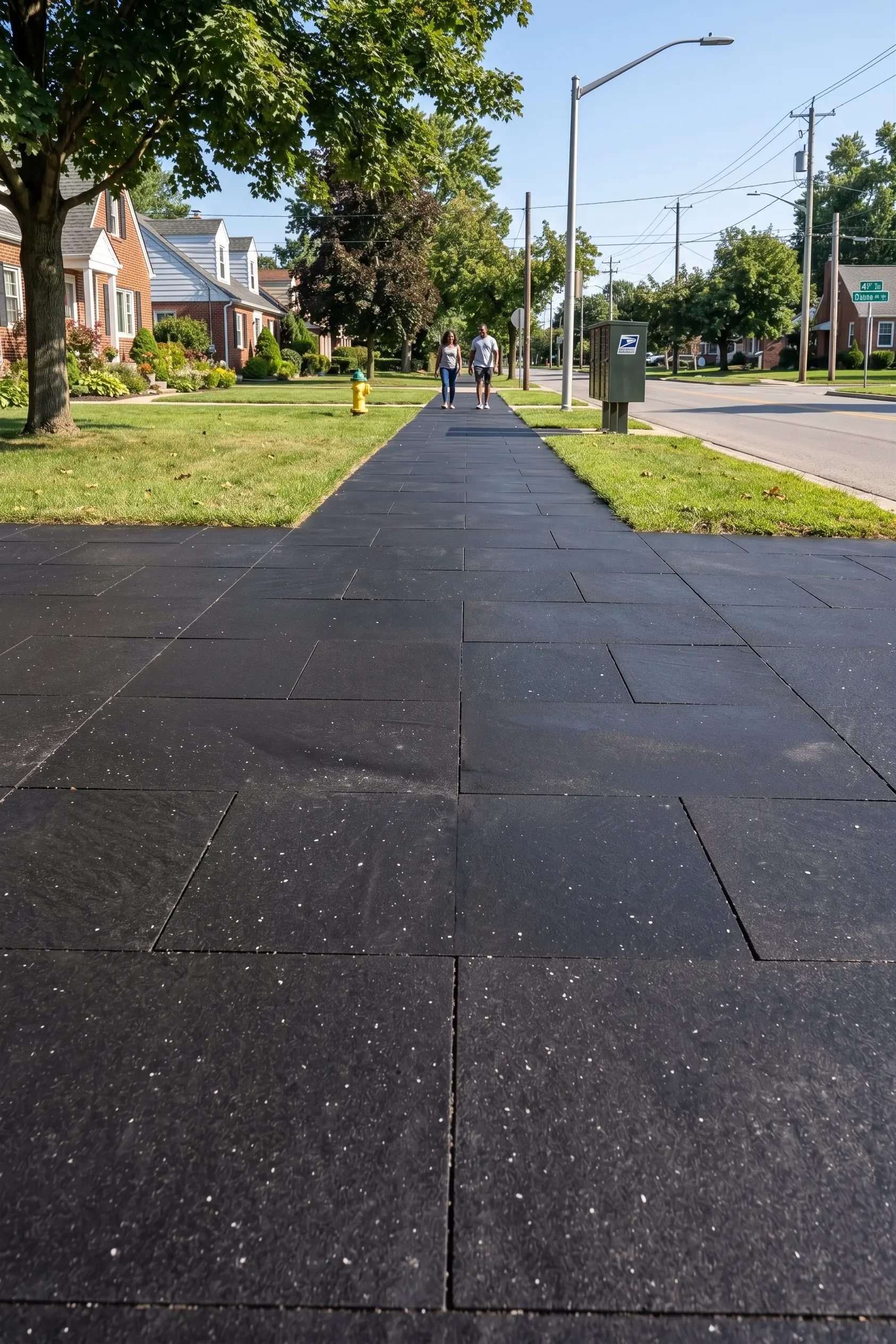
What Holds Up Over Time: Performance Characteristics Worth Specifying
Basalt’s durability traces back to its igneous origin — it formed under conditions of extreme heat and pressure, then cooled into a structure with virtually no inherited weaknesses like bedding planes or fossil voids. According to USGS basalt volcanic rock properties and composition, basalt is one of the most abundant fine-grained igneous rocks on Earth, with a silica content and mineral interlocking pattern that supports high compressive loads and resists surface degradation under traffic.
For specification purposes, key performance indicators include compressive strength, flexural strength, water absorption, and abrasion resistance. Request the relevant ASTM test reports from your supplier rather than relying on published range estimates — actual values vary between quarry sources and flow layers. The Natural Stone Institute’s published igneous stone paving technical standards provide the testing framework against which quarried material should be certified. Absorption values in flood basalt tiles can be very low, but the specific figure for a given batch belongs on a certificate, not in a general article.
- Request ASTM test reports for compressive strength, flexural strength, and absorption before writing flood basalt into a final specification
- Confirm that the tested sample represents the specific flow layer your tiles will come from — upper and lower flow zones can differ measurably
- Cross-reference finish type (honed, flamed, sawn) with the absorption certificate, because surface treatment alters effective porosity and sealing requirements
- For high-traffic commercial floors, ask for abrasion resistance data tested to ASTM C241 and confirm results against your project’s traffic category
Basalt Deltas and Flow Stratigraphy: Reading the Quarry Stack
The term basalt deltas refers to the fan-shaped lobe structures that form at the leading edge of individual flows as lava spreads into lower terrain or standing water. These marginal zones cool faster and often show higher vesicularity — meaning more gas pockets — than the central flow interior. Specifying tile from the central, dense portion of a flood basalt flow stack is what secures the tightest colour and hardness consistency. Quarry operators who understand flow stratigraphy select extraction faces accordingly, and that selection decision is invisible once the tile is cut and polished.
At our selected quarries, we cross-check which flow stratum each production batch originates from, because even within a single quarry face, the transition from one cooling episode to the next can shift tone by several shades. That verification step is what lets a specifier trust that tiles dispatched in separate deliveries will still read as a unified floor. It’s the kind of upstream quality check that doesn’t appear on a product page but determines whether a large-format installation looks intentional or patchy.
Basalt deltas also create natural variation in vesicle density from the flow margin inward. Understanding where in the delta structure your extraction face sits is therefore a direct input to your specification — a consideration that distinguishes experienced sourcing from commodity procurement.
Finish Options and How Surface Texture Affects Long-Term Appearance
Flood basalt responds well to a range of surface finishes, each producing a distinct visual and tactile result. Honed basalt — cut and ground to a smooth, matte surface — reveals the fine-grained crystalline matrix clearly and is the most common choice for interior flooring. Flamed basalt is thermally shocked to produce a rougher, open texture that is widely used for exterior applications where the surface needs to handle wet conditions. A sawn finish sits between the two: it removes the quarry skin but leaves subtle saw marks that give the tile a directional character.
- Honed finish: tight, matte surface that shows the stone’s natural colour depth — requires sealing because the open micro-texture allows liquid penetration
- Flamed finish: thermally opened surface with a coarser texture — generally lower absorption in practice because the heat partially fuses surface pores, though you should request the absorption figure for each batch
- Brushed finish: a brushed wire treatment that softens the honed surface and produces a tactile variation useful in areas where a completely flat surface is undesirable
- Sawn finish: industrial look with directional texture, often specified for contemporary outdoor schemes or feature walls
Slip resistance under ANSI A326.3 is the current wet-tested standard for evaluating stone tile surfaces, replacing the ASTM C1028 static test withdrawn in 2014. The finish is the primary variable — a flamed surface will test differently from a honed one under identical conditions. Never rely on dry test results to satisfy a wet-use specification. If you need performance data for a particular finish, the test report is available on request.
Specifying Flood Basalt Tile: Dimensions, Thicknesses, and Tolerances
Your specification for basalt floor tiles should define nominal dimensions, thickness, finish, and dimensional tolerance as separate line items — not as a single description. Flood basalt tiles are commonly available in square formats from small mosaic through to large format slabs, and thickness is specified according to the point loads and subfloor conditions of the application. Thinner tiles work for wall cladding or light residential floors with a solid concrete substrate; heavier nominal thicknesses are appropriate for commercial floors, exterior paving under vehicular load, or installations over screed where deflection is a concern.
Dimensional tolerance matters more in basalt than in some sedimentary stones because the material’s hardness makes field cutting slower and more tool-intensive. A tile with a poorly controlled thickness variation will create lippage at joints even with skilled installation. Specify your tolerance in the purchase order and ask for a sample batch before the main production run is cut. Checking TCNA natural stone tile installation standards for your project’s application class gives you a starting framework for joint sizing, setting material type, and substrate preparation — then adjust for the specific absorption and density characteristics of the flood basalt batch you’ve selected.
- State nominal thickness and the acceptable deviation in millimetres as a specific contractual requirement
- Define flatness tolerance across the tile diagonal — this affects adhesive bed depth and lippage risk
- Specify calibrated or rectified edge condition if the installation pattern requires tight joint lines
- For exterior paving, confirm that the specified thickness supports the design point load without relying on the adhesive bed for structural contribution
Seasonal Timing and Temperature Windows for Basalt Tile Installation
Basalt’s density affects how it interacts with setting materials during installation — and that interaction changes significantly with ambient and substrate temperature. Most cementitious adhesives and large-format tile mortars carry a published working temperature range, and flood basalt’s low absorption means that moisture from the setting bed doesn’t migrate into the tile body quickly. In colder months, this is actually an advantage: the adhesive retains workability longer, giving installers more time to adjust large-format pieces before initial set. In warmer seasons, the opposite dynamic applies.
In high-heat conditions — particularly on exterior projects where the slab and adhesive are exposed to direct sun — the open time of most standard cementitious adhesives collapses faster than the package data suggests. Scheduling exterior basalt work for early morning hours, before the substrate absorbs peak radiant heat, extends workable time meaningfully. Moving into late spring and summer, switching to a slow-set adhesive formulation rated for the actual substrate temperature you expect to encounter is a practical field call, not an upgrade option. Check the adhesive manufacturer’s data sheet for the upper substrate temperature limit — exceeding it voids the product warranty and typically causes bond failure at the interface rather than within the adhesive body itself.
- Schedule exterior basalt installations to begin as early in the morning as the light permits, especially in warm seasons
- Confirm adhesive working temperature range against the actual substrate temperature before mixing — not against the air temperature
- In freeze-thaw regions, allow full cure time (typically at least 28 days for the substrate and the adhesive system) before the first freeze cycle stresses the bond
- Autumn installations in continental climates can offer the most predictable temperature windows — mild mornings, low UV, and slower adhesive set than summer peaks
- Avoid installing over a substrate that has been in direct sun for more than two hours without shade protection or forced cooling — shadow the work area progressively as installation proceeds
Colour Consistency in Practice: What Mid-Grey Basalt Tones Tell You
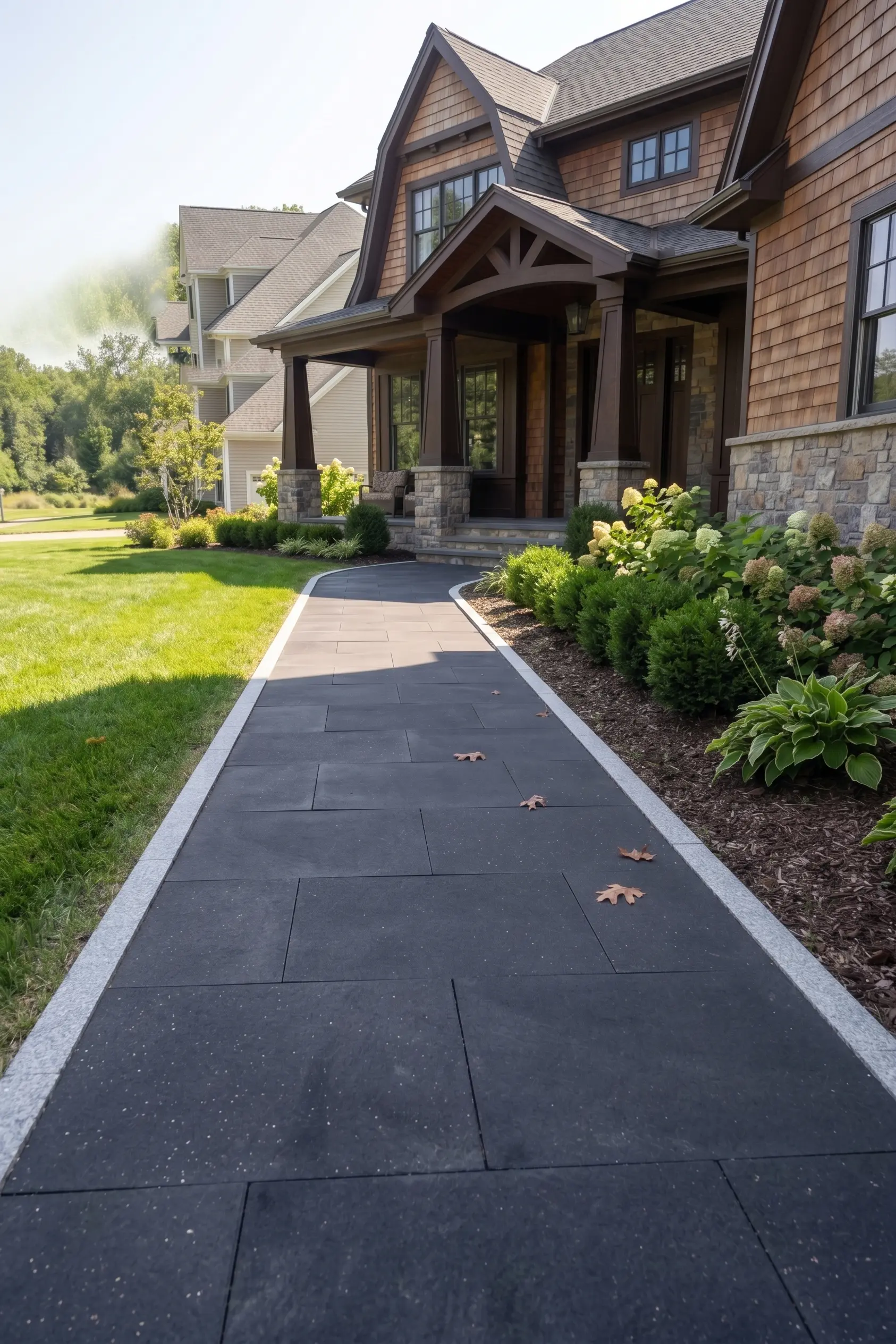
Basalt tile is often described by tone, and one tone worth understanding is the warm-grey to blue-grey range that appears in certain flood basalt flows where the iron and magnesium mineral proportions sit within a specific band. Tone wording like this is descriptive shorthand for a visual character, not a geological designation. When you see it in a product description, it signals that the stone has been selected from a flow zone where the cooling chemistry produced less of the near-black saturation common in higher-iron basalt and more of the silvery mid-grey that photographs neutrally and pairs easily with light-coloured grout.
Colour consistency across an order is the practical concern. Even within a flow that reads as consistent, the cut face exposed by the quarry will shift tone subtly as extraction progresses. Ordering your complete tile quantity in a single production batch — and confirming that all tiles come from the same extraction block — is the most reliable way to control this. If the project phases over time and a matching top-up order is needed later, request a calibrated sample against the first batch before confirming the reorder. Flood basalt’s geological consistency reduces this risk compared to sedimentary stone, but it doesn’t eliminate it. This warm-grey to blue-grey range is especially sensitive to such shifts because its defining quality is the narrow mid-grey band — any movement in iron content reads as a visible step change.
Sealing Protocols and Long-Term Maintenance
Honed and brushed flood basalt floors need sealing after installation and at intervals determined by your sealer manufacturer’s stated reapplication schedule. The stone’s low absorption rate means that penetrating impregnator sealers work well — they enter the micro-pore network and cure below the surface rather than forming a film coat that can chip or cloud under traffic. Film-forming sealers are generally unsuitable for basalt floors that carry foot traffic, because they sit on the surface and abrade visibly in circulation paths.
For ongoing maintenance, pH-neutral cleaners are the correct choice. Acidic cleaners — including many common tile cleaning products — will dull the surface of honed basalt over time by attacking the calcium-bearing minerals in the crystalline matrix. This is more of a concern in kitchens and food-service environments where cleaning frequency is high. Instruct whoever maintains the floor in writing, and specify the cleaner type in the project handover documentation.
- Apply penetrating impregnator sealer to honed and brushed basalt surfaces before grout installation and after grouting is complete and dry
- Test the sealer on a sample tile before full application — some silicone-based formulations darken certain basalt tones slightly and permanently
- Specify resealing frequency on your maintenance schedule — typically every one to three years for interior floors depending on traffic intensity
- Flamed exterior basalt may require sealing in dense urban environments where airborne soiling is a factor, even if the absorption rate is lower than honed equivalents
Ordering, Lead Times, and Delivery Logistics
Flood basalt tiles are cut to order at our selected quarries, which means lead time is tied to production scheduling. When you specify our consistent basalt floor tiles, your project timeline needs to build in production time plus transit from the quarry to site. Lead times are quoted with each order and depend on the volume, format, and finish specified — factor this into your programme before the specification is finalised, not after the contract is signed.
Delivery to site involves offloading considerations worth addressing early. Large-format basalt tiles are heavy, and pallet weights for a significant floor area can be substantial. Confirm your site’s access constraints and offloading capability — whether that’s a forklift, pallet truck, or manual handling — before the delivery date is set. Offloading arrangements are confirmed before dispatch so that the material arrives when the site is ready to receive it, not before adequate access is in place.
- Confirm your full tile quantity in a single order where possible to ensure batch consistency
- Provide accurate site access information — road width, overhead clearance, and available unloading equipment — when placing the order
- For phased projects, store tiles flat on pallets in a dry, covered area to avoid surface contamination before installation
- Order a modest quantity overage to allow for cuts, breakage during installation, and future replacement tiles — flood basalt’s batch-specific colour means late reorders may not match precisely
Getting Flood Basalt Specifications Right
The geological case for flood basalt as a specification material comes down to a single argument: formation conditions that produce lateral homogeneity translate directly into tile-to-tile predictability that other igneous sources rarely match at scale. Your job as a specifier is to interrogate that consistency at the point of purchase — request the ASTM test reports, confirm the extraction stratum, order in a single batch, and match your setting system to the ambient conditions your installation schedule will actually encounter. A basalt floor that ages well is one where each of those decisions was made deliberately, not assumed. For projects incorporating stone on adjacent or complementary hardscape elements, placing basalt boulders for slope stability covers another dimension of basalt performance worth reviewing for site integration. Citadel Stone selects flood basalt grades for their broad, uniform layers that yield steady tile color and hardness.
Related reading: choosing grey basalt tile · basalt rock types for tiles · basalt mosaic tile ideas.