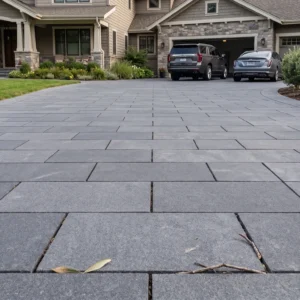
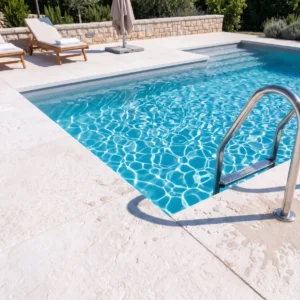
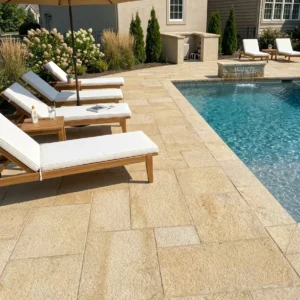
This comprehensive guide examines why natural stone has become the preferred choice for resort hardscape materials, covering performance advantages, design benefits, maintenance realities, sourcing logistics, and real-world cost considerations. Whether you’re planning a boutique property or a major resort expansion, understanding these factors will help you make informed decisions that benefit both guests and your bottom line.
Performance Advantages in Tropical Coastal Environments
Salt & Weather Resistance — Why Certain Stones Outperform Manufactured Alternatives
Caribbean coastal environments present unique challenges that quickly reveal material weaknesses. Salt-resistant stone options like dense limestone tiles, black basalt pavers, and properly selected granite demonstrate superior performance compared to concrete pavers, which can suffer from salt penetration and spalling within 5-7 years.
Natural stone’s crystalline structure provides inherent resistance to salt water exposure. Dense stones with low absorption rates (typically under 3% by ASTM C97 standards) create effective barriers against salt intrusion. This contrasts sharply with manufactured alternatives that rely on surface treatments or sealers that require frequent reapplication in harsh coastal conditions.
Storm resistance represents another critical advantage. Natural stone’s mass and structural integrity help resist uplift forces during hurricanes, while properly installed stone systems flex without catastrophic failure during seismic events common to the Caribbean region.
Thermal Comfort & Surface Temperature
Surface temperature management directly impacts guest comfort and safety around pools, walkways, and plaza areas. Light-colored stones like cream limestone or white coral stone typically maintain temperatures 15-20°F cooler than dark alternatives under direct tropical sun.
Finish selection dramatically affects thermal performance. Honed and bush-hammered surfaces create micro-textures that reduce heat absorption compared to polished finishes. For high-traffic barefoot areas like pool decks, these textured finishes also provide essential slip resistance while maintaining comfortable surface temperatures.
Strategic color and finish combinations allow you to create thermal comfort zones throughout your property. Use lighter stones for primary guest circulation and darker accent stones for visual interest in shaded or less-trafficked areas.
Durability & Abrasion Resistance for High-Traffic Public Areas
Resort environments subject hardscapes to constant traffic, wheeled carts, furniture movement, and maintenance equipment. Natural stone’s proven durability shows measurable advantages over manufactured alternatives in abrasion resistance testing (ASTM C241).
Black Basalt and granite excel in high-traffic applications, maintaining surface integrity for decades with minimal wear. Even softer stones like limestone develop attractive patinas over time rather than showing obvious deterioration. This aging characteristic helps maintain the authentic, established appearance that guests associate with quality resorts.
Impact resistance matters for operational efficiency. Natural stone typically withstands maintenance equipment, dropped objects, and furniture movement better than porcelain or concrete alternatives, reducing replacement costs and operational disruptions.
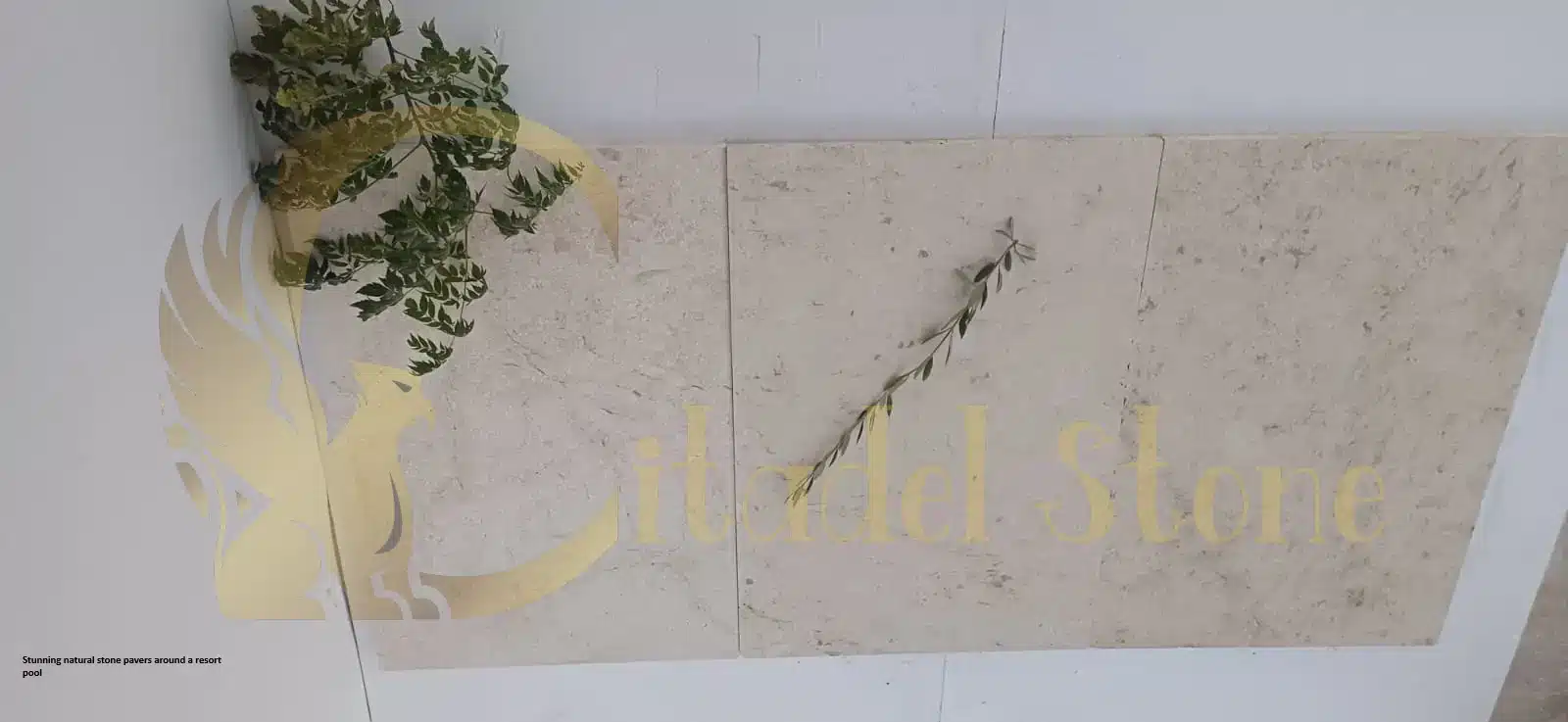
Design & Aesthetic Benefits That Attract Guests
Natural Variation, Luxury Cues, and the “Place-Making” Effect
Guests subconsciously associate natural stone with permanence, authenticity, and luxury. The inherent variation in natural stone creates visual interest that manufactured products struggle to replicate. This variation helps establish a sense of place that connects the resort to its Caribbean setting.
Luxury resort landscaping increasingly emphasizes materials that tell a story. Local limestone connects guests to geological history, while imported stones can reference global travel and sophistication. The key lies in selecting stones that complement rather than compete with the natural beauty of Caribbean coastal environments.
Color palettes derived from natural stone create harmonious transitions between built and natural environments. Warm creams, soft grays, and weathered blues found in Caribbean limestone and coral stones provide sophisticated neutrals that enhance rather than overwhelm tropical landscaping.
Finish Options and Applications
Finish selection strategically impacts both performance and aesthetics across different resort areas:
Pool Decks: Bush-hammered or flamed finishes provide optimal slip resistance while maintaining elegant appearance. Avoid polished finishes in wet areas.
Plaza Areas: Honed finishes offer refined appearance for formal gathering spaces while providing adequate traction for normal foot traffic.
Walkways: Sandblasted finishes create subtle texture that guides circulation while complementing both formal and casual landscape treatments.
Terraces: Tumbled or antique finishes work well for intimate dining or lounge areas, providing casual elegance that encourages relaxation.
Maintenance, Lifespan & Lifecycle Cost (Real ROI)
Typical Maintenance Cycles vs Concrete/Porcelain
Natural stone maintenance requirements prove surprisingly manageable when properly specified and installed. Annual cleaning with appropriate stone cleaners, bi-annual sealing for porous stones, and periodic joint maintenance typically comprise the full maintenance schedule.
This contrasts favorably with concrete pavers requiring frequent pressure washing, crack repair, and complete replacement every 10-15 years in coastal environments. Porcelain systems often suffer from grout deterioration and individual unit replacement challenges that disrupt guest areas.
Maintenance timing flexibility represents a significant operational advantage. Stone maintenance can typically be scheduled during slower periods without emergency intervention requirements common to failing manufactured systems.
Browse durable exterior tiles Bahamas with fast shipping — Start now.
Expected Lifespan and Lower Total Cost of Ownership
Properly selected and installed natural stone systems regularly achieve 25-50 year lifespans with routine maintenance. Dense stones like basalt or granite can perform well beyond 50 years in resort applications.
Lifecycle cost analysis consistently favors natural stone despite higher initial material costs. When you factor replacement cycles, maintenance intensity, and operational disruptions, natural stone typically shows 20-40% lower total cost of ownership over 20-year periods.
Labor cost advantages compound over time. Stone repairs typically require skilled mason work rather than complete system replacement, allowing targeted maintenance that minimizes guest area disruptions.
Repairability and Patching Advantages
Individual stone replacement allows targeted repairs without large-area reconstruction. This proves invaluable for resort operations where guest area availability directly impacts revenue.
Color and texture matching improves with age as both original and replacement stones develop similar patinas. This natural aging process helps repairs blend seamlessly, unlike manufactured products where color matching becomes increasingly difficult over time.
Emergency repair capabilities matter for storm recovery. Natural stone systems can often be temporarily stabilized and fully restored using local resources, while manufactured systems may require extended lead times for replacement materials.
Sustainability & Certification — Meeting ESG & Guest Expectations
Local Sourcing and Embodied Carbon Considerations
Caribbean stone sourcing opportunities vary significantly by island, with excellent limestone quarries in Barbados, Jamaica, and the Bahamas. Local sourcing reduces transportation emissions while supporting regional economies and ensuring cultural authenticity.
Embodied carbon calculations increasingly favor natural stone over energy-intensive manufactured alternatives. Stone extraction and basic processing require significantly less energy than concrete or porcelain production, particularly when transport distances remain reasonable.
Environmental Product Declarations (EPDs) for natural stone typically show favorable lifecycle environmental impacts compared to manufactured alternatives, supporting LEED and BREEAM credit strategies. Browse natural stone Natural Stone Floor Tiles Bahamas for walkways — See how much you can save.
Reclaimed Stone and Circularity Options
Reclaimed stone applications offer compelling sustainability stories for environmentally conscious guests. Historic buildings, old infrastructure projects, and quarry waste provide character-rich materials with proven durability.
Circularity advantages include indefinite reusability, minimal processing requirements for repurposing, and biodegradable end-of-life options. Unlike manufactured products requiring energy-intensive recycling or landfill disposal, natural stone returns to earth without environmental impact.
Project waste streams from stone cutting and fitting can often be repurposed for landscape features, drainage applications, or future maintenance needs, minimizing overall waste generation.
Green Building Credits
LEED and BREEAM certification strategies benefit from natural stone’s inherent sustainability characteristics. Regional materials credits reward local sourcing, while durability credits recognize extended lifespan performance.
Heat island reduction credits become achievable through light-colored stone selections and textured finishes that minimize thermal absorption. Stormwater management credits may apply when permeable stone systems are incorporated into design strategies.
Indoor environmental quality credits can benefit from natural stone’s lack of volatile organic compound emissions and contribution to thermal mass that moderates temperature fluctuations.
Material Selection: Which Stones Work Best in the Caribbean & Why
Recommended Stone Types
Limestone pavers remains the top choice for tropical resort paving, offering excellent thermal comfort, a choice of textured finishes, and strong aesthetic compatibility with Caribbean architecture. Dense varieties like Indiana limestone or Caribbean coral stone provide optimal performance in salt air environments.
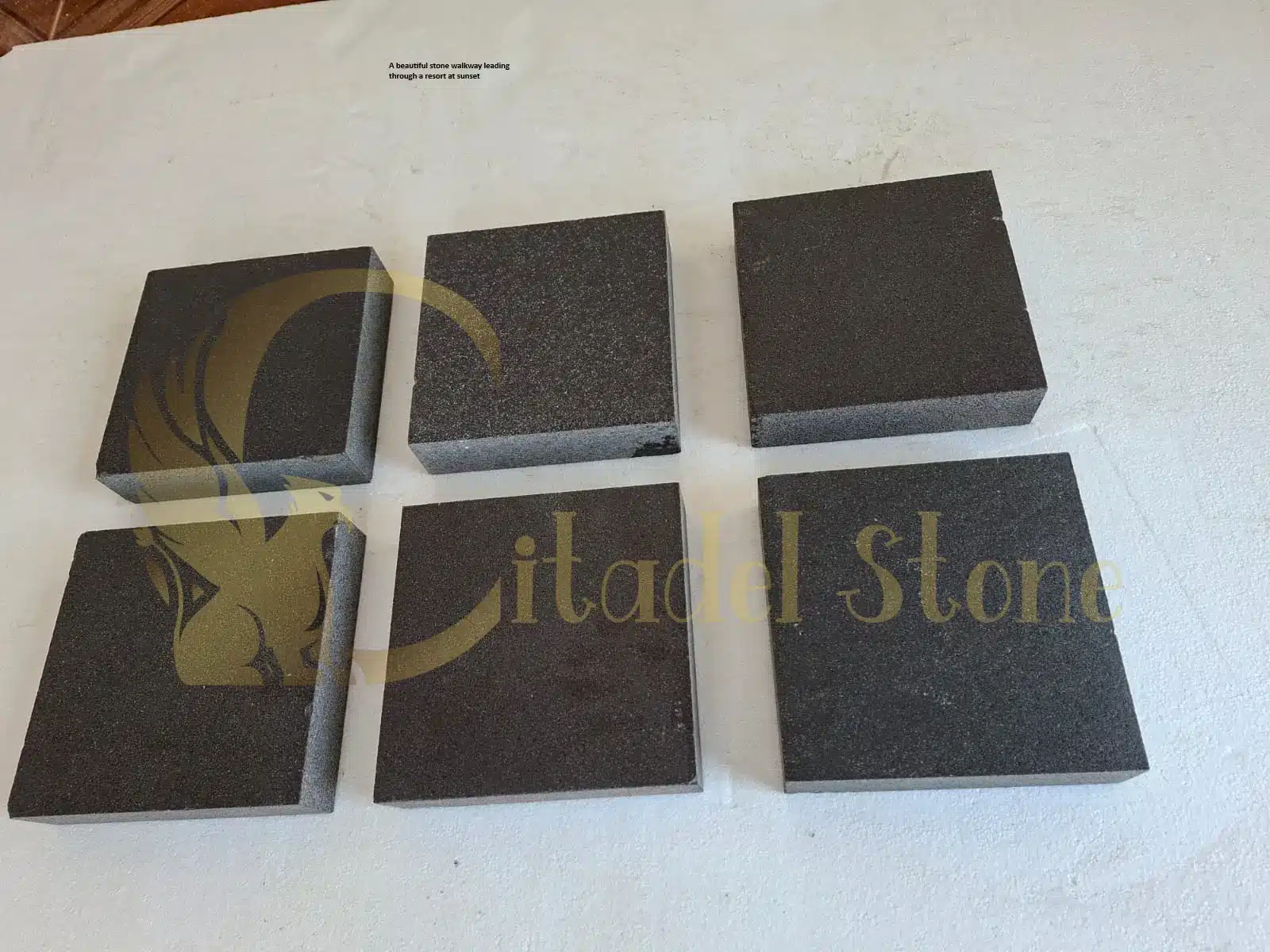
Basalt tiles deliver maximum durability for high-traffic areas, with excellent abrasion resistance and minimal maintenance requirements. Dark colors require careful thermal management but create stunning contrast with light tropical colors.
Granite provides premium performance and luxury appearance, particularly in formal plaza areas or upscale resort zones. Select varieties with proven coastal performance and avoid highly polished finishes in wet areas.
Shellstone pavers offer authentic Caribbean character with excellent thermal properties and natural surface texture. Local varieties provide compelling sustainability stories and cultural connection.
Sandstone works well for casual resort areas, offering warm colors and natural texture. Specify dense varieties with proven coastal durability and avoid overly porous selections in salt air environments.
Build low-maintenance pavers Bahamas for modern designs — Get a free installation estimate.
Choosing Finishes and Thicknesses by Application
Pool edge applications require slip-resistant finishes and rounded edge profiles. Bush-hammered or flamed finishes on 2-inch thick stones provide optimal safety and durability.
High-traffic plaza areas benefit from honed finishes on 1.5-2 inch thick stones for refined appearance with adequate traction. Consider darker colors for visual interest in areas with overhead shade.
Terrace applications allow more finish flexibility, with tumbled or antiqued surfaces creating intimate scale appropriate for dining and lounge areas. Standard 1.25-1.5 inch thicknesses typically suffice for pedestrian loads. Buy granite tiles Bahamas for driveways — Claim your sample.
Installation & Detailing Best Practices for Resorts
Subbase, Drainage, and Edge Restraint Specifics
Coastal installation requirements demand enhanced drainage systems and corrosion-resistant materials. Specify 6-8 inch aggregate subbases with geotextile separation and positive drainage to prevent undermining during storm events.
Edge restraints must withstand salt air corrosion and thermal expansion. Stainless steel or hot-dip galvanized systems provide longevity, while concrete haunching offers economical solutions for areas without freeze-thaw concerns.
Drainage integration requires coordination with landscape and pool systems. Plan for 1-2% minimum slopes toward drainage collection points, with additional slope in areas subject to wash-down or pressure cleaning.
Jointing Materials and Anti-Slip Strategies
Jointing material selection significantly impacts long-term performance. Polymeric sand systems work well for pedestrian areas, while mortar joints may be required for vehicular loads or areas subject to pressure washing.
Anti-slip strategies extend beyond surface finishes. Joint width and orientation affect traction, with narrower joints (3-6mm) providing better walking comfort and wider joints (8-12mm) offering enhanced drainage in wet areas.
Sealant selection requires UV and salt water resistance. Silicone-based sealants typically outperform urethane alternatives in tropical coastal conditions, though both require periodic maintenance.
Mockups, Sample Panels and On-Site QA
Resort projects consistently benefit from comprehensive mockups that demonstrate color range, finish quality, and installation techniques. Plan for 100-200 square foot sample areas that allow stakeholder evaluation under various lighting conditions.
Quality control protocols should include absorption testing, dimensional verification, and finish consistency evaluation. Document acceptable color and texture ranges during mockup approval to guide installation quality standards.
Installation supervision requires experience with natural stone systems. Plan for specialist oversight during critical phases like edge details, drainage integration, and complex geometric areas.
Sourcing, Logistics & Procurement for Island Projects
Local Quarries vs Import — Pros/Cons and Planning
Caribbean quarry capabilities vary significantly by location. Barbados offers excellent limestone with established export infrastructure. Jamaica provides diverse stone types but may require more complex logistics coordination.
Import considerations include freight costs, customs procedures, and lead time management. Plan for 8-12 week lead times for imported stones, with additional time for customs clearance and local transport. Container shipping typically provides the most cost-effective transport for substantial quantities.
Quality verification becomes critical for imported materials. Specify pre-shipment testing for absorption, strength, and dimensional tolerance. Consider facility audits for major suppliers to verify production capabilities and quality systems.
Bulk Ordering and Storage Strategy
Island storage requirements must account for hurricane season logistics and just-in-time delivery constraints. Plan staging areas that accommodate full container loads while providing protection from storm damage.
Hurricane season planning affects material delivery timing. Schedule deliveries outside peak storm periods (June-November) when possible, or ensure adequate covered storage for weather protection.
Inventory management strategies should include 10-15% overage for installation waste, future maintenance, and potential storm damage repairs. Maintain detailed inventory tracking to support warranty and maintenance requirements. Buy durable Outdoor Tiles Bahamas with financing options — Secure your price now.
Vetting Suppliers: Certifications and Testing
Supplier qualification requires verification of quarry capabilities, quality systems, and export experience. Request ASTM or equivalent test reports for absorption (C97), compressive strength (C170), and abrasion resistance (C241).
Facility audits help verify production capabilities and quality control systems. Evaluate quarry reserves, processing equipment, and export logistics capabilities during supplier selection.
Reference project verification provides insight into real-world performance. Request project lists with contact information for similar resort or coastal projects completed within the past 5 years.
Cost Ranges & Budgeting Tips
Material costs for Caribbean resort applications typically range from $8-25 per square foot for stone materials, depending on type, finish, and sourcing. Local stones generally fall in the $8-15 range, while premium imported materials may reach $20-25 per square foot.
Installation costs add $12-25 per square foot depending on complexity, access, and local labor rates. Simple pedestrian areas typically cost $12-18 per square foot installed, while complex pool areas or detailed plaza work may reach $20-25 per square foot.
Total project costs for resort hardscape renovations generally range from $20-50 per square foot including materials, installation, and project management. Budget additional contingencies for:
- Waste allowance: 10-15% material overage
- Freight buffers: 15-20% for import delays
- Mockup allowance: $2,000-5,000 for sample areas
- Access/logistics: 10-25% premium for remote locations
These figures serve as general guidance only and must be verified through detailed quotes based on specific project requirements, location, and current market conditions.
Common Pitfalls & How Resorts Avoid Them
Mistaking Look for Performance
Visual appeal alone cannot guide material selection for resort applications. Performance testing verification through ASTM standards provides objective data for absorption rates, strength characteristics, and durability predictions.
Many attractive stones prove unsuitable for coastal resort applications due to high porosity or poor freeze-thaw resistance. Always specify testing requirements and verify compliance before finalizing selections.
Sample evaluation should occur under actual use conditions, including wet testing for slip resistance and thermal testing under direct sunlight. Indoor showroom samples cannot predict real-world performance characteristics.
Poor Detailing Around Pools and Drainage
Drainage integration failures cause most long-term maintenance problems in resort stone installations. Inadequate slopes, poor joint sealing, or insufficient drainage capacity lead to standing water and accelerated deterioration.
Pool area details require special attention to thermal expansion, chemical exposure, and slip resistance requirements. Standard residential details prove inadequate for commercial resort applications with intensive use and chemical cleaning requirements.
Edge details around water features need waterproof membranes and proper flashings to prevent water infiltration and structural damage. Plan for thermal movement and potential settlement in these critical areas.
Underestimating Transport/Handling Needs on Islands
Island logistics present unique challenges often underestimated during planning. Limited crane capacity, restricted access roads, and container handling limitations can significantly impact project schedules and costs.
Site access evaluation should occur early in planning, with specific attention to delivery vehicle requirements, crane positioning, and material staging areas. Many resort sites require specialized equipment or alternative delivery methods.
Weather-related delays affect island projects more severely than mainland work. Plan buffer time for storm delays, shipping disruptions, and seasonal access limitations that may affect project schedules.
Quick Decision Checklist for Resort Buyers
- Require ASTM test reports for absorption (C97), strength (C170), and abrasion resistance (C241)
- Specify finish types and slip resistance requirements for each application area
- Plan hurricane-season staging windows and weather-protected storage
- Verify supplier export experience and Caribbean project references
- Include 10-15% material overage for waste, future repairs, and storm damage
- Schedule pre-installation mockups for stakeholder approval and quality standards
- Coordinate drainage integration with pool, landscape, and building systems
- Plan thermal expansion joints for large areas and perimeter conditions
- Specify corrosion-resistant edge restraints and jointing materials
- Include maintenance manual with recommended cleaning products and schedules
- Verify local crane capacity and delivery vehicle access for material handling
- Plan installation sequencing to minimize guest area disruptions during operations
FAQs — Short Practical Answers
Can natural stone be used safely around pools? Yes, when properly selected and finished. Bush-hammered or flamed finishes provide excellent slip resistance, while light colors minimize thermal absorption. Avoid polished finishes in wet areas.
How much extra stone should I order for a resort project? Plan for 10-15% overage to account for installation waste, future maintenance needs, and potential storm damage repairs. Island projects may require additional contingency for shipping delays.
Do reclaimed stones meet luxury resort standards? High-quality reclaimed stones often exceed new material performance while providing unique character. Verify structural integrity and specify cleaning or refinishing as needed for aesthetic requirements.
What’s the typical lifespan for resort stone hardscapes? Properly selected and installed natural stone systems regularly achieve 25-50 year lifespans with routine maintenance. Dense stones like basalt or granite often perform beyond 50 years.
How do I verify stone quality before shipping? Require ASTM test reports for key properties, conduct facility audits for major suppliers, and specify pre-shipment samples for final approval. Consider third-party inspection for large orders.
What maintenance should I budget for natural stone? Plan for annual cleaning, bi-annual sealing for porous stones, and periodic joint maintenance. Total maintenance costs typically run $0.50-1.50 per square foot annually depending on stone type and traffic levels.
Stone Performance Comparison Table
| Material | Salt Resistance | Slip-Resistant Finishes | Best Applications | Typical Lifespan |
|---|---|---|---|---|
| Limestone | Excellent (dense varieties) | Honed, bush-hammered, sandblasted | Pool decks, walkways, terraces | 25-40 years |
| Basalt | Outstanding | Flamed, bush-hammered | High-traffic plazas, pool edges | 40-50+ years |
| Granite | Outstanding | Flamed, bush-hammered, honed | Formal plazas, feature areas | 40-50+ years |
| Shellstone | Very Good | Natural texture, light sandblasting | Casual areas, pathways | 20-35 years |
| Sandstone | Good (dense varieties) | Natural cleft, sandblasted | Terraces, low-traffic areas | 20-30 years |
Conclusion & Call to Action
Natural stone has emerged as the preferred choice for tropical resort paving applications because it delivers unmatched performance, timeless aesthetics, and superior long-term value. From coastal stone pavers that withstand salt air exposure to sophisticated plaza installations that enhance guest experiences, natural stone provides the durability and beauty that Caribbean resorts demand.
The evidence is compelling: superior weather resistance, thermal comfort, design flexibility, maintenance efficiency, and lifecycle cost advantages make natural stone the logical choice for discriminating resort developers and property managers.
Ready to explore how natural stone can enhance your Caribbean resort project? Contact Citadel Stone today to request samples, schedule mockup installations, or discuss procurement strategies tailored to your specific requirements. Our team of specialists understands the unique challenges of Caribbean resort projects and can guide you through material selection, sourcing logistics, and installation best practices that ensure long-term success. Request a customized consultation for stone needs with your natural stone supplier.
Contact us for a procurement consultation and discover why leading Caribbean resorts trust Citadel Stone for their hardscape needs. Request your sample kit today and see the difference that quality natural stone makes for resort environments.