Why the 24×24 Format Changes Your Specification Decisions
Limestone pavers 24×24 impose a different set of structural demands than their smaller-format counterparts — and most specifiers underestimate how much the format itself drives every downstream decision, from base depth to joint width. At 24 inches square, each unit covers four times the surface area of a 12×12 tile, which means any base irregularity telegraphs directly to the finished surface with no neighboring unit to absorb the discrepancy. Your tolerance for base flatness tightens considerably, and that has real cost implications for site prep.
The format also changes how the stone itself behaves under load. Thermal cycling acts across a longer span, and deflection under point loading becomes a function of unsupported edge length rather than just thickness. For pedestrian and light vehicular applications, a 1.25-inch nominal thickness holds well on a properly prepared base — but for anything carrying concentrated loads, you’ll want to step up to 1.5 inches minimum and verify your compressive strength spec against NSI limestone technical properties before finalizing the order.
Surface Finish Options for 24×24 Limestone Pavers
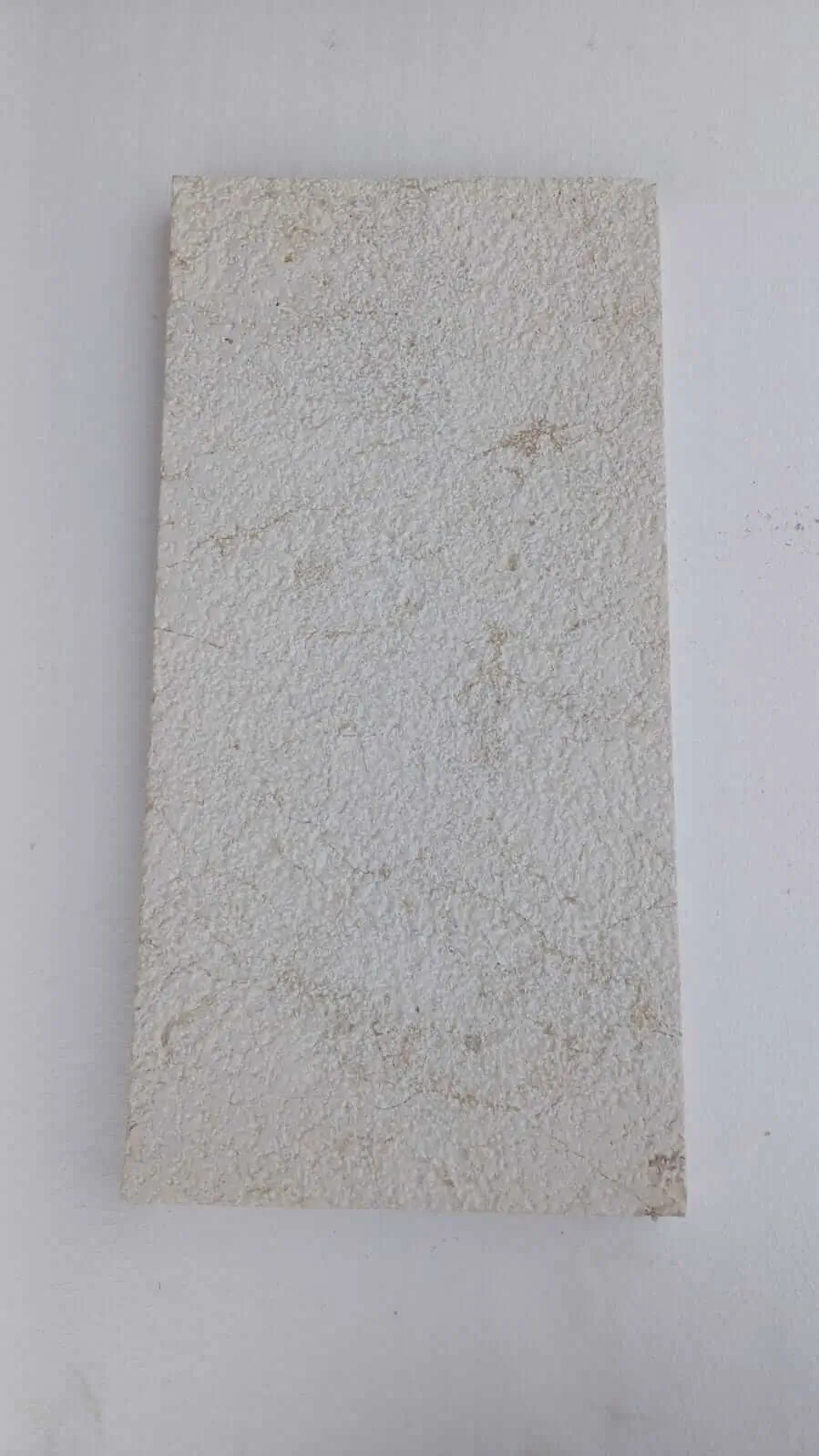
The finish selection for limestone pavers 24×24 is exactly where most buyers need guidance, because the finish affects thermal comfort, slip resistance, maintenance frequency, and long-term visual consistency in ways that aren’t obvious from a sample tile.
Honed Finish: What You’re Actually Getting
Honed limestone pavers 24×24 deliver a matte, smooth surface that sits between raw-sawn and polished. The grinding process closes surface pores partially, which reduces initial absorption rates but doesn’t eliminate them — you’re still working with a calcium carbonate matrix that responds to acid, standing water, and freeze-thaw cycling. Honed surfaces read as contemporary and clean in large-format applications, and the extended plane of a 24×24 unit makes the finish’s uniformity highly visible. Any variation in color or surface density from the quarry will show clearly at this scale.
Slip resistance on honed limestone depends on finish grit and surface texture. A 400-grit hone produces a measurably different coefficient of friction than an 800-grit hone, and for outdoor applications in areas that experience wet conditions, verify the finish against ASTM slip resistance testing standards relevant to your application. Don’t assume honed equals safe — get the actual COF data from your supplier before specifying for pool surrounds or entry approaches.
Brushed and Tumbled Finishes for Outdoor Use
Brushed limestone opens the surface texture more than honing does, creating microscopic ridges that significantly improve grip in wet conditions. For outdoor 24×24 installations where foot traffic is the primary concern, brushed finishes consistently outperform honed on COF measurements. The trade-off is that the open texture requires more aggressive sealing maintenance — typically annually rather than biennially — and organic debris embeds more readily into the surface profile.
- Brushed finishes increase wet COF by 15–25% compared to equivalent honed surfaces on the same limestone stock
- Tumbled edges on 24×24 units create a deliberately aged aesthetic, but the scale of the format can make tumbling look less authentic than on smaller units — evaluate a full layout mockup before committing
- Sandblasted finishes achieve maximum texture depth and are appropriate for steep-grade applications or areas with consistent moisture exposure
- Sawn finishes are the most economical and provide a reliable, mid-range texture suitable for covered patios and interior-exterior transitions
Polished Limestone in Large Format: Field Realities
Polished limestone at 24×24 creates dramatic reflective planes that architects specify for interior lobbies, covered outdoor areas, and feature paving. Field reality: polished limestone is highly sensitive to scratching, etching from acidic cleaners, and moisture penetration at the joint interface. Outdoors, polished finishes degrade noticeably within 3–5 years without rigorous maintenance schedules. For interior applications with controlled traffic and proper sealing programs, polished limestone pavers 24×24 deliver exceptional longevity and visual impact.
Limestone Varieties That Perform at 24×24 Scale
Not every limestone species handles the 24×24 format equally well. The format amplifies any inherent inconsistency in the stone’s bedding planes, fossil content, or color variation — which is useful to know before you see the first truck deliver material to site and realize the batch reads differently than your sample board.
- Dense, fine-grained limestones (compressive strength above 8,000 PSI) handle the unsupported-span demands of large-format paving without flexural failure risk
- Seagrass limestone, with its distinctive linear fossil patterns, creates striking visual movement across a 24×24 surface — the larger format amplifies the seagrass limestone’s natural striations in ways that smaller tiles can’t achieve
- Highly fossiliferous or vuggy limestones can work at this scale but require careful thickness specification — voids near the surface reduce effective load-bearing cross-section
- Lighter-colored limestone varieties reflect solar radiation effectively and maintain lower surface temperatures in direct sun exposure, making them practical for patios and pool surrounds where barefoot comfort matters
- Darker dense limestones absorb more heat but offer superior visual uniformity — useful where color consistency across a large surface is the design priority
According to USGS data on limestone composition and construction applications, limestone’s variable fossil content and diagenetic history create meaningful differences in porosity and compressive strength even within a single quarry’s output. That’s why quarry-specific data matters more than generic limestone specifications when you’re working at large formats where performance margins are tighter.
Layout Patterns and Joint Spacing That Work
The 24×24 module is inherently modular, which makes it well-suited to grid layouts but demands precision in base preparation and setting that smaller-format stone forgives more easily. Your limestone pavers 24×24 layout pattern affects not just aesthetics but drainage geometry, thermal movement accommodation, and the visual legibility of any base preparation errors.
Grid vs. Offset: More Than an Aesthetic Choice
A true grid (jack-on-jack) pattern with 24×24 units creates continuous grout lines in both directions. This is structurally efficient and visually clean, but any differential settlement reads as a continuous fault line rather than an isolated point. For large open surfaces, a 50% offset (running bond) breaks up settlement visibility and distributes point loads more evenly across setting beds. Consider how your limestone pavers 24×24 layout will interact with drainage channels, step risers, and border treatments before finalizing the pattern — changing direction mid-project is expensive.
- Grid (jack-on-jack): maximum visual formality, requires tightest base tolerances, ±3mm flatness across any 10-foot run
- 50% offset (running bond): more forgiving of minor base variations, reduces the visual impact of individual unit warpage
- Pinwheel (alternating 24×24 with 12×12 accent units): allows material cost reduction on large surfaces while maintaining the large-format aesthetic at key focal points
- Random ashlar incorporating 24×24 units with 12×24 and 12×12 elements: adds visual interest but requires careful planning to avoid awkward cuts at borders
Joint Width and Thermal Movement at Large Format
Here’s what often gets overlooked: limestone pavers 24×24 have a linear thermal expansion coefficient of approximately 4.4 × 10⁻⁶ per °F. Across a 24-inch unit experiencing a 70°F temperature swing — common in direct sun applications — you’re looking at roughly 0.007 inches of movement per unit. Across a 20-foot run, that accumulates to meaningful displacement. Your joint width needs to accommodate this movement without cracking grout or creating lippage between units. A 3/16-inch minimum joint filled with a flexible polymeric sand or sanded grout is the practical minimum for outdoor large-format limestone installations.
Base Preparation: Where Large-Format Installations Succeed or Fail
The base is where 24×24 limestone paver installations diverge most sharply from standard paving work. Explore Citadel Stone paver formats to understand how thickness and base depth specifications correlate across the product range — the relationship matters more at large format than most installers account for.
A 24×24 unit needs a setting bed with consistent support across its full surface area. Any voids, low spots, or inconsistent compaction create a rocking unit — and a rocking 24×24 limestone paver will crack under load within 2–3 years even if the stone itself is rated for the application. For pedestrian applications, a 4-inch compacted aggregate base with a 1-inch screeded sand or mortar setting bed is the standard minimum. For vehicular applications, step that to 6–8 inches of compacted aggregate with a full mortar bed.
- Compacted aggregate base must reach 95% Proctor density — verify with field testing before any stone is set
- Sand setting beds work for residential pedestrian applications; mortar beds are required for vehicular loading and for installations over concrete substrates
- Geotextile fabric at the subgrade level prevents fines migration and base contamination over time, particularly critical in clay-heavy soils
- Drainage slope should be 1–2% away from structures — flatter slopes create standing water that accelerates joint deterioration and promotes biological growth on the limestone surface
Cost Factors and Sourcing Decisions for 24×24 Limestone
Limestone pavers at the 24×24 format carry a higher unit cost than smaller formats for two compounding reasons: quarrying and fabricating large-format stone produces more waste per ton, and transportation logistics for heavy large-format material are more cost-sensitive to freight distance than smaller pavers. Your total project budget needs to account for both the material-to-labor ratio shift and the sourcing decision’s downstream freight implications.
The material-to-labor ratio at large format actually favors the material side more than many project owners expect. Fewer units per square foot means faster installation — a skilled installer can set 24×24 limestone at approximately 150–180 square feet per day versus 80–100 square feet per day for a complex 12×12 pattern. That labor efficiency partially offsets the higher per-unit material cost. Where the math shifts unfavorably is on freight: a full truck load of 24×24 limestone is heavier per pallet than smaller formats because there’s less air in the stack, and freight cost per pound from warehouse to jobsite doesn’t change. If your project is well outside major distribution corridors, budget freight at 10–15% of material cost rather than the 5–8% that closer-in projects typically see.
- Ordering complete pallets rather than mixed quantities reduces warehouse handling fees and shipping surcharges
- Lead times from warehouse stock are typically 1–2 weeks; custom-cut or specialty-variety orders can extend to 6–8 weeks if material needs to be sourced internationally
- Overordering by 10–12% for large-format limestone is standard practice — cuts at borders and matching replacement units later are both more expensive than carrying modest surplus
- Large limestone planters and built-in seating elements using matching stone from the same batch provide design cohesion and can be ordered in the same consignment to reduce multiple freight runs
At Citadel Stone, we stock 24×24 limestone in multiple species and finishes, which means your project doesn’t have to absorb the 6–8 week import cycle that comes with sourcing directly from overseas. Confirming warehouse availability before finalizing your project timeline protects your schedule and your contingency budget.
Sealing and Maintenance Protocols for 24×24 Limestone
Large-format limestone surfaces have less grout joint per square foot than smaller-format installations — which sounds like a maintenance advantage but actually increases the demand on the stone’s sealed surface to perform as the primary moisture barrier. Your sealing program determines how the stone ages visually and structurally over a 20–30 year service life.
- Initial sealer application should occur 48–72 hours after grout cure, once all residual moisture has evacuated the setting bed — sealing over trapped moisture creates a whitish haze that requires full strip and reapplication to correct
- Penetrating impregnating sealers (silane-siloxane chemistry) are the preferred choice for outdoor 24×24 limestone — they allow vapor transmission while blocking liquid water and oil penetration
- Surface-coating sealers create a visible sheen that changes the limestone’s natural appearance and can peel under freeze-thaw cycling — avoid for exterior applications
- Resealing frequency: high-traffic outdoor surfaces every 12–18 months; low-traffic covered areas every 24–36 months
- Acidic cleaners — including vinegar, citrus-based degreasers, and many commercial tile cleaners — etch calcium carbonate surfaces permanently; alkaline or pH-neutral cleaners are mandatory for limestone maintenance
The interaction between joint sand and the limestone’s surface chemistry matters more than most maintenance guides acknowledge. Polymeric joint sand contains activators that, if tracked onto the limestone surface before washing, can stain permanently. Clean the surface immediately after joint sand installation and before any rain event activates the polymers in the joints.
Integrating 24×24 Limestone Throughout a Limestone Home Design
One of the strongest design arguments for the 24×24 format is its ability to carry visually from exterior paving through interior flooring — creating the seamless stone flow that defines a cohesive limestone home aesthetic. The format reads as architectural at this scale, not just utilitarian. But achieving genuine visual continuity requires consistent species, finish, and batch sourcing across both applications, which creates specific project coordination requirements.
Interior applications for 24×24 limestone pavers differ from exterior installations primarily in substrate and setting requirements. Interior concrete slabs need to be fully cured (minimum 28 days), clean, and flat to ±1/8 inch over 10 feet before large-format stone is set. Radiant heating systems require flexible epoxy adhesives rated for thermal cycling — standard thin-set mortars can debond at the thermal movement levels that radiant floors generate. Specify the adhesive system in writing before installation begins, not after the floor lifts.
- Exterior-to-interior transitions should use a genuine threshold unit rather than a cut field tile — the edge profile and thickness transition require proper detailing to prevent water infiltration at the joint
- Interior 24×24 limestone in high-gloss polished finish requires felt pads under all furniture legs — the large flat surface makes micro-scratches from dragged furniture highly visible
- Matching grout color to the limestone’s dominant tone reduces the visual fragmentation of joint lines and makes large-format surfaces read as more continuous
For projects that incorporate large limestone planters or built-in seating in the same material, coordinating the order with the paving consignment ensures batch consistency and eliminates the color variation that comes with separate sourcing events. Seagrass limestone, in particular, benefits from this approach — its distinctive linear fossil patterning varies enough between batches that mixing sources across a single exterior scheme is a visible risk.
Getting 24×24 Limestone Paver Specifications Right
The decisions that separate a successful 24×24 limestone paver installation from a costly remediation project come down to three things: base preparation precision, finish selection matched to actual use conditions, and sourcing discipline that locks in consistent batching across the full material quantity. Getting one of these wrong at the 24×24 scale amplifies the consequences in ways that smaller formats absorb more forgivingly. Your specification should address all three explicitly — vague notes on shop drawings lead to field substitutions that you’ll be managing for years afterward.
For projects that incorporate large-format limestone paving alongside other stone elements, related technical details are worth reviewing before finalizing specifications. Our resource covering large limestone tile installation explores substrate preparation and setting system requirements in detail that complements the format and layout decisions covered here. The overlap between large-format pavers and large limestone tiles in specification practice is significant, and the installation variables align closely enough that reviewing both helps you catch specification gaps early. Paving from Citadel Stone arrives from select natural stone quarries worldwide, with square-format units that reduce cutting waste on large open surfaces.
Related reading: how to remove limestone stains · large limestone planters guide · large limestone blocks for sale.