Travertine slab selection trips up even seasoned specifiers when they treat every slab as interchangeable — and the consequences show up three years later in spalling edges, uneven joints, and finish degradation that no sealer can reverse. The cut orientation, fill type, and finish you specify before the slab ever leaves the warehouse determine roughly 80% of long-term performance outcomes. Understanding how those decisions interact is the real work of getting travertine slab selection right on your project.
Cut Orientation: Cross-Cut vs. Vein-Cut Travertine
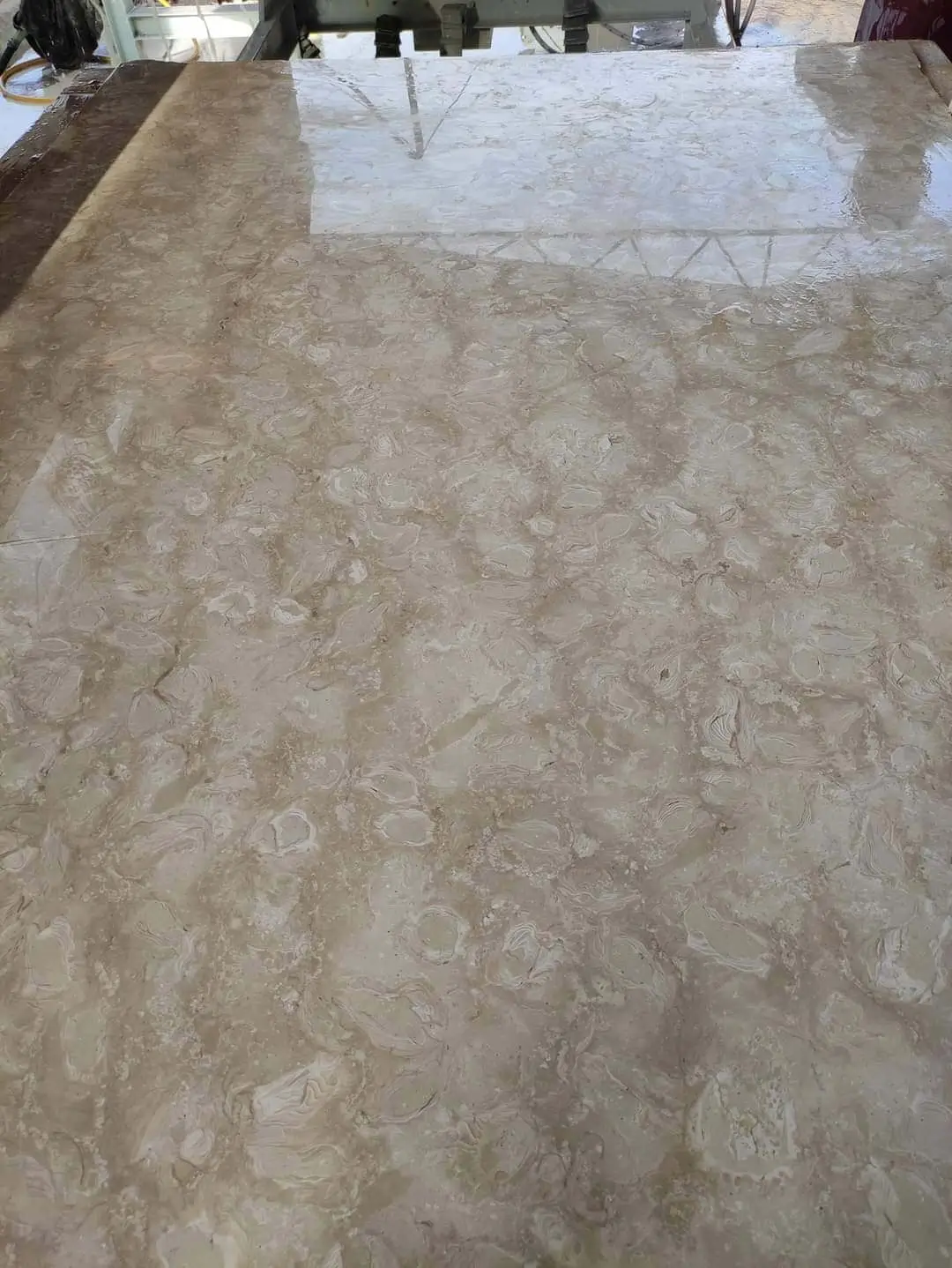
The way a quarry slices through the stone’s bedding planes produces two entirely different visual and structural profiles. Cross-cut travertine is sawn perpendicular to the vein direction, exposing the stone’s horizontal growth rings — those concentric, cloud-like patterns that most people picture when they think of travertine. Vein-cut travertine is sawn parallel to the vein, revealing the flowing linear striations that run through the stone’s interior. These aren’t just aesthetic differences; they carry real structural implications for your specification.
Cross-cut material tends to expose larger, more open voids because you’re cutting across the natural pore channels rather than along them. That means more fill is required, and the filled surface has a slightly higher proportion of grout-to-stone ratio at the face. Vein-cut slabs generally show tighter, shallower pores aligned along the cut plane, which translates to a denser face surface and marginally better resistance to surface abrasion in high-traffic interior applications. Your finish and fill selection should account for this difference — it’s not a reason to avoid cross-cut, but it does change the sealing protocol.
For large-format slab work — countertops, feature walls, bathroom surrounds — vein-cut orientation allows you to book-match panels by flipping adjacent slabs open like the pages of a book, creating mirror-image symmetry across seams. That technique requires you to specify consecutive slabs from the same quarry block, and you’ll want to confirm warehouse stock includes matched pairs before finalising your layout drawings.
Understanding Fill Types and When Each Applies
Travertine’s natural voids — those distinctive pits and channels formed during the stone’s deposition — are either left open, filled with grout, or filled with epoxy resin during processing. Each treatment changes how the material performs in service, and selecting the wrong fill type for your application is one of the most common field errors in travertine slab selection.
Unfilled Travertine: The Case for Leaving Voids Open
Unfilled travertine retains its natural pore channels, which contributes to a genuinely rustic, textured aesthetic — but it also creates moisture traps in outdoor or wet applications. In pool surrounds and exterior flooring where standing water is a factor, open voids accumulate organic debris and moisture at a rate that accelerates biological staining. For interior feature walls and dry-environment flooring where the aesthetic is paramount, unfilled material is entirely defensible. Just factor in the maintenance commitment: you’ll be cleaning channels that grout-filled surfaces don’t have.
Grout-Filled vs. Epoxy-Filled: Practical Differences
Standard grout fill uses cementitious material to pack surface voids before honing or polishing. It’s economical and visually consistent, but it’s also the fill type most vulnerable to differential thermal movement. In climates with significant day-to-night temperature swings, grout fill can micro-crack at the void interface over repeated cycles, creating hairline channels that trap water and stain. Epoxy fill bonds more aggressively to the stone matrix and accommodates slightly more movement before fracturing, which is why it dominates high-end countertop and commercial floor specifications where thermal cycling and point loading are real concerns. According to ASTM C1527 travertine dimension stone specifications, filled travertine must meet absorption and modulus-of-rupture thresholds regardless of fill type — a benchmark worth referencing when evaluating slab certifications from your supplier.
- Unfilled: best for dry interiors, decorative walls, and applications where texture is a deliberate design feature
- Grout-filled: appropriate for most interior flooring applications with moderate traffic and controlled climate
- Epoxy-filled: recommended for countertops, commercial floors, exterior applications in freeze-thaw regions, and any use case with consistent moisture or thermal cycling
- Confirm fill type in writing with your supplier — some processors fill selectively, leaving back-face voids open while filling the face, which affects adhesive bond area during installation
Finish Selection and Performance Implications
The finish applied to a travertine slab after cutting and filling affects slip resistance, light reflectivity, maintenance frequency, and how aggressively the stone will age visually. Getting this decision right means matching finish to end use, not just to aesthetic preference.
Polished travertine develops a reflective surface through progressive grit grinding — typically finishing at 800 to 1500 grit depending on the stone density. It reads as the most luxurious of the finishes and dramatically amplifies veining and colour depth. The trade-off is a surface coefficient of friction (COF) that drops significantly when wet; polished travertine in a wet environment without an applied anti-slip treatment can fall below the ANSI A326.3 minimum wet DCOF of 0.42. Reserve polished finishes for dry interior applications: feature walls, bathroom vanity tops, fireplace surrounds, and areas with controlled foot traffic.
Honed travertine is ground to a smooth but non-reflective surface — typically 400 grit — which retains most of the polished appearance while providing meaningfully better wet COF values. It’s the standard specification for interior floors and is increasingly used for exterior applications where aesthetic quality matters alongside safety. Brushed finishes go a step further, using wire or abrasive brushes to open the grain slightly, creating a tactile texture that performs well outdoors. Tumbled travertine — edges and corners mechanically worn — is suited for pool decks and courtyards where the aged aesthetic fits and the textured surface supports barefoot safety. The Natural Stone Institute travertine performance guidance provides finish-specific absorption benchmarks that are useful when writing project specifications.
- Polished: interior feature use only — COF drops sharply when wet
- Honed: interior and light exterior, standard for floors with moderate foot traffic
- Brushed: exterior patios, courtyards, transitional spaces with weather exposure
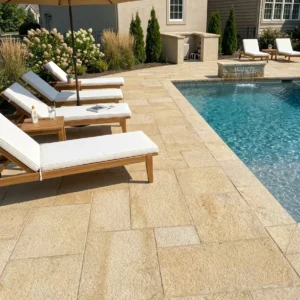
- Tumbled: pool surrounds, outdoor entertaining areas, and rustic design applications
- Sandblasted: functional anti-slip applications, commercial exterior, and ramp surfaces
Slab Thickness and Structural Adequacy
Thickness is the variable most often underspecified in travertine slab selection, and it’s where installation failures concentrate. The relationship between slab thickness, span, and point load capacity is not linear — doubling thickness more than doubles flexural strength because the modulus of rupture calculation is exponential with depth. A 3/4-inch slab that performs acceptably as a floor tile becomes a liability as a countertop overhanging more than 8 inches without substrate support.
For countertops and vanity tops, 3/4-inch (2 cm) material is the industry minimum for fully supported applications with plywood substrate underneath. Move to 1-1/4-inch (3 cm) for overhangs exceeding 8 inches, waterfall edges, or any application where the stone is the structural element rather than a veneer over a substrate. Exterior paving slabs should run 1.25 inches minimum for pedestrian applications and 2 inches or heavier for vehicle access areas — travertine’s compressive strength typically ranges from 3,000 to 8,000 PSI depending on density, and you’ll want to confirm the specific value from your supplier’s test documentation before specifying vehicle-rated applications.
For how travertine slabs are classified and what dimension-stone testing validates structurally, the USGS limestone and travertine natural mineral formation reference provides useful geological context for understanding why density varies between quarry sources — and why slabs from Middle East quarries can differ structurally from material quarried in other regions despite similar visual appearance.
Colour Variation and Batch Matching
Travertine’s colour variation is one of its most praised qualities and simultaneously one of the most challenging aspects of large-project procurement. The material shifts in tone, vein density, and background colour across quarry faces — sometimes dramatically across a single block — and a project specified from sample approval can arrive with slabs that read noticeably different once they’re laid out at full scale.
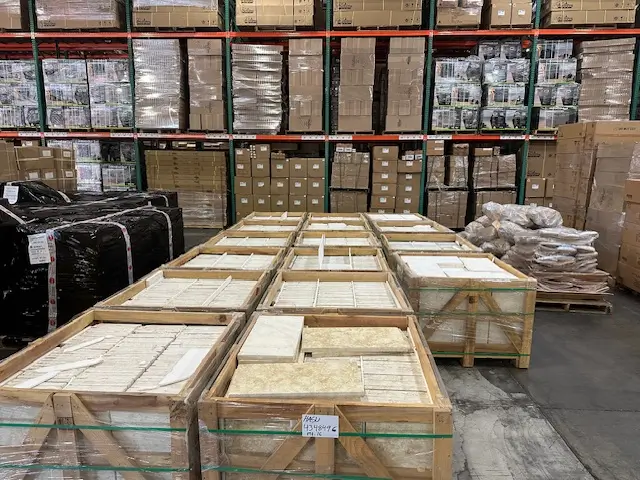
The practical solution is to request quarry-run lots rather than mixed-stock procurement. A quarry-run lot pulls consecutive slabs from the same extraction sequence, minimising the colour range within your project’s allocation. At Citadel Stone, we verify lot consistency before truck dispatch by dry-laying a representative sample from each pallet, which catches the outlier slabs that would otherwise surface during installation. That step adds a day to warehouse processing but eliminates the field problem of a slab that reads two shades lighter than its neighbours once it’s in the mortar bed.
Walnut, ivory, classic, and gold are the primary colour families you’ll encounter in commercial sourcing — but within each family, the variation can span 30% in tone from light to dark. For flooring applications larger than 500 square feet, require your supplier to provide full-lot photos of actual warehouse stock before you confirm the order. Never specify colour family alone on large projects.
- Request quarry-run lots for projects exceeding 300 square feet of coverage
- Review full-lot warehouse photos, not just sample tiles, before confirming large orders
- Dry-lay at least 20% of slabs before cutting to identify outliers before installation
- Specify allowable colour variation tolerance in writing (e.g., ±15% shade variation from approved sample) to establish accountability
- Reserve 10-15% overage from the original lot for future repairs — reordering from a different lot rarely achieves a match
Budget and Procurement Factors for Travertine Slabs
Total project cost for travertine slab work is driven by more than material price per square foot — and specifiers who evaluate only the slab cost routinely underbid the job. Freight distance from the warehouse to your project site is a significant variable. Slabs are dense; a single truck load of 3 cm travertine can approach 20,000 pounds, and long-haul freight for that weight adds meaningful cost that is invisible in the per-square-foot material quote. For projects in interior markets far from major stone distribution hubs, verify delivered pricing rather than ex-warehouse pricing before you build your budget.
Labor-to-material cost ratios for travertine slab work differ from tile installation. Large-format slab setting requires experienced stone mechanics, heavy-duty suction lifters, and more precise adhesive bed preparation than standard tile work. In markets where skilled stone installers are scarce, labor can represent 60-70% of total installation cost on complex slab projects — which means a 10% savings on material procurement has a smaller budget impact than finding an installer who understands travertine’s specific requirements around back-butter coverage and open time management.
Browse current inventory and coordinate delivery pricing directly through Citadel Stone travertine slabs for sale, where lot-specific stock and freight options are available for national project planning. Value engineering on travertine slab projects typically finds savings in thickness optimisation — specifying 2 cm material with full substrate support rather than defaulting to 3 cm everywhere reduces both material and truck weight cost without compromising performance where the substrate does the structural work.
Sourcing, Provenance, and Quality Documentation
Travertine reaches the market from quarries across Turkey, Italy, Iran, Peru, and selected quarries from the Middle East — and the difference in density, void character, and colour stability between these sources is real and measurable, not just marketing language. Turkish travertine, particularly from the Denizli region, is the most widely specified in commercial projects and offers the most consistent quality documentation. Italian travertine from Tivoli carries a premium tied to centuries of architectural use and distinctive warm tonality. Material from Middle East quarries tends to run denser with tighter void patterns, which some specifiers prefer for high-traffic exterior applications where fill durability is a priority.
Quality documentation should accompany any commercial-volume purchase. Request test certificates showing water absorption (ASTM C97), modulus of rupture (ASTM C99), and abrasion resistance (ASTM C241) for the specific lot you’re buying, not generic material averages. These figures vary meaningfully between sources and even between extraction levels in the same quarry. A slab lot with absorption above 3% will require more aggressive sealing frequency — that’s a maintenance cost you should quantify before specification, not discover after installation.
- Confirm quarry of origin in writing — not just the country but the specific quarry where possible
- Request ASTM test certificates for water absorption, modulus of rupture, and abrasion resistance specific to the purchased lot
- Understand that price differences between sources often reflect real performance differences, not just margin
- For exterior or high-moisture applications, prioritise density and absorption data over aesthetic factors when evaluating source options
Sealing and Ongoing Maintenance Requirements
Travertine’s calcium carbonate composition makes it reactive to acids — citrus, vinegar, coffee, and even carbonated water will etch a polished or honed surface if left to dwell. This isn’t a flaw unique to lower-quality material; it’s an inherent property of the mineral that every travertine slab selection decision should account for. The sealing protocol you establish at installation determines how much of that vulnerability is managed over the stone’s service life.
For interior applications, a penetrating impregnating sealer applied at installation and refreshed every 18 to 24 months is the standard protocol. Test for sealer saturation by dropping water on the surface — if it beads immediately, you have coverage; if it absorbs within 30 seconds, reapplication is overdue. For exterior applications with UV exposure and temperature cycling, some sealer chemistries degrade faster than they would indoors, and annual reapplication may be required depending on climate conditions.
Topical sealers — film-formers that sit on the surface rather than penetrating the stone — are appropriate only for matte and tumbled finishes where a slight sheen change is acceptable. Never apply a topical sealer to polished travertine; it will alter the reflective quality and peel unevenly as the film weathers. Penetrating sealers are finish-neutral and the correct choice across virtually all travertine slab applications.
Getting Travertine Slab Selection Right
The decisions that define a travertine slab installation — cut orientation, fill type, finish, thickness, and source provenance — are all made before the first slab is set. Getting them right doesn’t require compromise between aesthetics and performance; it requires understanding how each variable interacts with your project’s specific use conditions. Your specification should address all five dimensions explicitly, with test documentation supporting the key structural claims.
For projects that span different application zones — say, a kitchen countertop connecting to an exterior terrace — travertine slab selection may mean specifying two different fill and finish combinations from the same colour lot, so the visual continuity holds while each zone gets the performance profile it needs. Citadel Stone maintains national warehouse inventory across fill types and finish categories, which means sourcing consistent lot material for blended specifications is a logistics problem we solve regularly. As you finalise your slab decisions, the insights from inspecting natural stone slabs before purchase offer useful parallel guidance on what to evaluate physically before committing to any lot — a step that applies equally to travertine sourcing at any project scale. Vein-cut travertine available through Citadel Stone displays a flowing linear pattern distinct from the more varied appearance of cross-cut material.
Related reading: natural stone paving slab cost · remnant granite slabs vs full slabs · how to choose a marble slab.