Aruba’s sweetest word is its way of life: dushi — the Papiamento blessing covering everything good — and nowhere does the island live more dushi than in its family yards: the multi-generation gathering grounds where Sunday asado smoke rises, birthday tents appear overnight, dominoes clack under mango shade and the extended family’s whole calendar plays out on home ground. The dushi yard is Aruban residential culture’s heart, and its stonework serves love at family scale. Here is the yard’s guide.
The yard as institution
The Aruban yard works institutionally: weekend gatherings that assume thirty, holiday seasons that assume eighty, the yard’s furniture — long tables, borrowed chairs, the drinks cooler fleet — deployed and struck like the event choreography it locally is. Ground craft answers with capacity: gathering courts on the long-table geometry at family generosity, circulation absorbing the crowd without lawn casualties, level fields where tents pitch and bounce-houses anchor, and the hosting-stage philosophy built once for decades of occasions.
Asado infrastructure
The Sunday grill is the yard’s altar, and its stone setting runs the grill-court craft in Aruban register: masonry grill stations at family scale — often built generational, expanded as the cooks multiply — working counters on hose-down stone, wood-and-charcoal stores dry against the rare rain, the lee-craft positioning smoke downwind of the dominoes, and the gathering orbit — seat walls, shade, drinks stations — arranged so the cook holds court while cooking. The asado court earns the yard’s best stone; it hosts the family’s history weekly.
- Build the grill and prep counter in masonry rather than buying a unit that will corrode.
- Keep the working surface at a comfortable height for someone standing for two hours.
- Site the grill downwind of the table so smoke leaves rather than circulates.
- Provide a wipe-clean surface beside it, because that is where everything gets put down.
Shade as inheritance
The yard’s great trees — mango, tamarind, flamboyant — are family members with planting dates remembered, and yard design orbits their canopy: gathering courts placed in inherited shade, the root-respecting craft protecting the elders’ ground, new shade planted at each generation’s start on the landmark-tree wisdom, and built shade — arbors, sail courts — supplementing on the structure-and-plinth rules where the canopy gaps. Stone benches ring the trunks the way the culture rings its elders: close, comfortable, permanent.
The multi-generation ground plan
Dushi yards serve every age at once — abuela’s shaded throne with the grand-friendly access, the toddler swarm on forgiving surfaces within every auntie’s sightline, teenagers claiming their corner, the domino table’s sacred level ground — and the ages-and-stages philosophy runs here at extended-family width: one ground plan, four generations, zero excluded. Flush thresholds and eased edges serve walkers and wheelchairs; the yard that welcomes abuela hosts everything.
Yard economics, island reality
The family yard builds on household budgets in staged reality — the staged-build wisdom Aruban-style: the asado court this year, the front terrace next, batch records kept so phases match across the seasons of saving, and the island supply guide serving family scale honestly: modest orders welcomed, spares included for the yard’s hard use, durability economics that respect what family money means. The yard’s stone competes with school fees and repays across every gathering it hosts; specified honestly, it wins the argument for decades.
- Phase the yard so the terrace and shade come first and the refinements follow.
- Spend the budget on the surface people stand on rather than on decorative features.
- Choose one material and one format to keep both cost and future repairs simple.
- Leave provision for a future extension rather than rebuilding the terrace to add one.
Dushi, built
The finished yard performs the culture: Sunday smoke rising over stone that hosts without complaint, the tent going up on ground that takes the stakes, dominoes clacking level, four generations circulating on surfaces that welcome every foot — the island’s good life, grounded. The island supply hub holds the dushi yard among its favorite briefs: family-scale packages, gathering-grade surfaces, and stonework built for the only review that matters — the family’s, weekly, forever.
Rain on the party: the wet-day yard
Aruba’s rain is rare, brief and usually inconvenient — arriving, by family law, twenty minutes before the asado’s guests — and the dushi yard’s design should treat the wet day as a solved problem rather than a canceled one. The covered layer leads: a generous roofed terrace or ramada, sized for the core table rather than a token bench, turns a shower into an atmosphere; the grill station’s cover keeps the cook dry and the menu on schedule; and the circulation between covered points — kitchen to table to cooler station — runs under roof or within a quick dash on stone that grips wet from its first specification. Drainage does the rest of the hospitality: falls that clear the gathering courts in minutes, no ponding line where the dance floor was, and the yard back in service before the second round of drinks — the island’s showers rarely outlast a good story.
The details are family-tested across the island. Power and lighting live at covered points so the music never stops for weather; the tent-and-tarp kit stores dry with the party furniture, its anchor points cast into the yard’s permanent stone rather than improvised into planters; and the wet-day fallback for the biggest occasions — the birthday that must proceed — is drawn into the plan from the start: which court the tent spans, where its guys land, how the caterer’s run stays dry. None of it costs much at build; all of it is expensive to retrofit the week before a wedding.
The wet-day yard is really a statement of the institution’s seriousness: the family calendar does not reschedule for twenty minutes of weather, and the ground is built accordingly. Rain on stone dries to a cleaner party; the dushi yard, properly drained and partly roofed, treats the island’s rare showers as what they are — a pause for the toast, and free irrigation for the mango.
The yard is the main room
In an Aruban household the outdoor space is not an amenity, it is where the family actually lives, and the climate is the reason. Figures from Aruba on its own weather and climate give temperatures of 80 to 90 degrees Fahrenheit year round, only 18 inches of annual rainfall, a dry season from January to April, and constant trade winds. There is no month when the yard is unusable and no season that forces everyone indoors, which changes how much a surface has to withstand.
- Design for daily year-round use rather than for occasional entertaining.
- Expect chairs to be dragged across the surface several times a day, every day.
- Build shade as structure rather than relying on anything the trade wind can move.
- Keep the route from kitchen to table short and hard-surfaced, since it is walked constantly.
- Plan for evening use, because the hours after sunset are when the yard is busiest.
Grip on a surface people cross barefoot
A family yard is walked wet from the pool, wet from a hose and wet from the short heavy showers that arrive between October and December. Guidance from Use Natural Stone on frictional testing sets ANSI A326.3 as the method and a dynamic coefficient of friction of 0.42 as the benchmark for level interior surfaces expected to be walked on wet, notes that no exterior threshold is published, and records that polished stone generally fails the wet test. In a yard used by children and grandparents alike, that is the specification driver.
- Specify a textured finish everywhere, including the strip immediately outside the kitchen door.
- Keep grip consistent across the whole yard so nobody meets a change while carrying a tray.
- Test the delivered finish rather than trusting the description of the stone family.
- Avoid polished thresholds, which are the most common slip point in a house of this kind.
Warmth, wear and how it feels at four in the afternoon
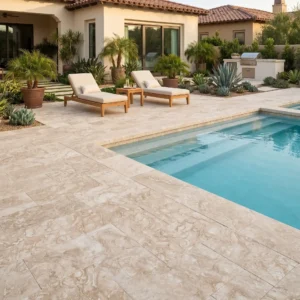
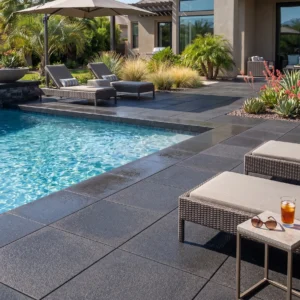
Two properties decide whether a family will actually use a yard: how hot the surface gets and how well it hides ordinary life. A dark stone under this sun becomes impossible barefoot by mid morning. A brilliant white one glares and shows every mark. The answer is almost always a warm mid tone with visible texture, which stays walkable, hides dust and takes a spilled drink without recording it.
- Choose a warm mid tone that neither absorbs heat nor throws glare.
- Prefer a surface with natural variation, since it disguises the marks of daily use.
- Select an abrasion-resistant material where chairs are moved constantly.
- Keep one format across the whole yard so a damaged unit can always be swapped.
Family yard stone that earns its keep every day
This is the hardest-working surface in an Aruban house and it is chosen far too casually. Warm mid tone for comfort underfoot, real texture for grip, abrasion resistance for the chairs, fixed shade for the wind, and one format throughout so a repair is never a project. Our Aruba stone supply guide sets out the formats, finishes and lead times that suit this island. Get the yard right and the house gets a room it uses every single day of the year.