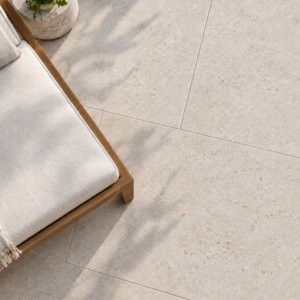
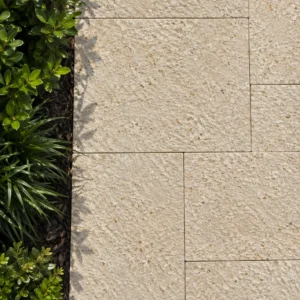
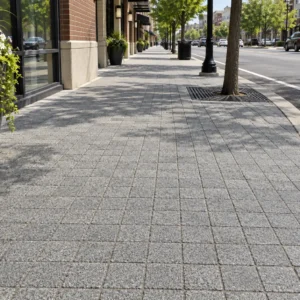
Cayman’s gardens live between the cluster’s poles: greener than the dry islands’ cactus country, drier than the volcanic islands’ jungles — a seasonal rhythm of generous wet months and honest dry ones, on thin soils over limestone, in salt wind that reaches everywhere. The register produces a garden culture of its own: manicured estate grounds, native-planting movements, and the perpetual negotiation between lawn tradition and island reality. Stone is the negotiation’s referee, and this is the Cayman garden guide.
The in-between climate, read honestly
Garden design here starts with the split calendar: wet-season months when growth accelerates and drainage earns its keep, dry months when irrigation bills audit every planting decision, and salt wind as the constant editor of what thrives. The stone framework serves both seasons — paths and courts that shed the wet months’ downpours on honest falls, gravel-and-slab compositions from the dry-garden playbook where water thrift rules, and the growth-management bones where the wet season’s enthusiasm needs edges to respect. The best Cayman gardens zone by moisture: lush where water naturally gathers or graywater serves, dry-composed where it does not.
- Wet-season months when growth accelerates and drainage earns its keep.
- Dry months when irrigation bills audit every planting decision.
- Salt wind acting as the constant editor of what actually thrives.
- Paths and courts built to work in both seasons without a change of finish.
- Planting chosen so the garden looks composed in March as well as September.
The lawn question, Cayman edition
The island’s estate tradition loves its lawns, and the honest audit is the cluster’s standing one at Cayman water prices: turf as a chosen feature — the children’s green, the croquet flat — inside firm stone bones, with mowing strips abolishing the strimmer’s tax on every edge, rather than default ground cover renewing its subscription weekly. The alternatives have matured locally: native ground covers, gravel gardens with sculptural planting, and the stone-court-and-shade-tree composition that reads more established than lawn ever will. Where lawn stays, stone earns its perimeter; where it goes, stone carries the redesign.
Native movements and the sea-grape register
Cayman’s landscape culture is turning native — silver thatch, sea grape, buttonwood and the dry-shrub palette replacing thirstier imports — and stone partners the movement naturally: pale courts against silver-green foliage, gravel mulches cutting evaporation in the beds, low walls framing planting that reads wild by design, and the sculptural-restraint principles translated to Caymanian species. The native garden’s promise is the absent-owner months every Cayman household knows: grounds that hold their composition through a dry August nobody watered.
Thin soils, limestone ground: the planting-meets-paving reality
The island’s geology writes garden construction rules: thin soils over caprock mean tree pits are excavated commitments, root-versus-paving planning is honest from day one (the root-strategy rules apply with limestone’s own logic), drainage thinks in soakaway terms because the rock drinks what the soil cannot hold, and hardscape foundations find solid bearing shallow — one of the island’s quiet construction gifts. Raised beds in stone solve half the planting challenge at a stroke: soil depth manufactured where nature skipped it, edged to sitting height, drained by design.
- Thin soils over caprock, which makes every tree pit an excavated commitment.
- Root-versus-paving planning settled on day one rather than discovered in year eight.
- Drainage thought of in soakaway terms, because the rock drinks what reaches it.
- Modular paving on root-risk routes, so one lifted slab is an hour of work.
- Irrigation kept away from paving edges, since roots follow the water you supply.
Salt wind and the sheltered room
The trade breeze that cools every Cayman afternoon also salts every leaf, and garden layout answers with the wind-craft rules: sheltered courts where tender planting and dining coexist, tougher natives holding the windward lines, and walls doing double duty as garden architecture and salt screens. The sheltered room is the Cayman garden’s heart — the courtyard where herbs survive and candles stay lit — and stone builds it: walls, floor and the seat caps where the evening settles.
The maintained-estate standard
Cayman’s garden culture runs professionally — landscape crews on weekly rounds, irrigation on controllers, standards kept high because the neighborhood keeps them — and the stone framework serves the operation: mowing strips and edge details that speed the crews, hose points and equipment routes on the service-side logic, gravel zones that rake to crisp, and documentation — batch records, spares — filed with the household’s property manager like everything else on this administered island. The result is the Cayman signature: grounds that look effortless because the system behind them is anything but. The island supply hub packages garden stone accordingly — framework first, planting’s partner always.
Watering honestly: irrigation on limestone ground
Cayman gardens fail more often from watering habits than from plant choices. The island’s thin soils over free-draining limestone hold moisture briefly; municipal water is desalinated and metered; and the lush look, pursued by hose, becomes a utility bill with a fungus problem. The honest system starts with zoning: the sheltered green rooms that justify irrigation get drip lines at the roots — not spray that feeds the wind and stains the walls — while the native movements and sea-grape registers beyond them are planted to live on rain once established, which they reliably do. Timers run at dawn; sensors skip the days the wet season waters for free; and the system’s controller lives where the caretaker actually checks it.
The stone interface is where design pays. Irrigation overspray is the quiet enemy of pale paving — mineral staining, algae at the splash line, joints kept damp into the mold hours — so heads and lines are set back from terrace edges, beds beside stone drain away from it, and planters on decks sit on feet with saucers as absolute policy. Where a lawn panel meets paving, a clean stone mowing edge keeps the sprinkler’s reach and the mower’s wheels off the terrace both. And the garden’s water storage earns its look: cistern overflow routed to the planted zones, rain chains and channels made features rather than hidden, the island’s brief hard showers harvested by the landscape instead of shed past it.
The result reads effortless because the effort moved upstream: a garden watered at the roots, on a meter the owner can look at without wincing, beside stone that stays the color it was bought. On a limestone island, that is what lush actually costs — less than the hose, forever.
What the two seasons actually deliver
A garden here is designed against a split calendar, and the split is measured rather than felt. The Cayman Islands National Weather Service publishes the island climate in plain figures.
- A wet season from May to October averaging about 6.91 inches of rain per month.
- Peak rainfall in September and October, which is when drainage is tested.
- A dry season from November to April averaging about 2.43 inches per month, lowest in March.
- Wet season temperatures averaging around 84.6 degrees Fahrenheit, dry season around 80.3.
- Recorded extremes of 95.5 and 52.0 degrees Fahrenheit, which planting has to tolerate.
Setting systems for thin soil over rock
Building a garden on caprock is a different exercise from building on deep soil, and the setting system decides how forgiving the result is. This overview of detailing natural stone paving covers the options.
- Sand-set paving on garden paths, so units lift and relay when a root arrives.
- Mortar-set construction at steps, seat walls and anywhere stability governs.
- Pedestal systems only where a terrace sits over structure with drainage beneath.
- Base depth matched to the traffic rather than to the thickness of the stone.
- Drainage designed as part of the system, since standing water on limestone feeds algae.
Designing for a low-water dry season
Cayman water is expensive, and the garden that survives February on very little is the one that was planned for it.
- Native and adapted planting as the default, with thirstier species treated as accents.
- Gravel mulch through the beds, which cuts evaporation and reads as design.
- Roof and terrace runoff directed into planting basins rather than off the plot.
- Turf treated as a chosen feature inside stone bones rather than as a default ground cover.
- Mowing strips at every lawn edge, which removes the trimmer from the maintenance bill.
Cayman garden design stone for condo and villa applications
The island sits between two garden climates and its soil sits on rock, which together argue for a garden with strong stone bones and modest planting ambitions. Build the paths, courts and edges to work in both seasons, plan roots against paving on day one, direct every drop of wet-season runoff into the beds, and let native planting carry the dry months. The result costs less to run and looks composed all year. Where the same palette continues to the terrace and pool, our Cayman pool deck and coping guide picks it up. Build the bones in stone and let the planting be the part that changes.