Where Fabrication Stone Defects Actually Begin
Fabrication stone defects rarely originate at the fabrication shop — they trace back to decisions made weeks earlier, at the point of slab selection. A slab with an existing micro-fissure network, inconsistent crystalline structure, or high moisture content will telegraph those weaknesses the moment a CNC router or wet saw applies lateral stress. Understanding where defects originate lets you intervene at the right stage rather than troubleshoot expensive failures after the fact.
Your countertop fabrication process amplifies whatever is already in the stone. What looks like a hairline scratch on a freshly cut granite edge is often a pre-existing grain boundary that opened under blade pressure. Knowing this changes how you approach material selection, handling protocols, and installation sequencing — all before a single templating measurement is taken.
Granite Countertop Care Problems That Start at Fabrication
Granite countertop care problems often get blamed on sealer failure or surface neglect, but a surprising number of them are baked in during the cutting and polishing phases. Pitting along an edge profile, for example, typically indicates that the fabricator ran a polishing wheel too fast across a coarse-grained section, pulling feldspar crystals out of the matrix rather than abrading them flush. You end up with a finished surface that holds moisture and staining agents in ways a properly polished slab never would.
- Edge pitting from excessive wheel speed during profiling — common in coarser biotite granites
- Micro-scratching visible under raking light, caused by grit contamination between polishing stages
- Dull patches near sink cutouts where the blade overheated the crystal lattice
- Hairline fractures radiating from drilled faucet holes when feed rate exceeded the stone’s tensile limit
- Uneven sheen across a slab caused by inconsistent polishing pad pressure on cambered granite
Specifying consistent blade water flow rates and requiring shop humidity logs before accepting fabricated pieces gives you a paper trail that matters when granite countertop care problems surface post-installation. According to Natural Stone Institute fabrication certification standards, documented shop protocols are a primary differentiator between certified and non-certified fabrication facilities — and the data shows defect rates are significantly lower in certified environments.
Marble Countertop Fabrication: Where the Risk Profile Differs
Marble countertop fabrication demands a fundamentally different approach than granite work, and fabricators who treat them interchangeably produce predictable failures. Marble’s calcite matrix is substantially softer — typically registering 3–4 on the Mohs scale versus granite’s 6–7 — and it reacts to acidic coolant water, tool lubricants, and even atmospheric humidity during cutting. You’ll see this manifest as etching along cut edges that gets polished over rather than corrected, creating a surface that looks finished but will deteriorate faster than expected under normal use.
- Blade speed must be reduced by 20–30% compared to granite protocols to prevent heat-induced calcite recrystallization
- Coolant chemistry matters — slightly alkaline pH (7.5–8.5) prevents edge etching during wet cutting
- Bookmatched slabs require synchronized cutting sequences to preserve veining alignment across seams
- Penetrating sealers should be applied before final polishing in high-absorption marble to prevent stain lock-in at the fabrication stage
- Miter joints in marble demand back-rod reinforcement — calcite’s lower flexural strength makes unsupported miters a fracture liability
The detail most fabricators underestimate is how marble responds to temperature differentials during transport. A slab that leaves a climate-controlled shop and enters a truck bay at significantly higher ambient temperatures can develop stress fractures along existing vein planes before it reaches the job site. Your delivery scheduling should account for this thermal transition window, particularly during hot-weather months.
Reading Slab Defects Before Fabrication Begins
The single most effective intervention point for fabrication stone defects is the pre-fabrication slab review. At Citadel Stone, we conduct slab-by-slab inspections on incoming inventory, specifically looking for the structural anomalies that fabrication equipment will exploit. This isn’t a visual pass — it involves backlighting, edge percussive testing, and moisture content measurement using a calibrated probe meter.
Backlighting a slab against a diffused light panel reveals fissure networks invisible in ambient conditions. A fissure that crosses more than 30% of the slab width should prompt either a redesign of the cut layout to avoid stressing that plane, or outright rejection of the slab for countertop applications. You can often repurpose fissured material for wall cladding or exterior applications where the cut pattern avoids the weak zone — but never for spans over unsupported voids like sink cutouts.
To evaluate our quality controls before your order is processed, review our slab inspection process — it details how we document structural integrity at the warehouse stage so fabricators receive material that’s already been vetted.
How Subgrade Conditions Amplify Fabrication Defects
This is where the conversation shifts from the shop floor to the installation environment — and it’s a connection most countertop specifications ignore entirely. Fabrication stone defects that were latent in the slab can activate when the installed stone experiences differential support, which is directly tied to subbase conditions beneath the structure it rests on.
In buildings constructed on expansive clay soils, seasonal moisture cycling causes foundation slabs to heave and settle by measurable increments — sometimes 3–8mm across a kitchen span. A cabinet run that appears level at installation can develop a 2mm twist within one wet-dry cycle. That twist translates directly to a stress riser at any pre-existing fissure in the countertop, particularly at seam locations or sink cutouts. The latent defect you thought you avoided simply needed time and the right ground conditions to express itself.
- Sandy or gravelly subgrades offer more uniform settlement and lower differential stress risk
- Expansive clay subgrades — common in many interior regions — require foundation movement assessments before specifying natural stone for any countertop application
- Buildings on caliche subgrade can be deceptively stable but develop point-load concentrations where hardpan layers are uneven
- High water-table environments create buoyancy effects in shallow foundations, producing cyclic vertical movement that fatigues stone seams over time
Your specification should include a clause requiring cabinet installers to confirm levelness within 1mm per linear meter before stone templating. This single requirement eliminates a significant percentage of stress-related failures tied to underlying fabrication stone defects.
Edge Profile Failure Modes and What Drives Them
Edge profiles concentrate fabrication risk into the smallest cross-sectional area of the slab. A full bullnose profile on a 3cm granite slab removes material symmetrically and maintains reasonable structural integrity, but an ogee or dupont profile introduces multiple directional changes that create stress concentration points at each curve transition. These transition points are exactly where pre-existing fissures — invisible during slab selection — become fracture initiation sites under vibration or impact loading.
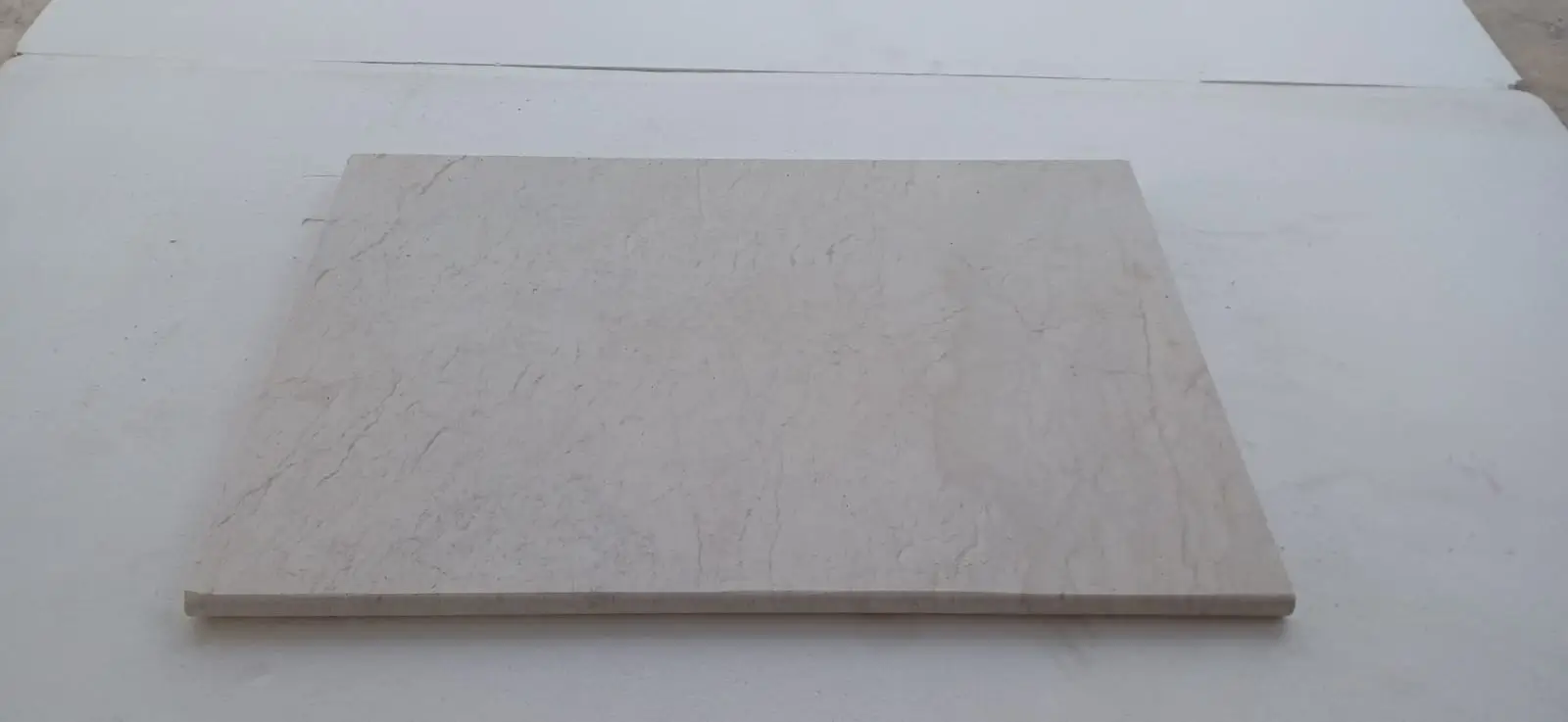
- Ogee profiles on slabs thinner than 2.5cm carry significant fracture risk at the cove transition point
- Waterfall edges require back-rod or mesh reinforcement behind the mitered vertical face — no exceptions on spans over 600mm
- Eased edges are the safest profile for marble countertop fabrication because they minimize material removal depth
- Chipped edges immediately post-fabrication usually indicate improper clamping during profiling, not inherent material weakness
- Polished edges on heavily veined stone should be oriented so vein planes run parallel to the profile direction, not perpendicular to it
According to ASTM natural stone fabrication and quality testing standards, flexural strength values for granite dimension stone typically range from 1,200 to 2,200 psi — but profiled edges can reduce effective load capacity by 15–25% depending on profile geometry and stone orientation. Sharing those figures with your fabricator before profiling begins sets a defensible technical baseline.
Seam Placement and Adhesive Selection
Seam placement is a fabrication decision that locks in long-term performance before installation day. The default approach — placing seams where material length requires it — often lands joints directly over unsupported cabinet gaps, dishwasher openings, or cooktop cutouts. Each of those locations represents a flexural stress point that will cycle with every load placed on the counter surface.
Your layout review should mandate seam placement over solid cabinet support, minimum 150mm from any cutout edge, and never at a corner intersection. Corner seams in L-shaped counters are the single most common location for post-installation fracture in natural stone countertops, and virtually every failure at that location begins with a fabrication stone defect that was present but undetected at seam time.
Epoxy color matching matters more than most specifications acknowledge. A seam filled with a slightly mismatched color-coded epoxy becomes significantly more visible over two to three years as the stone’s surface oxidation shifts the base color. Requiring a 24-hour wet-test of the epoxy against the actual slab — not a reference chip — before full seam application catches this early. Citadel Stone maintains warehouse inventory of matched epoxy kits with every slab order, which streamlines this verification step considerably.
Surface Finish Defects and How Light Exposure Reveals Them
A polished stone surface is essentially a mirror — and mirrors reveal everything. Surface finish defects from the fabrication stage become dramatically more visible once a countertop is installed under kitchen task lighting or near a window with raking natural light. Swirl marks from rotary polishing, flat spots from uneven pad pressure, and transition lines between polishing grits (typically visible at the 400-to-800 grit boundary) are all defects you need to catch in the shop, not at final inspection.
- Request a raking-light inspection at the fabrication shop before transport — use a single LED work light held at 15 degrees to the surface
- Swirl marks that disappear under diffused overhead light will reappear daily under directional task lighting in the installed kitchen
- Honed finishes are more forgiving of polishing irregularities but will show fingerprint etching more readily in marble and limestone
- Leathered or brushed finishes mask surface defects effectively but require higher sealer viscosity to achieve adequate penetration depth
The NSI ASTM stone tile specifications provide reference gloss levels for polished stone surfaces — typically 70–90 on a gloss meter for commercial polished granite. Requiring fabricators to provide gloss meter readings at delivery is a straightforward, quantifiable quality gate that replaces subjective visual assessment with defensible data.
Before You Specify Natural Stone
Fabrication stone defects are rarely random — they follow predictable patterns tied to slab quality, fabrication protocols, edge geometry, and the structural environment the finished stone will inhabit. Your specification document should address all four of these dimensions before a single slab is ordered. Require pre-fabrication slab inspection reports, specify profiling parameters by stone type, define seam placement rules, and include a final raking-light acceptance inspection as a contractual delivery condition.
Beyond countertops, the decisions you make at the specification stage carry over to every natural stone application on a project. Understanding the comparison between different production approaches helps frame those decisions more precisely — how slab fabrication compares to prefab countertops provides useful context for projects where production method affects defect risk and quality control latitude. Whichever direction your project takes, the principles remain consistent: vet the material early, specify the fabrication process explicitly, and build acceptance criteria into your contract before work begins. Stone selected from premium quarries in Turkey and the broader Middle East region helps Citadel Stone limit fabrication stone defects early.
Related reading: slab fabricators · How to Choose a Stone Fabricator: A Practical Guide · stone custom fabrication.