The storm question, answered plainly
Aruba sits outside the main Atlantic hurricane track. That single fact reorganizes a specification. There is no storm-season mobilization to build into a program, no seasonal pause in the installation calendar, and none of the seasonal cost padding that shapes construction elsewhere in the region. It does not mean weather is irrelevant, and it is not a promise about any particular year, so drainage, falls and edge restraint still deserve proper attention. What it does mean is that money spent detailing against a rare storm event is money not spent on the thing that works at this island every single day. Copying a storm-island specification wholesale is not caution; it is aiming the budget at the wrong target.
What actually attacks the floor here
The trade winds run more or less constantly, and they arrive carrying two things at once: salt off the water and fine abrasive dust off dry ground. Between them they set the maintenance agenda:
- A salt film that re-forms on every horizontal surface, all year
- Airborne grit that works like a mild abrasive underfoot and under furniture
- Dust settling into open joints and collecting at every upstand
- Strong sun on pale surfaces, which drives glare more than heat retention
- Rain that arrives on an arid island in bursts rather than as steady rinsing
Two coasts, two jobs
The island reads as one climate and details as two. The sheltered western side, where the Palm Beach and Eagle Beach corridor sits, takes heavy foot traffic, pool chemistry and sunscreen residue on surfaces people walk on barefoot. San Nicolas and the eastern coast take the wind first and hardest, with salt and grit driven at a frontage rather than settling gently on it. Specify surfaces that take daily grit where the wind lands, and keep the softer, cooler-reading choices for the sheltered decks where comfort underfoot is the whole point.
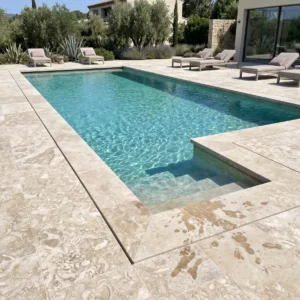
Pool decks and the rinse routine
Pool surrounds carry three loads at once: bare feet, splash-out water and whatever the wind deposits between cleanings. On an arid island the rain will not do the rinsing for you on any schedule you can rely on, so a simple, regular freshwater wash matters more here than a sophisticated sealer specification. Frequency beats chemistry, and gentle beats aggressive, every time. The deck details worth fixing at drawing stage are short and unglamorous:
- A textured face on every surface that will be walked on wet
- Eased or rounded edges at the water line and at every step nosing
- Falls that carry splash-out away from the stone rather than along it
- A hose point close enough that rinsing is genuinely easy to do
Joints, edges and blown sand
Joints and edges are where outdoor paving gives trouble, rather than the middle of a unit. Blown sand fills open joints, water finds any unrestrained perimeter, and a creeping edge takes a whole field with it:
- Restrain every free edge, including the ones that look self-supporting on the drawing
- Choose joint material that tolerates windblown grit rather than trapping it
- Keep falls positive and continuous, with no flat spots to hold a puddle
- Detail thresholds so grit does not sweep straight into the building
- Set drainage lines where they can be cleared without lifting stone
Finish choice on a dusty island
Finish does a great deal of work on an island like this one. A high-gloss face shows dust within an hour of cleaning and turns glare into a genuine complaint. A textured or lightly worked surface scatters light, disguises the film that keeps arriving, and grips better underfoot when a deck is wet. Before locking a schedule, look at the texture options behind that choice against the exposure of each zone, because the same stone in two different faces can behave like two different materials.
Working beside older Aruban fabric
Aruba’s older building memory is caliche from the south-eastern hills and dry-laid coral rock walls, fitted without mortar so precisely that the craft is described as a lost art, with many of those walls still standing. That memory is masonry, not paving. There is no historic stone floor to match into, so a stone terrace beside a traditional cunucu house is a new layer rather than a repair, and the older fabric nearby is walling rather than flooring. Keep the tones quiet, keep the units modest, and let the older walls stay the thing people look at. A new terrace that argues with hand-fitted walls of that kind rarely wins the argument.
A maintenance rhythm that fits the island
Care here is a rhythm rather than an event, and a short routine repeated often beats a heavy intervention once a year. Set it out for whoever actually maintains the property:
- Sweep before washing, so grit is lifted away instead of ground in
- Rinse with fresh water at intervals matched to each zone’s exposure
- Keep cleaning products mild, and test anything new on a spare unit first
- Review any sealed areas on a set cycle rather than waiting for a visible problem
- Clear joints and drainage lines before the next heavy rain arrives
Stone on this island is not fighting one storm; it is answering the same wind every morning, and a specification that respects that will still look right years later.