Salt Sets the Schedule
Every maintenance guide written for a temperate market opens with frost. Here that page can be torn out. It never freezes across the Turks and Caicos Islands, so the thing that actually works on a stone floor is salt, carried inland on a steady breeze and deposited on every exposed surface. Salt is patient. It gets into the pores of a thirsty stone, it corrodes the fixings around a floor faster than most people expect, and it does its work quietly over seasons rather than dramatically over a weekend. A routine built around salt will keep a floor looking right for decades.
The Weekly Rhythm
Good maintenance is boring and short. The aim is to remove abrasive grit before it is walked into the surface, and to rinse salt off before it dries and builds up.
- Sweep or dry-mop the grit off first, since loose grit underfoot is what dulls a floor over time.
- Mop with a pH-neutral cleaner made for natural stone, not a general household spray.
- Rinse outdoor stone with fresh water after heavy spray or a windy stretch.
- Change the mop water often, because dirty water just redistributes what you lifted.
What Not to Use
The fastest way to ruin a limestone floor is to attack it with the wrong bottle, and the damage is usually done long before anybody notices. Etching is not dirt. It is a chemical change to the surface, and no amount of later cleaning brings the sheen back. If a product does not clearly state that it is safe on natural stone, treat that silence as a firm no.
- Vinegar, lemon juice and descalers, which etch a calcareous stone permanently.
- Bleach and strongly alkaline degreasers, which dull the surface over time.
- Steam cleaners, which drive moisture down into joints and bedding.
- Wire brushes and hard pads, which change the finish exactly where you scrub hardest.
Sealing, and What It Actually Does
A sealer is not a coating that makes stone waterproof, and any product promising that is overselling itself. Most modern sealers are impregnators. They sit inside the top few millimeters of the stone and slow the rate at which liquids are absorbed, which buys you time to wipe up a spill before it becomes a stain. That is genuinely useful in a house where sunscreen, cooking oil and red wine all meet a pale floor. It does not make the stone immune to anything, and it does not remove the need for prompt cleaning. Denser, low-absorption stone needs less help from a sealer in the first place.
When and How to Seal
Timing matters more than brand. Sealing a damp floor traps moisture, and in a humid climate a floor is damp far more often than a mainland one. The stone we stock for villas arrives with guidance on whether sealing is recommended for that particular material and finish.
- Let a newly set floor dry properly before any sealer goes down.
- Clean thoroughly first, because a sealer locks in whatever is already there.
- Test on a spare tile from the same batch to see how the tone shifts.
- Reseal when water stops beading and starts darkening the surface instead.
Outdoor Surfaces and Burst Rainfall
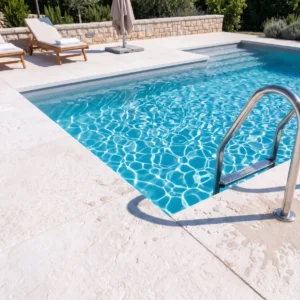
Rainfall across these islands runs to roughly 43 inches a year, but it does not arrive evenly. It comes in concentrated bursts that test drainage hard, and on a flat limestone platform water has nowhere obvious to go. That makes the maintenance job partly a drainage job. Standing water in a shaded corner will encourage biological growth on a textured face far faster than anything the sun and salt manage on an exposed terrace, so four checks are worth making before every wet season.
- Check that falls actually run to an outlet rather than to a low corner.
- Clear drains and channels before the wet season rather than during it.
- Sweep leaf litter out of the low points of a textured face.
- Rinse pool chemicals off the stone instead of letting them dry in place.
Fixings, Metals and Everything Around the Floor
The stone often outlives what is fixed to it. Salt-laden air corrodes standard metals quickly, which is why stainless fixings are recommended across these islands and cast zinc alloys are avoided. Rust running off a bracket, a hinge or a furniture foot stains stone badly, and the mark is far harder to remove than the corrosion that caused it. Check railings, door hardware, planters and outdoor furniture on the same schedule as the floor. Anyone weighing how stone reaches these islands should plan the fixings order alongside the stone, since both come by sea.
A Routine That Lasts
Nothing here is difficult. Sweep before you mop, use a neutral cleaner, keep acids away, rinse the salt off, sort the drainage and use stainless. Write the routine on a card and leave it with whoever looks after the property, because most stone damage in island houses comes from a well-meaning helper with the wrong bottle rather than from the climate itself. Reseal when the floor asks for it and not because a calendar says so. The floors that age badly in island villas are almost never the ones that were cleaned too little. They are the ones cleaned enthusiastically with the wrong chemistry, week after week, by somebody who was never told what the surface was. Simple habits repeated weekly will keep an island floor looking new far longer than any product ever will.