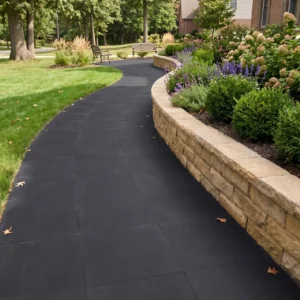
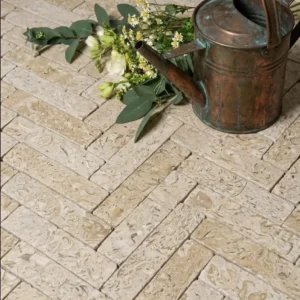
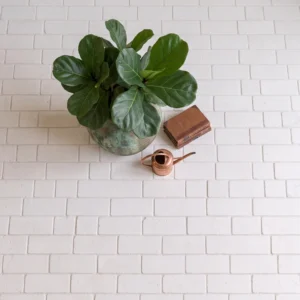
The density difference between bluestone and granite steps is not cosmetic — it’s structural. Bluestone typically registers compressive strengths between 10,000 and 14,000 PSI depending on the quarry bed, while granite consistently hits 19,000–25,000 PSI under ASTM C615 testing. For a bluestone vs granite steps decision, that gap matters most when you’re specifying treads for a high-traffic entry where point loads from steel-heeled footwear or delivery equipment are a daily reality. Neither material is a wrong answer, but each performs best under different conditions, and the wrong match costs you a premature replacement cycle rather than a 30-year installation.
What Separates Bluestone from Granite at a Material Level
Bluestone is a dense sandstone or basaltic material — the exact mineralogy shifts by quarry region — with a naturally cleaved texture that gives it exceptional grip without mechanical surface treatment. Its layered sedimentary structure means it splits predictably along bedding planes, which is why you’ll see it sawn to consistent 1.5-inch and 2-inch tread thicknesses across most commercial specifications. Grain variation is part of its character: blues, grays, and occasional green tones shift across a single slab, which suits naturalistic settings but complicates projects where uniform color matching is a priority.
Granite forms under intense igneous pressure, producing an interlocked crystalline matrix with virtually zero bedding plane weakness. Its mineral homogeneity — primarily quartz, feldspar, and mica — means surface color remains consistent from tread to tread, and edge profiles hold tolerances that bluestone simply cannot match due to its layered structure. According to Natural Stone Institute granite durability and application specifications, granite’s crystalline density makes it one of the most abrasion-resistant dimension stones available for exterior stepped applications.
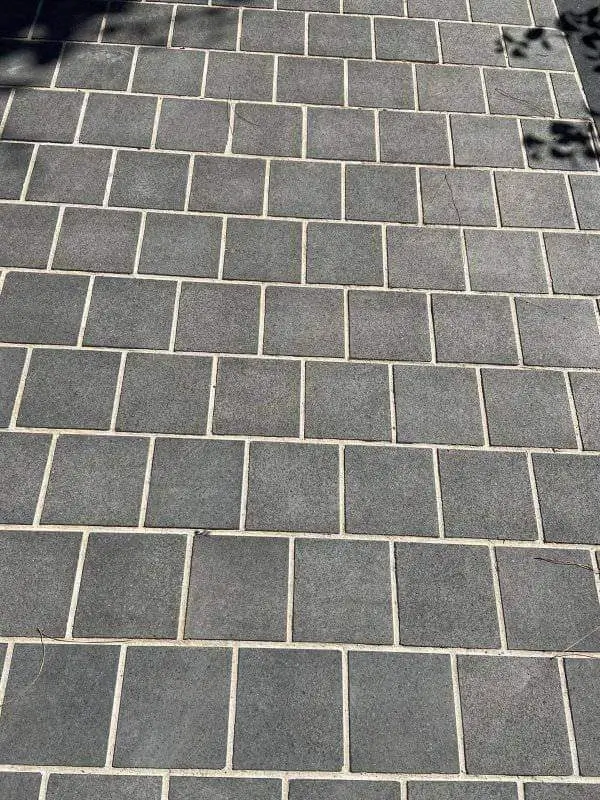
Surface Finish and Slip Resistance: What You Actually Need to Specify
Here’s where most project specs go sideways: both materials ship in multiple finish options, and the finish changes the slip performance more than the material itself. For bluestone steps, a thermal or natural cleft finish delivers a coefficient of friction (COF) well above the ADA’s 0.6 minimum for accessible routes — typically in the 0.7–0.85 range in dry conditions. A honed bluestone finish drops that number closer to 0.55, which fails the wet-condition threshold for exterior steps entirely.
Granite steps present the same calculation. A flamed or bush-hammered granite finish opens the crystalline surface and creates reliable wet-COF above 0.65. A polished or fine-honed granite, however — which looks impressive in showrooms — can register wet COF values below 0.45. ADA accessibility surface and slip resistance requirements for stone steps are unambiguous: exterior steps on accessible routes require a stable, firm, and slip-resistant surface, and a polished finish on either material will not satisfy that standard in a real-world exposure environment. Specify finish before you specify material — the finish decision carries more weight for safety compliance.
- Natural cleft or thermal bluestone: open, textured face — the usual specification for exterior steps
- Honed bluestone: closed, smooth face — avoid for exposed step treads
- Flamed or bush-hammered granite: COF 0.65–0.80 wet — excellent for high-traffic entry steps
- Polished granite: COF below 0.50 wet — unsuitable for exterior step applications
- Sandblasted granite: mid-range COF, good durability, slightly coarser texture than flamed
Tread Thickness and Structural Span: Numbers That Matter in the Field
Your tread thickness specification depends on whether the step is fully supported on a masonry riser or spans an open distance. For fully supported bluestone steps — sitting on a concrete riser or solid masonry substrate — 1.5-inch nominal thickness handles standard residential loads without issue. Span that same bluestone tread more than 18 inches unsupported, and you’re asking for flexural failure, because bluestone’s modulus of rupture runs around 800–1,200 PSI, low enough that a shock load from a dropped object or uneven frost heave can fracture it mid-span.
Granite handles unsupported spans with significantly more confidence. A 2-inch granite tread can span up to 30–36 inches in most residential and light commercial applications without exceeding safe flexural limits — its modulus of rupture typically exceeds 2,500 PSI. For projects with open-riser architectural stair designs, monolithic platforms, or any configuration where the tread bridges a gap, granite stone steps are the technically defensible specification. According to Natural Stone Institute stone steps and treads design specifications, flexural strength testing under ASTM standards is the critical evaluation criterion for any step tread spanning an open substrate.
- Fully supported bluestone: 1.5-inch minimum thickness adequate for residential loads
- Bluestone on open spans over 18 inches: upgrade to 2-inch or switch to granite
- Granite for open-riser or platform designs: 2-inch nominal handles spans to 36 inches
- Always verify the substrate — a cracked riser beneath a slab effectively creates an unsupported span
Freeze-Thaw Performance and Water Absorption
Water absorption rate is the number that tells you how a stone will perform in freeze-thaw regions — not the stone’s general reputation. Bluestone absorbs water at roughly 1.5–3.5% by weight depending on the specific material (dense basaltic bluestone sits at the lower end; sandstone-type bluestone can reach 4%). In areas with sustained freeze-thaw cycling, that absorption range means you need to seal bluestone steps every 2–3 years with a penetrating silane-siloxane sealer to prevent spalling at surface edges and nosing profiles. Skip the sealing schedule and you’ll start seeing delamination along the bedding planes within 8–12 seasons.
Granite’s absorption rate is typically 0.1–0.4% by weight, which is why it performs without sealing in freeze-thaw regions. The crystalline structure leaves almost no capillary pathway for water ingress, so the freeze-thaw expansion cycle has nowhere to act. For projects in climates with 50+ freeze-thaw cycles per year, granite’s absorption advantage is a maintenance-cost argument as much as a durability argument — you’re eliminating a recurring specification requirement across the life of the installation. When comparing bluestone vs granite steps for cold-climate durability, the absorption differential alone often settles the specification debate for long-term projects.
Blue Stone Steps for Garden and Porch Settings
Blue stone steps earn their reputation in naturalistic and landscape-integrated contexts. The cleft texture and tonal variation read as organic in garden environments — they visually belong alongside planted borders, natural stone walls, and informal paving in a way that the tighter pattern of granite simply doesn’t replicate. For porch steps connecting to a period or craftsman-style home, the textural softness of bluestone genuinely enhances the architectural character of the setting.
The practical specification for blue stone steps in garden applications should include a minimum 1.5-inch tread thickness, a 12-inch tread depth to provide comfortable footing, and a raised nosing profile of at least 0.25 inches to shed water away from the riser face. The bluestone geological classification and properties entry confirms that the material’s layered sedimentary origin creates the natural cleft surface that makes it a preferred choice for exterior stepped features with a traditional or naturalistic character. Sealing is non-negotiable in garden settings — organic debris and soil contact accelerate biological growth in the surface pores of unsealed stone.
- Ideal for informal garden entries, cottage-style porches, and landscape staircases
- Natural cleft finish provides grip without additional surface treatment
- Tonal variation between treads adds visual depth — embrace it rather than fighting it with tight color matching
- Seal with penetrating silane-siloxane product at installation and every 2–3 years thereafter
- Pair with irregular flagstone landings for a cohesive material palette
Granite Stone Steps for Formal and High-Traffic Entries
Granite stone steps belong wherever durability, color consistency, and low maintenance converge as the primary specification criteria. Formal porch entries, commercial building approaches, and any installation expected to handle 200+ daily users are environments where granite justifies its cost premium. The crystalline surface resists oil, rubber scuff marks, and road salt staining better than any sedimentary alternative — maintenance in high-traffic settings typically requires nothing more than periodic pressure washing.
For porch applications, granite’s ability to hold precise edge profiles means you can specify a clean 1.5-inch bullnose nosing or a pencil-round edge detail that remains crisp after decades of wear. Bluestone nosing profiles, by contrast, gradually feather at the leading edge as surface cleavage layers are worn through — it’s not a failure mode, just a natural aging characteristic, but it changes the visual character of the step over time. At Citadel Stone, we’ve consistently found that customers specifying formal entry steps for masonry or stone-clad homes gravitate toward granite once they understand how the nosing edge holds across a 20-year timeline compared to bluestone.
Cost Factors and Sourcing Decisions
Material cost for bluestone steps typically runs $15–$30 per linear foot in standard tread dimensions at the supply level — granite stone steps in comparable tread profiles generally price at $25–$55 per linear foot depending on color and finish. Those numbers shift based on freight distance from the quarry source and warehouse, and that’s where national sourcing decisions genuinely affect your project budget. Bluestone quarried domestically carries lower freight overhead for projects across a wide geographic range; granite, much of which is imported, carries port-to-warehouse logistics costs that become more pronounced when you’re planning a high-volume order.
Labor cost ratios also deserve attention. Granite’s greater weight per linear foot — typically 15–20% heavier than equivalent bluestone treads — increases the labor hours for placement, especially on multi-flight stair projects. On a 20-tread installation, the labor differential can add $400–$800 to the total project cost depending on your regional labor market. Value engineering a granite specification often means selecting a lighter-weight domestic granite rather than a dense imported black granite, without compromising the structural performance you need. Confirm warehouse stock availability before finalizing your project schedule, because granite tread profiles in custom dimensions can carry 4–6 week lead times from some suppliers, while standard profiles ship from warehouse inventory in 7–10 business days through Citadel Stone’s national distribution network.
- Bluestone: lower material cost, lighter weight, shorter freight distances for domestic quarry material
- Granite: higher material cost offset by lower long-term maintenance and superior color consistency
- Labor cost is 15–20% higher for granite on volume installations due to weight differential
- Custom tread dimensions in granite require longer lead times — confirm warehouse availability early
- Total installed cost difference between materials is often narrower than the material-only cost difference suggests
For projects where tread specifications need to align across a long multi-flight run, you’ll want to review the full dimensional range available. Citadel Stone bluestone treads are stocked in consistent tread depths and thicknesses suitable for both garden and formal porch applications, which simplifies the ordering and installation process considerably.
Installation Variables That Change the Outcome
Base preparation quality determines whether a stone step installation lasts 10 years or 30 — material selection is secondary to substrate work. For either bluestone vs granite steps, your compacted aggregate base should be a minimum of 6 inches of clean crushed stone, compacted in two 3-inch lifts. Setting material should be a dry-pack mortar bed at 3/4-inch nominal thickness, not a wet mortar slurry — the wet slurry approach creates differential settlement as moisture migrates unevenly through the base.
Thermal movement is the detail most installers underestimate. Granite expands at roughly 4.4–8.0 × 10⁻⁶ per °F — a wider range than most specifications acknowledge, varying by mineral composition. Bluestone expansion coefficients sit at approximately 5–7 × 10⁻⁶ per °F. On a long run of steps — say, eight or more treads in a continuous flight — you need to build in a 1/16-inch gap between treads filled with flexible sealant rather than mortar, to accommodate cumulative expansion without cracking the riser face. Most field failures in both materials trace back to a fully mortared tread-to-riser joint with no expansion relief.
- 6-inch compacted crushed-stone base minimum — compact in two lifts, not one
- Dry-pack mortar bed at 3/4-inch for setting — avoid wet mortar slurry under stone treads
- Leave 1/16-inch expansion gap between treads and riser face on long flights
- Fill expansion joints with polyurethane sealant, not mortar — mortar cannot flex with thermal movement
- Verify tread overhang is consistent at 1–1.5 inches — uneven overhang creates pooling at the riser face
Stone Front Steps: Making the Final Design Decision
Stone front steps are among the most visible material choices on a property — they’re the first surface a visitor touches and the feature that anchors the entry composition visually. The right material decision comes down to three converging factors: the architectural character of the structure, the expected maintenance commitment, and the structural requirements imposed by the step configuration.
Bluestone suits traditional, craftsman, and landscape-integrated entry designs where material variation and natural texture are assets rather than inconsistencies. Granite stone steps suit formal, contemporary, and high-traffic configurations where edge precision, color uniformity, and minimal maintenance are non-negotiable. Neither choice is universally superior — the specifications exist to help you match material performance to the actual conditions your steps will face across a 25-year service life. Beyond the step material itself, related masonry features can inform the broader specification — keystone arch and masonry detailing explores how Citadel Stone materials perform in a complementary structural context worth reviewing if your project includes arch or masonry wall elements alongside the stepped entry.
Where color consistency matters most, granite’s tighter mineral pattern holds an advantage — Citadel Stone carries both materials in comparable tread dimensions.
Related reading: stone steps on a slope · how to build stone steps.