Why Stone Profile Changes Everything
Black edging stones installed at the wrong profile height are the single most common reason garden borders look unfinished within a season. Your stone choice determines not just color — it sets the physical line that separates bed from lawn, gravel from grass, and structured planting from open ground. Getting that line right means selecting a material dense enough to resist frost heave, heavy enough to stay put when the mower runs close, and dark enough to create genuine visual contrast against green turf and lighter mulch.
What Black Edging Stones Are Actually Made Of
Not every dark edging stone performs the same way in the ground. The most durable options on the market are sourced from basalt, dark limestone, and dense quartzite — each with its own absorption rate, compressive strength, and surface hardness. Basalt-based black edging stones typically register compressive strengths above 15,000 PSI, making them highly resistant to water to cracking under lateral soil pressure. Dark limestone edging falls in the 8,000–12,000 PSI range, which still outperforms most concrete alternatives while offering a slightly warmer, more textured visual character.
The material’s porosity is where real performance differences appear. Basalt and quartzite both absorb less than 1% water by weight, which matters enormously in freeze-thaw regions where water infiltration leads to spalling within a few seasons. Dense dark limestone, sealed correctly, achieves similar impermeability — but you’ll need to factor in a biennial sealing schedule to maintain that performance over time. According to ASTM compressive strength standards for dimension stone, materials intended for ground-contact edging applications should meet minimum absorption thresholds that only dense igneous and metamorphic stones reliably achieve without treatment.
Sizing Your Edging Stones Correctly
Thickness is the specification most buyers underestimate. For edging applications, your stone should be a minimum of 2 inches thick — ideally 2.5 to 3 inches for borders adjacent to lawn areas where mower pressure and foot traffic create lateral force. Thinner pieces look fine in photographs but develop micro-fractures at the base within two or three growing seasons, particularly in clay-heavy soil that expands and contracts with moisture cycles.
- Standard edging height above grade: 1.5 to 2 inches — enough to see the border clearly, not so high it becomes a trip hazard
- Burial depth: at least 30–40% of total stone height should sit below grade for stability
- Width range for black edging stones: 4 to 8 inches is the practical functional range for most residential and commercial beds
- Joint spacing: keep gaps under 0.5 inches to prevent grass rhizomes from threading through over time
- Length: 12-inch and 18-inch units allow for tighter radius curves than longer slab pieces without cutting
Fitting Black Edging Into Your Landscape Design Style
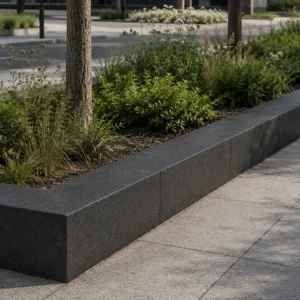
The real reason specifiers reach for black edging stones isn’t purely structural — it’s the contrast they create. Against white decomposed granite, pale limestone mulch, or a cream-colored rendered wall, a dark stone border does the visual work of a pencil line, defining exactly where one element ends and another begins. That clarity reads differently depending on the design language you’re working within.
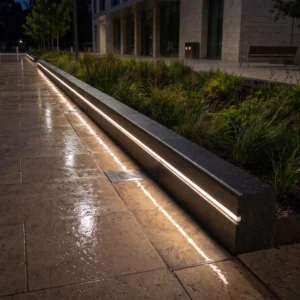
Modern minimalist gardens use black edging stones as a deliberate design gesture — straight runs, tight joints, and a flush-to-grade profile create a ground plane that feels architectural rather than agricultural. In more naturalistic planting schemes with billowing perennials and ornamental grasses, the same edging stones still anchor the composition without competing with the plants. Traditional formal gardens benefit from the edging’s ability to hold a geometric bed shape season after season without the maintenance that clipped box hedging demands. For desert-influenced xeriscaping, black stone edging creates a strong tonal anchor between light gravel mulches and drought-tolerant plantings — a pairing that looks intentional rather than accidental. The ASLA landscape edging and border stone design guidance supports the use of natural stone edging across a range of planting styles for its longevity and visual coherence.
For clients working with gray edging stones as an alternative, the contrast effect is softer and better suited to gardens with cool-toned planting palettes — silver-leaved plants, blue ornamental grasses, or pale lavender. But when the goal is maximum definition and year-round boldness, dark-toned edging stones hold that line far more powerfully across seasons and changing light conditions.
Base Preparation That Makes Edging Last
The single biggest field failure in edging stone installation isn’t the stone — it’s the base. Your installation needs a compacted aggregate base of at least 4 inches, particularly if you’re placing edging in an area with organic topsoil that hasn’t been mechanically stabilized. Organic material compresses unevenly over time, which is why black edging stones set directly into topsoil shift visibly within one or two winters.
- Excavate to a depth of at least 6 inches below finished grade to allow for base aggregate and set bed
- Use a 3/4-inch crushed angular aggregate — rounded pea gravel will not compact correctly under edging stones
- Compact the base in two lifts of 2 inches each rather than one single 4-inch layer
- Set edging stones into a 1-inch dry-pack mortar bed for fixed installations, or directly onto compacted aggregate for removable configurations
- Backfill both sides simultaneously to prevent lateral lean during soil settlement
The USGS granite curbing and kerb stone dimension stone data documents the long service life of properly bedded natural stone edging — a performance record that concrete and plastic alternatives simply don’t match in outdoor soil-contact applications.
Using Small Black Stones as Edging Companions
Combining formal edging stone with small black stones as infill or mulch creates a layered design effect that reads far more finished than mulch or bark alone. Crushed black basalt or polished black river pebbles placed inside or immediately adjacent to your border edging create a visual transition zone that makes the planted bed feel deliberate and curated. The tonal continuity between the edging and the infill material also reduces the visual ‘jump’ when beds are viewed from a distance.
Practically, small black stones used as mulch suppress weed germination effectively because the dense surface blocks light penetration. They also retain some soil moisture when placed 2 to 3 inches deep, which benefits plant roots during dry spells. Keep the infill level about 0.5 inches below the top of your edging stones — this prevents material migration onto lawn areas and keeps the defining edge line visible.
Color Pairing: Getting Contrast Right
Your hardscape material palette should be decided before the edging stone is specified, not after. Black edging stones work best in contrast relationships, and those contrasts need to be intentional. Placing dark edging against dark soil or dark mulch loses the definition that makes the border worth having in the first place.
- High contrast: dark edging against pale limestone gravel, white decomposed granite, or bleached wood chip mulch
- Medium contrast: dark edging against terracotta-toned mulch, rust-colored gravel, or warm tan decomposed granite
- Low contrast (avoid for definition): dark edging against dark bark mulch, black rubber mulch, or very dark soil without surface treatment
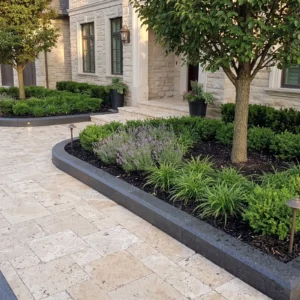
- Paving transition: dark edging stones pair strongly with warm-toned flagstone, cream travertine, or buff sandstone paving — the border reads as a frame rather than a seam
For projects that include both a hard paved area and planted beds, consider how NSI natural stone variety specifications can guide consistent material selection across the full project scope rather than treating the edging as an afterthought to the main paving choice.
Ordering, Quantities, and Delivery Planning
Calculating quantities for black edging stone projects requires two measurements: the total linear run of edging and the unit length of your chosen stone. Divide total linear feet by unit length, then add 8–10% for cuts, waste, and the occasional broken piece during delivery or installation. Underordering by even 10% creates a real problem — matching stone from a second warehouse pull can introduce color variation across quarry batches that becomes visible in the finished border.
At Citadel Stone, we recommend ordering your full quantity from a single warehouse shipment rather than splitting delivery across multiple dates. Stone sourced from the same quarry batch maintains consistent color saturation and surface texture, which matters considerably in a long continuous border run. Verify stock levels before your project timeline is fixed — popular dark stone profiles do move through warehouse inventory faster than lighter-colored options, particularly in spring. Citadel Stone ships black edging stone projects nationwide, and truck delivery lead times from our stocked warehouse typically run 5–10 business days for standard pallet quantities.
Getting Black Edging Stone Specifications Right
The practical details that separate a border that holds its line for fifteen years from one that needs resetting within three seasons come down to material density, base preparation depth, and quantity planning. You can specify the most visually striking black edging stones available, but the installation will only perform as well as the decisions made before the first stone is set. For a related natural stone application that complements garden edging projects, limestone border edging installation methods covers how Citadel Stone’s edging products perform in long-run garden applications. Choose your profile, commit to the base specification, order your complete quantity in a single pull, and the result takes care of itself across seasons. Drawn from select natural stone quarries worldwide, black edging stones give lawns a crisp, defined border line.
Related reading: how limestone edging is quarried · Limestone Landscape Blocks for Borders and Raised Beds · Limestone Planter Care Guide: Drainage & Stain Prevention.