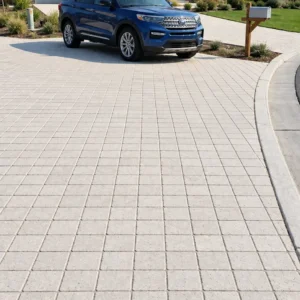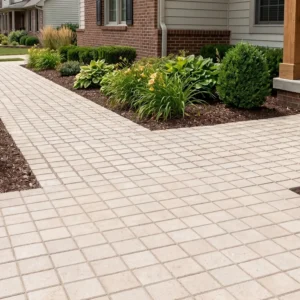

Stone paver driveway ideas look their best on paper until the structural variables hit — and that’s where most projects either nail it or end up with sunken sections and failed joints inside three years. The format, thickness, and base depth of your stone paver driveway are not aesthetic choices; they’re engineering decisions that your local building department often has an opinion on before the first stone is laid. What follows cuts through the surface-level inspiration and gets into the specification decisions that actually determine whether your driveway holds up for decades.
Stone Choices That Define the Look
Your first decision — and the one that sets every other choice in motion — is which stone you’re working with. The material defines the palette, the finish options, and ultimately the character of the driveway. Natural stone brings a visual weight and permanence that poured concrete and asphalt simply don’t replicate, and the range of options gives you enormous design flexibility.
- Dark basalt setts deliver a contemporary, almost monolithic aesthetic — the fine grain reads as uniform and sharp in natural light, especially in a honed or split-face finish
- White and cream limestones warm a facade and work particularly well on homes with traditional or Mediterranean architecture
- Grey and buff flagstone reads as relaxed and naturalistic, suiting garden-forward or craftsman-style exteriors
- Granite setts bring the most color variation — speckled silver, charcoal, and pink tones all exist in the material, giving you subtle contrast without additional design effort
The ASLA driveway paving material guidance emphasizes that material selection for driveways should factor in both environmental performance and structural suitability — not just visual preference. That’s the right order of operations: qualify the material structurally, then refine aesthetically.
Format and Layout Ideas That Work at Scale
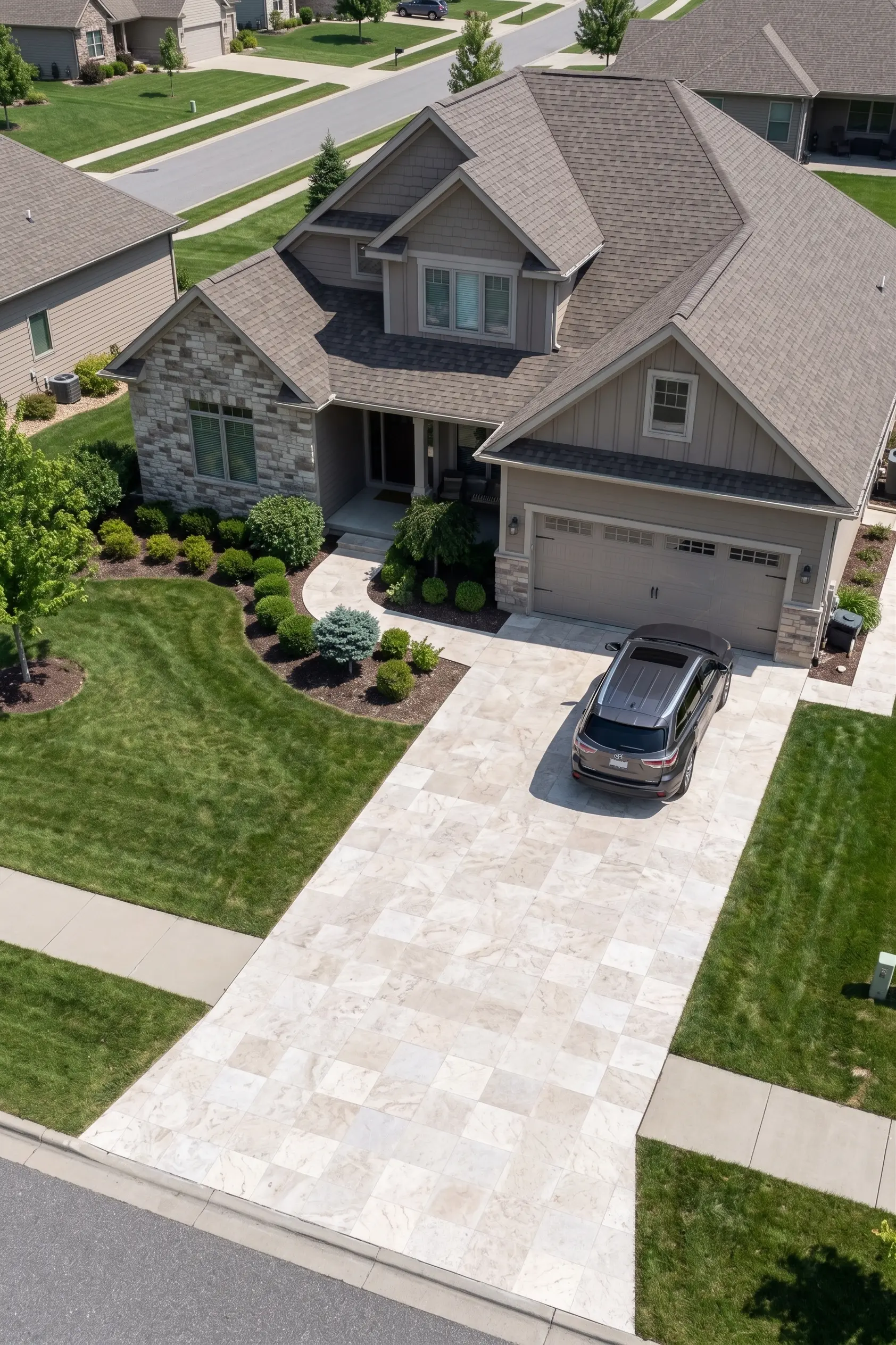
Layout pattern is where stone paver driveway ideas move from concept to real design. The format you choose — sett size, joint width, bond pattern — changes the visual scale of the driveway dramatically, and it also has a structural dimension most homeowners don’t anticipate.
Smaller setts (3 × 5 in or 4 × 8 in nominal) laid in a herringbone pattern at 45 degrees to the direction of vehicle travel perform structurally better under repeated load than a running-bond layout aligned with vehicle movement. The angled herringbone distributes load laterally across more joints, which means less differential settlement over time. That’s not just a stylistic observation — it’s why many municipal paving specifications mandate herringbone for trafficked areas.
- Herringbone at 45 degrees: best load distribution for trafficked surfaces, works at any sett size
- Running bond: visually clean and contemporary, works for pedestrian-priority areas and apron approaches with low vehicle frequency
- Basket weave: strong period character, suits courtyards and motor courts more than primary approach lanes
- Random ashlar: works well in flagstone formats for wide driveways where the organic pattern reads as intentional, not mismatched
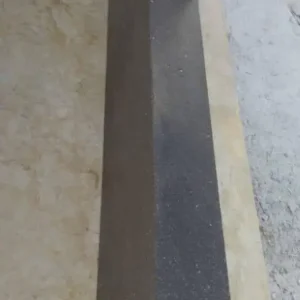
- Border courses in a contrasting stone: add visual definition without complicating construction — a single soldier course around the perimeter unifies the whole installation
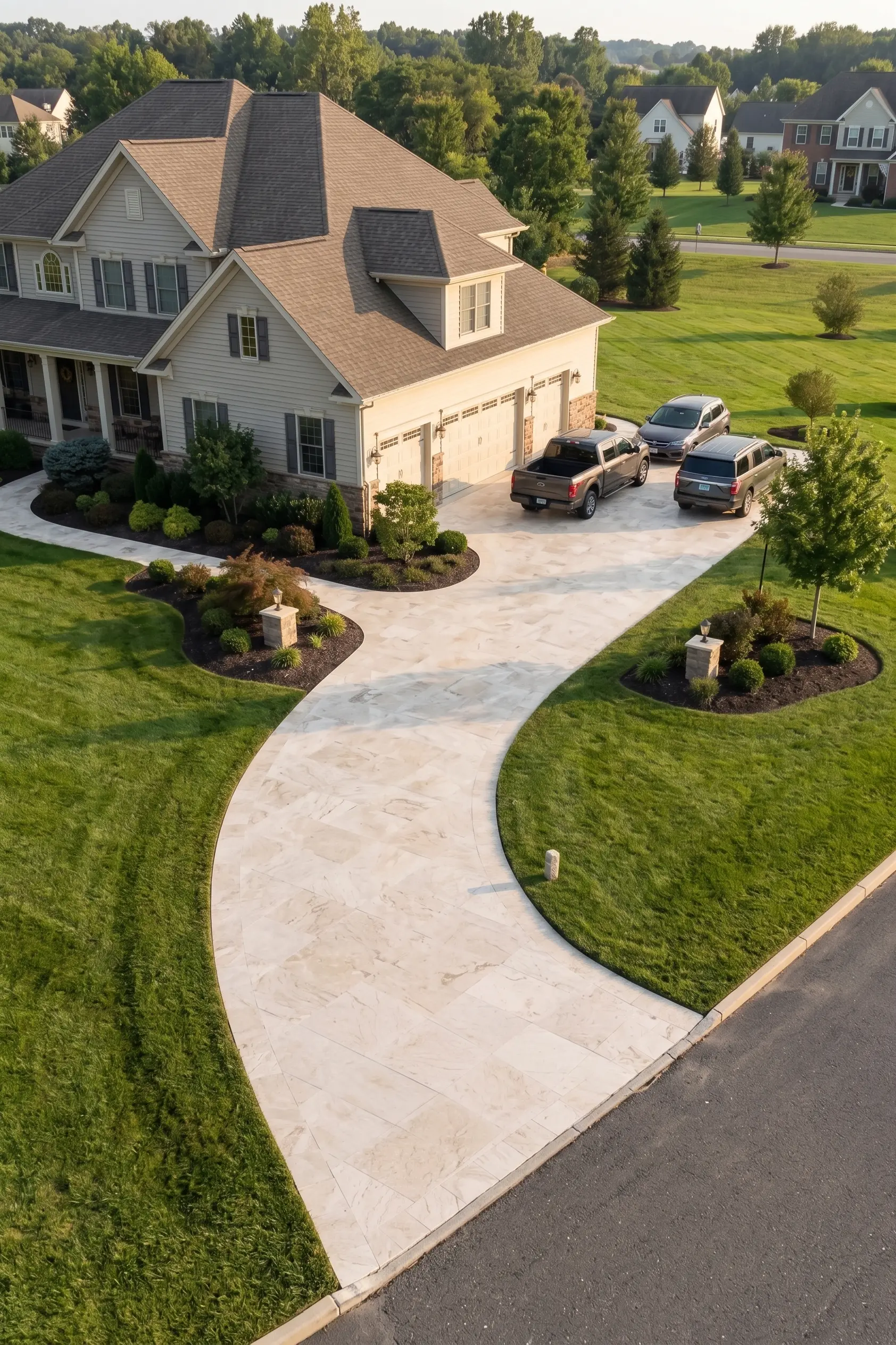
Inset apron bands at the garage threshold and contrasting border courses along the site boundary are both legitimate design moves that add cost but very little installation complexity. Your stone supplier needs to know these dimensions early — they affect cut quantities and can be sized to minimize waste.
Thickness and Base Depth: The Numbers That Matter
Here’s where stone paver driveway ideas have to meet structural reality. For driveways, use setts or cobbles at least 3½ in (4 in standard) thick on a compacted base, or pavers 2 in (5 cm) or thicker mortar-bonded to a reinforced concrete slab. Those aren’t conservative suggestions — they’re the minimum threshold for vehicle loads.
Thinner pavers (1¼ in / 3 cm nominal) are for patios, pool decks, and pedestrian plazas. Specifying them under vehicle traffic is a failure waiting to happen, regardless of the stone’s compressive properties. The stone isn’t the weak point — the substrate deformation under repeated point load from a tire is.
- Flexible installation (setts on compacted aggregate): base depth varies by soil type and frost line — in freeze-thaw regions, the aggregate base must extend below the local frost depth, which can run from 12 in to over 48 in depending on climate zone
- Rigid installation (pavers mortar-bonded to reinforced slab): the slab design carries the structural load, so slab thickness and reinforcement are engineered to the site — your structural engineer, not your stone supplier, calls those numbers
- Edge restraint is non-negotiable in either system: without a concrete or steel perimeter edge, flexible-set setts migrate outward under load and the entire installation loses its geometry over time
The ASTM compressive strength standards for driveway paving stone give you the test framework for evaluating stone properties — ASTM C615 for granite, ASTM C568 for limestone, ASTM C616 for sandstone and quartzite. Those properties matter, but they describe the stone in isolation, not the system. A stone that passes the standard still fails if the base isn’t right for the load.
Building Code and Local Requirements
Most homeowners are surprised to learn that a stone paver driveway with a driveway approach (the section between the sidewalk and the street) almost always requires a permit. The approach crosses the public right-of-way, and local authorities have specific requirements for surface drainage, curb-cut dimensions, and sometimes paving material type.
Frost line depth is the structural code variable that varies most dramatically across the country. In warm climates, a 6–8 in compacted crushed-stone base is often adequate for flexible installation. In northern freeze-thaw regions, the aggregate base depth requirement from the local building department can be significantly deeper — the goal is to place the bottom of the base below the depth at which the soil freezes, preventing frost heave from lifting the entire installation.
- Check with your municipality’s public works department before specifying base depth — frost line maps are a starting point, but the enforced depth in your jurisdiction is what governs
- Seismic zones (primarily the West Coast and parts of the Mountain West) add joint flexibility requirements that affect mortar-set installations — a rigid slab can crack at a seismic joint if expansion and movement detailing isn’t built in
- Stormwater ordinances in many jurisdictions now require a drainage plan for large impermeable surfaces — a driveway over a certain square footage may trigger a retention or infiltration requirement
- ADA-compliant cross-slopes (typically no more than 2% across the direction of travel, about ¼ in per foot) apply to any surface that serves as an accessible route — if your driveway is also the pedestrian approach to the house, that standard is in play
At Citadel Stone, we recommend confirming your local authority’s base depth and drainage requirements before finalizing the specification — these requirements are what set the true project budget, not the stone cost alone.
Finish Selection for Driveway Surfaces
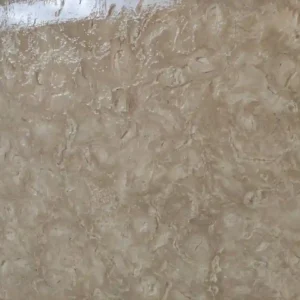
The finish on your stone affects texture, maintenance, and how the driveway reads visually at different times of day and in different weather. For driveways, courtyards, and garden paths, a Brushed 16 Grit finish gives you a coarser, open surface that handles vehicle traffic well. For patios and pool surrounds adjacent to the driveway, Brushed 36 Grit works as a visual transition that ties the spaces together while maintaining a slightly finer texture.
Split Face is worth considering for feature walls that frame the driveway entrance, retaining walls along the approach, and exterior elements like pillars or gate surrounds — it gives a raw, dimensional texture that contrasts cleanly with a smooth-ground driveway surface. For pool decks, wet steps, and ramps adjacent to the driveway, choose a bush-hammered finish. For other outdoor paths, bush-hammered or brushed in the coarsest grit both work — check a sample in context before committing.
- Brushed 16 Grit: driveways, courtyards, garden paths — the standard for trafficked outdoor surfaces
- Brushed 36 Grit: patios and pool surrounds adjacent to the driveway, good indoor-outdoor transition finish
- Bush-Hammered: pool decks, ramps, wet and public areas — an open, dimpled texture from mechanical processing
- Split Face: feature walls, cladding, retaining walls, and exterior fireplace surrounds flanking the driveway
- Polished: dry indoor surfaces only — not for driveways or any exterior application
Explore the full range of Driveway Pavers that Citadel Stone stocks and cuts to order at our selected quarries for projects across the country.
Material-Specific Performance: What to Expect
Different stones bring different performance profiles under vehicle traffic and weather cycling, and understanding those differences upfront saves you from specification regret.
Basalt is a fine-grained volcanic rock — the USGS overview of igneous rocks describes how rapid lava cooling keeps crystal size small, which is what gives basalt its dense, tight face and consistent dark color across cuts. That density makes it exceptionally durable under vehicle loads, with very low water absorption — specify it to ASTM C615 as it performs comparably to granite dimension stone in most testing contexts. Black Basalt Paver Steps are a natural extension of this material into the driveway approach — the same stone, the same finish, continuous from the drive surface up to the entry.
Limestone performs very well in driveway applications provided you’re working with a dense, well-sourced material. White Limestone Patio Pavers — in a driveway-adjacent patio or motor court application — bring a warm, pale tone that pairs cleanly with dark sett borders. Limestone is specified to ASTM C568; a laboratory certificate of test covering density, absorption, compressive and flexural strength, abrasion and modulus of rupture is available on request for white limestone.
- Basalt: dense, fine-grained volcanic stone, very low absorption, consistent color — ASTM C615 applies as the governing granite/hard igneous standard
- Granite: extremely hard-wearing, available in sett format in multiple tones, ASTM C615 governs
- Limestone: warmer palette, range of densities — specify dense grades for trafficked areas, ASTM C568
- Sandstone and quartzite: ASTM C616; variable absorption by source — specify water absorption testing for driveway use
- Shellstone: Ocean Reef Leathered Shell Stone Pavers work beautifully in motor court applications and low-frequency vehicle areas; a laboratory certificate of test covering density, absorption, compressive and flexural strength, abrasion and modulus of rupture is available on request
Sealing, Maintenance, and Long-Term Care
Your driveway’s service life depends heavily on what happens after installation. Natural stone driveways benefit from sealing — it reduces staining from oils and tannins, slows efflorescence migration through the joints, and extends the interval between deep cleans. The sealer you choose should be appropriate for the stone type and the finish; your sealer manufacturer’s data sheet will specify the reapplication interval, and that interval is what your maintenance schedule runs on, not a general rule of thumb.
Joint maintenance is the other variable most homeowners underestimate. In a flexible installation, the bedding sand and joint sand settle after the first wet season and need topping up and re-compaction. Skipping this step allows water to pool in low spots, which accelerates the differential settlement that creates rocking, uneven setts. In a mortar-set installation, inspect the mortar joints annually and rout and repoint any cracks before water gets into the joint and cycles through freeze-thaw.
- Seal within the first few weeks of installation, before the driveway sees vehicle traffic
- Re-seal on the interval your sealer manufacturer states — this is the most commonly skipped maintenance step
- Top up joint sand and re-compact in flexible installations after the first wet season
- Inspect mortar joints annually in rigid installations and repoint any cracked sections before winter in freeze-thaw regions
- Use pH-neutral cleaners for routine washing — acidic cleaners damage limestone and calcite-bearing stones
Planning Delivery and Project Logistics
Your project’s access constraints are worth thinking through before you finalize the order. Natural stone for a full driveway installation arrives on pallets, and the delivery arrangement needs to account for curb-side offloading, driveway grade, and whether the pallets can be positioned close enough to the installation zone to keep labor costs reasonable. Offloading arrangements are confirmed before the delivery date — lead times are quoted with the order, so build that into your project schedule rather than assuming a fixed window.
Citadel Stone stocks material at our selected quarries and cuts to order, which means you can specify custom dimensions, border course widths, and step nosing profiles as part of the same order rather than sourcing standard sizes and cutting on site. That reduces waste and gives the finished installation a precision that field-cut work rarely achieves. The driveway approach requires a permit in most municipalities, and that permitting timeline should be your project’s start point — stone lead times and construction scheduling both flow from that date.
What Matters Most for Your Stone Paver Driveway
The design decisions that separate a compelling stone paver driveway from a generic one are mostly made in the planning stage: stone type, format, layout pattern, border course detailing, and finish. Getting those right before the first measurement is taken is the difference between an installation you’re proud of for decades and one that looks like it was assembled from whatever was available. Your local building department’s requirements for base depth, drainage, and curb-cut dimensions are the structural framework everything else fits inside — start there, then build the design around it.
Slip resistance on a driveway surface is worth understanding in the right terms. The finish is the variable — a bush-hammered or coarsely brushed surface leaves an open, matte texture that behaves differently from a honed face in wet conditions. ANSI A326.3 is the current standard for evaluating slip resistance, measured wet; your specifier can call that test method out in the project specification. What to avoid is a polished finish on any exterior or wet-area surface — that’s a finish for dry indoor applications only. As you think through the full scope of your outdoor stone project, grass and stone driveway layouts offer another dimension worth reviewing if you’re considering a permeable or blended-surface approach.
Motor courts, inset apron bands and contrasting border courses are all achievable when Citadel Stone’s natural stone is supplied from our selected Middle East quarries and cut to the dimensions the design calls for.
Related reading: Permeable Stone Driveway Pavers for Wet Climates · driveway paver quantity estimate · widening driveway with pavers.