
Layout Geometry Is Where Grass and Stone Driveway Design Wins or Loses
The pattern ratio between stone and grass in a grass and stone paver driveway determines far more than aesthetics — it controls how load is distributed, how water moves through the surface, and whether the turf survives under repeated tire pressure. Most designers pick a grid that looks balanced on paper and discover mid-project that the soil beneath behaves differently from their assumption. Your layout decisions should start with the soil profile and the wheel-track lines, then work outward to visual proportion.
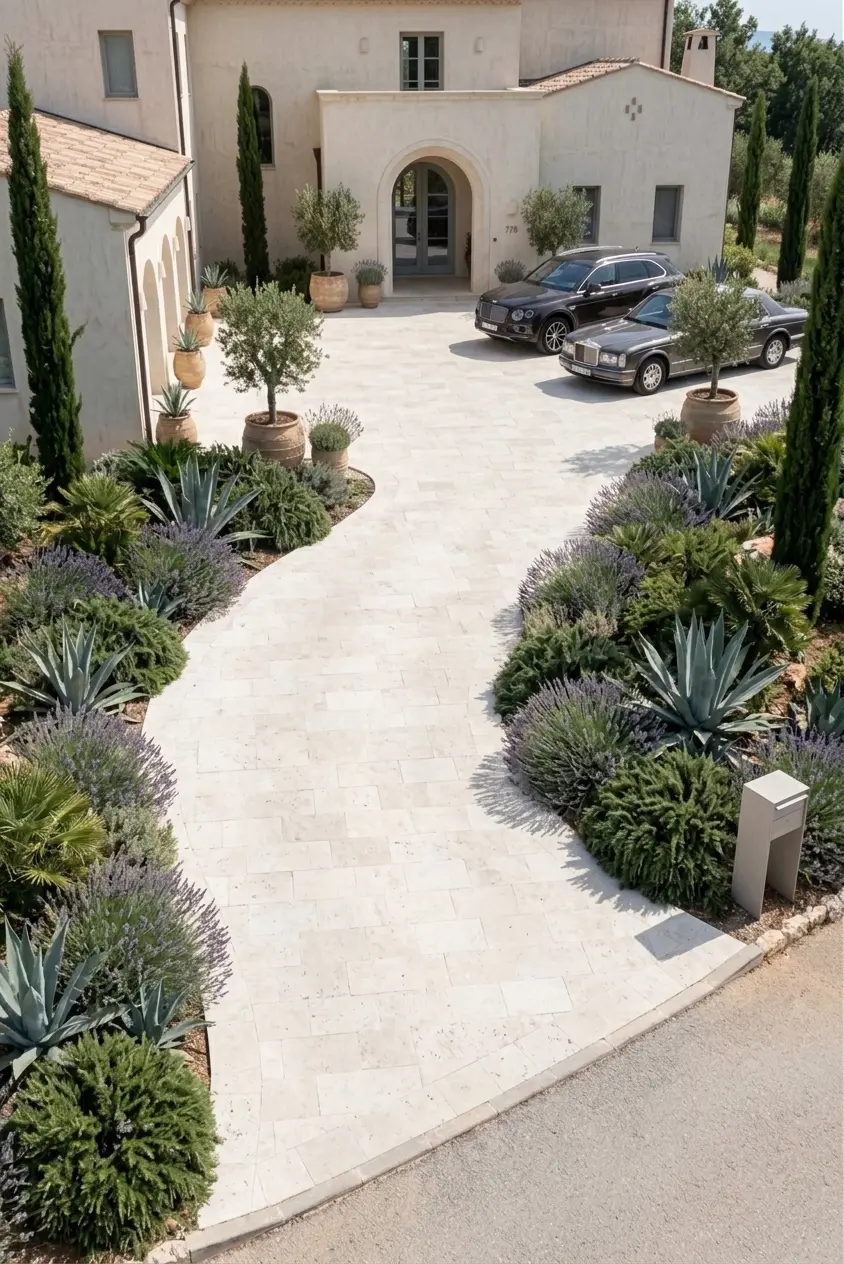
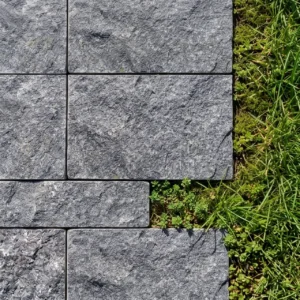
Stone-to-grass ratios that work consistently in the field tend toward at least 50% hardscape coverage in the actual tire tracks, with grass fills occupying the center strip and edges where wheel contact is rare. Dropping below that threshold in the load zone creates a situation where the stone edges are cantilevered into soft ground on wet days, and you’ll see rocking and settlement within the first year.
Choosing the Right Stone Format for a Grass Driveway Layout
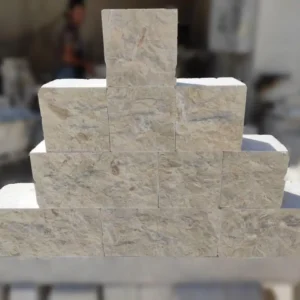
Your stone choice shapes everything downstream — joint width, bedding depth, and how you manage the edge condition where paver meets turf. Thicker, denser formats hold grade better in the wheel tracks because they resist the micro-rocking that grinds away at bedding material over time. For driveways, use setts or cobbles at least 3.5 in (4 in standard) thick on a compacted base, or pavers 2 in (5 cm) or thicker mortar-bonded to a reinforced concrete slab.
- Setts in a running bond pattern distribute point loads across a wider footprint than individual square pavers set in a grid
- Irregular shapes introduce more joint length, which means more grass surface and more edge-to-stone transitions to stabilize
- Large-format pavers keep the grass panels generous enough to establish deep root systems, which is what holds the lawn fill in place between stones
- A consistent nominal thickness across the entire run matters more than the specific thickness — mixed depths create a corrugated surface that becomes unpleasant to drive on within a season
The ASLA guidance on permeable surfaces outlines how stone-and-grass layouts contribute to stormwater management and site hydrology — a consideration worth reviewing early in your project planning. For a broader look at stone formats suited to vehicle areas, Driveway Pavers covers thickness, format, and bedding requirements in detail.
Base Preparation: The Work That Determines Whether the Layout Holds
Your base preparation is the most consequential decision in the whole project, and it’s the one that gets underspecified most often in residential grass and stone paver driveway jobs. The standard guidance — compacted crushed-stone base — is correct but incomplete. What it doesn’t tell you is that the depth requirement changes with the existing soil’s bearing capacity, and that clay subgrade demands a geotextile separation layer that granular soil doesn’t.
- Test your subgrade’s bearing capacity before specifying base depth — clay-heavy soils compress under vehicle load in ways that a standard compacted base can’t fully compensate for without additional depth or a stabilization layer
- A geotextile separation fabric between subgrade and crushed-stone base prevents the fine clay particles from migrating up into the aggregate and softening it over time
- Compact the crushed-stone base in lifts — adding the full depth at once and compacting once creates a base that densifies unevenly and settles in patches under the stone
- Leave your grass-cell zones slightly lower than your stone surface at this stage so that the bedding sand or mortar brings everything to a consistent finished grade
The ASTM dimension stone standards specify how stone is evaluated for load-bearing applications — a useful reference when you’re deciding which format and thickness to specify for the wheel-track sections. Getting the base right also means your grass fills establish faster because the surface drains predictably rather than pooling.
How Terrain Changes Your Drainage and Layout Decisions
Elevation change along a driveway run is the variable that reshapes every other specification decision in a grass and stone layout. On a flat site, water exits the surface primarily through the turf gaps and the perimeter, and a standard 1–2% cross-fall keeps the stone panels clear. On a sloped site — anything beyond about 5% grade — you’re managing sheet flow down the driveway’s length, and that changes where erosion starts.
Your cross-sectional drainage channels need to work harder on sloped sites. Installing a stone-edged channel or a shallow linear drain at regular intervals along the grade intercepts the sheet flow before it undercuts the grass fills and exposes the stone bedding. The turf cells in the wheel tracks are the first to fail on steep runs because the downhill edge of each grass panel gets progressively washed. On grades above 8–10%, a bush-hammered finish on the stone panels gives an open, matte texture that keeps the driving surface functional in wet conditions — for pool decks, wet steps and slopes, choose a bush-hammered finish; for other outdoor paths, bush-hammered or brushed in a coarser grit both work well.
- At grade changes of 5% or more, slope your cross-fall perpendicular to the driveway centerline rather than along it — this redirects sheet flow to side drainage rather than concentrating it at the low end
- Retaining edges or small curb checks every 15–20 ft (4.5–6 m) along steep runs prevent stone panels from migrating downhill under vehicle load over time
- Low-lying sites where the driveway sits below the surrounding grade require perimeter French drains to prevent the base from becoming saturated — a saturated base loses bearing capacity regardless of how well the surface layer is designed
- On hillside sites, your compacted base depth on the uphill edge of a cut section needs to account for increased lateral soil pressure, which is a structural question that benefits from an engineer’s review
Getting Turf to Establish and Stay in the Stone Gaps
The grass component of a driveway lawn pavers layout is not a passive afterthought — it’s an active material specification that requires as much attention as the stone selection. Varieties that establish a dense, low-growing mat root deeply enough to resist the mechanical disturbance of vehicle tire contact. Tall fescue, zoysia, and buffalo grass cultivars have all performed well in the wheel-adjacent zones in hot, dry conditions; fine-bladed varieties that look refined in photos tend to thin out under vehicle stress within two seasons.
Your fill material inside the grass cells matters too. Topsoil alone settles and compacts under load, leaving the turf roots sitting in an anaerobic pocket. A 70/30 blend of sand and compost drains well enough to prevent root suffocation and compact enough to hold the grass root zone stable. Citadel Stone cuts stone to order at our selected quarries, so the cell dimensions in your layout can be matched exactly to your chosen grass panel size — which removes the guesswork from the fill-depth calculation.
- Pre-germinate your grass seed in the panels before the first winter if you’re installing in fall — established roots hold the fill material through freeze-thaw cycles far better than bare soil
- Avoid oversized grass cells in the direct wheel tracks — panels wider than about 6 in (150 mm) in the tire contact zone flex under load, breaking root systems at the edges
- Irrigation planning for the grass strips should account for the drying effect of the stone panels radiating absorbed heat outward — grass immediately adjacent to stone may need more frequent watering than your overall lawn
Finish Selection for the Stone Panels
Your finish choice on the stone pavers affects the visual character of the driveway, the texture under tire contact, and long-term maintenance. For a grass and stone paver driveway, the finish options that hold up best in outdoor conditions are bush-hammered and brushed in the coarser grits. A bush-hammered finish leaves an open, matte texture that handles debris without trapping it, and it ages in a way that complements the organic quality of the grass fills. A brushed finish in the coarser grits — Brushed 16 Grit for a rugged courtyard feel, or Brushed 36 Grit for a slightly more refined outdoor surface — both sit comfortably in a driveway context.
Polished finishes are reserved for dry indoor surfaces only and have no place in an outdoor vehicle area. Split face is used in cladding, feature walls, and cobble sett applications, not in flat driveway pavers. For the stone panels in the wheel tracks, a bush-hammered or coarse brushed finish is the consistent recommendation — the texture holds up under tire contact and doesn’t require a maintenance cycle beyond periodic resealing.
Sealing the Stone and Maintaining the Grass-Stone Interface
Your sealing interval is determined by the sealer manufacturer’s specification, not by a generic rule of thumb applied to the stone type. What changes with stone selection is the sealer chemistry — a dense, low-absorption basalt takes a surface-coat sealer differently from a more porous limestone, and the wrong product will cloud the face rather than protect it. The Natural Stone Institute’s limestone technical overview outlines the porosity characteristics that drive sealer selection for sedimentary stones.
- Reseal the stone panels on the interval your sealer manufacturer states — typically every 2–4 years for outdoor vehicle areas, depending on UV exposure and traffic frequency
- Keep the grass-to-stone joint free of organic debris — decomposing leaf matter traps moisture against the stone edge and accelerates the efflorescence cycle in calcareous stones
- Re-tamp any stone panel that develops a hollow sound underfoot before the settlement becomes a tripping hazard or a drainage problem — catching it early means releveling a single unit rather than a whole section
- Top-dress the grass cells annually with the same sand-compost blend used at installation to restore the fill level as organic matter breaks down
Planning Your Order and Site Delivery
Quantity takeoffs for a grass and stone paver driveway require a separate calculation for the stone panels and the grass areas — a step that’s easy to conflate. Measure the total driveway footprint, subtract the gross grass area your layout calls for, and add 10–12% waste for cuts at the perimeter and around any curves. At Citadel Stone, we cut stone to the specified dimensions at our selected quarries, so your order reflects your exact panel size rather than a nearest-available standard cut.
Delivery scheduling for a large stone order on a residential driveway access is worth confirming early. Your project’s access constraints may affect delivery scheduling — a narrow or low-clearance entry changes offloading logistics. Lead times are quoted with the order, and offloading arrangements are confirmed before the delivery date so that the stone arrives in a sequence that suits your installation progress rather than stacking all material at the site entrance.
Spec Wrap-Up: Getting the Grass and Stone Paver Driveway Right
A grass and stone paver driveway is one of the more demanding natural stone applications to specify correctly because it asks stone, turf, and drainage to perform as a single integrated system. Your layout geometry has to follow the wheel-track lines. Your stone format and thickness have to meet the minimum structural requirements for the load. Your base has to be designed for your specific subgrade, not a generic depth. And your grass selection has to match the mechanical and climatic conditions of the actual site. Get each of those right and the layout holds its geometry and its visual character for decades of service life.
As you refine your overall site plan, it’s worth considering how drainage-focused stone surfaces perform in areas of your property that receive heavier rainfall or sit at a lower grade — permeable stone driveway options covers how open-jointed natural stone layouts manage stormwater across a range of site conditions. In hot, dry climates where turf struggles, natural stone pavers cut to order at our selected quarries can be spaced with gravel gaps as a practical grass alternative.
Related reading: Driveway Pavers Cost Calculator: Estimating Stone Quantities and Budget · Widening a Driveway With Pavers: Stone Blend Guide.