
Thin pavers for pool deck installations force a specification decision that most buyers underestimate: the relationship between nominal thickness, substrate stiffness, and long-term joint stability under repeated wet-dry cycling. Getting that balance wrong shows up fast — usually within the first full season — as rocking units, opened joints, or surface spalling at the edges. Your material choice sets the ceiling, but your substrate and setting method determine whether the installation reaches it.
What “Thin” Actually Means in Pool Deck Specification
The term “thin paver” covers a range of nominal thicknesses that perform very differently depending on the application. For pool deck overlays — where you are laying stone over an existing concrete slab rather than building from grade — you are typically working with slabs or tiles in the ¾ in to 1¼ in (20–32 mm) range. At that thickness, the concrete substrate carries virtually all the structural load, and the stone’s job is to provide a stable, attractive wearing surface that handles foot traffic, furniture, and chemical exposure from pool water.
That distinction matters for your specification because thin pavers for pool deck use are not engineered for point loads the way a full-depth slab is. The substrate must be sound, flat within acceptable tolerances, and free of active cracks before you set a single piece. Any movement in the slab transfers directly to the stone at that thickness.
The Natural Stone Institute limestone specifications outline why limestone in particular performs reliably at reduced thicknesses in covered and outdoor settings — the stone’s density and low porosity under a good sealer make it well suited to overlay work where weight reduction matters.
Material Selection for Pool Deck Overlays
Not every natural stone is an appropriate candidate for thin-format pool deck work. The properties that matter most are density, absorption, and surface texture after finishing — and you want to evaluate each of those separately rather than accepting a general claim about a stone “working well” near water.
- Density and absorption govern how the stone responds to prolonged contact with chemically treated water and seasonal moisture cycling — specify these by ASTM C568 for limestone or the relevant standard for your chosen material, and ask for the test documentation
- Surface texture after finishing determines what the deck feels like underfoot and how much organic matter accumulates in the pores over time — open textures clean easily but need sealing more frequently
- Color stability under UV affects how the deck looks after a few seasons — lighter stones tend to hold their tone better than darker ones that show bleaching at the joints
- Edge behavior at ¾ in to 1¼ in thickness varies by stone type — some materials chip at cut edges under impact, so your installer’s handling protocol matters as much as the stone itself
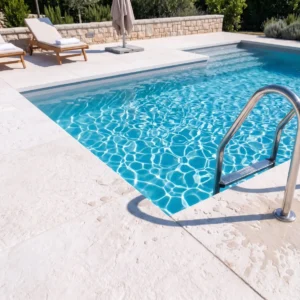
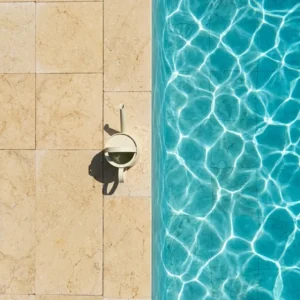
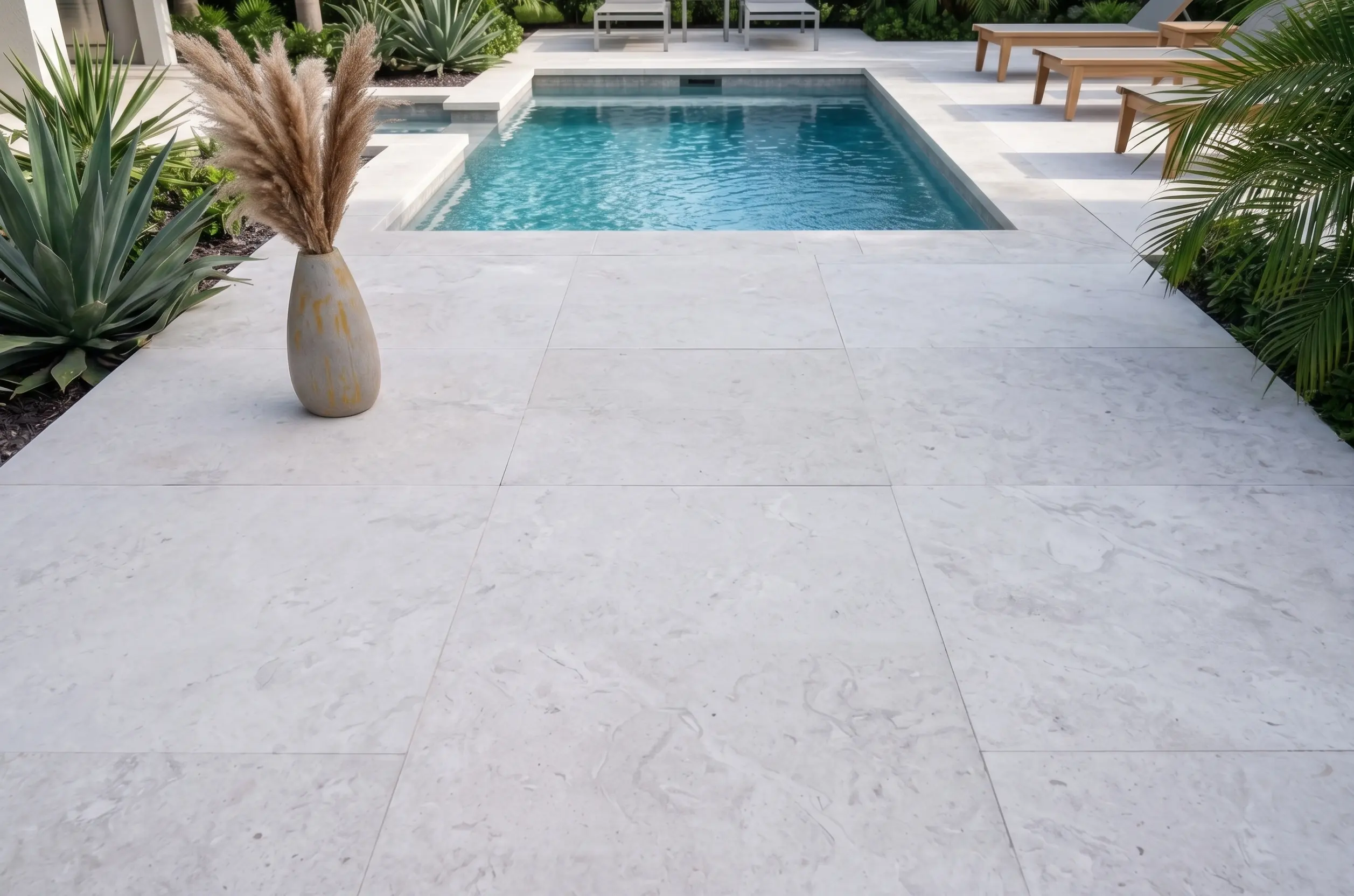
White Limestone Patio Pavers are a strong candidate for pool deck overlay work in this thickness range. The stone’s pale, even tone stays cooler underfoot on sunny days than darker alternatives, and the material holds up well under the kind of repetitive wet-dry cycling a pool deck sees. A laboratory certificate of test covering density, absorption, compressive and flexural strength, abrasion and modulus of rupture is available on request for this product, which gives your project specification a solid technical foundation.
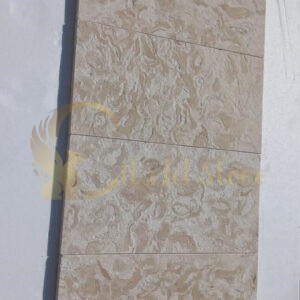
Ocean Reef Leathered Shell Stone Pavers offer a markedly different aesthetic — the leathered finish leaves an open, matte texture with the characteristic shell-fossil detail visible across the face. That surface character works naturally in relaxed, resort-style pool surrounds, and the stone’s composition gives it good dimensional stability in thin formats. A laboratory certificate of test covering density, absorption, compressive and flexural strength, abrasion and modulus of rupture is available on request for this material as well.
Finish Selection for Wet Pool Deck Surfaces
Your finish choice for thin pavers on a pool deck is not primarily an aesthetic decision — it drives how the surface behaves underfoot when wet and how easy the deck is to maintain over time. For pool decks, wet steps, and slopes, choose a bush-hammered finish. For other outdoor paths, a bush-hammered or brushed finish in a coarser grit both work; check a sample before committing.
The brushed range from the Citadel Stone finish collection gives you options across a spectrum of texture depth. Brushed 36 Grit works for pool surrounds where you want texture without the aggressive relief of a bush-hammer. Brushed 80 Grit is appropriate for barefoot pool decks and terraces where comfort underfoot is a priority alongside texture. Bush-hammered finish is the strongest choice for areas with direct water runoff, ramps, or any surface with grade change.
- Polished finish is excluded from pool decks and any wet outdoor surface — it is appropriate for dry indoor surfaces only, including interior floors, countertops, and vanity tops
- Honed finishes sit between polished and brushed in terms of surface openness — suitable for covered pool houses and interior pool surrounds, but evaluate carefully for uncovered deck areas
- Split Face finish works for coping walls and vertical feature elements around the pool surround but is not appropriate for walking surfaces
- The finish affects how often you reseal — coarser textures have more surface area and absorb sealer faster, so your maintenance interval shortens compared to a smoother finish
Slip resistance around pool decks is governed by ANSI A326.3, measured wet, and the finish is the key variable. No slip figure or class is published here — your project specifications should reference ANSI A326.3 and require wet testing of any finish you are considering.
Substrate and Setting Requirements for Thin Stone Overlays
The existing concrete slab under your overlay is the structural component of the finished deck — the thin stone is the wearing layer. That means slab condition is a go/no-go variable before any other decision. A slab with active cracks wider than hairline, significant settlement, or inadequate drainage slope is not a candidate for direct stone overlay without remediation.
Drainage Slope and Slab Survey
Drainage slope is the most commonly underestimated variable on pool deck overlays. The finished stone surface needs a consistent slope away from the pool structure — the tile and setting bed add thickness, which can flatten your effective drainage slope if you don’t account for it in the substrate survey. Survey the existing slab with a level and straightedge across multiple axes before specifying material, and confirm that the finished surface will still drain at the minimum slope required by your applicable code.
- Setting bed selection — polymer-modified thin-set over a sound slab is standard for natural stone overlays at ¾ in to 1¼ in thickness; large-format slabs may require medium-bed mortar to achieve full back coverage
- Back-buttering is mandatory for natural stone at this thickness — a void beneath a thin paver transmits point load directly to the unsupported span, and that is where edge chipping and cracking originate
- Grout joint width should allow for thermal movement of the stone — tighter joints look cleaner but risk spalling if the stone cannot expand slightly under summer heat
- Perimeter and field expansion joints must align with any existing control joints in the slab below — bridging a control joint with a continuous stone panel is a frequent cause of cracked pavers
Budgeting for Thin Pavers Across Different Markets
The total installed cost of thin pavers for pool deck work varies considerably depending on where your project sits — and freight distance from the supply point is a larger share of that total than most buyers initially expect. Natural stone is heavy even at ¾ in to 1¼ in thickness, and delivery cost from a national supplier to a project far from a major port or distribution corridor adds real dollars to your material-side budget.
Labor markets compound that variability. In markets where skilled stone installation labor is in short supply, labor cost can equal or exceed material cost on a standard overlay job. Where experienced stone installers are more accessible, the material-to-labor ratio tips back toward material. That split affects how you approach value engineering: in high-labor markets, reducing waste through careful layout planning and accurate material takeoffs saves more money than trying to find a lower unit cost on the stone itself.
- Freight distance from the supply point should be quoted and confirmed before you finalize your material budget — the variance between a nearby delivery and a cross-country delivery can be significant on a full pallet order
- Offloading arrangements at the site affect scheduling — truck access to the pool area, site elevation, and unloading equipment all feed into the delivery plan, and those details are confirmed before the delivery date is set
- Lead times for cut-to-order natural stone pavers are quoted with the order and depend on the stone, the size, and the finish — build that lead time into your project schedule from the start rather than treating it as a variable
- Ordering a small overage for cuts and breakage is better economics than a second delivery run, particularly when freight distance is long
Citadel Stone stocks material at our selected quarries and cuts thin pavers to order, which means your specification drives the size and finish rather than available inventory. For pool deck overlay projects, that cut-to-order approach lets you match the existing slab geometry precisely rather than working around standard module constraints.
The Citadel Stone overlay paving stone range covers the main stone types suited to pool deck overlay work, with finish and size options specified per order.
Sealing and Long-Term Maintenance for Pool Deck Stone
Natural stone at any thickness around a pool needs a penetrating sealer appropriate to the stone type and finish. The sealer does not change how the surface behaves underfoot — it reduces absorption of pool chemicals, organic matter, and mineral deposits into the stone body, which is where staining and surface degradation originate. Without sealing, chlorinated water leaves calcium and mineral deposits in the pores that progressively lighten the stone tone and roughen the surface.
Your sealer manufacturer’s interval — not a generic rule of thumb — governs when you reseal. Coarser finishes in high-use areas may need more frequent attention than a honed surface in a lightly trafficked surround. Test with a few drops of water: if the water beads, the sealer is working; if it absorbs within thirty seconds, it is time to reseal.
- Apply sealer to a clean, dry surface — moisture trapped under the sealer prevents proper penetration and can cause haziness on darker stones
- Pool chemical exposure, particularly from splash-out, accelerates sealer degradation near the pool edge — that zone typically needs more frequent sealer maintenance than the outer deck area
- Efflorescence — the white mineral deposit that migrates through setting materials to the stone surface — is more common in the first year after installation; a sealer appropriate to the stone type slows but does not entirely prevent it, and periodic cleaning with a pH-neutral cleaner manages it over time
- Avoid acid-based cleaners on limestone and shell stone — they etch the surface, which changes both the visual and the texture character of the finish
Size Format and Layout for Pool Deck Overlays
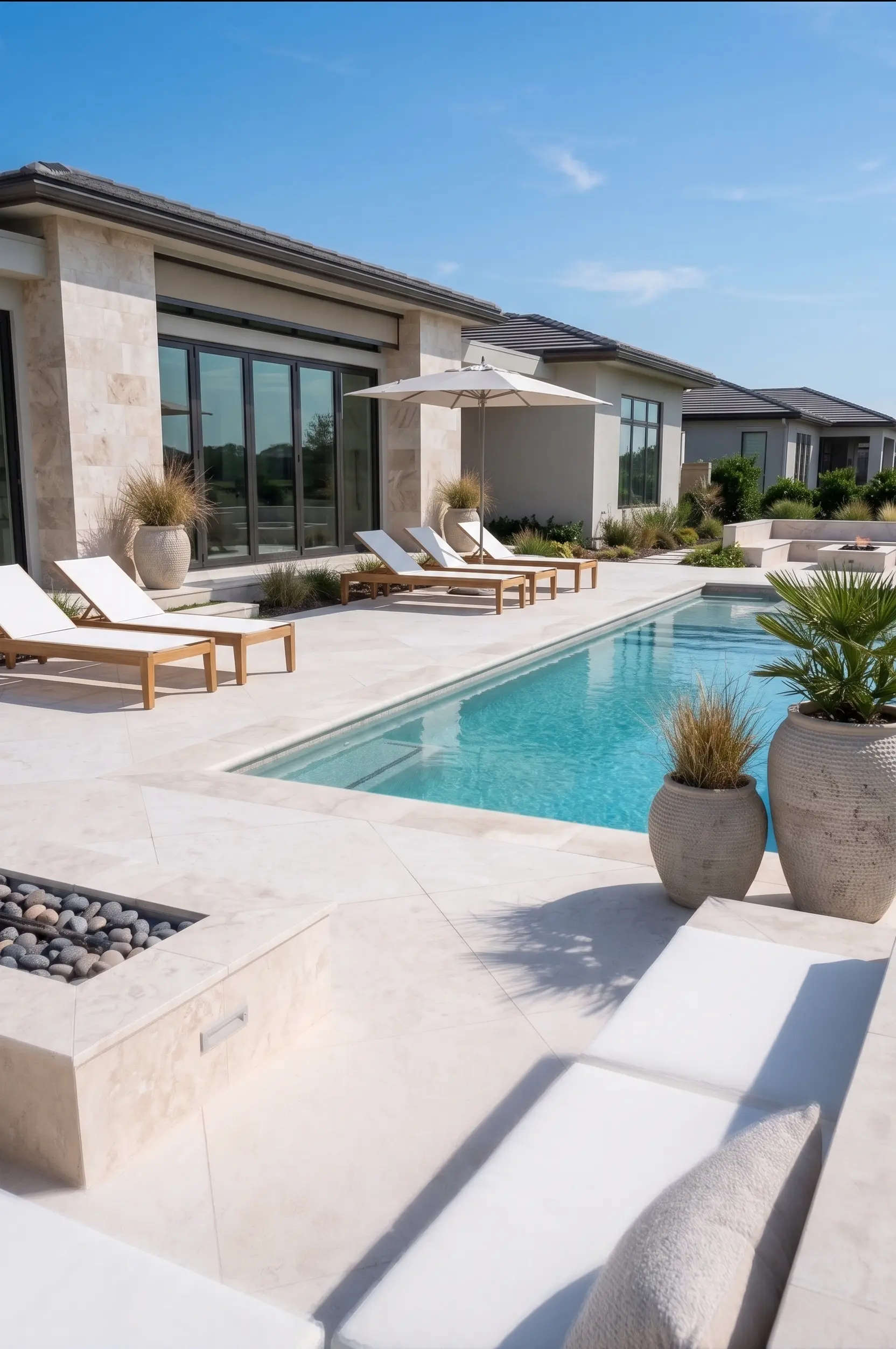
The relationship between paver format and pool deck geometry is worth resolving on paper before you order. Standard formats — 12 × 12 in (300 × 300 mm), 16 × 16 in (400 × 400 mm), and 24 × 24 in (600 × 600 mm) — work efficiently on rectangular decks with clean dimensions. Irregular pool shapes, curved coping lines, and step runs all generate cuts, and the cut percentage drives your overage requirement.
Larger formats — 24 × 24 in and above — look proportionally strong on wide, open decks but require a flatter substrate. Any deviation in the slab that is acceptable under a 12 × 12 in tile becomes an unsupported span under a 24 × 24 in format, and the thin stone will reflect that in its long-term performance. Use a floor flatness survey before committing to large-format stone on an overlay application.
- Running-bond patterns with rectangular formats — 12 × 24 in (300 × 600 mm) and similar — are popular on pool decks and work well with the linear geometry of most pool surrounds
- Random or ashlar patterns generate more cuts but create a more relaxed, less grid-like appearance that suits informal outdoor settings
- Coping stone at the pool edge is typically thicker than the deck field — coordinate the coping and deck stone specification together so the finished line height is consistent
- Color variation within a stone type is natural and expected — reviewing samples from the specific production batch before installation avoids tone mismatches across the finished deck
The PHTA pool deck and coping safety standards provide useful reference points for coping overhang, edge profile, and deck slope requirements that inform your layout and size decisions before the stone goes down.
Getting Your Thin Paver Pool Deck Specification Right
Specifying thin pavers for pool deck overlay work is a substrate-first discipline. Your stone selection, finish, and format all perform to their potential only when the existing concrete slab is sound, flat, and draining correctly. Get the substrate survey done early — it is the decision that shapes every other specification that follows.
Material-wise, natural limestone and shell stone in the ¾ in to 1¼ in (20–32 mm) thickness range are well matched to the overlay context. White Limestone Patio Pavers bring a consistent pale tone and good dimensional stability; Ocean Reef Leathered Shell Stone Pavers bring a distinctive texture and fossil detail that reads well in relaxed poolside settings. Both are available with supporting laboratory test documentation covering density, absorption, strength, and abrasion. Finish selection follows a clear rule: bush-hammered for areas with direct runoff and slope changes, brushed in a coarser grit for flat deck areas where barefoot comfort matters. The USGS limestone formation and composition data provides useful geological context for why dense, fine-grained limestone performs as consistently as it does in demanding outdoor applications.
Budget the freight honestly, sequence your lead times into the project schedule from the first planning meeting, and confirm delivery access before the material ships. For projects that extend beyond the main pool surround, planning adjacent stone elements in the same order saves a second freight run. As you think through the full scope of your poolside stone specification, above-ground pool stone surrounds covers related considerations for a different pool context worth reviewing. Sourced from our selected Middle East quarries, thinner stone slabs reduce weight while keeping a textured natural stone surface around water.
Related reading: best pavers for pool deck · gray pool pavers · Pavers Around Pool: How Much Does Stone Cost?.