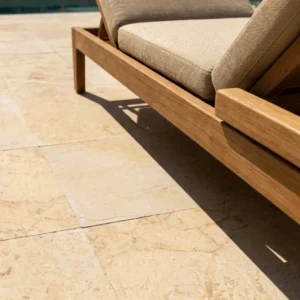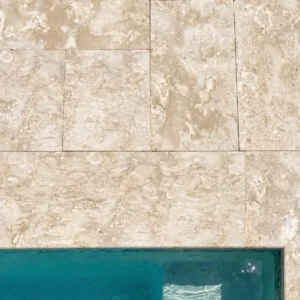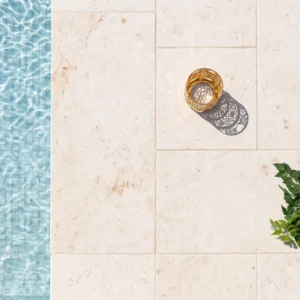

Gray pool pavers narrow the selection faster than most buyers expect — not because the color is rare, but because the tone interacts with finish, format, and stone type in ways that compound quickly. The right combination of gray pool pavers keeps the deck comfortable underfoot in full sun, holds its appearance through years of UV exposure and wet-dry cycling, and works structurally within a mortar-bonded coping or a sand-set field. Get one variable wrong and the aesthetic you specified on day one looks noticeably different by year three.
What Makes Gray Work Around a Pool
The appeal of cool-toned stone around water is practical as much as visual. Lighter gray tones reflect a meaningful share of solar radiation rather than absorbing it, which matters when barefoot traffic crosses the deck between the water and a shaded area. Darker grays — especially in basalt or a deep-toned limestone — absorb more heat and can become uncomfortable on a full-sun afternoon. That thermal dynamic is worth understanding before you commit to a specific shade, because the difference between a mid-tone gray and a near-black gray is measurable in surface temperature, not just in photographs.
Stone type is the second variable. Gray arrives in limestone, granite, basalt, slate, and bluestone, and each one behaves differently under a pool environment’s combination of water, pool chemicals, UV, and physical traffic. The Natural Stone Institute limestone technical overview describes limestone as a sedimentary stone with a grain structure that ranges from dense to open depending on formation conditions — relevant because pool decks need stone with lower absorption to limit chemical ingress over time.
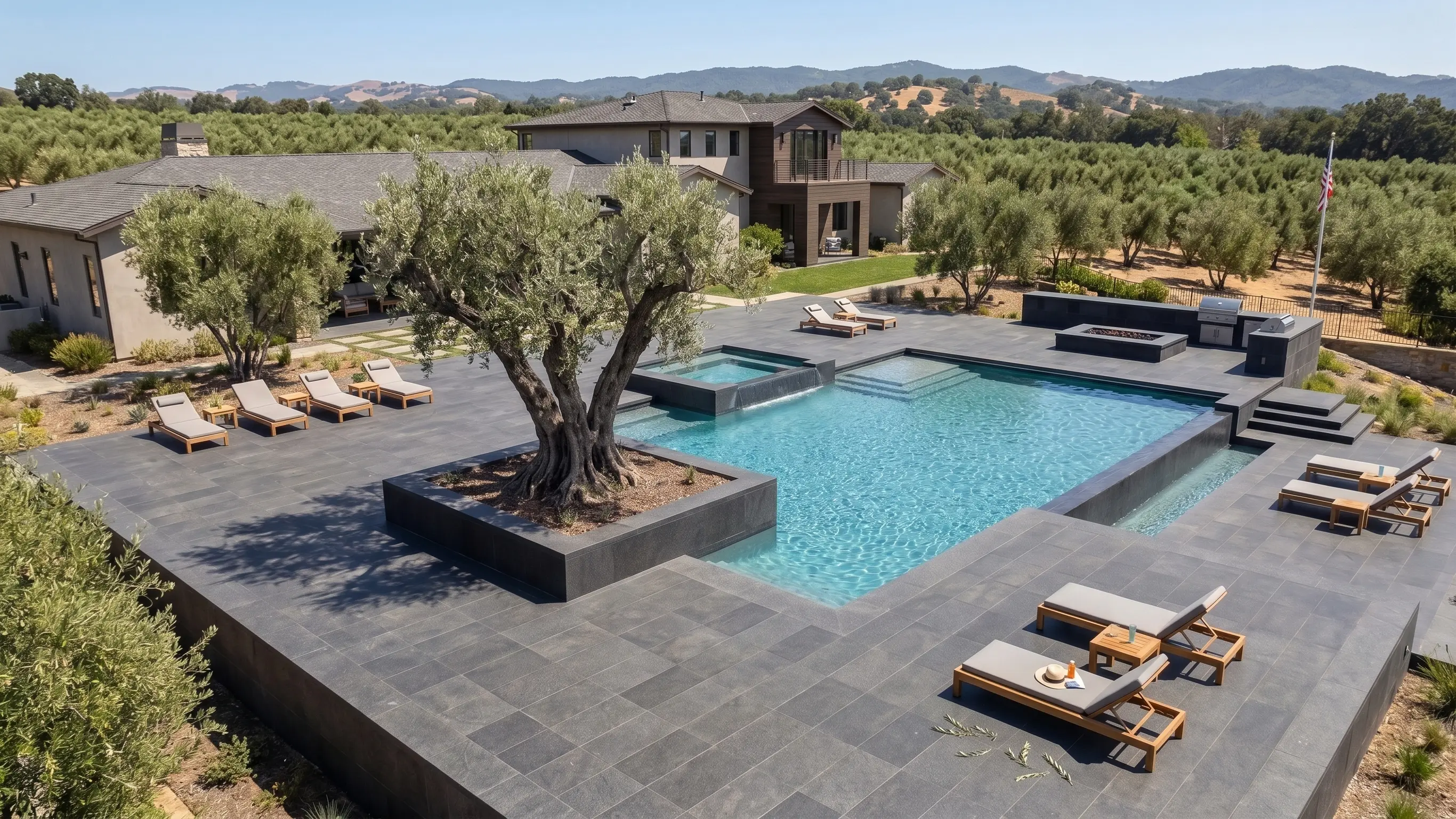
Stone Types in the Gray Family
Your material choice is the decision that sets every downstream specification. Each gray stone type brings a distinct combination of density, surface texture options, and long-term weathering behavior worth understanding before format and finish decisions follow.
- Gray limestone: a mid-range density sedimentary stone, available in blue-gray and fossil-gray tones; takes a honed or brushed finish cleanly; specified under ASTM C568 (Limestone Dimension Stone)
- Gray granite: a denser, lower-absorption igneous stone with consistent grain; holds a honed surface longer than softer stones; specified under ASTM C615 (Granite Dimension Stone)
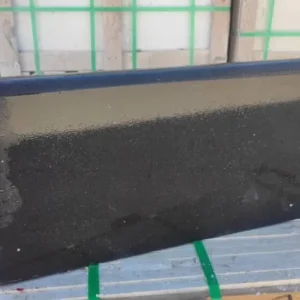
- Black and dark-gray basalt: a fine-grained volcanic stone with very low porosity; available in honed or bush-hammered finishes; note that dark basalt absorbs significantly more solar radiation than lighter gray options
- Gray slate: a metamorphic stone with natural cleft texture and directional layering; specified under ASTM C629 (Slate Dimension Stone); layering means edge detailing needs care
- Gray bluestone: a dense sedimentary stone with a blue-gray face; classified under ASTM C616 (Quartz-Based Dimension Stone); a common choice for pool coping formats
For pools specifically, absorption behavior is the physical property to scrutinize first. A stone that absorbs pool water carries chlorine and mineral content into the pore structure, and over time that leaves calcium deposit and surface etching. Specify water absorption by ASTM test method and ask your supplier which stones in their range perform toward the lower end — no figure is needed to make that comparison, only a ranked shortlist from the certificate.
Finish Comparison for Gray Pool Pavers
The finish is what you actually see and feel, and it governs texture, maintenance interval, and how the color reads in different light. For gray pool pavers, the finish comparison comes down to four practical candidates.
A bush-hammered finish leaves an open, fractured-point texture across the surface. For pool decks, wet steps and slopes, choose a bush-hammered finish — it produces a consistently coarse matte face that reads as a medium gray regardless of the angle of light. The texture is visible and tactile, and it does not require a glossy sealer to look intentional.
A brushed finish removes loose surface material and leaves a directional texture. Brushed 36 Grit suits patios and pool surrounds; Brushed 80 Grit produces a softer texture suited to barefoot pool decks and terraces where a finer surface feels more comfortable underfoot. The grit number tells you the coarseness — lower numbers are coarser. Both brushed grits keep the gray tone matte and natural.
Honed 60 Grit and Honed 120 Grit give a flat, smooth surface without the reflective depth of a polish. Honed works well for covered pool house floors and shaded coping faces where wet exposure is limited or managed. For open wet decks, a honed surface is smoother than brushed, so the finish choice needs to suit the specific zone of the pool area, not the whole project in one specification.
- Bush-hammered: coarsest available texture; suited to pool decks, ramps, and wet and public areas
- Brushed 36 Grit: medium texture; suited to pool surrounds and patios
- Brushed 80 Grit: finer texture; suited to barefoot pool decks and terraces
- Honed 60 / Honed 120: smooth, matte surface; suited to covered or dry zones only
- Polished: dry indoor surfaces only — not for pool decks, wet zones, or any exterior surface
Format and Size Decisions for Pool Decks
Format determines how the stone installs, how joints perform over time, and how the pattern reads from a distance. For swimming pool pavers, the format conversation covers three main options: large-format slabs, standard tiles and pavers, and coping pieces.
Large-format slabs — 24 × 24 in (600 × 600 mm) and above — read as contemporary and reduce joint count, which also reduces the maintenance interval for grout and joint filler. The trade-off is that larger formats require a flatter substrate. A substrate that deflects or settles unevenly across a wide slab puts bending stress into the stone, and without adequate flexural strength and thickness, large formats crack at the weakest point. Specify flexural strength by its ASTM test method when ordering slabs wider than 24 in.
Standard 12 × 24 in (300 × 600 mm) and 16 × 16 in (400 × 400 mm) tiles and pavers are easier to install on moderately prepared substrates and allow more joint flexibility to accommodate minor movement. They suit a wider range of installers and budget ranges. Citadel Stone cuts gray pool pavers to order from slab stock, so format is not a fixed catalogue constraint — you specify the size the drawing calls for.
Pool coping is a distinct format: it typically has a bullnose or drop-face edge profile, overhangs the pool wall by a set dimension, and must be compatible with the waterproofing system at the bond beam. Specify coping thickness to match the coping’s span and the point load of foot traffic at the pool edge. Your Pool Pavers range includes cut-to-size options for both deck fields and coping profiles.
UV Exposure and Color Stability in Gray Stone
Color stability is a long-term performance question that deserves more attention than it typically gets at the specification stage. A gray pool deck that looks clean and consistent at installation needs to look roughly the same after five or ten seasons of full sun, UV, water, and sealer cycles. That outcome depends on the stone’s mineralogy, its finish, and the sealer maintenance schedule.
Natural gray stone does not fade in the way that a painted or pigmented surface fades — the color comes from the mineral composition of the stone itself, not from a surface coating. What you do see over time in unsealed or under-sealed stone is surface oxidation in iron-bearing minerals, which can shift a blue-gray limestone toward a warmer, ochre-tinged tone in strong sun regions. Bush-hammered and brushed finishes, because they present a more open surface, can show that oxidation shift earlier than a denser honed surface. A penetrating sealer applied on the interval your sealer manufacturer states slows that process by limiting moisture and oxidant ingress.
UV exposure also degrades some sealers faster than others, particularly on south-facing or unshaded decks. An impregnating sealer with UV stabilizers maintains its performance longer in full-sun pool environments than a topical film-former. Ask your sealer supplier for the maintenance interval specifically for an exterior, UV-exposed application — that interval is shorter than the interior recommendation on the same product label, and the gap between them is where most pool decks get into trouble.
- Iron-bearing minerals in gray limestone and some granites can shift color tone under sustained UV without regular sealing
- Basalt and granite have minimal iron-bearing susceptibility; their gray tones are highly stable under UV
- Sealer UV stabilizer rating is a meaningful product selection criterion for pool deck applications
- Maintenance intervals for exterior pool decks should be confirmed with the sealer manufacturer, not assumed from a general label
The PHTA publishes pool deck and coping safety standards that inform how pool deck materials are evaluated in residential and commercial contexts — worth reviewing as part of a complete pool deck specification.
Thickness, Base Preparation, and Structural Detailing
Thickness is the specification variable most directly tied to installation performance, and it is more nuanced for pool pavers than for patio pavers because of the substrate constraints at a pool. The bond beam, the waterproofing layer, and the coping anchor all dictate available build-up depth, which in turn limits which formats are structurally appropriate.
For pedestrian pool decks — the field area beyond the coping — 1¼ in (3 cm) pavers mortar-bonded to a reinforced concrete slab are a standard specification for residential and light commercial use. That thickness is adequate for foot traffic loads when the bond is continuous and the slab underneath is sound. Thinner tile formats — ¾ in or less — require a perfectly flat substrate and continuous support; any void under a thin tile under foot traffic creates a point-load failure at the unsupported span.
For pool coping specifically, the overhang and the cantilever moment mean that flexural strength governs as much as compressive strength. Specify the coping thickness from the structural drawing, not from the field paver specification. Coping at 1½ in to 2 in (38 to 50 mm) is common, but the dimension should come from a structural calculation that includes the overhang span and the expected foot traffic load at the pool edge.
- Field pavers at 1¼ in (3 cm) mortar-bonded to a reinforced concrete slab: standard for pedestrian pool decks
- Coping thickness: determined by overhang span and structural load, not defaulted from field paver spec
- Large-format slabs wider than 24 in: require verified substrate flatness before ordering
- Sand-set formats are not appropriate for pool decks where drainage and chemical resistance are requirements
Slip Considerations and Finish Guidance for Wet Zones
Slip resistance is a legitimate performance topic for pool decks, and the relevant standard is ANSI A326.3, which measures wet — the wet condition being the operative one around a pool. The finish is the variable that most directly affects slipperiness when wet: a bush-hammered or coarse brushed finish leaves a more open, irregular texture than a honed surface, and that texture difference is meaningful in a wet zone. No slip figure is published here, and none is needed to make the specification decision — the finish guidance above gives you the practical framework.
What often gets overlooked is the transition zone: the coping face that drops from the deck to the pool wall is a surface people stand on while entering and exiting the pool. That face gets wet consistently and receives more concentrated foot traffic per square foot than the open field. Specifying the same finish on the coping face as on the field deck is the right approach; do not specify a polished or smooth honed face on coping just because it looks better in elevation drawings.
Ordering, Scheduling, and Delivery Planning
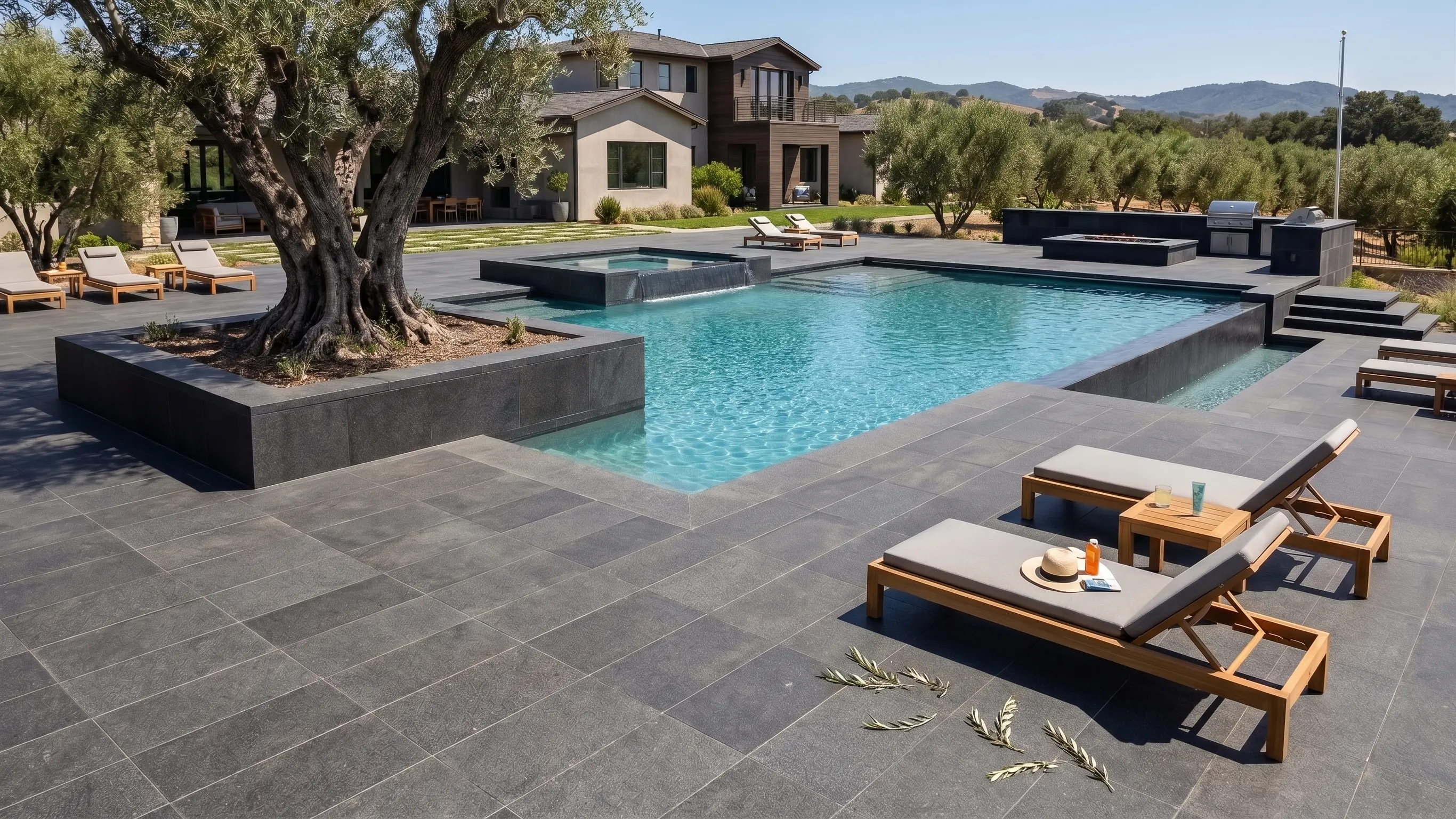
Modern pool pavers cut to a specific format and finish are a made-to-order product, not an off-the-shelf commodity. Your project timeline needs to account for the cut-to-order lead time, which is quoted with the order and confirmed before production starts. Delivery is arranged from the point of production and managed by Citadel Stone — offloading arrangements and site access constraints are confirmed before the delivery date, so flagging any site access limitations early in the order process avoids scheduling delays.
A complete pool deck order typically includes multiple line items: the field pavers in one or two formats, coping pieces with a specific edge profile, and sometimes step treads if the pool area has grade changes. Ordering these together from a single cut sequence keeps the color batch consistent across every piece on site. Stone cut from different production runs can show tonal variation — not a defect, but a natural characteristic of quarried stone — so a single order covering all pieces is worth specifying from the outset.
The ASTM standards publications covering dimension stone — including ASTM C568 for limestone and ASTM C615 for granite — are the reference framework that underpins material specification for pool deck stone. Referencing the applicable standard in your specification document gives the supplier and installer a shared quality baseline.
- Order field pavers, coping, and step treads from the same production cut for color batch consistency
- Lead times are quoted with the order — confirm before setting the installation date on the project schedule
- Site access and offloading equipment should be communicated during the order process
- Include finish, format, thickness, and edge profile in the written specification — verbal descriptions are insufficient for cut-to-order stone
Final Considerations for Gray Pool Paver Specifications
Your gray pool paver specification is only as strong as the decisions that sit behind the color choice. Stone type, finish, format, thickness, base preparation, sealer selection, and UV maintenance schedule are the real variables — and each one connects to the others. A coarse brushed gray limestone on a mortar-bonded slab with a UV-stable impregnating sealer maintained on the manufacturer’s exterior interval is a coherent specification. A polished gray granite on a sand-set base with a topical sealer that the sun degrades in two seasons is a specification that will look different from what the mood board promised.
For a broader look at how different natural stone types compare across pool deck applications, the guide covering natural stone pool deck selection walks through the full material comparison in detail. Take time with the finish sample before committing to format and quantity — the same gray stone in a Brushed 36 Grit and a Bush-Hammered finish reads differently in full sun, and seeing both in the actual project light is worth the extra step. Lighter gray natural stone cut to order at our selected quarries generally stays cooler than dark basalt or slate around a pool.